Kanazawa on the Sea of Japan

It was nice getting a little extra time in the morning. The food bar at this hotel was incredible. It didn’t matter where in the world you may have come from, there was something for everyone. The selection included sashimi of various kinds, several soups including waygo beef, and sweet potato, made to order omelets, croissants, fresh yogurt and countless fruits to select from including lychee and gold kiwi, etc. etc..

I may have already stated that Kanazawa is a culturally rich city. It a coastal city that sits on the Sea of Japan. Sadly we never got close enough to see the water. It is known for its well-preserved Edo period districts, traditional crafts and the Kenroku-en Garden.

Gold leaf is a vital element in Japan’s religious heritage, historic preservation, and traditional arts. Kanazawa produces 99% of the nation’s supply of gold leaf. Gold leaf doesn’t tarnish and is used to restore many national treasures such as Kyoto’s Golden Pavilion, and temple altars throughout the country. It is also applied to lacquerware, pottery, and even textiles. The Hakukokan Gold Leaf Center is a fabulous museum that celebrates the art and craft of gold leaf technology and houses a collection of art and gold leaf objects dating back to the late 16th century.

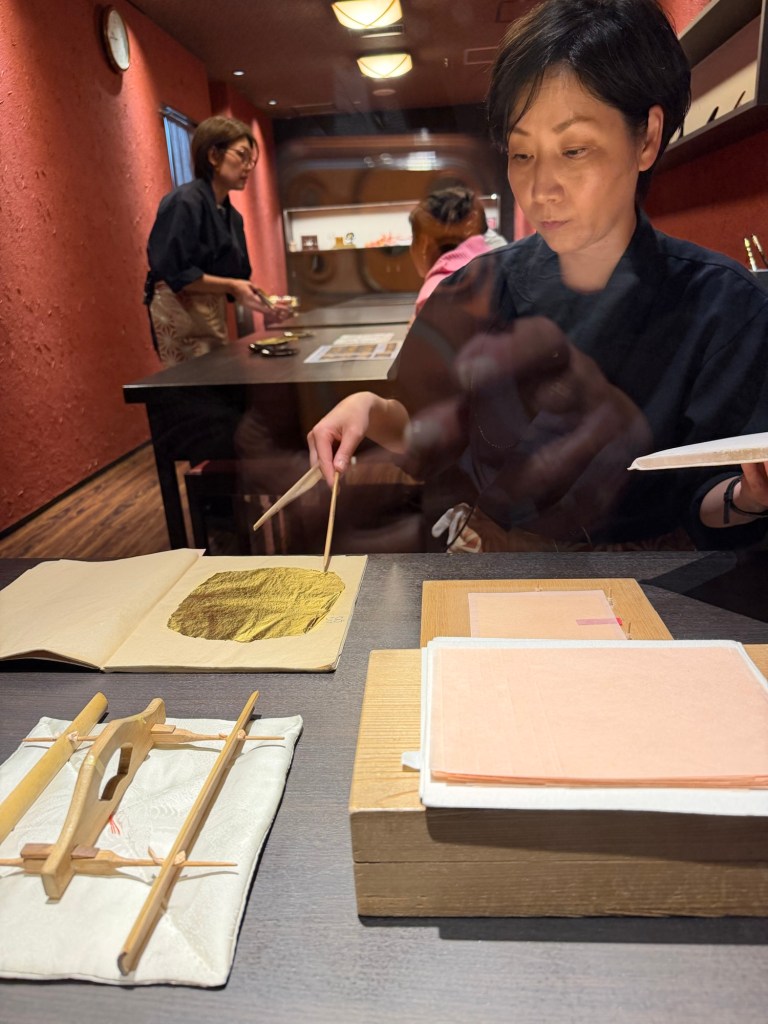
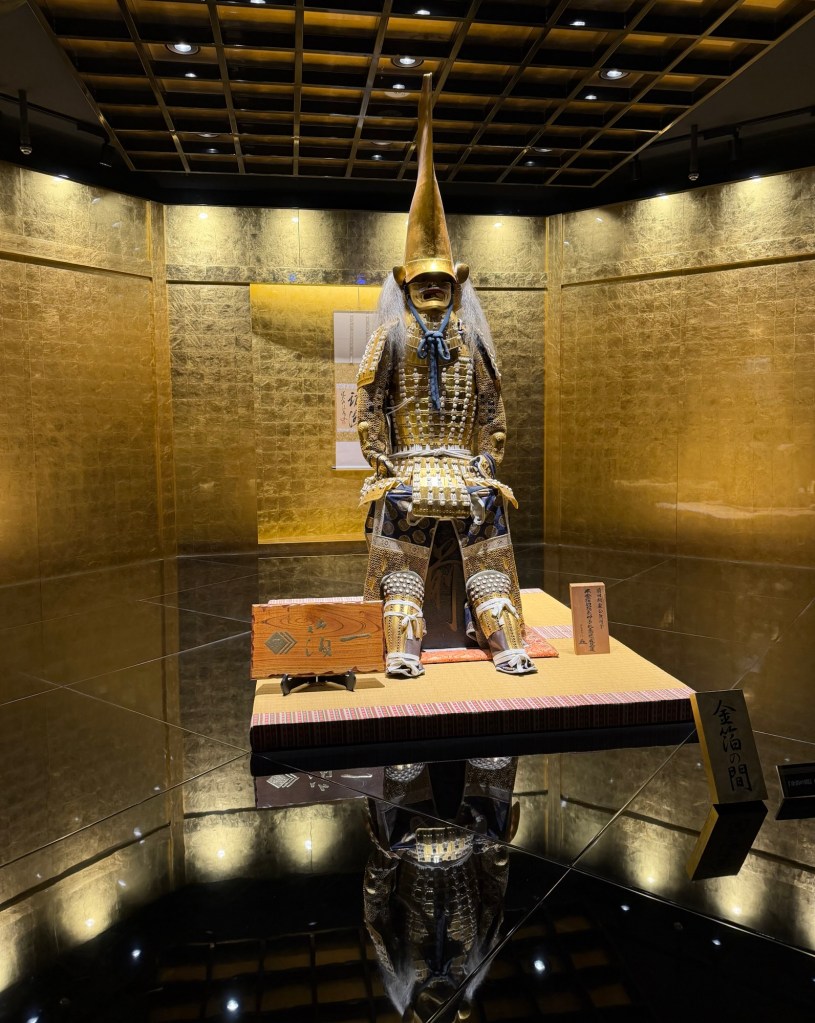
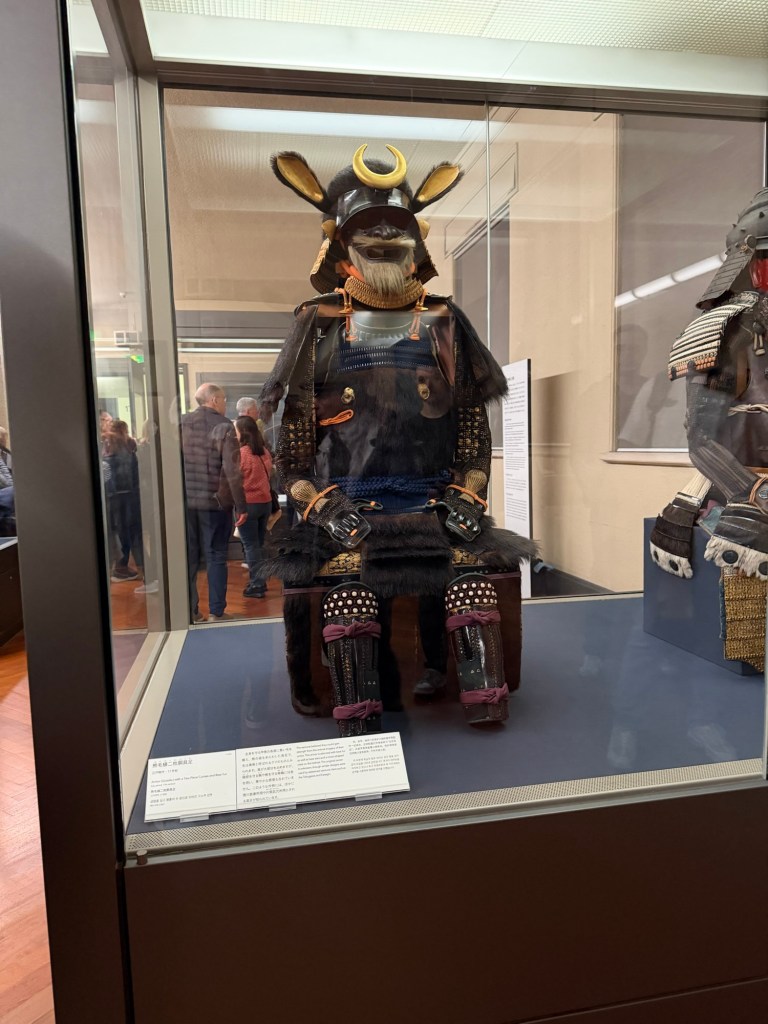
Hakukokan is an interactive museum, offering workshops, along with a beautiful shopping complex. We were greeted by a Samuraiwarrior wearing armour made of gold leaf. A gold leaf expert walked us through the production process. There was a full scale gold leaf pounding room, where the gold sheets are continually pounded until the leaf reaches about one ten-thousandth of a millimeter or 100 nanometers. Just 2 grams of pure gold—about the size of a small coin,can be beaten into a sheet that is about 1 square meter.

Stacks of up to 1,500 sheets over several days with machines or hand tools. In between the sheets of gold is handmade washi paper soaked in lye, persimmon tan on and egg white to prevent the gold from sticking or tearing. (The washi paper is sold as a cloth with cosmetic uses.) We saw a woman separate each of the gold sheets, and cut them into exact squares, many times blowing the sheet gently in order to get it to lie flat.
In the museum itself there were incredible examples of how gold leaf has been used over the centuries. There were examples of paintings, textiles and ceramics all of which involved the use of gold leaf.
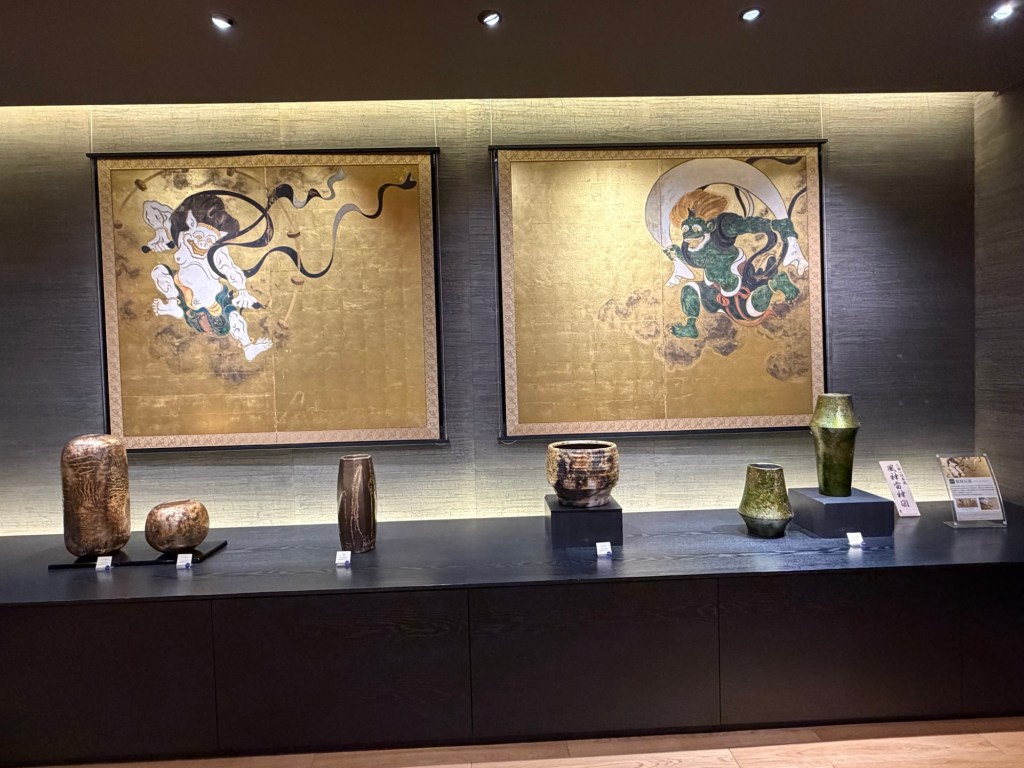
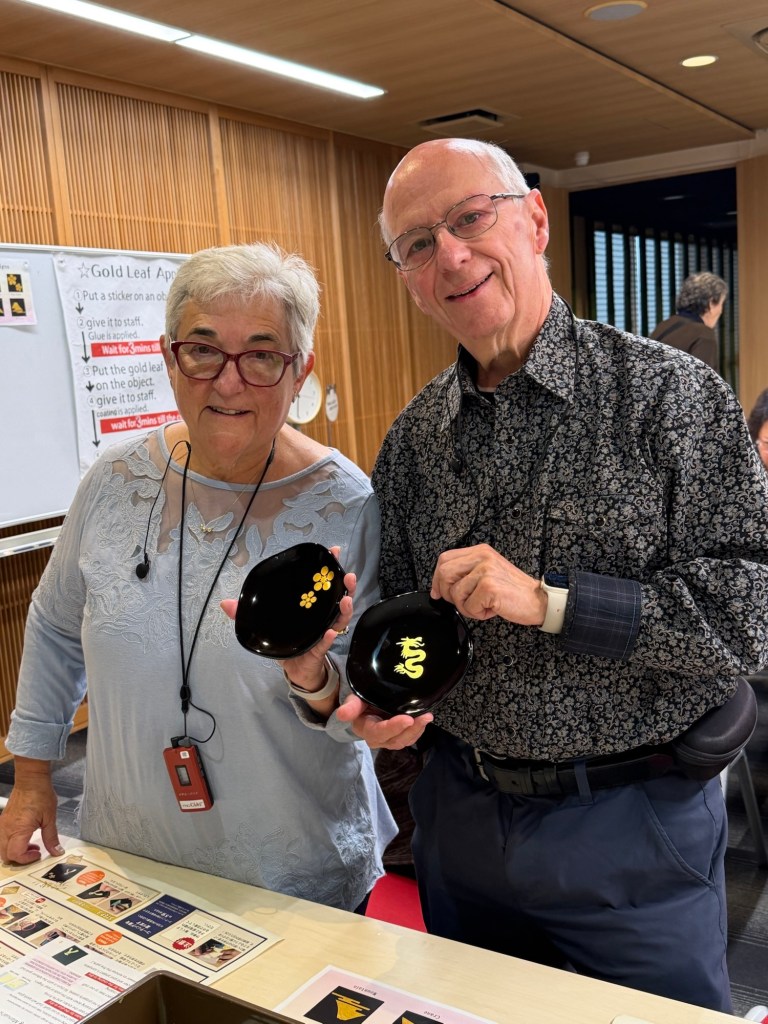
It was then time for us to participate in a little gold leaf artistry of our own. We were each asked to select a pattern we would like to see on a small black lacquered plate measuring about 8” wide. We were walked through a several-step process and ended up with a nice souvenir. We were then walked into an absolutely gorgeous showroom where we could buy anything from an ice cream cone topped with edible gold, tea with flecks of gold, and all sorts of decorative items.
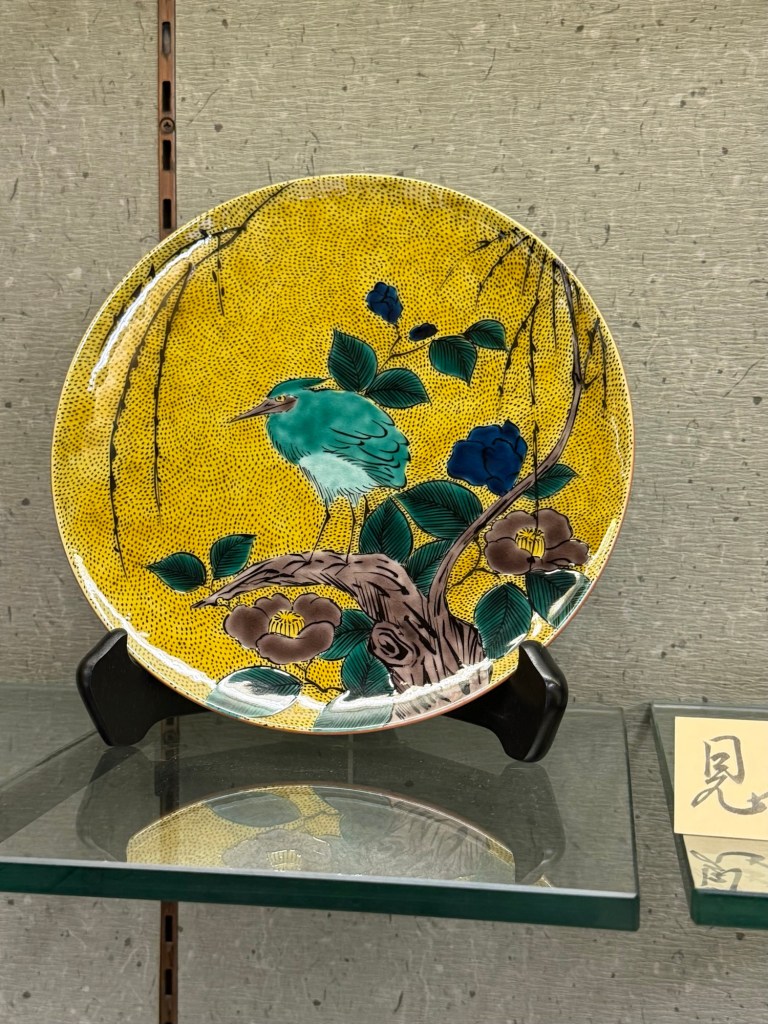
Our arts and crafts experience continued with a visit to Kutani Kosen Kiln, where artists fashion prized, highly regarded decorated porcelain. Mr. Kutani, whose family has owned the company since 1870. Walked us through his entire operation. Unlike most producers today, Kosen Kiln handles every step under one roof, from blending the raw clay, throwing the pieces on the potter’s wheel, glazing, painting and firing. The company specializes in traditional uwaetsuke (over glaze painting) using the classic five color Gosai palette of green, yellow, red, purple, and navy blue.
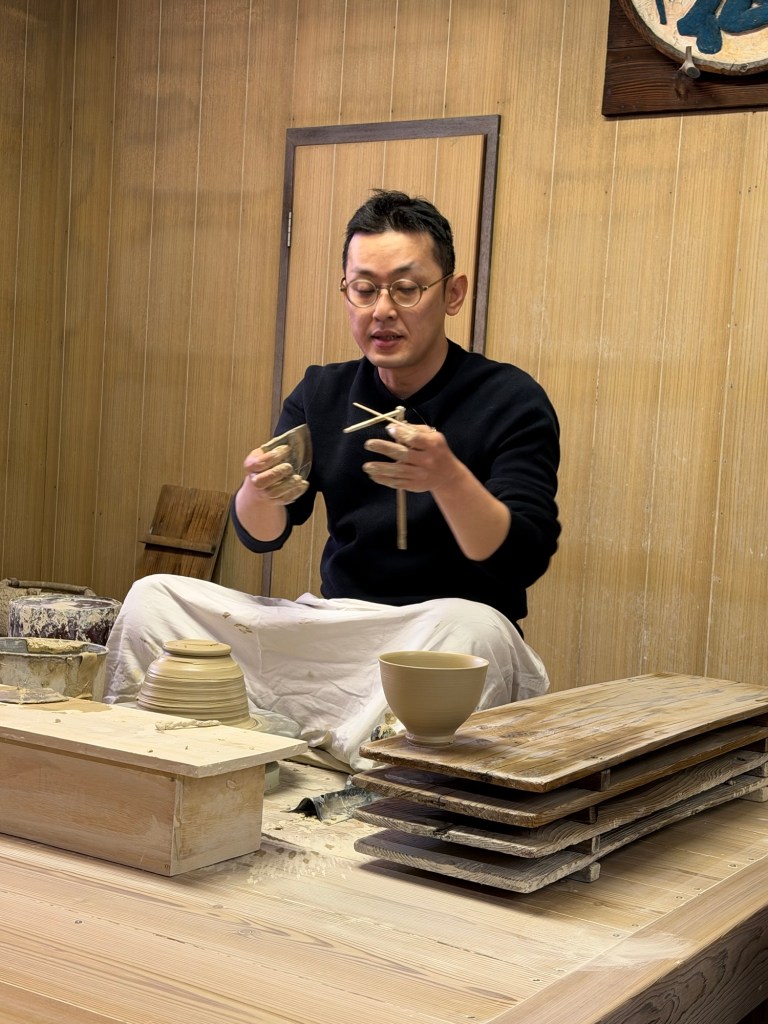
Mr. Kosen had just thrown the bowl sitting in front of him.

We had the chance to purchase art created by the Kosen Kiln. Unfortunately (or fortunately) for us a lot of things were out of stock.
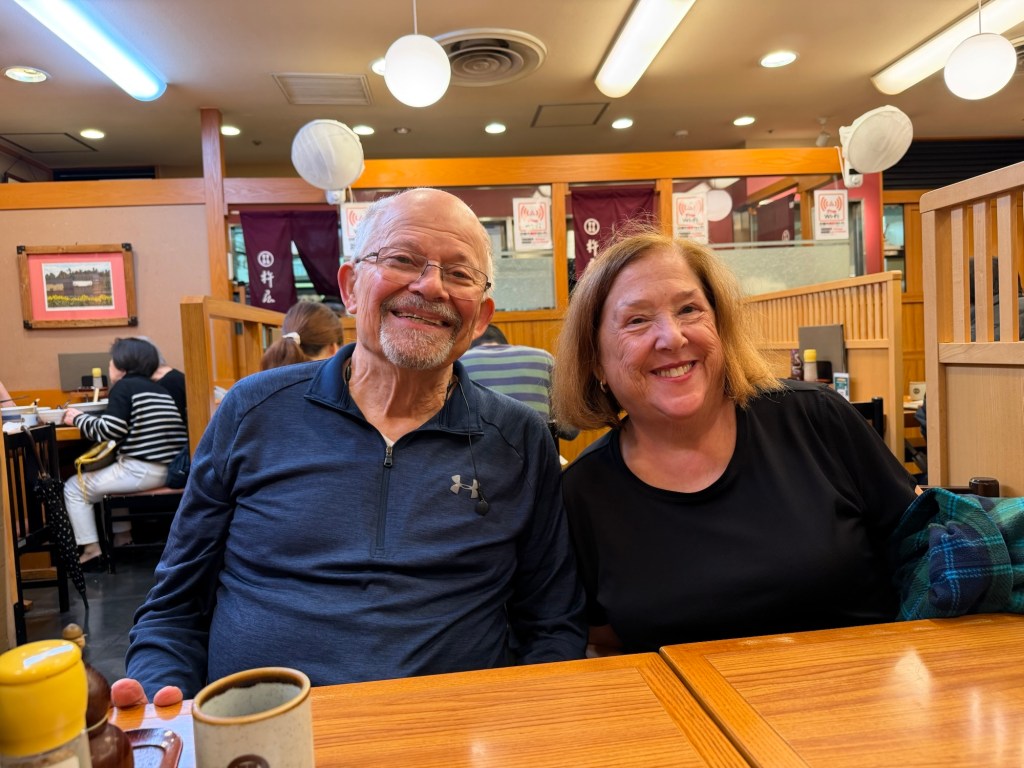
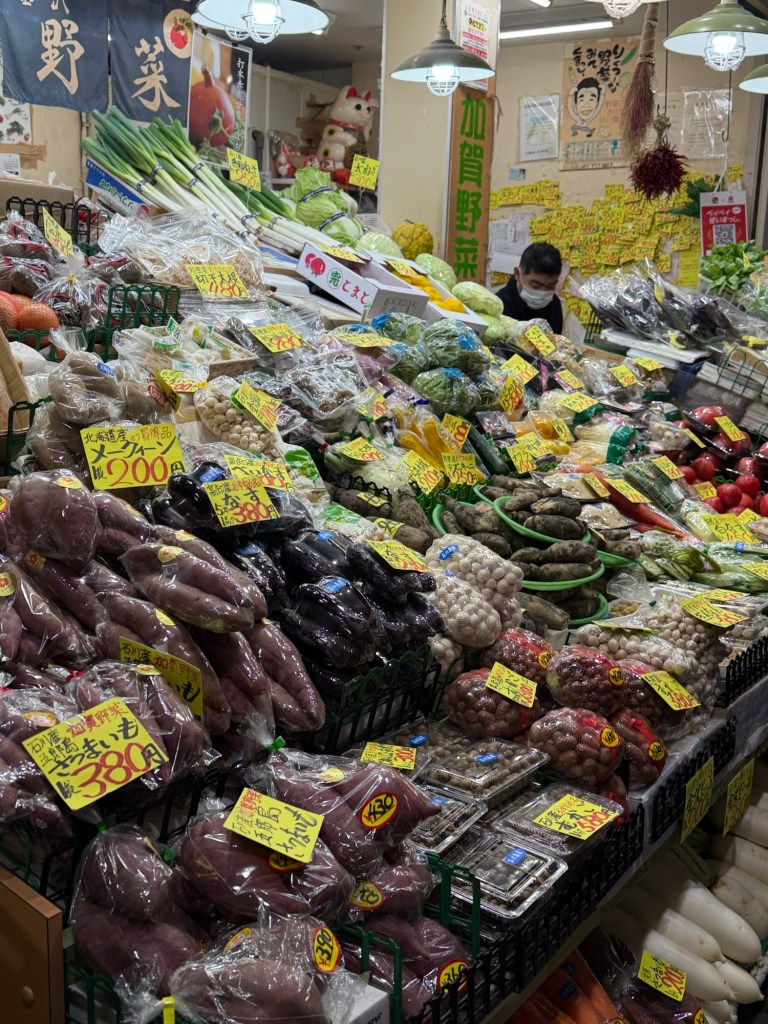
It was now time for lunch. We were given time to explore the Omicho market. The market was incredibly crowded. It was extremely difficult to follow Masako. We ended up having lunch with Cheryl and Jake. By the time we finished it was time to get back on the bus.
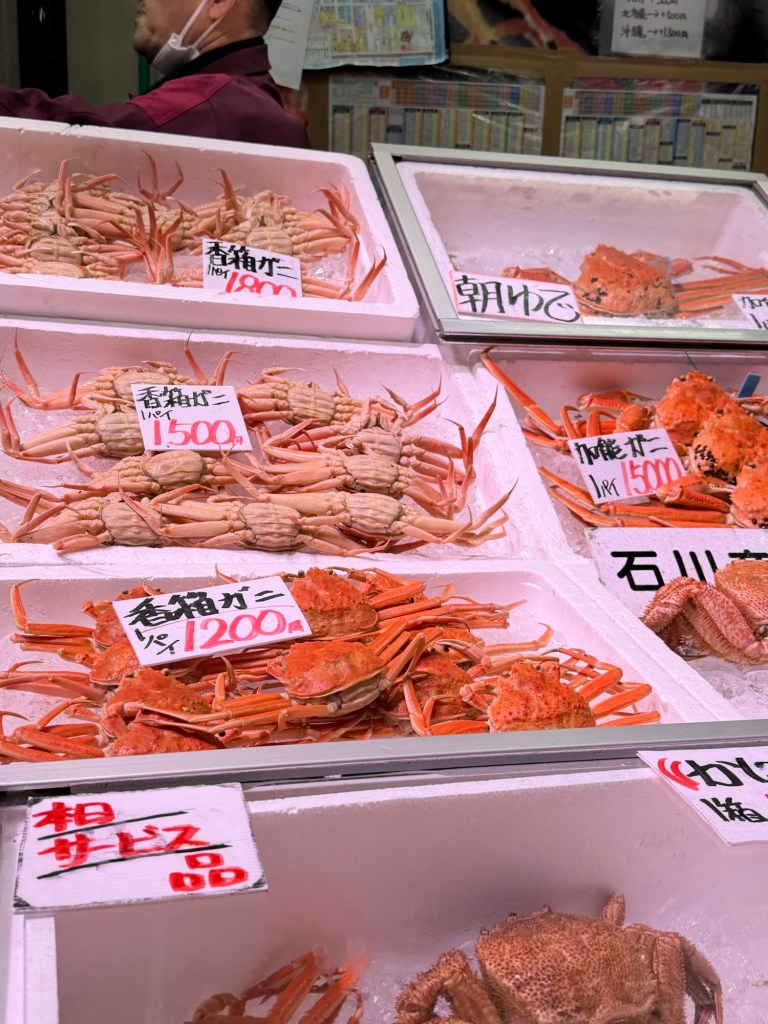
It’s crab season in Japan
Cheryl and Jake

The Kenrokuen Garden ( Garden of Six Attributes) is a national landmark whose origins date to 1676. It is one of Japan’s finest traditional gardens. It’s 25 acres represents the six qualities for the perfect garden: extensiveness, artifact, antiquity, waterways, panoramic views, and quiet seclusion. It was an absolutely beautiful place. Every corner you would turn presented another gorgeous view despite the rainy day. Note the ropes holding up the tree branches. The concern is that heavy snows might break branches, so to prevent that from happening the limbs are supported by ropes. Sometimes trees trunks are supported by wooden braces.
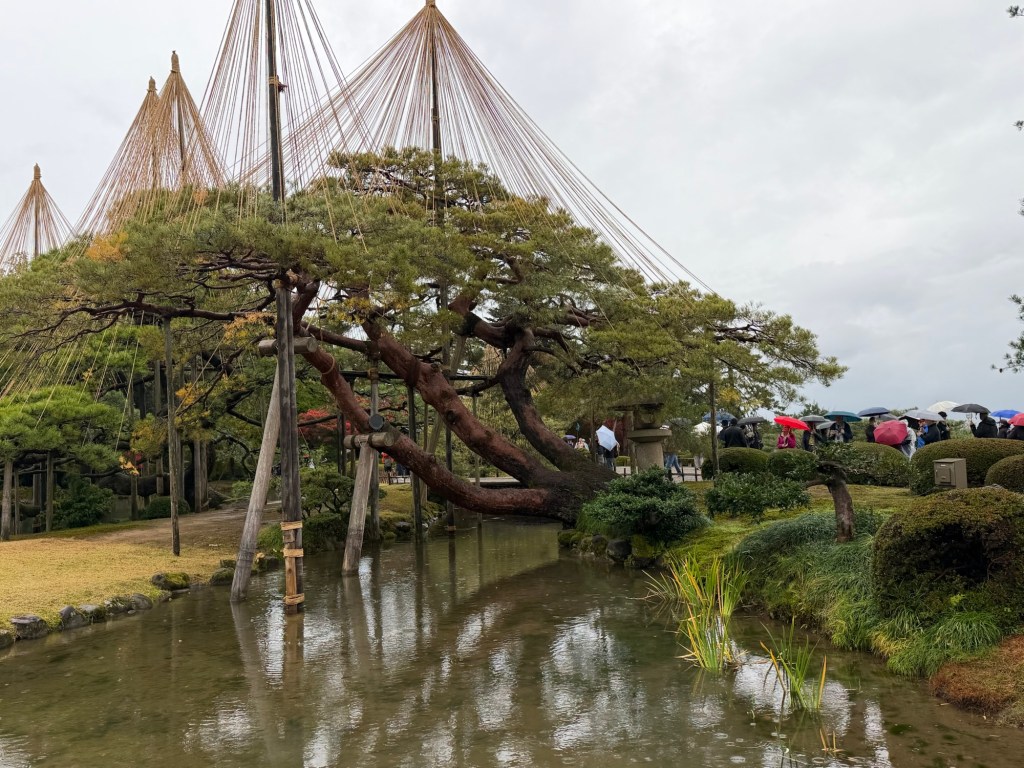
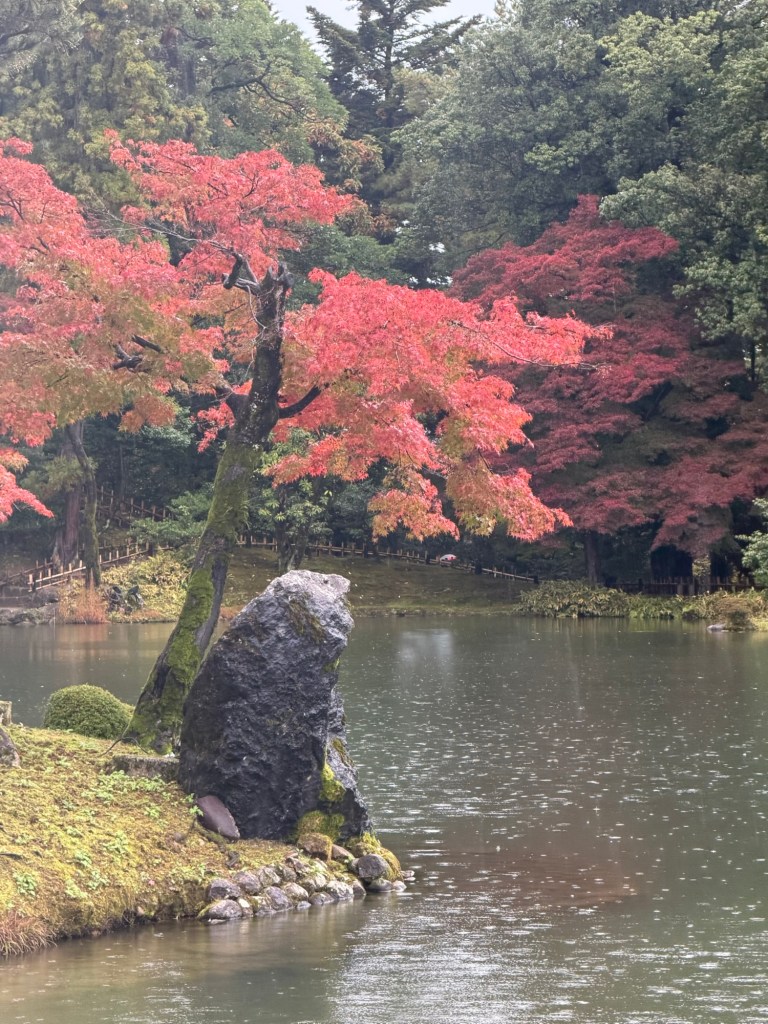
Trees being supported against future winter snows

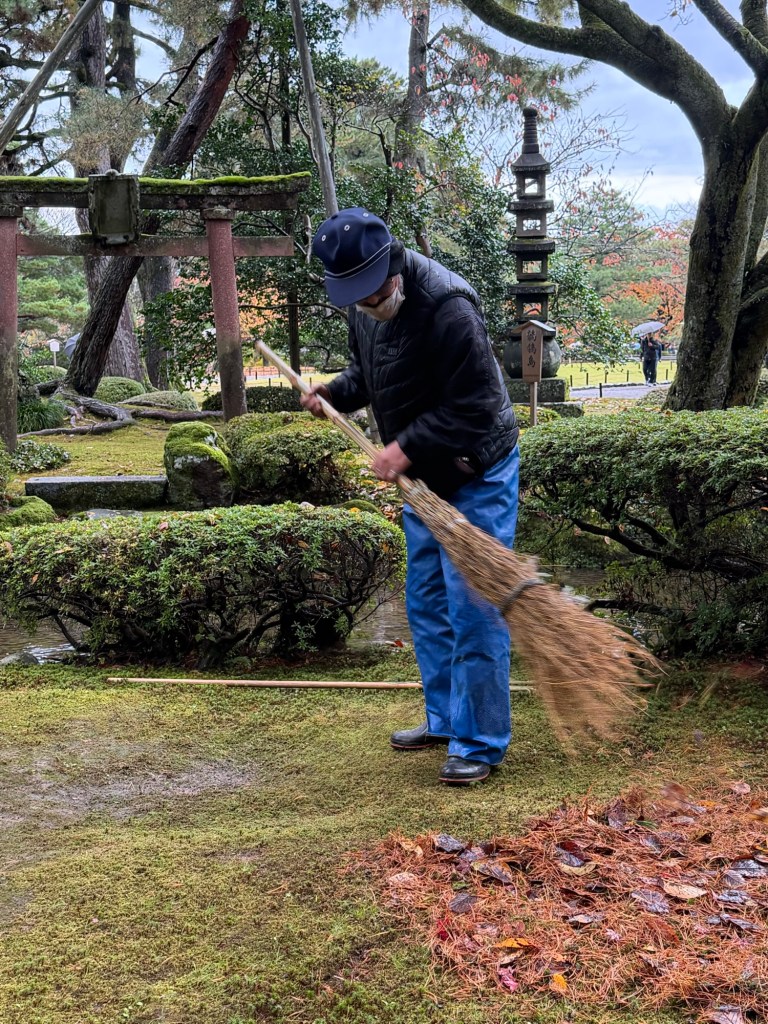
They really like moss in Japan. In fact they encourage its growth. At home I felt like moss was taking over parts of my yard, especially on the rocks in my backyard. However, I think I am going to take a Japanese point of view and learn to appreciate it. They even had people sweeping leaves off the moss with homemade brooms and kneeling on the moss literally picking out anything they didn’t think belonged there.
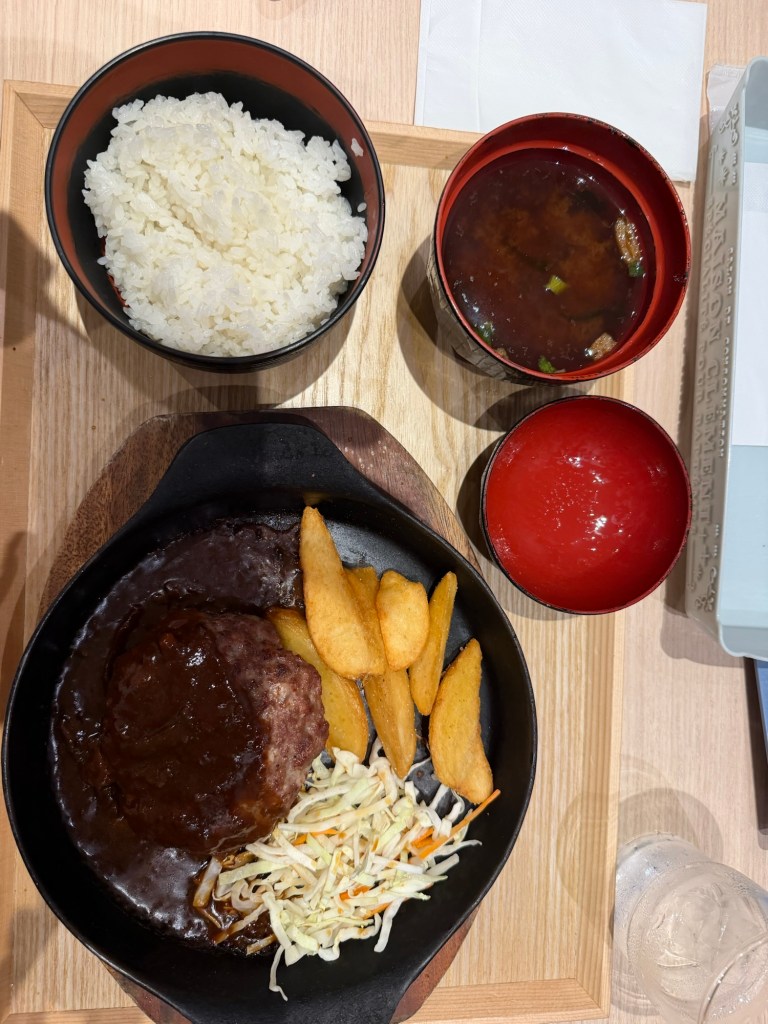
Dinner was on our own. We headed over to the train station because it was filled with a variety of restaurants. We arbitrarily picked a place that said they sold Wagyu burgers. Ellen from our group joined us for dinner. The burger was bun-free with a tasty barbecue-style sauce. It was served with a little shredded cabbage, ketchup, fries, miso soup and rice. The meat was quite tasty. The soup and rice were completely unnecessary.
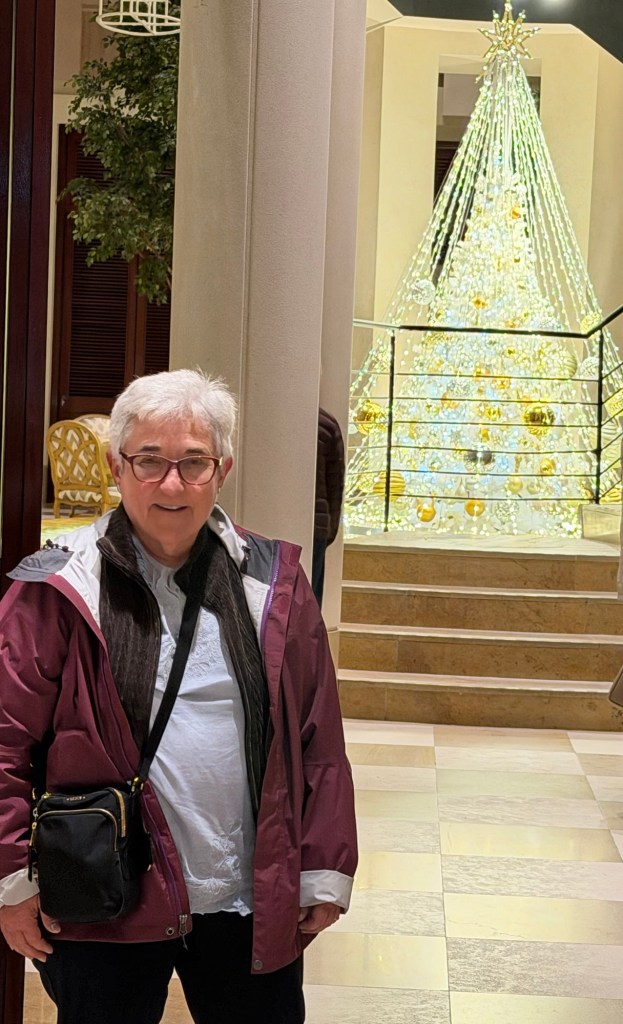
Our hotel’s decor was lovely. It had a bright crystal Christmas tree in the lobby.
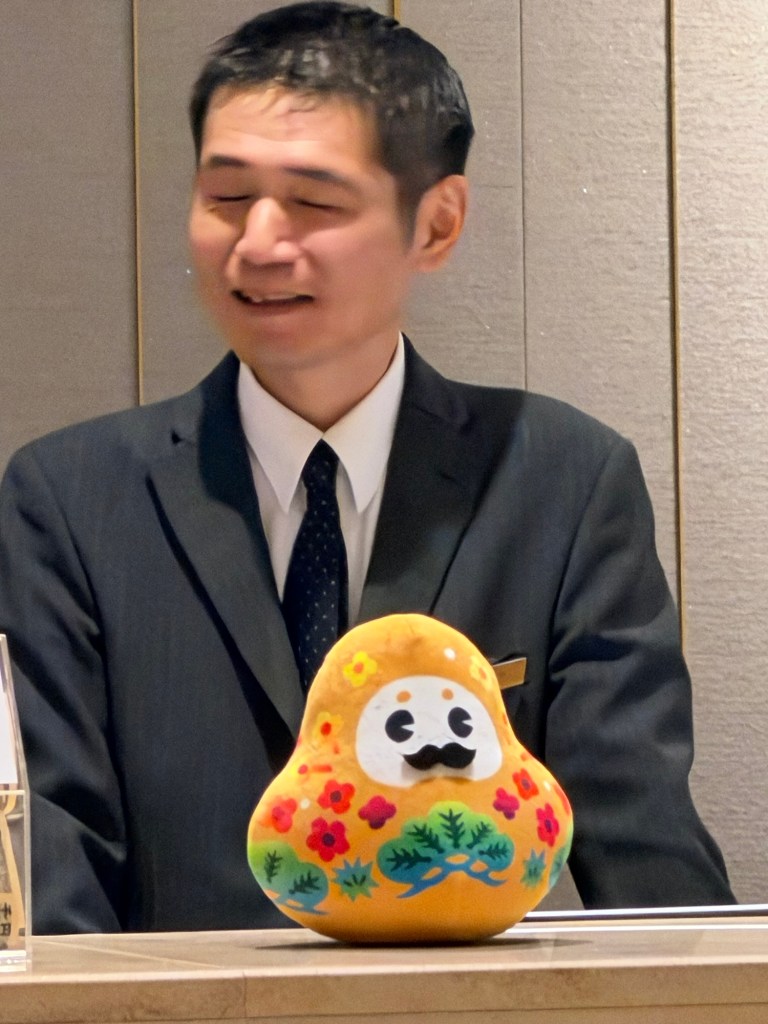
You also saw a rather cute looking creature featuring a mustache at the reception desk at the hotel and around the town. The stuffed toy was adorable, but the story behind it, not so pleasant. Long ago, there was a monk that was so passionate in his meditation that his legs atrophied, and because he never wanted to sleep, he cut off his eyelids. Charming story isn’t it? People admired him and his commitment to his faith. How this cutish creature came out of that story, is unknown.
Takayama to Kanazawa

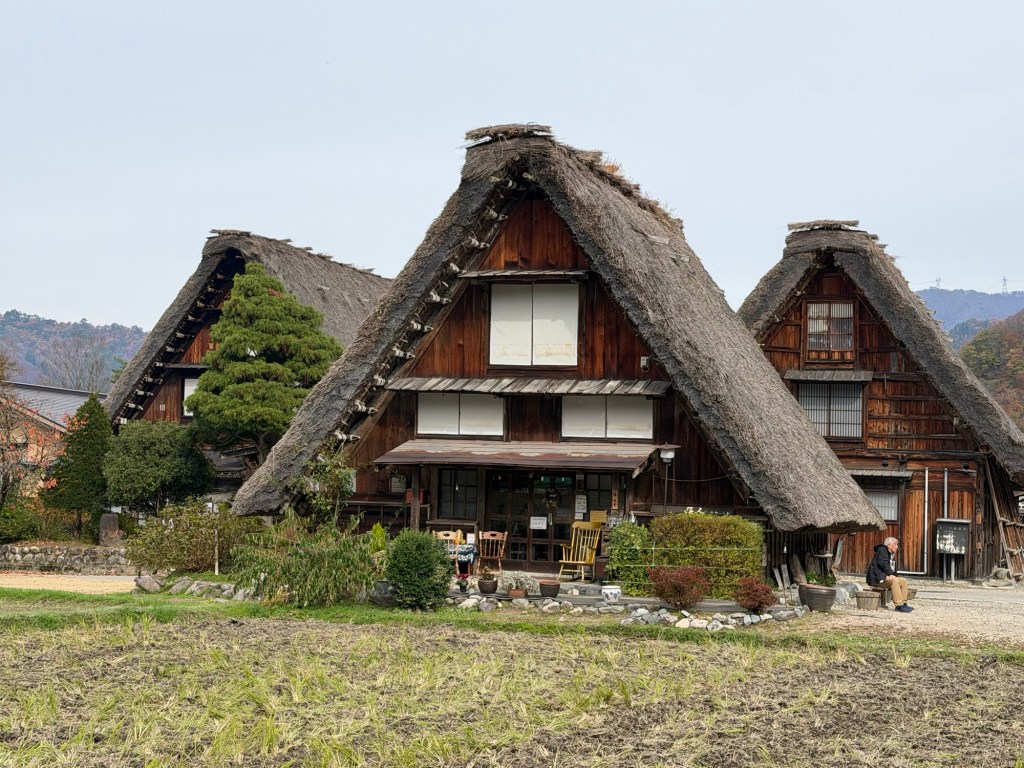
At 62 degrees and cloudy, the weather today should feel almost like home. We are covering a lot of territory by bus today. We will be visiting sites that will give us a sense of what life was like in Japan prior to WWII. Thatched roof houses were not uncommon in the countryside until about 70 years ago. That started to change after WWII and people migrated en masse to cities due to modernization and industrialization.

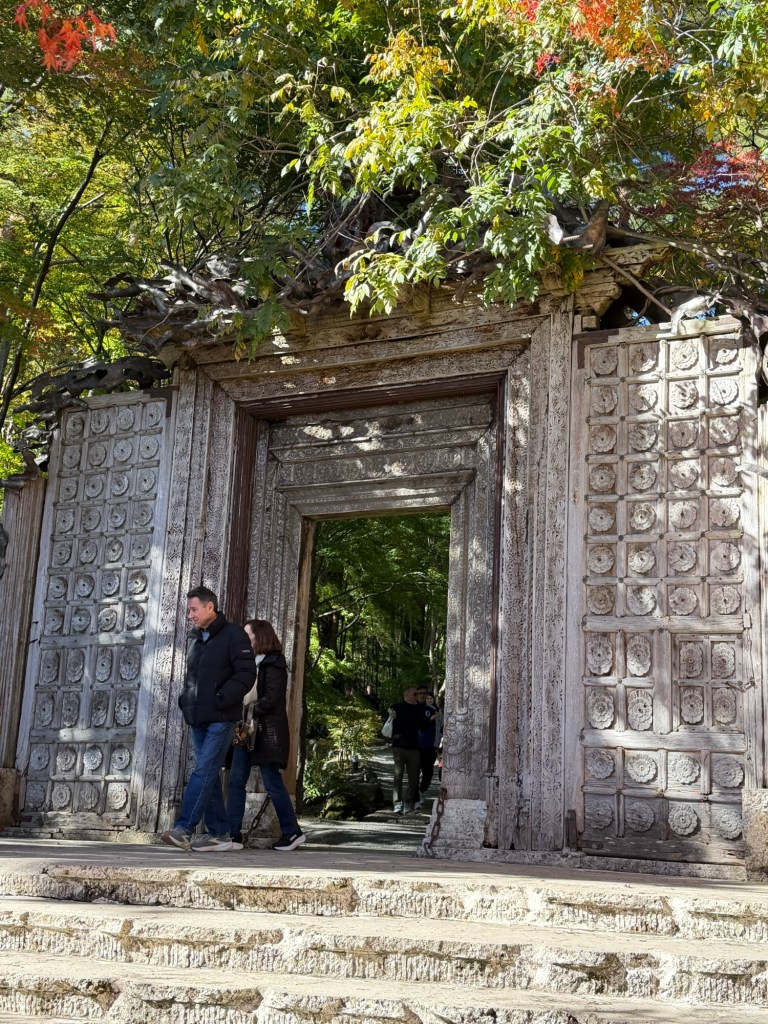
People continue to live in these homes and work together to preserve Gassho architecture. They were built to withstand harsh winters and earthquakes, however, they were susceptible to fire. Many of them were relocated from a nearby village that was razed to make way for a dam. It was enjoyable strolling amoung these unique building, some of which have now been turned into shops and restaurants.

A home with a thatched, steep roof is called a Gassho style house. In Shrakawa and Gokayama Village, both located very closely to each other, there were 1,850 homes prior to 1945, now there are only about 180 left. No nails or metals were used in their construction. All the joints on the second floor and up were fastened with vines and straw ropes. The thatch is made from pampas grass and lasts about 25 years. Due to the difficulty in getting the correct materials to build the roof, along with the limited number of people who know how to do the work, they are costly to replace. Fortunately the government offers funds to the homeowners, allowing them to take care of their properties.

Both villages are considered UNESCO World Heritage sites. This area of Japan was renown for the quality of the silk it produced. The upper levels of Gassho homes were used for the raising of silkworms. The silk industry no longer exists in these villages, or in the country of Japan for that matter.

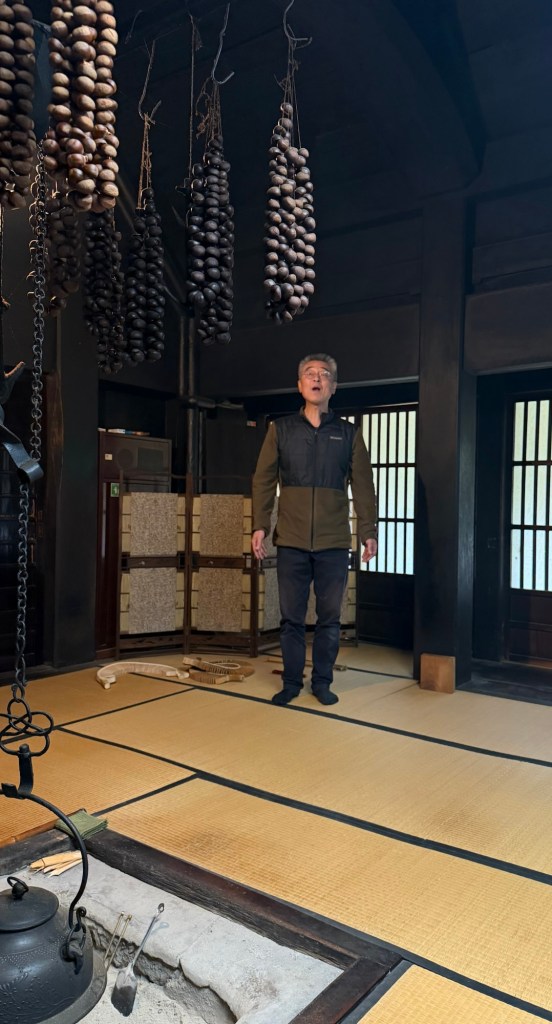
The Iwase family opens their home to visitors. Located in Gokayama, it has been designated an important cultural property since 1958. The house was built by Choemon Fuji about 300 years ago and took 8 years to complete. At the beginning of the Meiji Era (1868-1922) the family changed their name to Iwase. Until 1910, as many as 36 people lived in the house. The Iwase family still resides in this home. Happily the current owner’s son has agreed to take over responsibility of the home when his father retires. It’s nice knowing that the home will remain in the family.

Mr. Iwase tells us all about his home.
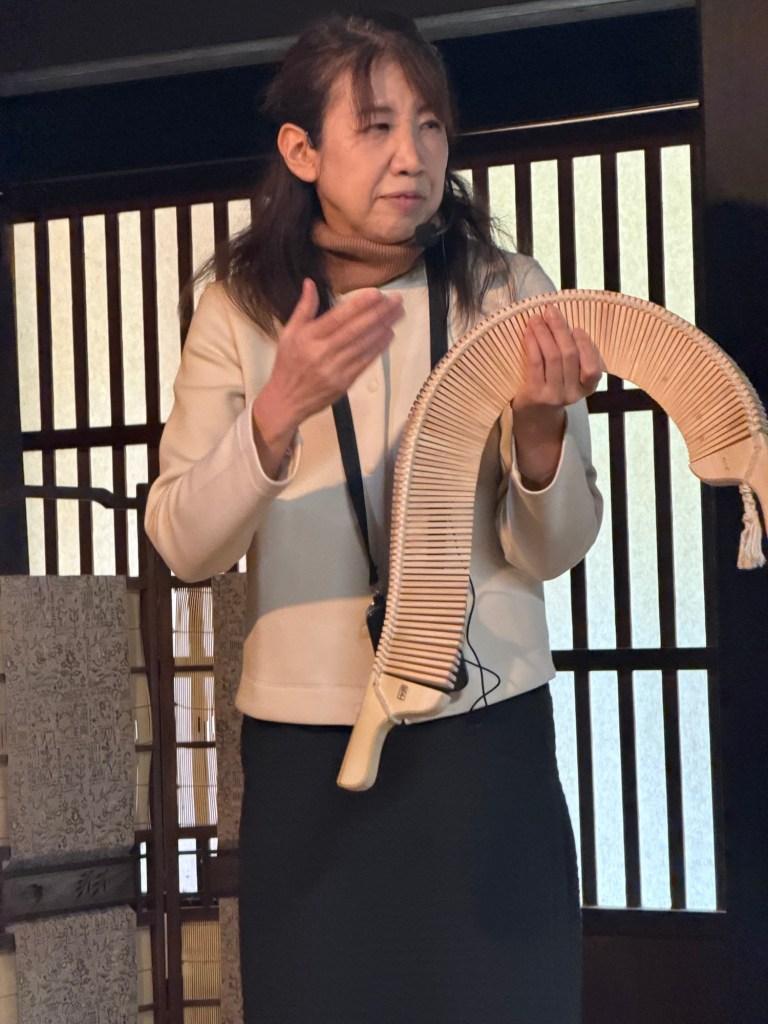
Mrs. Iwase explains how to use a Binsasara. It consists of dozens of thin wooden slats strung together on a cord with handles on each end. When you moved the handles in a wave-like motion the slats strike each other creating a succession of clacking sounds.

After Mr. Iwase spoke to us about his home, his wife introduced us to some simple, traditional instruments. We then watched a brief performance with Mr. Iwase dancing and playing the binsasara, while his wife sang and played another instrument. We all got the opportunity to try out the instruments, and of course, to purchase them.

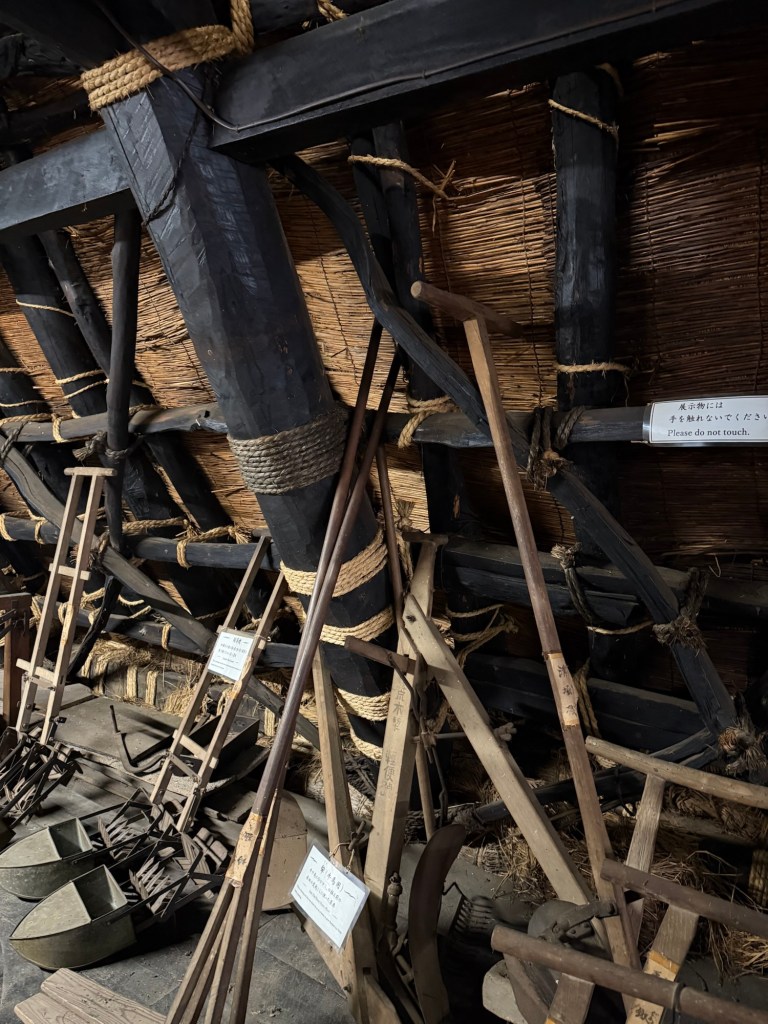
Those of us that were a daring (and perhaps not so smart) were allowed to take a steep and slippery ladder up to the next level. The room was enormous and it looked as if it were part of a sailing ship. The wall and roof were supported by huge logs wrapped in rope.

The inside of the roof looked like rigging on a ship.

We enjoyed a bento meal near Gokayama Village and were able to take a photo of the village from an overlooking hillside. Kanazawa is a popular destination because its old buildings survived WWII due to its out-of-the-way location in-between the mountains and the Sea of Japan. Along with Takayama, it is one of the best preserved Edo period castle towns and is a hub for traditional arts and crafts. In fact, our first stop in Kanazawa was to learn about washi paper making.

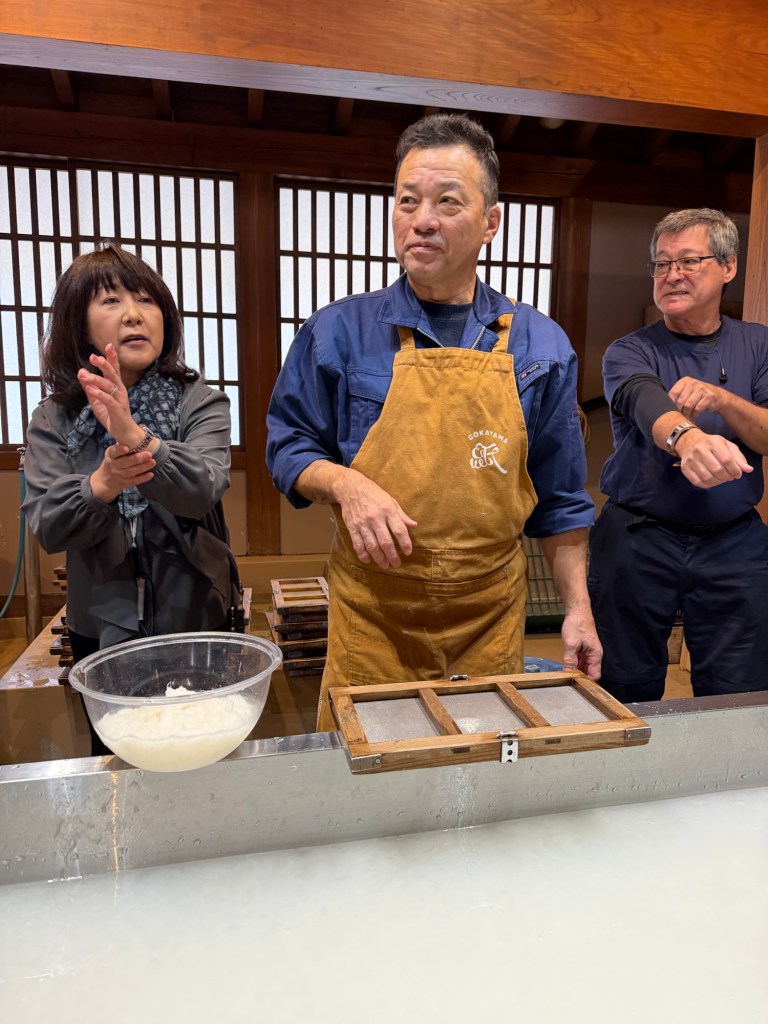
All of us enjoyed our visit to the Japanese Paper Experience House in Taira, just outside of Kanazawa. Etchu Kokushi or Gokayama Washi are traditional names for hand-made paper that comes from this region of Japan. This paper is made from a mixture of Kozo fibers a type of mulberry tree), and a viscous extract of the Torora Aoi (a relative of the Hibiscus plant). “This mixture gives the paper its beautiful appearance and highly prized usability.”

How to dip our screens into the paper mash.

Gokayama Washi has a history going back over 1,200 years. So much effort goes into the making of this paper its hard to understand how people figured out how to make it in the first place. We saw a video that showed how the mulberry branches were collected. The bark was then peeled off the branches all by hand. The branches were then placed on snow in order to be bleached, then boiled, rinsed, and beaten to loosen the fibers. The thickening agent was then added, followed by scooping, straining , shaking, pressing to drain water and then drying. Most of the work is done by hand.

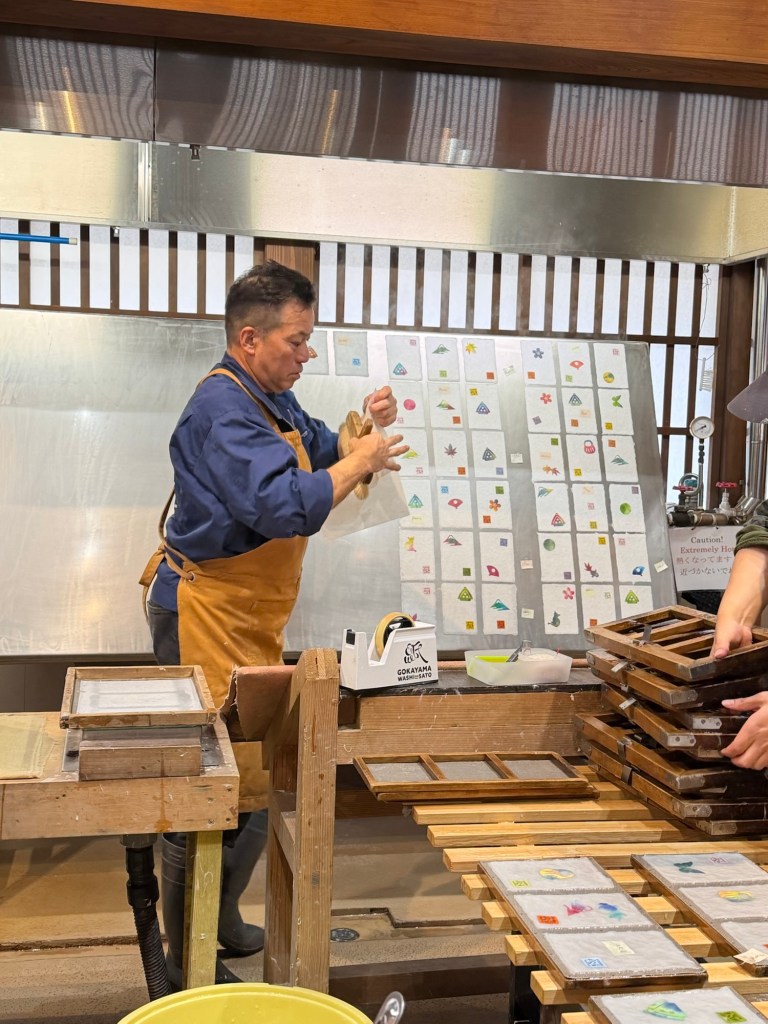
After the presentation we all had a chance to make some postcards made from washi paper. Frankly all we did was dip postcard sized screens into a bath of washi mash several times, and shaking the screen in between the dips to remove excess water. After 3 dips, and shaking, we placed some paper decorations on our sheets. Our instructor carefully removed them from our screens and hung them against a hot surface. Before too long, our postcards were finished.

Drying our works of art on a heated surface

Taking our handmade gifts with us, we were directed to their showroom. (There has either been a gift shop or showroom associated with almost every stop we have made.) It was amazing to see how many beautiful things can be made out of paper. We are finding it hard to resist buying things here in Japan. The handicrafts here are made so beautifully, and with such skill, there isn’t anything quite like it at home.

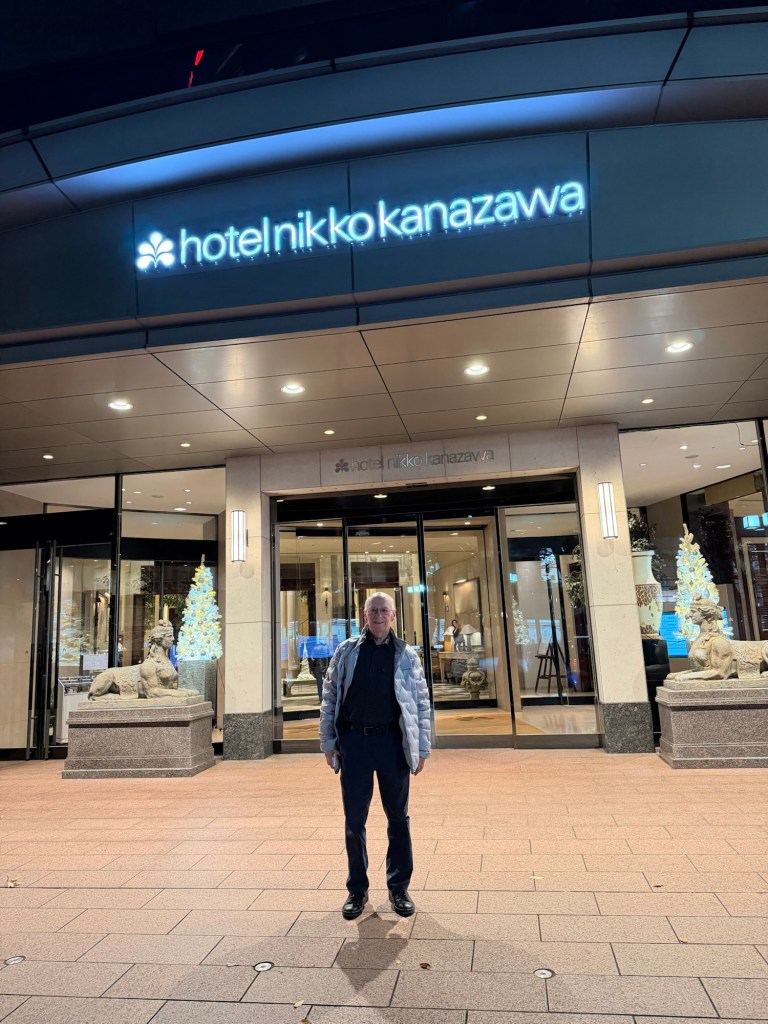
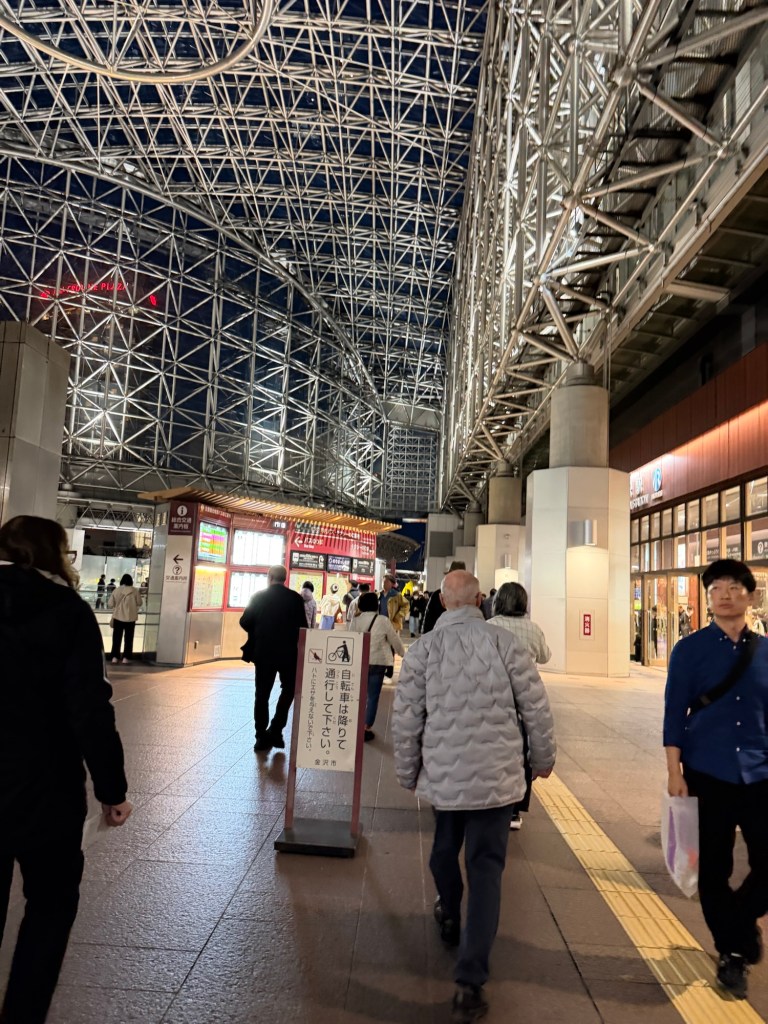
It was an enjoyable day, but we were happy to arrive at our hotel, the Hotel Nikki Kanazawa. It was a very nice hotel right near the geodesic dome-like train station. That night we enjoyed a lovely buffet with our group.

Dan standing outside of our hotel.
Kanazawa train station

A Beautiful Day In Takayama

Today we had a full-day of touring Takayama with an early morning visit to the centuries-old Miyagawaen Morning Market. It was so nice to walk rather than jump onto a bus or train. On the way to the market we made a few stops along the way.

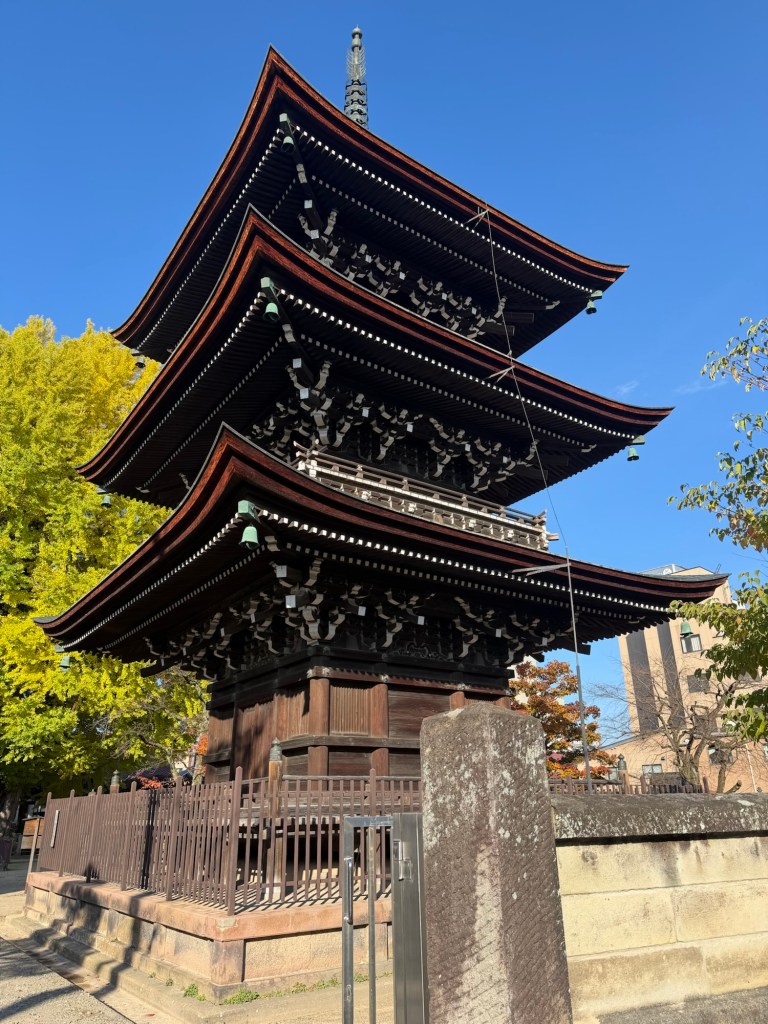
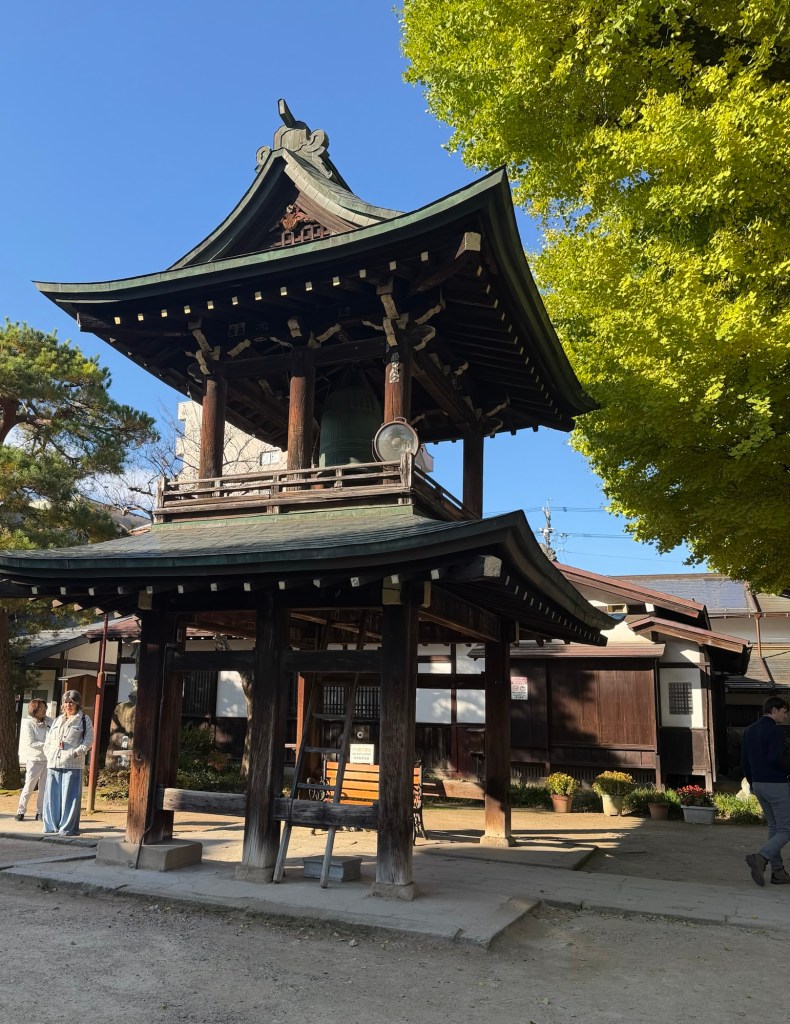
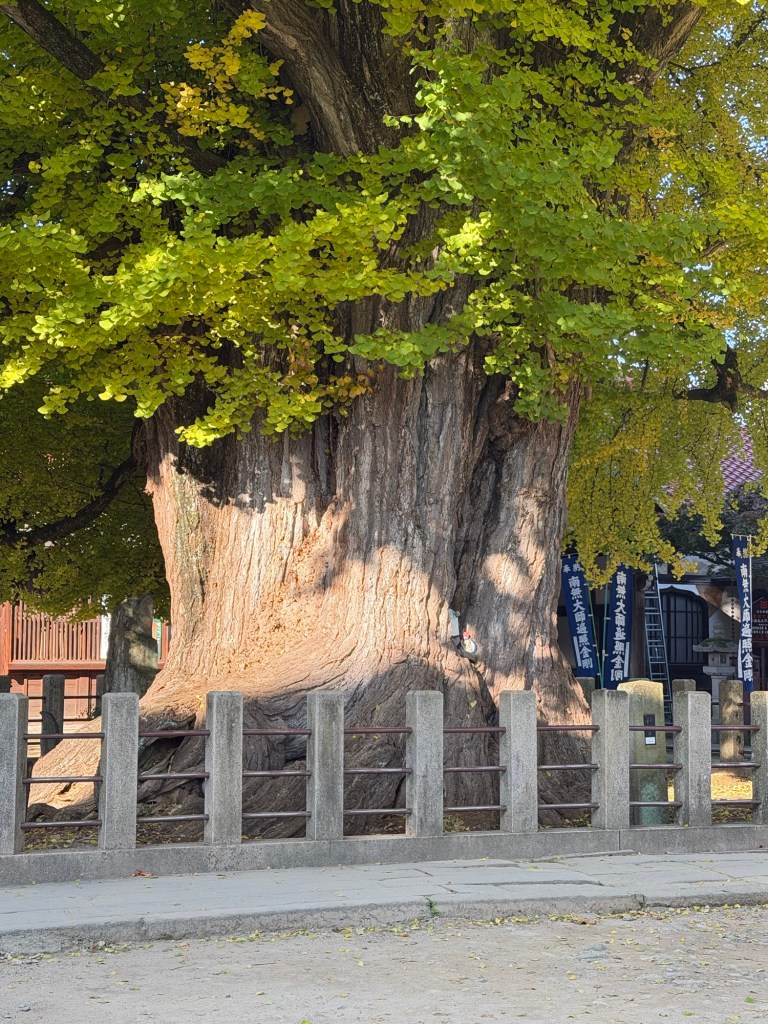
Takayama is a remarkably preserved Edo-period old town. There are old buildings, statues, and shrines hiding throughout the city. You can’t miss the three layer pagoda that is inside Takayama’s oldest temple complex,. The Hida Kokubunji Temple has a history dating back to 746 AD. Close to the pagoda is a huge 1,200 year old ginkgo tree designated as a National Natural Monument. It’s leaves were begining to turn golden. It is said that once the leaves fall the first snow is soon to follow. Some of the buildings in this complex date from the 15th or 16th century.
Pagoda, rebuilt in 1821
This building dates from the 15th or 16th century and sits next to the 1,200 year old ginkgo tree.
1,200 year old ginkgo tree

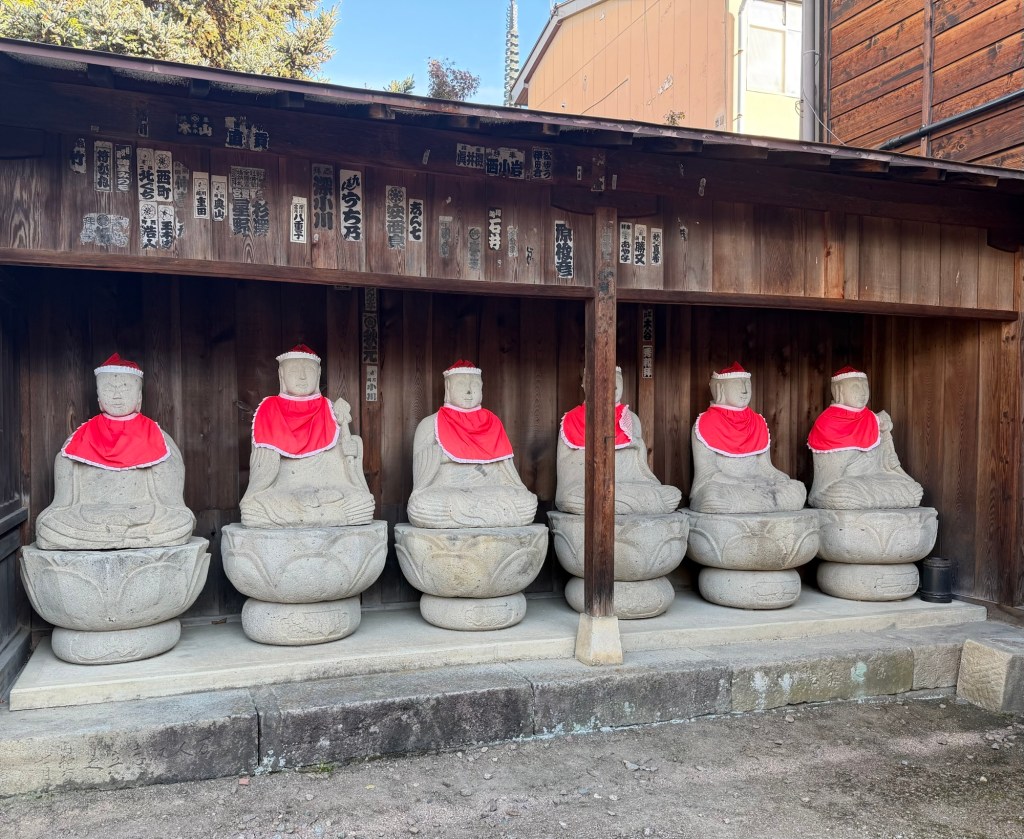
There was still more to discover on our walk to the Market. There were six Jizo Bodhisattva statues. They are revered in Japan as compassionate guardians of travelers and children. The red bibs are traditional offerings symbolizing protection and care. Red is believed to ward off evil and illness.

Six Jizo Bodhisattva statues

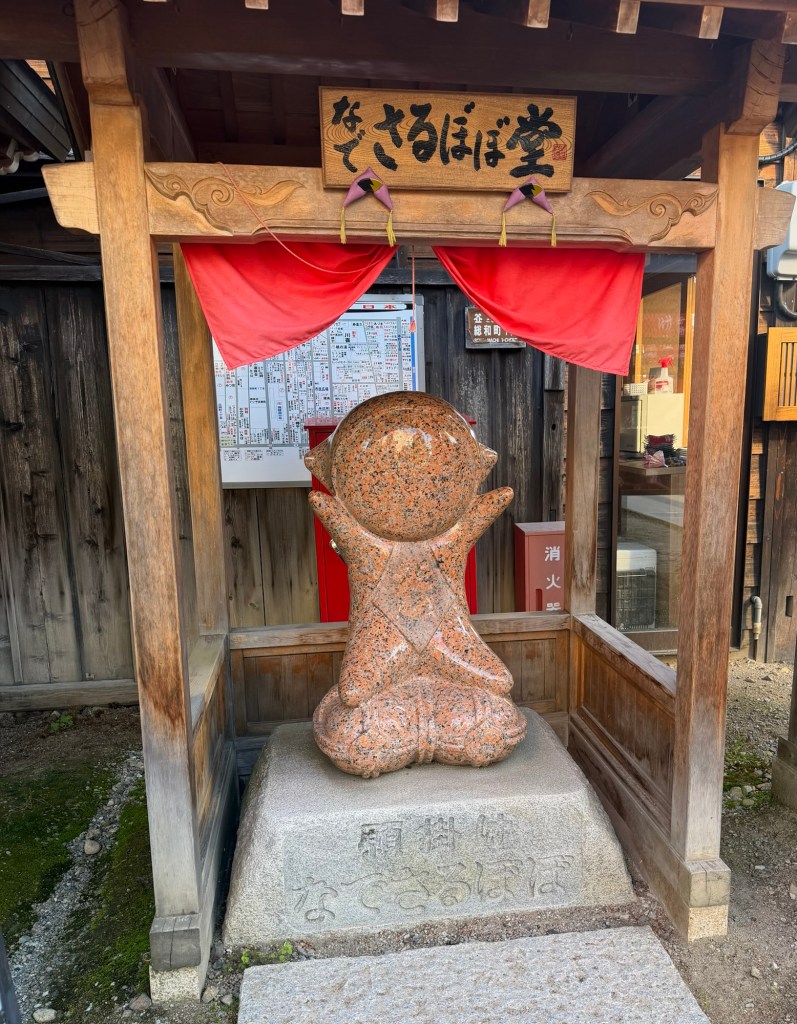
Another unusual statue we saw was of Sarubobo, a stone sculpture that represents a baby monkey and serves as a traditional good luck charm if you rub it. These faceless, human-shaped images are made into dolls which serve as protective good luck amulets for safe childbirth, happy marriages and healthy children. Without a fixed face it is said the owner can project their own feelings onto the doll. Red is the original color of these dolls, but they now come in a variety of colors each bringing their own blessings.

Sarubobo (Monkey Baby) statue

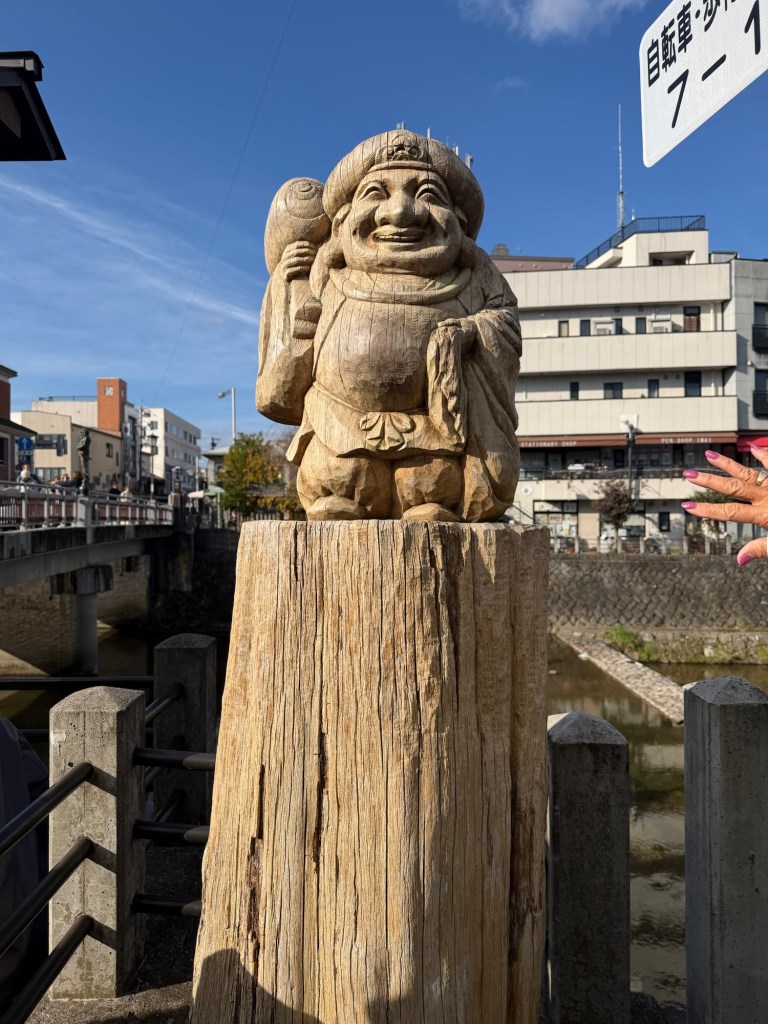
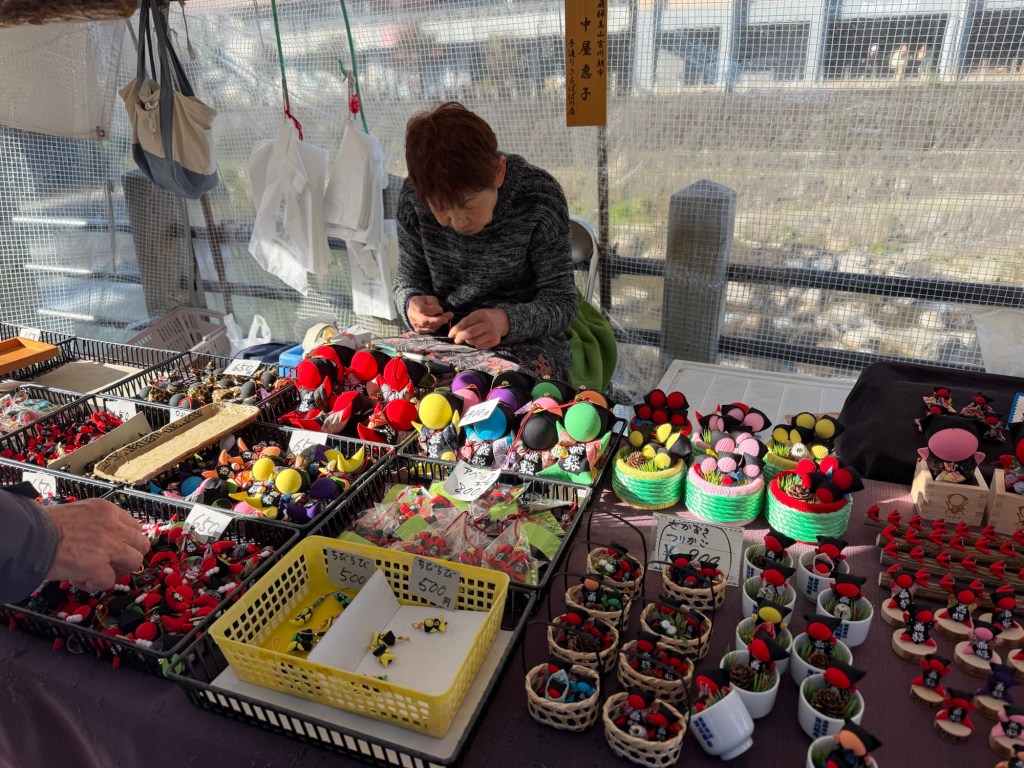
Located along the Miyagawa River, the Miyagawa Market vendors have been selling everything from fruit, flowers, souvenirs, and food for the past 200 to 300 years. An adorable yew carving greets you as you enter. There was a lot to see, but we weren’t given much time to explore. However, we purchased our very own Sarubobo doll from a woman who made them herself.

Welcome to the Miyagawa Market
Stall where we purchased our Sarubobo doll

An authentic Japanese cooking class was next on the agenda. We walked along a stone walkway covered with yellow ginkgo leaves that followed a large water channel filled with trout and coy fish. We were greeted by a lovely woman and her three assistants. The women are members of the Takayama community and not professional chefs. Their goal was to teach us how to make a typical Japanese meal and then have us enjoy eating our creations.

We made a Dashi Broth, Ajigohan (rice with veggies), matcha jelly (for dessert), Kokomo (a delicious potato made in a pot), spinach with egoma sauce (so good I want to find ground dogma), miso soup and fried eggplant. We truly enjoyed our lunch. It was one of the best we’ve had.

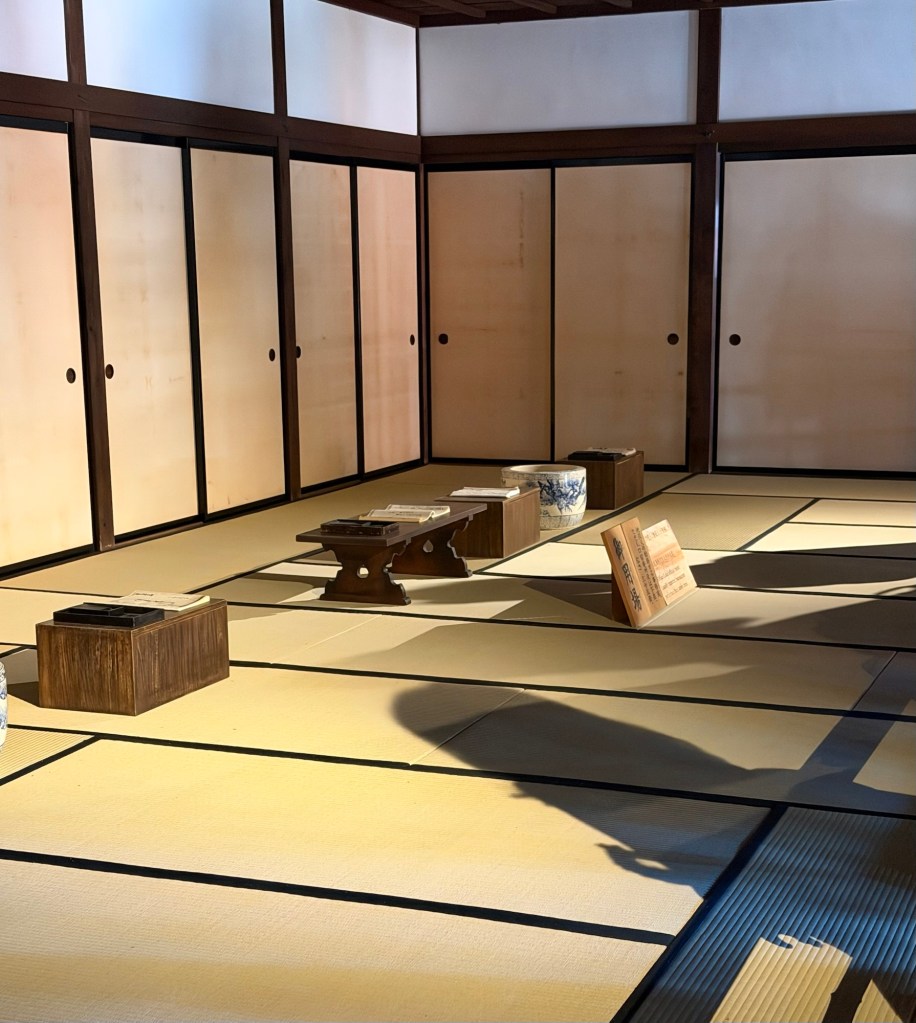
Cooking our lunch was not the last of today’s activities. After we enjoyed the fruits of our labor we went to visit the Takayama Jinya, a former government outpost. It is the only existing building of its kind in Japan. While the site dates back over 400 years, the building itself is from the 17th to 19th centuries. It served as the local administrative headquarters for the Hida region, where taxes were collected and trials held.

Meeting room
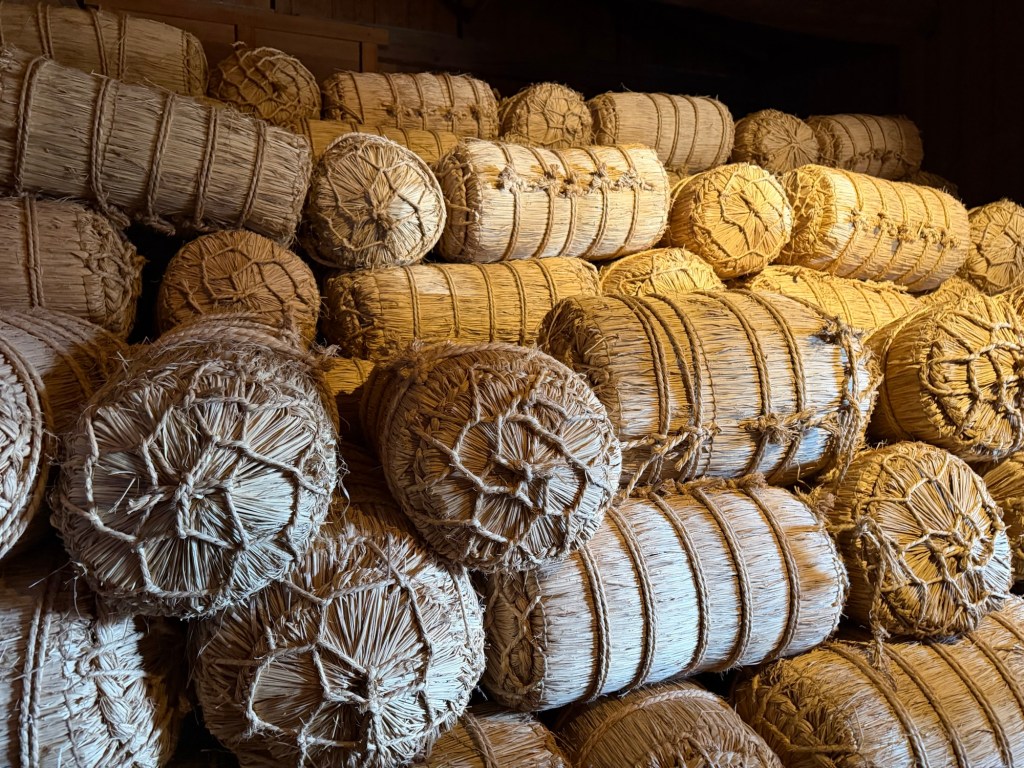
Bundles of rice like shown above were often used as a form of money to pay taxes.

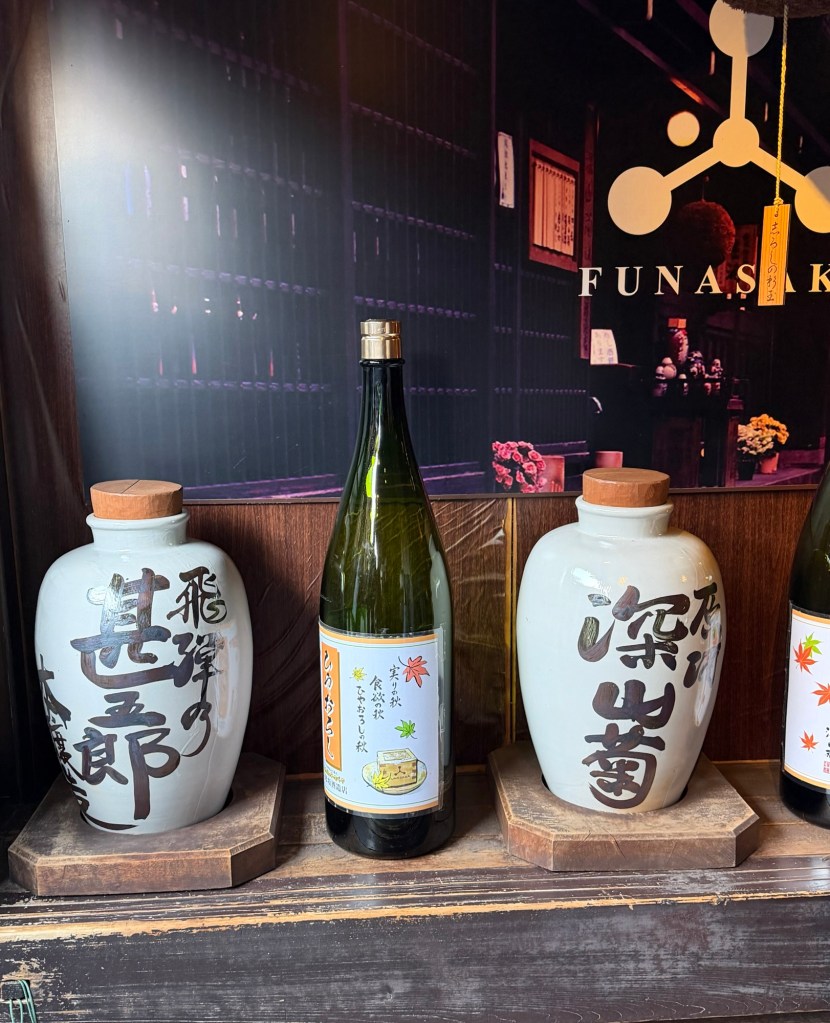
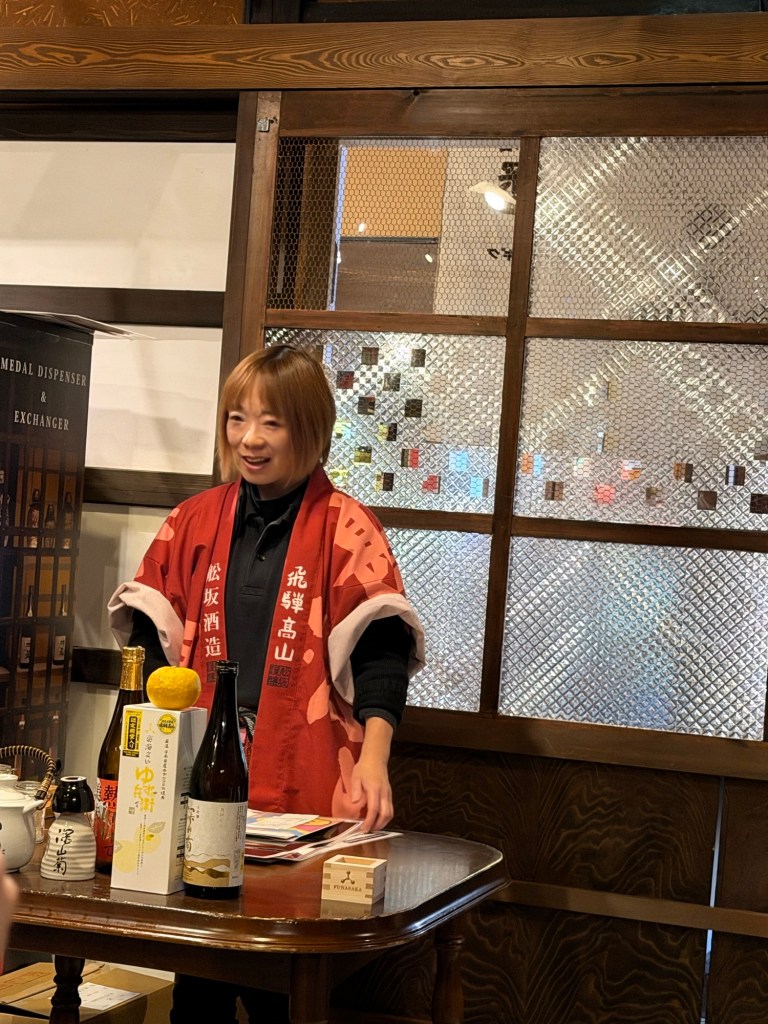
It was now time to head into the historic old town, but before we were set free to explore on our own we stopped for a tour of the Funasaka saki brewery. This region of Japan is known for its saki due to the availability of rice and fresh water. The tour included the tasting of two of their products. The one containing some citrus was very good, but there was no way we were going to carry bottles of saki around with us. We learned that the lower the number, the better the saki. One should never bother drinking anything higher than 50. It has something to do with the amount of polished rice that is used in producing the product.

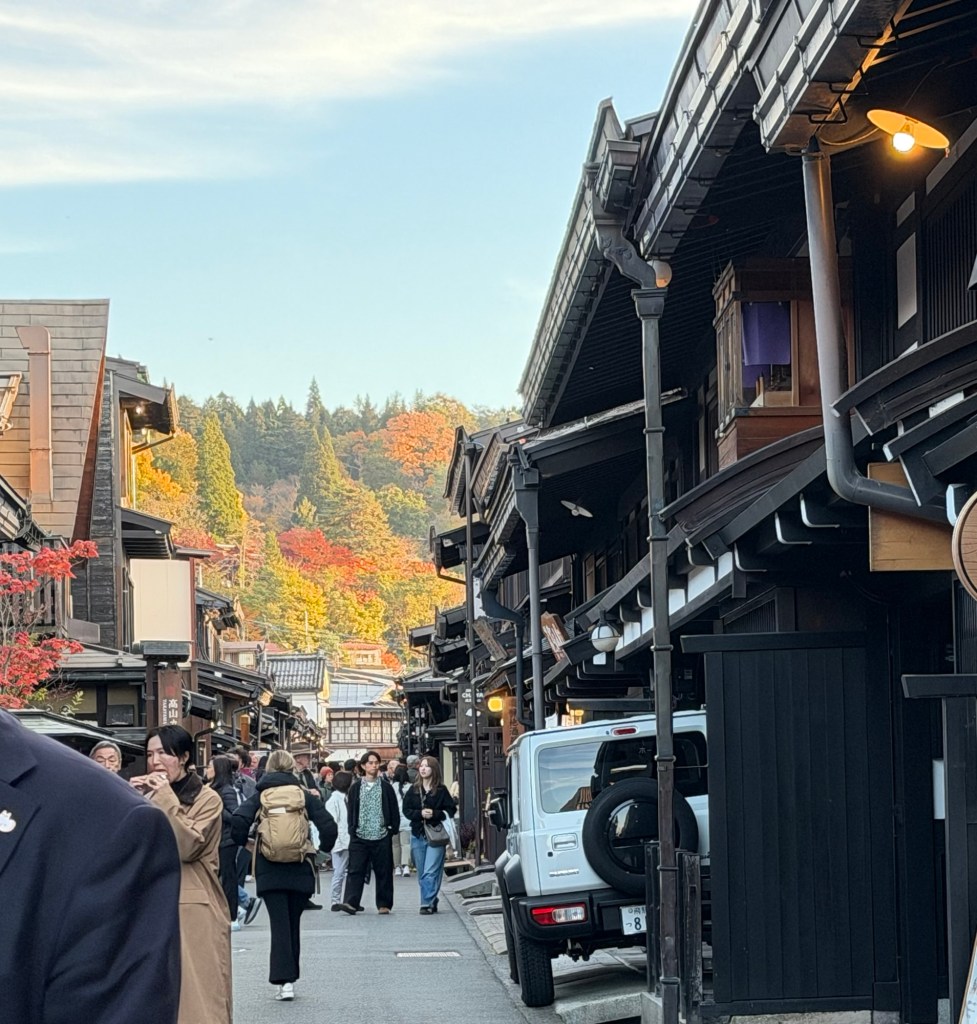
After the brewery we were free to explore the old town at our own pace. The buildings are beautifully preserved and are filled with retail stores and restaurants. It’s wooden buildings were crafted by master carpenters during the Edo period (1603 to 1867) and have all turned a black hue. Once again there are channels of fresh water running along the streets. I was told that the water had been used by residents and shopkeepers for drinking water and to fight fires should they break out.

The mountains can be seen from Old Town

We did a little damage while we were there. One thing we purchased was matcha. We found a small store run by an older gentleman who was producing his own matcha. Since our grandson, Mickey, likes to make his own we figured that might be a good gift for him.

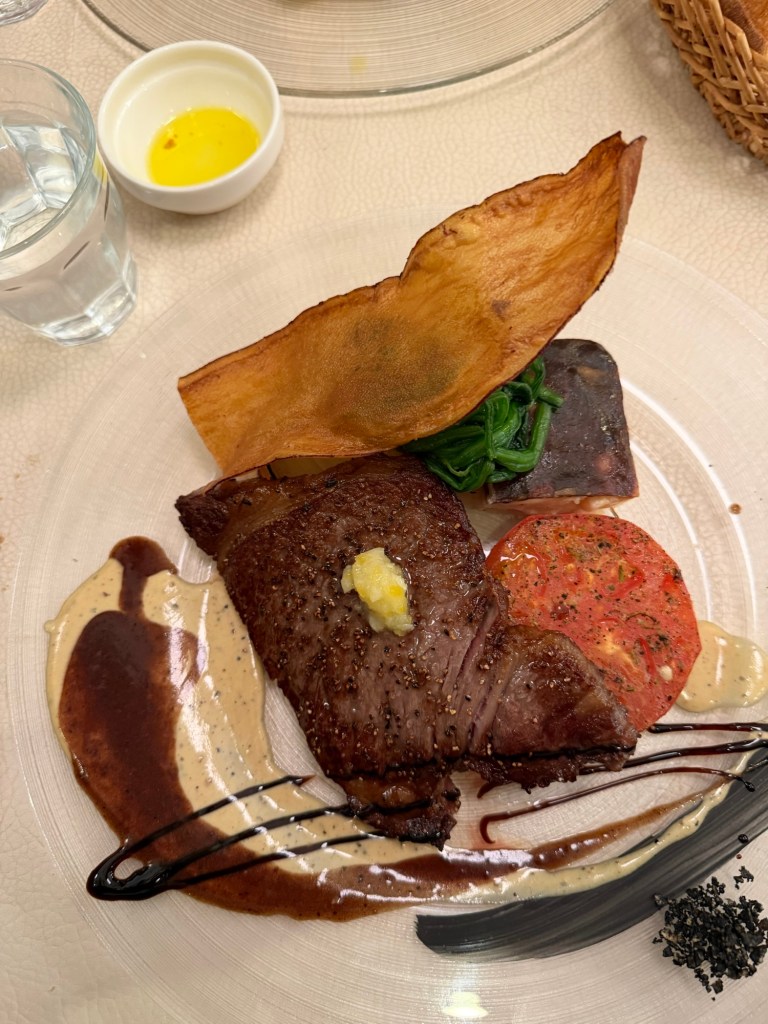
There was a little time for us to get ready for a special Hida Wagyu beef dinner at Le Midi. It was a short bus ride and turned out to be a delicious and enjoyable evening. Dan and I don’t eat much meat these days, and tend to purchase lean cuts when we do. This meat was nothing like that at all. It is the marbling of the fat that makes this meat special. For one night we made an exception. It was very good, but in all honesty we can’t really say it was the best we’ve ever eaten.

Le Midi Wagyu beef dinner

A very filling way to end a very busy day.

Travel Day to Takayama

Our journey continued with travel via Bullet Train and the Limited Express to the mountain town of Takayama. The city of 81,000 has a beautifully preserved old town that dates back to the Edo period of 1600 to 1868. It is also known for its high-grade local wagyu beef.

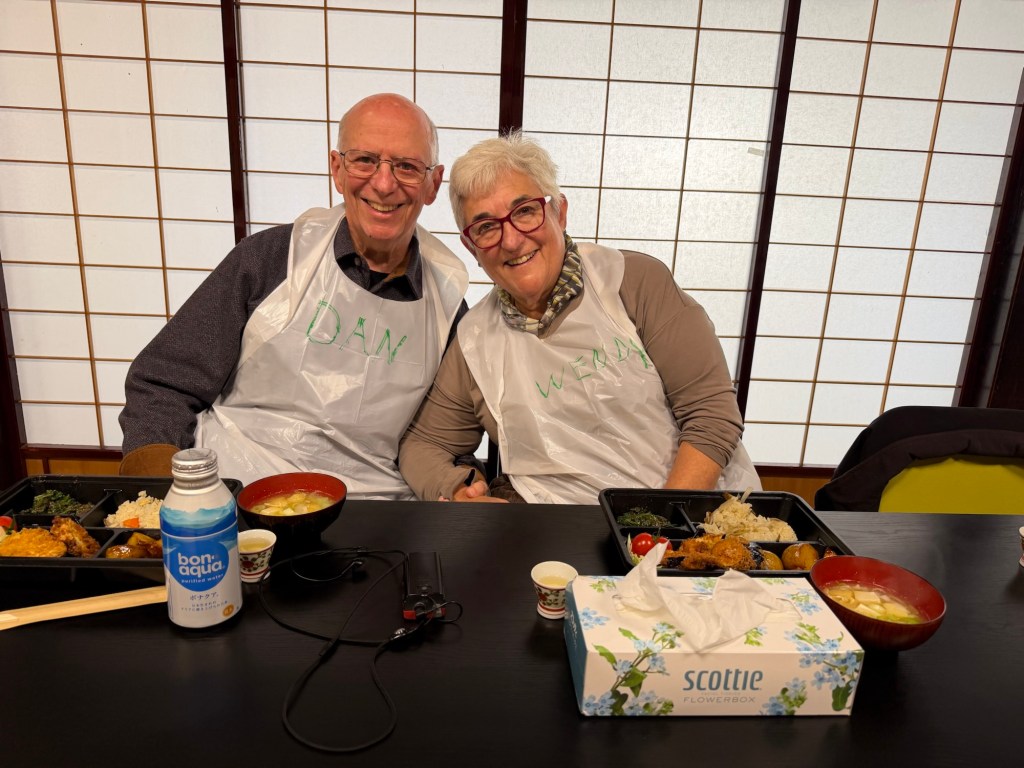
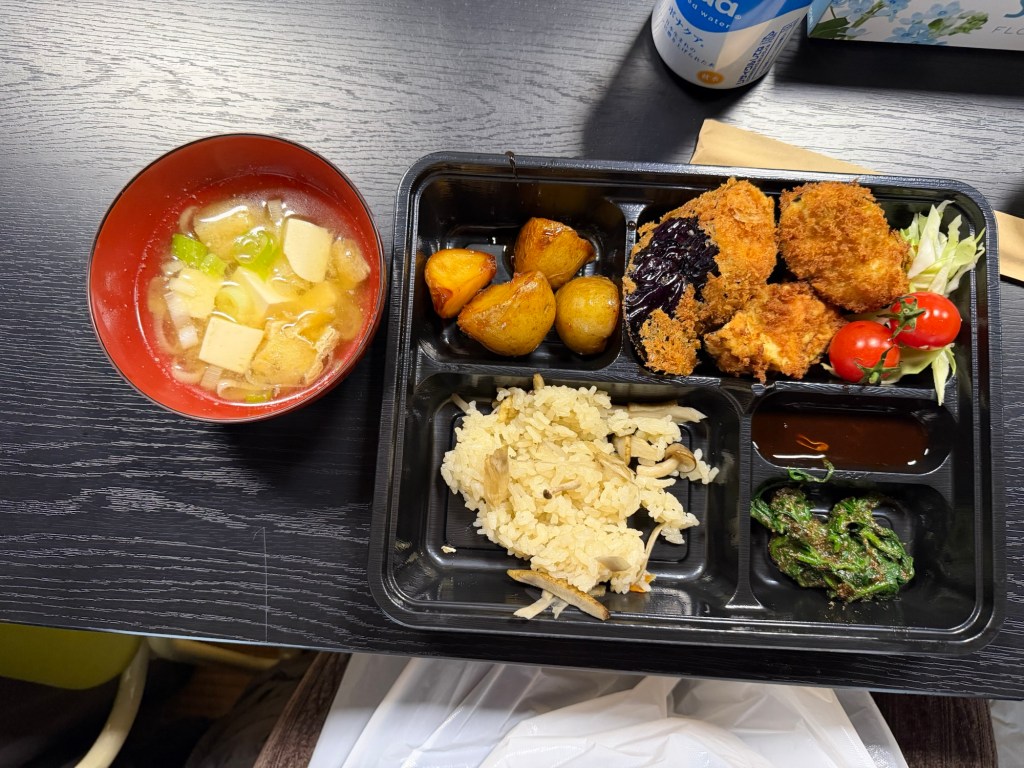
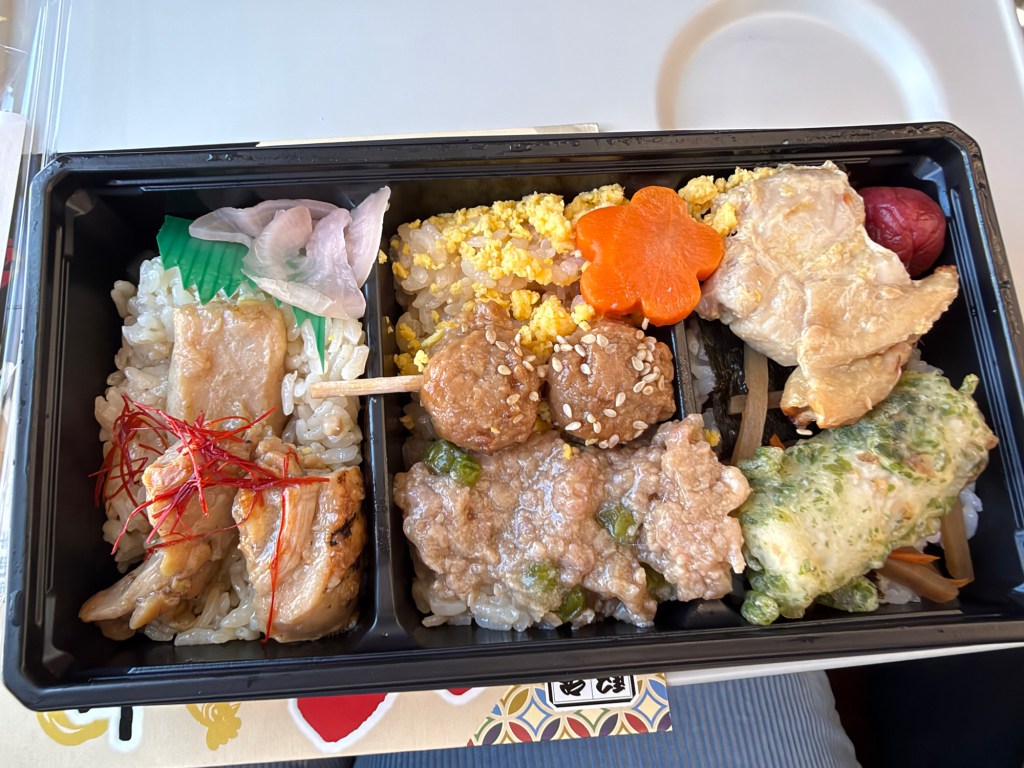
Before we left the station we had the option to buy a lunch to eat later on the train. Dan and I bought a Bento box to share — chicken for a change. A Bento box provides a single portion balanced meal.

Riding the Bullet train was interesting, because when the train is moving you don’t sense that you are traveling at between 300 to 350 mph. While waiting for our train to arrive several Bullet trains wizzed by at full speed— VERY, VERY, FAST The trains were roomy and comfortable. The regular express train we took was also very comfortable.

Our Chicken Bento box

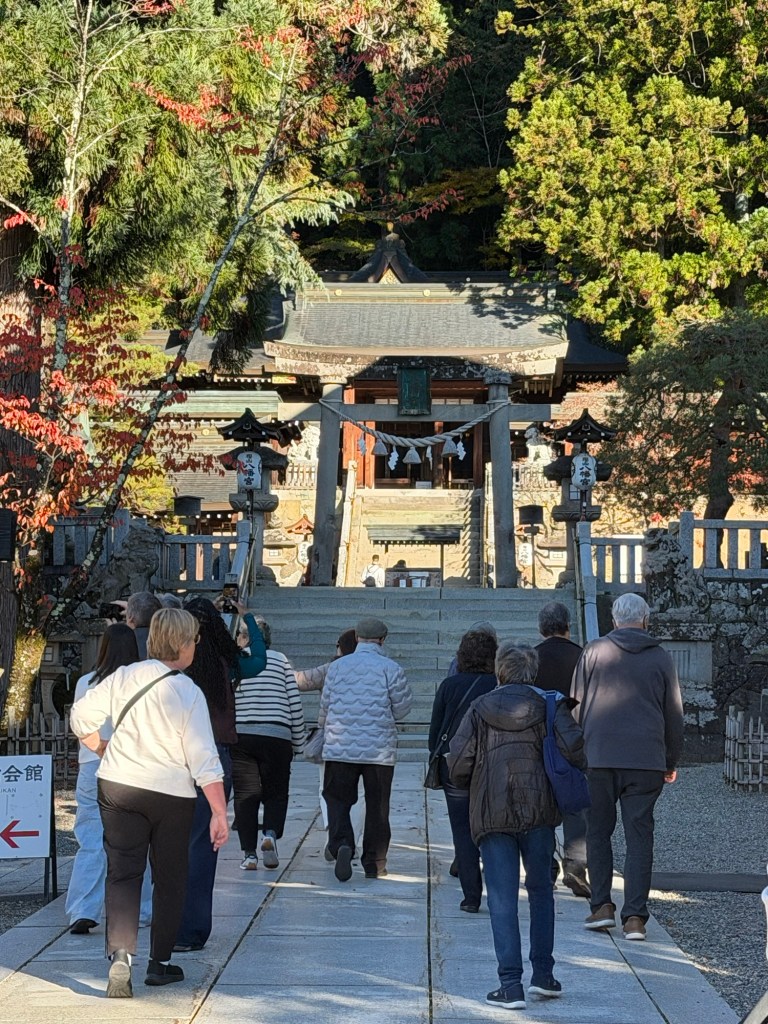
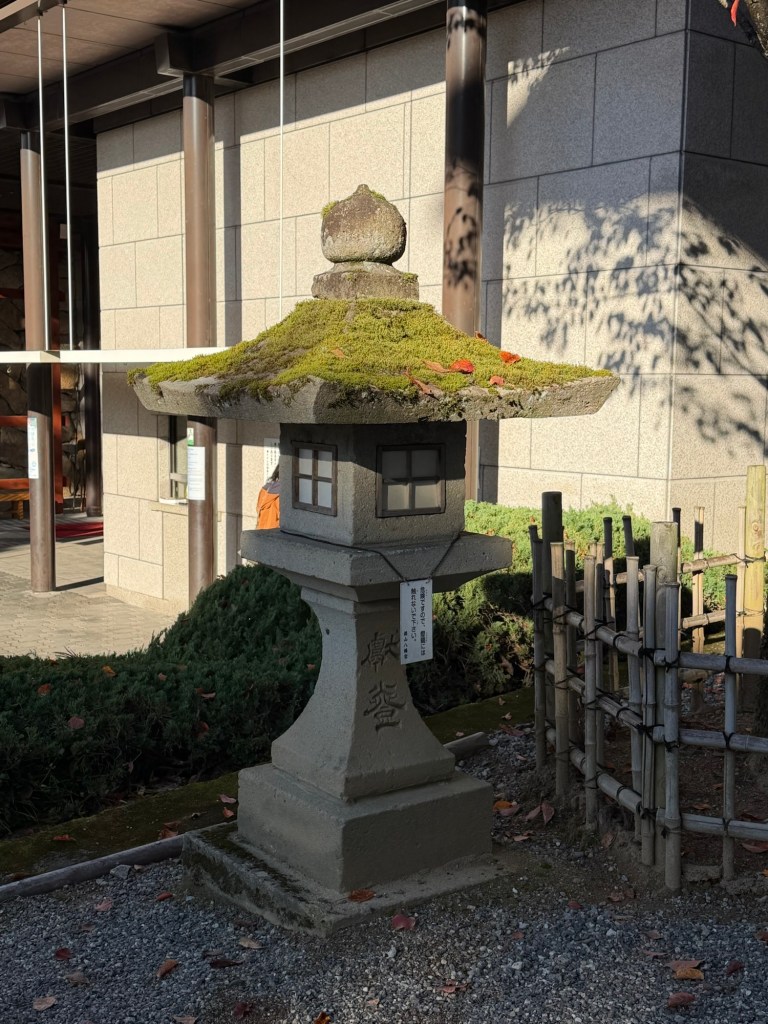
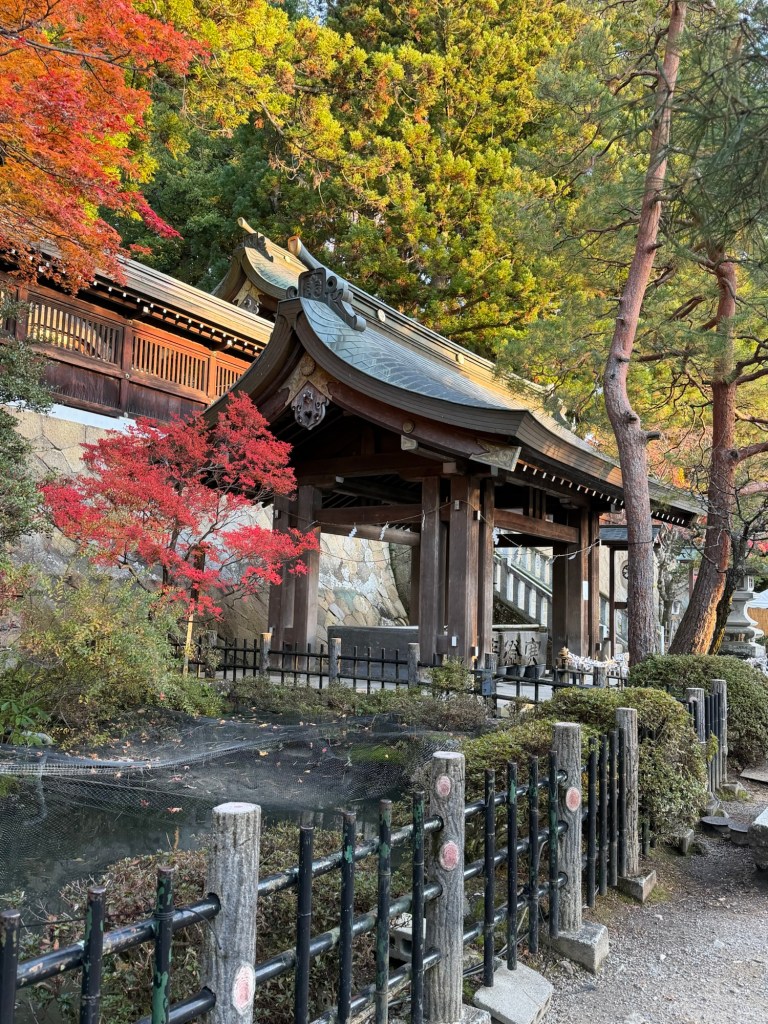
When we arrived in Takayama, Masako took us to Sakurayama Hachimangu Shrine. It is the oldest Shinto shrine in Takayama. It was founded in the 4th century, but expanded in 1683 under the powerful Kanamori clan who ruled the area. The grounds included tall cedar and cypress trees, along with moss covered stone lanterns.

Heading toward Sakurayama Hachimangu Shtrine
One of many moss covered stone lanterns. Many of the lanterns were from 1776 dedicated by a community leader in the hopes it would prevent him from going blind.

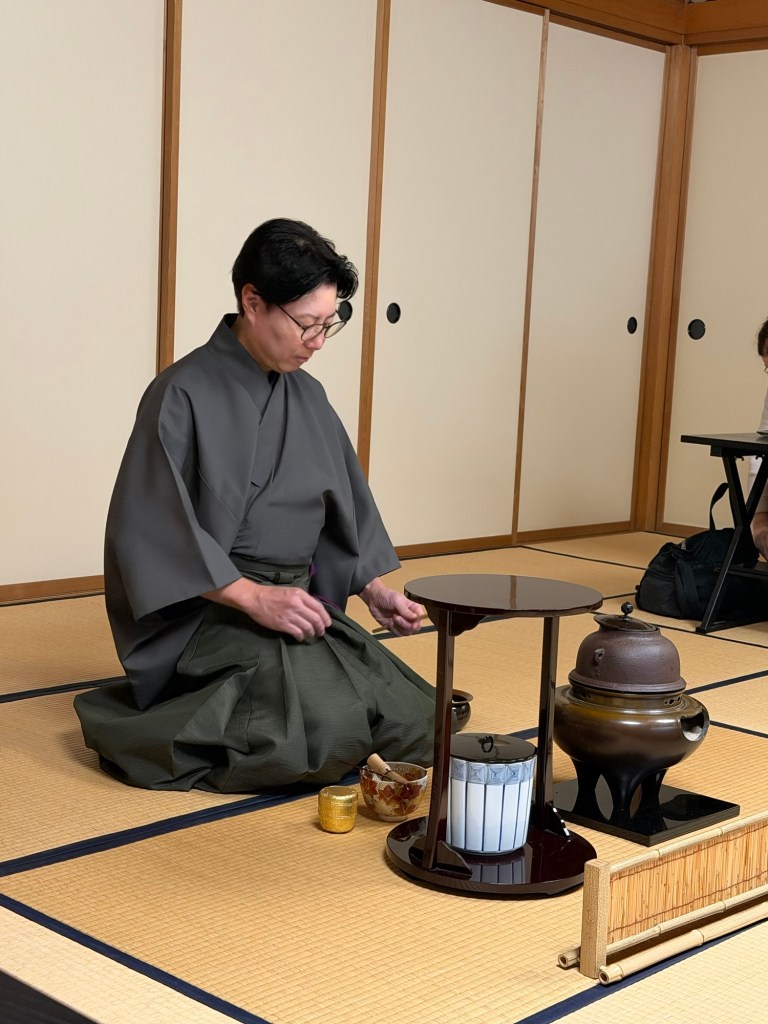
While visiting the shrine we participated in a very elegant tea ceremony. Japanese tea culture stretches back over 1,200 years, but the one we witnessed today has been performed in the same exact way for the past 450 to 500 years. All Samurai warriors were trained in the art of the tea ceremony which traditionally was performed by men only. Just like Kabuki theater, the entire ceremony moved slowly and precisely. Our host was dressed in a subdued-colored kimono, each of his movements was exact and all utensils were handled in very specific ways. Even the smallest of items, such as a silk wiping cloth, was carefully folded, used, folded and then returned to the host’s kimono in a well-rehearsed order. During the Edo period the ceremony was used to conduct diplomacy, show loyalty to the shogunate with no weapons allowed in the room.

Today the purpose of the tea ceremony is “mindfulness, cultural preservation, and genuine human connection rather than political.” The young man performed a ceremony that was beautiful to watch in its simplicity. All of us were served wagashi, a traditional Japanese sweet filled with anko, red bean paste. This was to help us enjoy the tea better since it tends to be bitter.

Each of us was individually served the tea in a ceramic cup. The server would bow to the guest they were serving and turn the cup in their left hand before handing it to them. The guest would bow in return, place the cup in their left hand and turn it until the side they sipped from had no design. It really was a lovely experience.

Performance of a tea ceremony

It had been a long travel day so nothing further was planned for the evening. Dinner was on our own, so we joined Cheryl and Jake Perelman and Ron Harnett at Matsuki Sushi. Wonderful for sushi, but not so much for Wagyu beef.

Exploring Tokyo in the Rain

Today we enjoyed what they called an American breakfast. We dressed warmly because temperatures were going to be in the 40’s and 50’s with rain the entire day. Despite the weather, the streets were crowded with people heading to work and the tourist sights jammed with people.

The first stop of the day was Asakusa Kannon, also known as Senso-ji. It is the oldest temple in Tokyo. Founded in 628 AD, it is Tokyo’s oldest temple. It was built after two fishermen caught a golden statue of Kannon, a Buddhist bodhisattva (enlightened being) of compassion, when fishing. The statue is supposedly enshrined somewhere inside the temple.

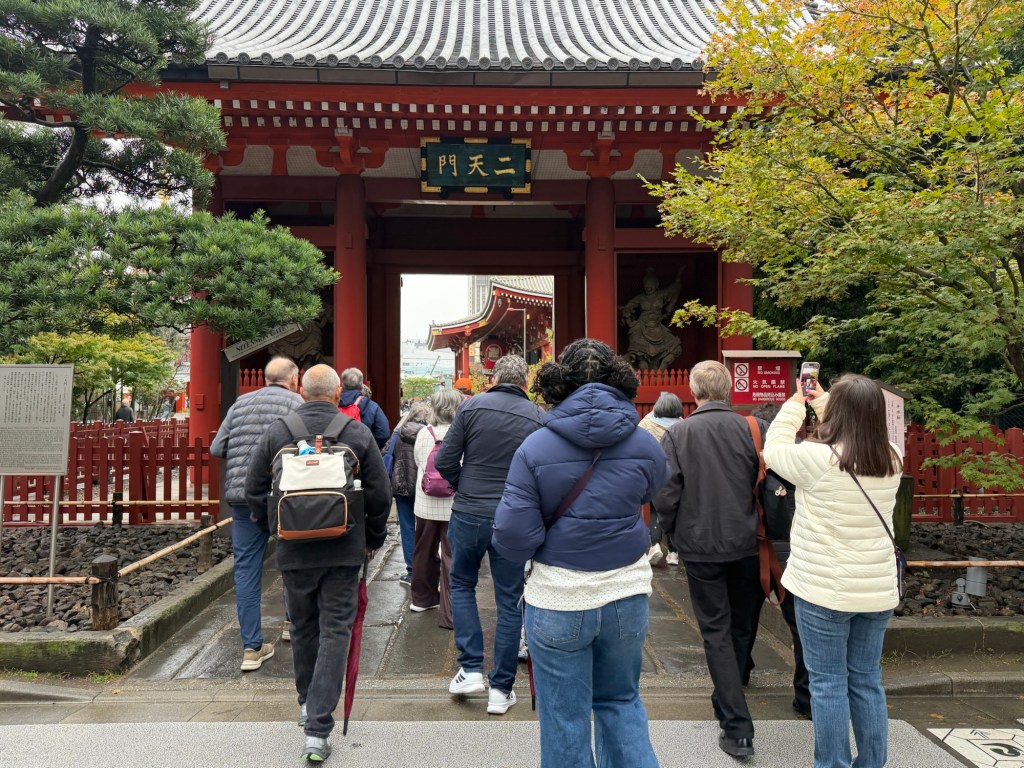
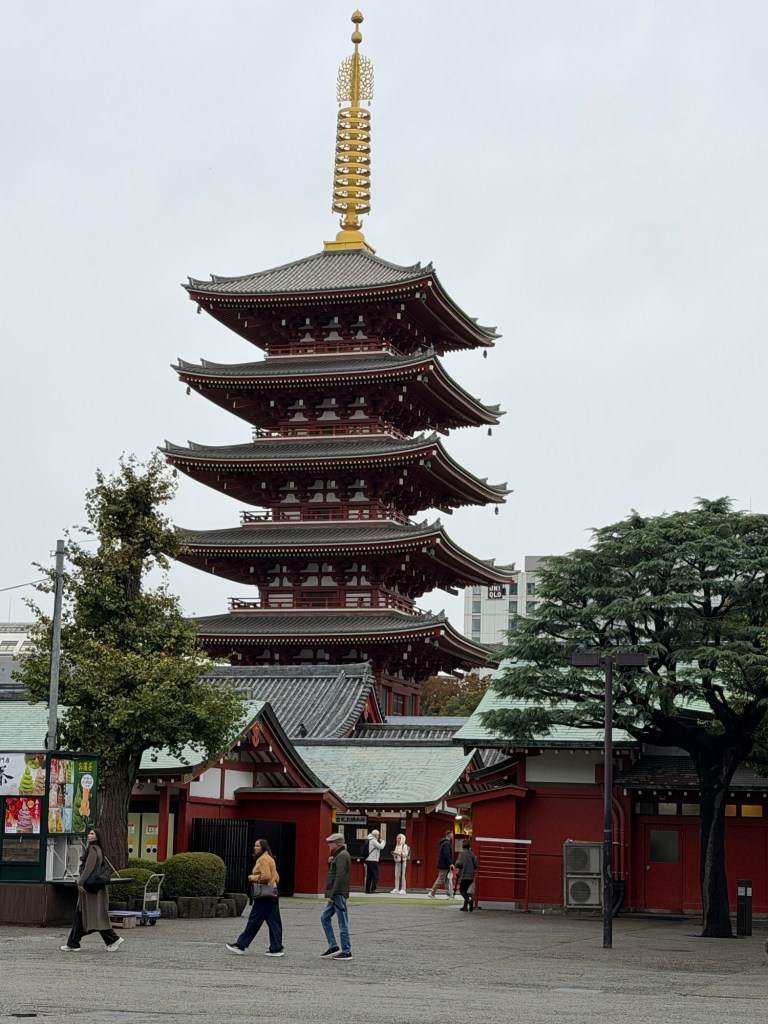
One way to enter the grounds is through the Nitenmon Gate (East gate) built circa 1649. Guardian statues were placed on each side of the gate for protection. The area also has the first pagoda we’ve seen on our trip. Appparently each floor represents an element of nature such as wind, water, and fire. According to Masako, pagodas no longer hold religious significance, but this one was quite beautiful to see.

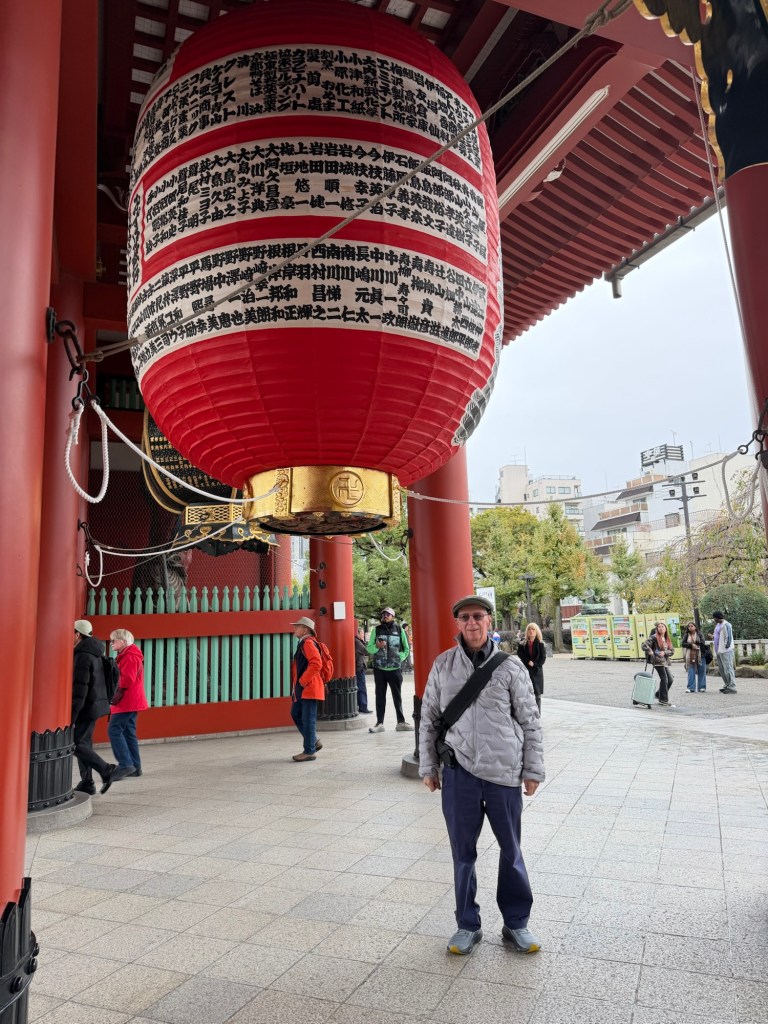
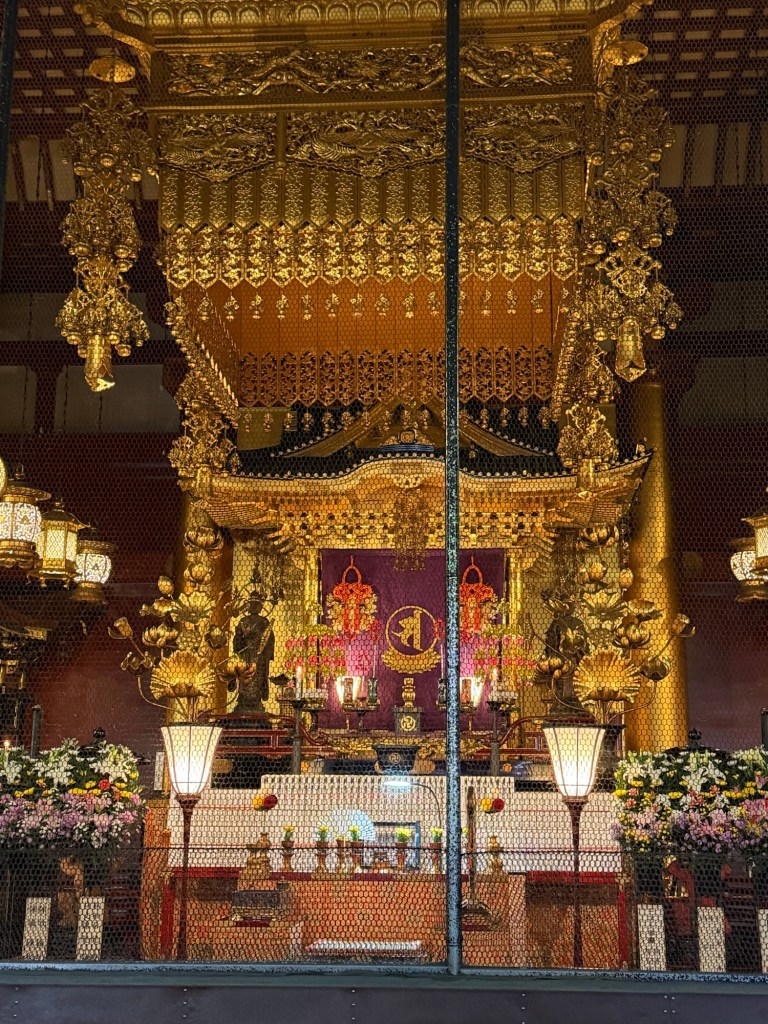
Before entering the Temple you pass under the Kaminarimon (Thunder Gate), that features a massive red paper lantern. The Temple itself is quite beautiful with lots of gold. Before entering we had been taught to scoop water and wash your hands, but this time you cupped your hands to collect water to wash out your mouth. You then spit the water into a trough. Bowing was also involved, but I don’t remember the rest of the sequence,

Massive paper lantern
Golden temple

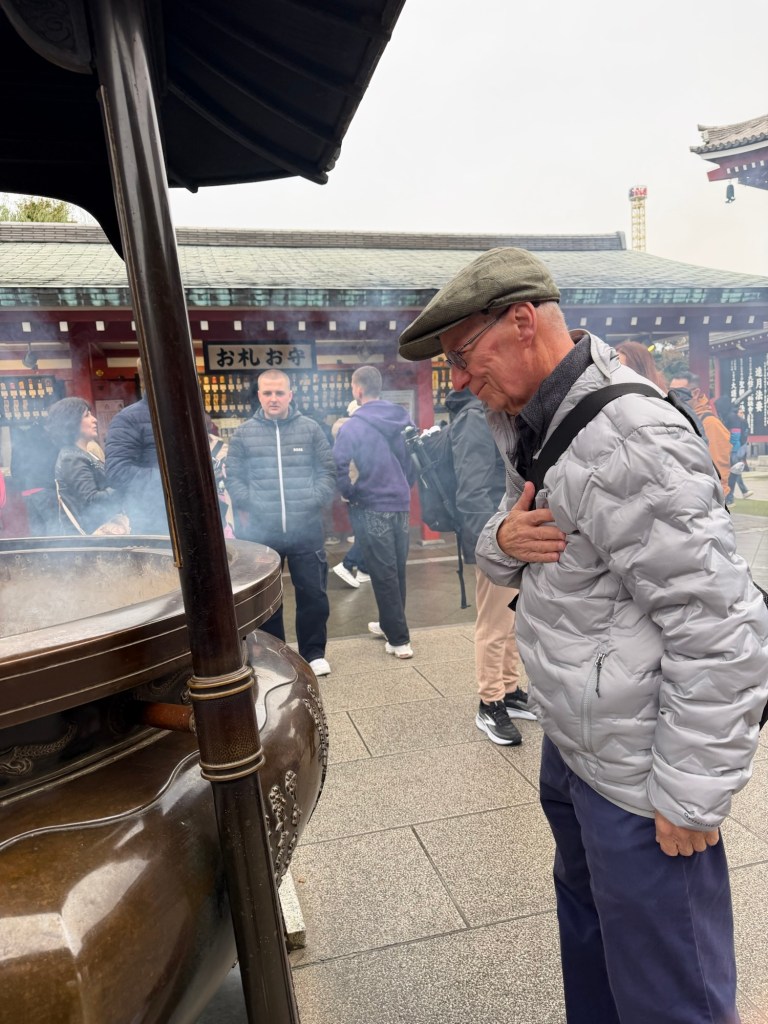
In the middle of the grounds is a large incense burner (Jokoro) where visitors waft the smoke over themselves for health and wishes. I’m not sure if Dan will get his wish, but he went ahead and smoked himself. Right beyond the incense is the Nakamise-dori, a historic and extremely busy shopping area. It was a great place to find souvenirs and pick up a sweet.

Dan asking for good health while breathing in unhealthy incense smoke.

One downside of a tour is that you need to follow the time guidelines set in place and sometimes it isn’t enough time. Shopping here was fun, but we had to stop to head back to our group. Now we were heading to the Tokyo National Museum. The museum houses an extensive collection of art and antiquities from Japan and other Asian countries. However, we are very spoiled by Cleveland’s Museum of Art. While we saw some marvelous things, Cleveland’s collection seemed more expansive than here in Japan.

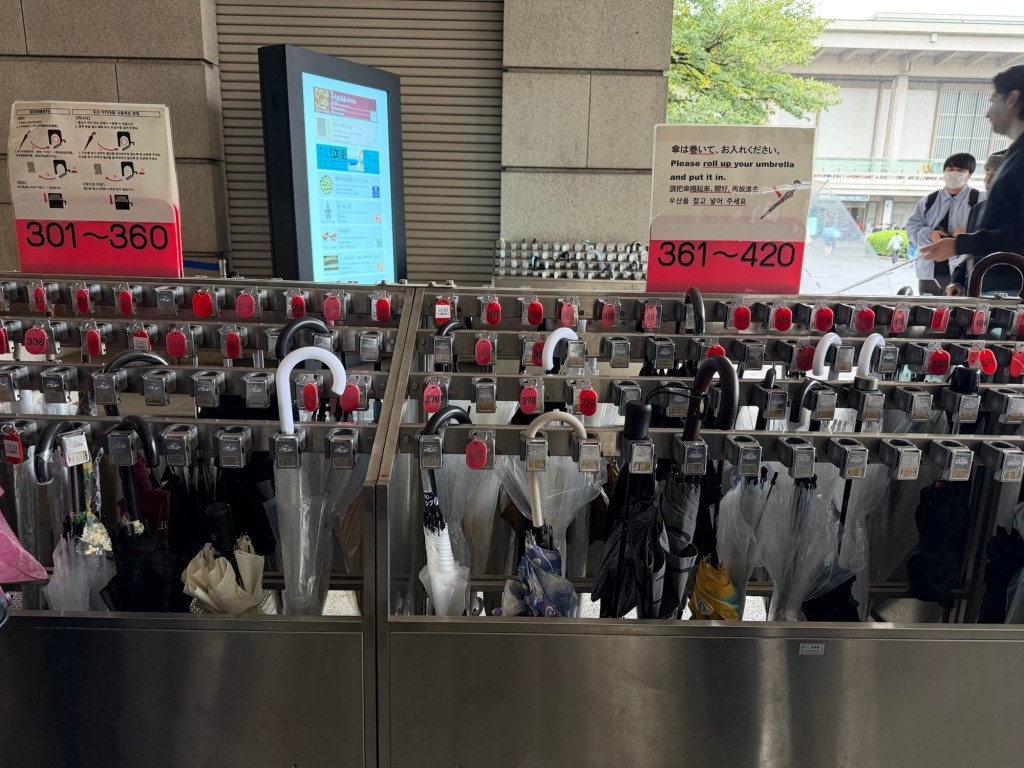
You see huge umbrella stands throughout Japan. This one was at the Museum.
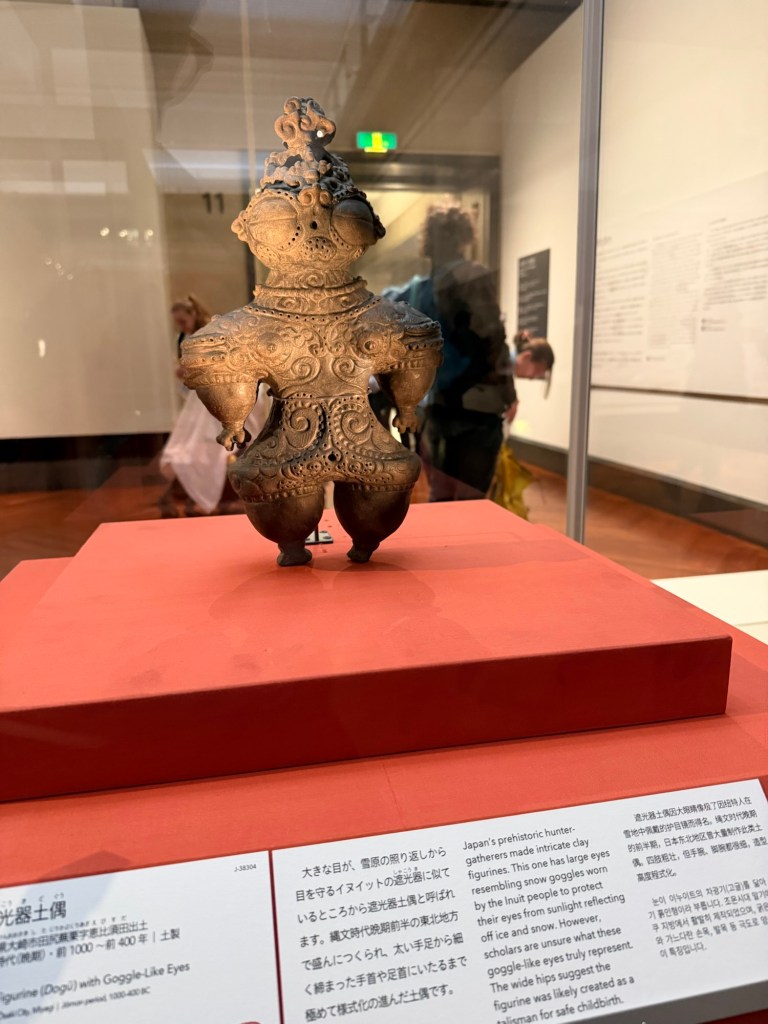
Prehistoric pottery
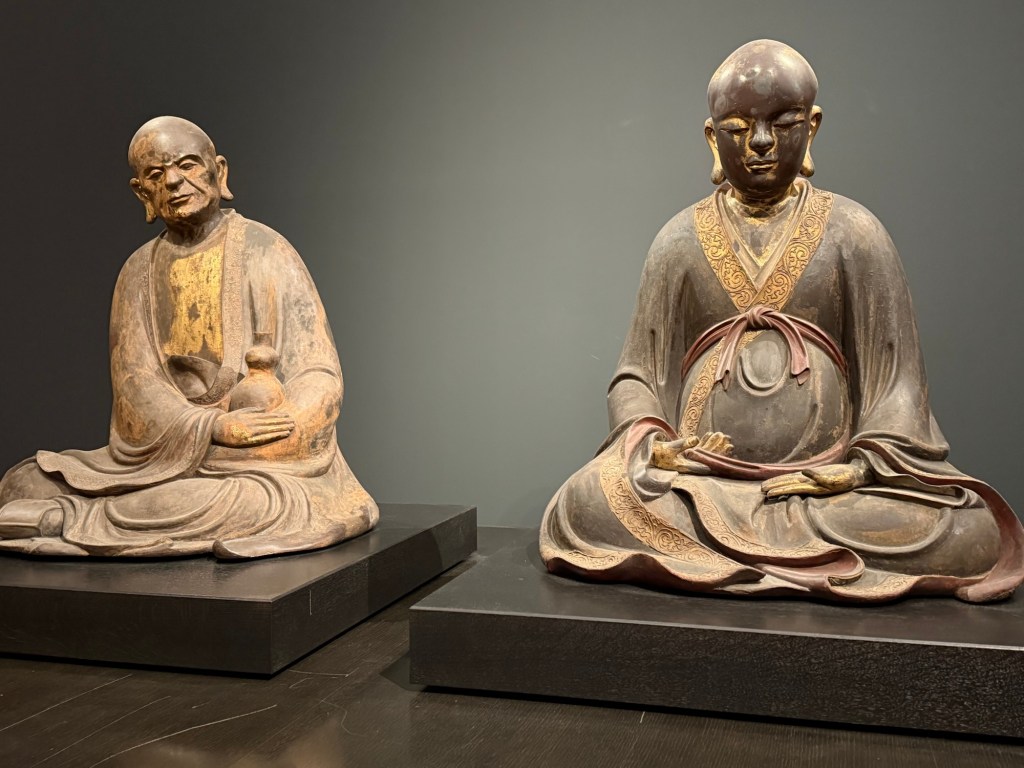
Seated Arhats, sacred beings entrusted with protecting and disseminating the Buddha’s teachings.
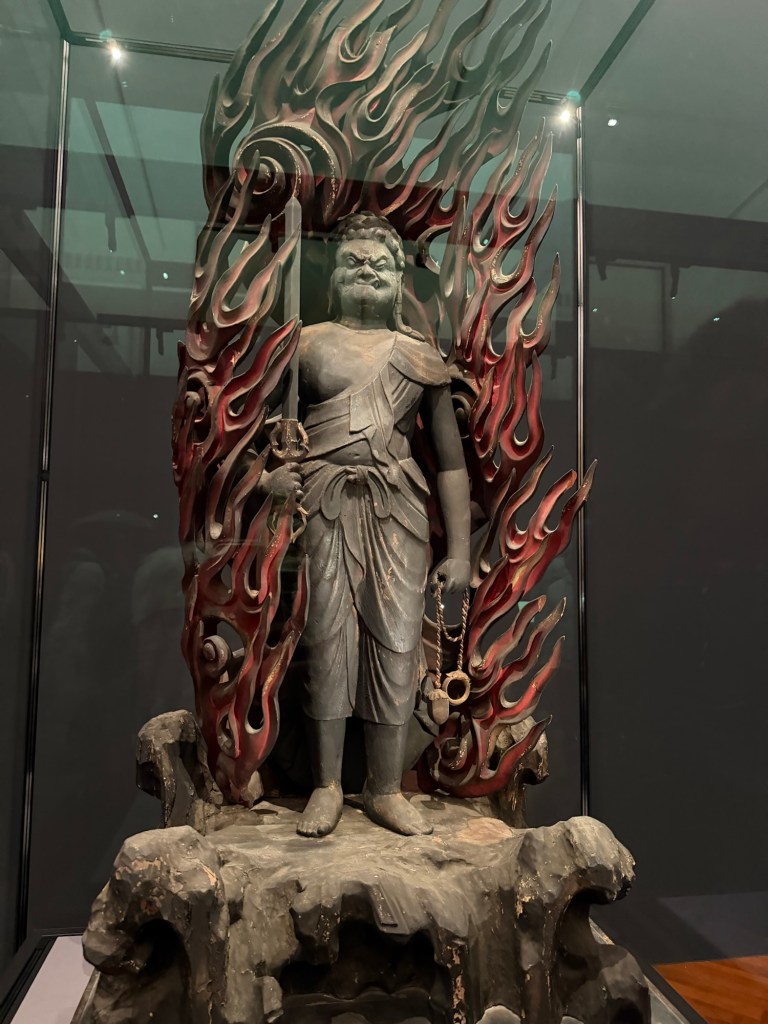
Wisdom King Fido, one of the oldest statues in the collection at 800 years. He is the avatar of the Cosmic Buddha. He repels enemies of Bhuddhism, cuts delusion with his sword, and pulls living beings toward salvation with his lasso. An all around good guy

We had free time to wander about the area outside the musuem and enjoyed another Starbucks coffee before heading to our next activity, the East Gardens of the Imperial Palace.

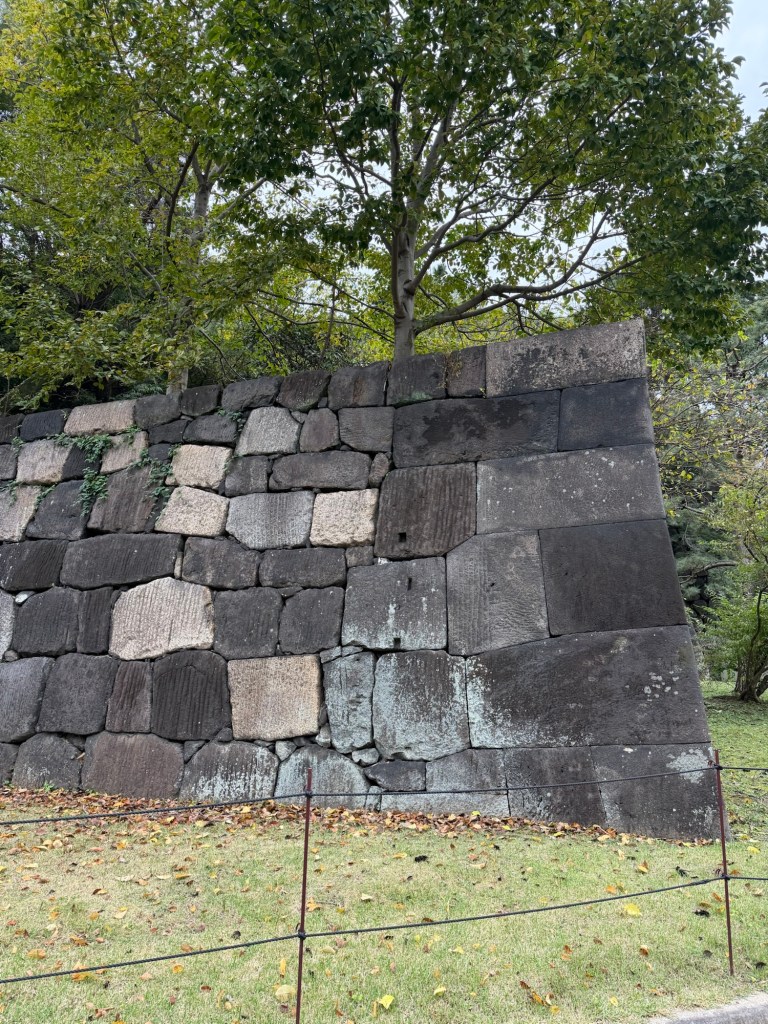
The Imperial Palace is surrounded by moats and huge stone ramparts. It houses the Imperial Family, which right now includes only three people, the Emperor, Empress and their daughter. The huge complex is called the Koko and dates back to the 15th century when territorial disputes required massive fortifications and societal norms demanded elaborate palaces to reflect the high positions of the feudal lords. The East Gardens are the only part of the Imperial Palace grounds open to the public. They were part of the innermost circle of defense of the historic Edo Castle that once stood there.

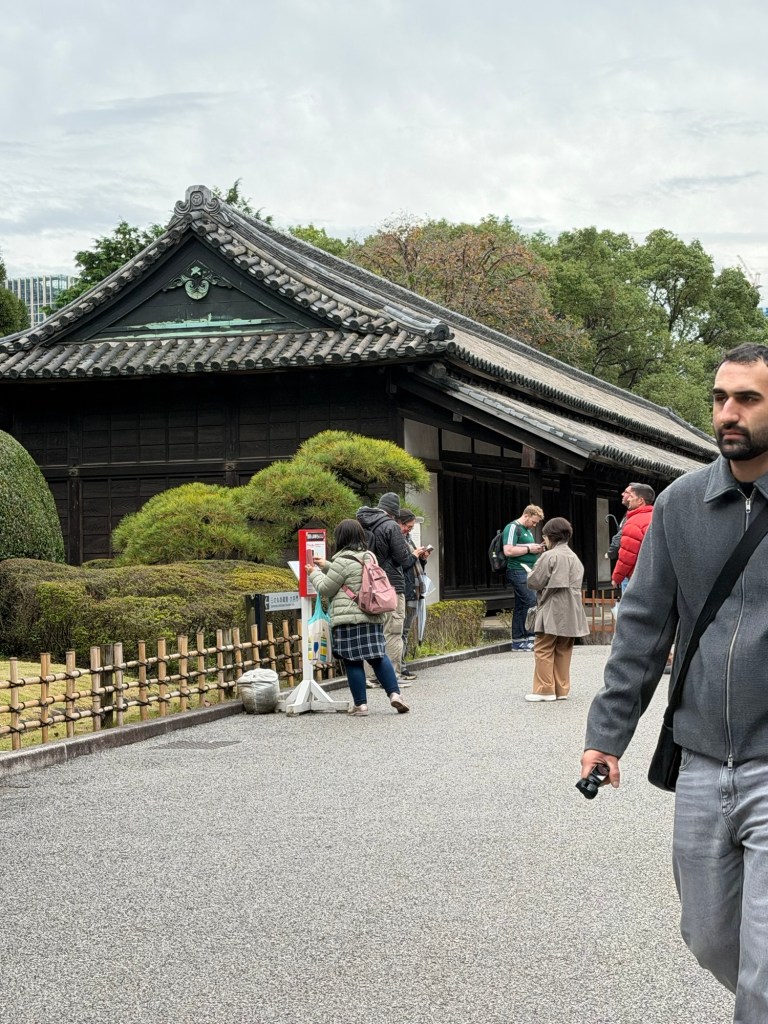
Original guardhouse
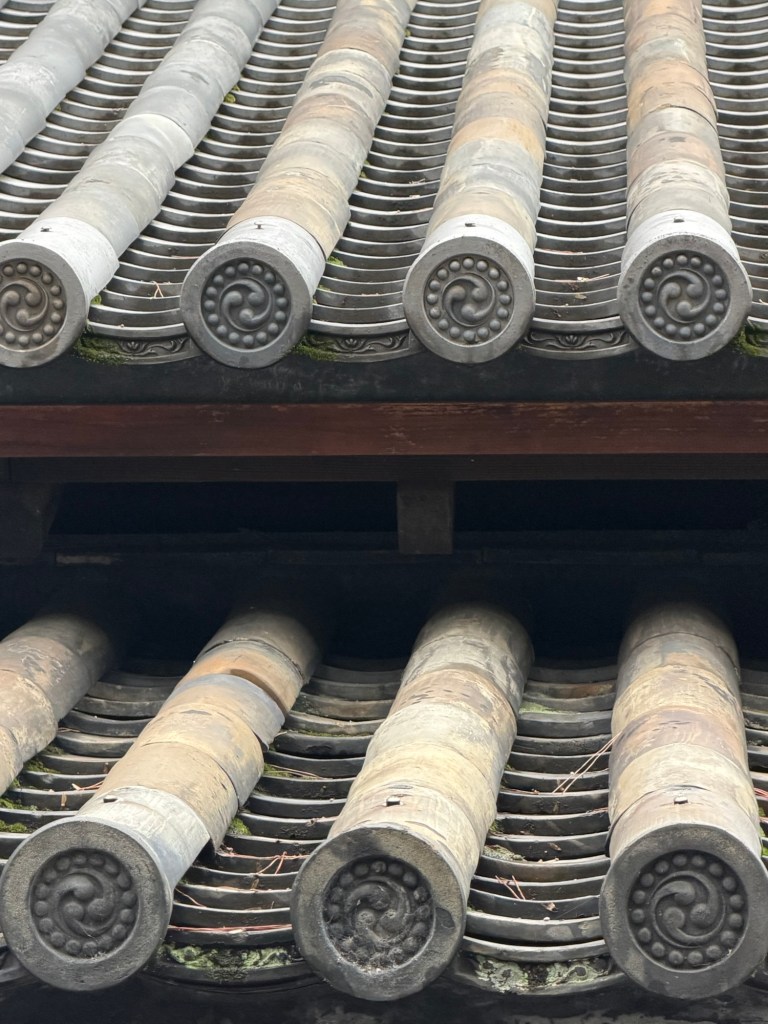
The roof tiles show a 3 commas of the mitsudomoe crest that dates back to the end of the Heian Period (794-1185) and was used to ward off fire since it represents water.

We then headed back to the hotel where we had an enjoyable dinner with friends at Andy’s Shin Hinamoto. None of us were very good at using Google Maps, but with the help of a kind stranger, we found the place. Interestingly enough both of us had the same restaurant recommended to us. After dinner we were all quite happy to head back and go to bed. The next morning would be an early one.

Today We See Mt. Fuji

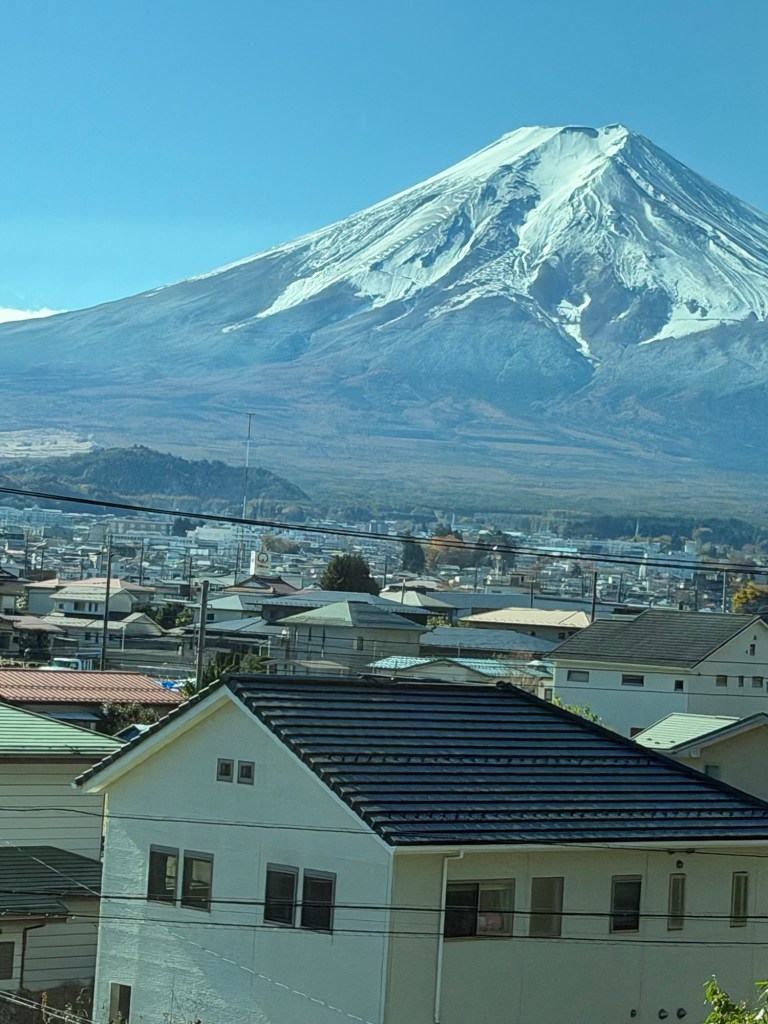
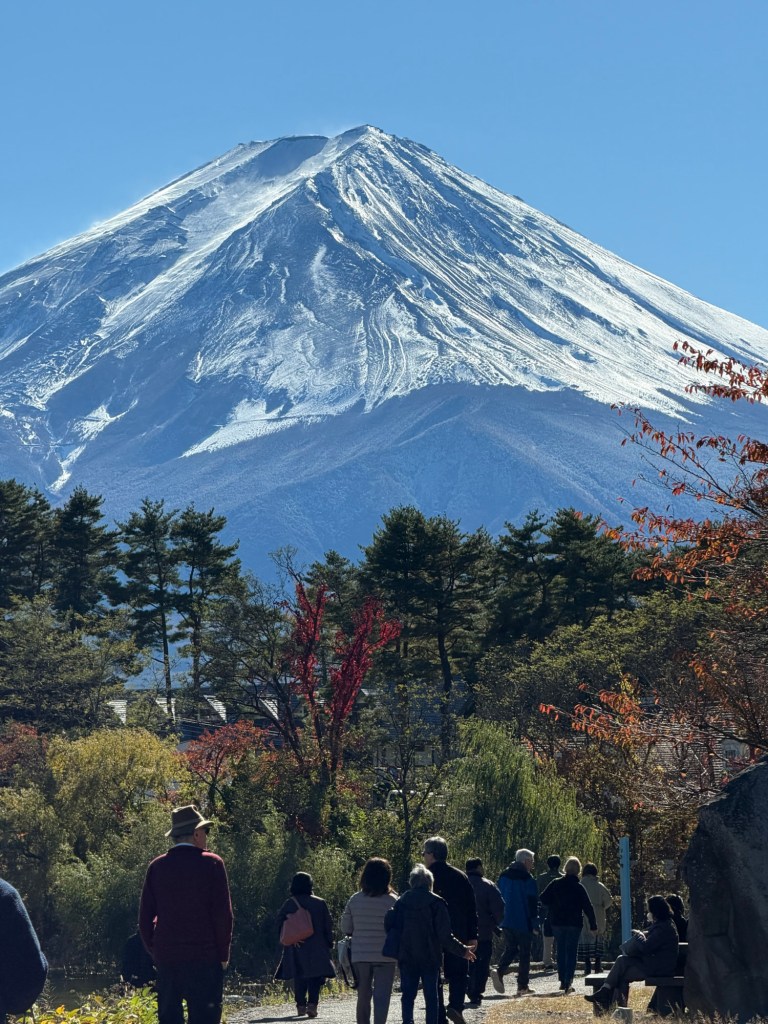
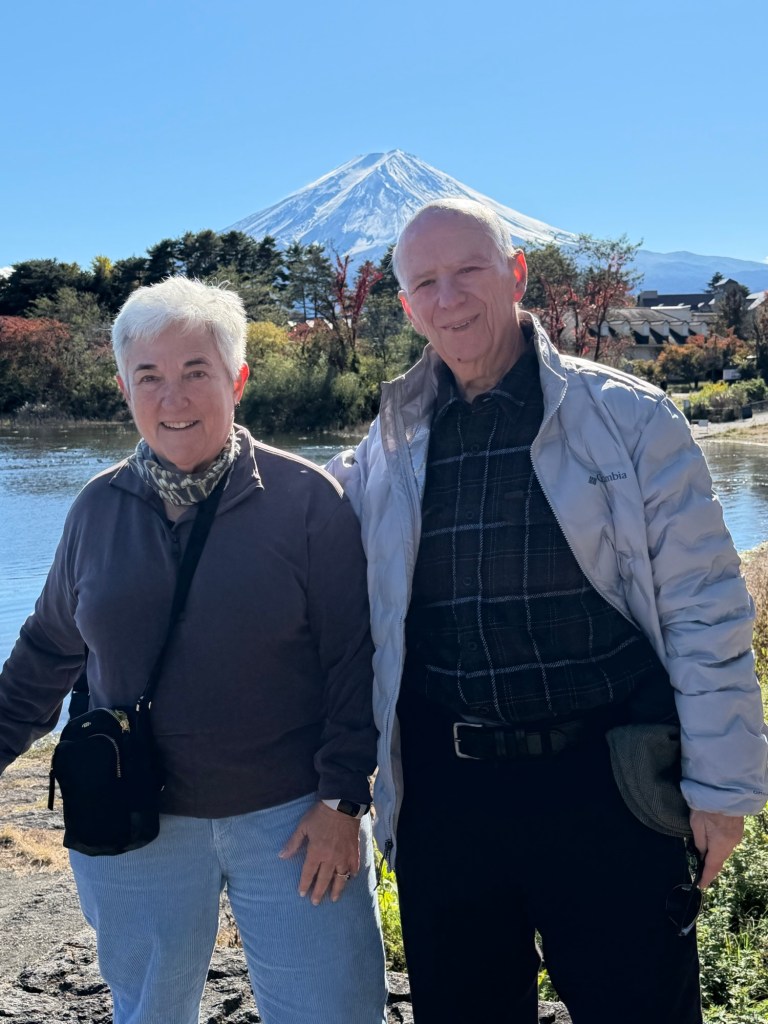
It is a glorious day today. The sun is shining and it is not nearly as cold. We got an early start and are headed toward Fuji-Hakone-Izu National Park via bus. We had been told that Mt. Fuji can be quite elusive, but not for us. The mountain is almost perfectly symmetrical and stands at 12,388 feet high. It is a dormant volcano that last erupted in 1707. The ash was said to reach all the way to Tokyo.

Glimpses of Mt. Fuji were possible as soon as the bus made its way out of Tokyo. We made a quick stop at one of Japan’s highway rest areas. It was an impressive place that offered an incredible variety of things. Nothing in the U.S. compares. Masako said that families often take a drive just so they can visit the rest area.

We reached the Mt. Fuji World Heritage Center where we watched a short video about the mountain. There was also a viewing platform, but oddly enough it didn’t provide a good view of the mountain. However, now that we are higher in the mountains we are seeing more signs of Fall, especially the Japanese maple trees, which have turned bright red.

Our tour is more arts-oriented than we had realized, but this is not a bad thing. After leaving the Park, we visited the Itchiku Kubota Art Museum. It is located on Lake Kawaguchi, one of five lakes surrounding Mt. Fuji. Kubota, who died in 2003, is famed for reviving a long-lost style of Japanese textile dye technique known as tsjuigahana. The museum is in the artist’s home and showcases a collection of hand-dyed Mt. Fuji themed kimonos. These are not your typical kimonos. The “Symphony of Light” depicks Mt. Fuji across seasons where multiple huge kimonos sit side by side and act as a massive canvas. The details, colors, and textures are impossible to properly describe, but are incredibly beautiful. Nothing stands between you and the kimonos. Unfortunately you can’t photograph his works.

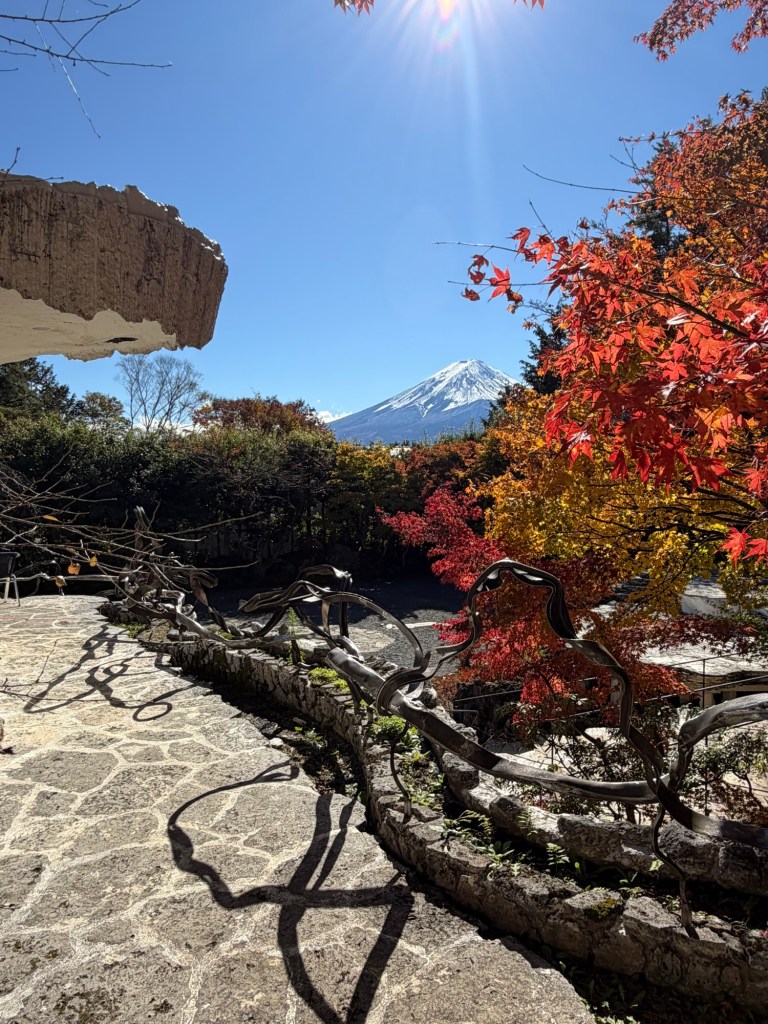
Kubuta’s home and grounds are worth seeing on their own. The structure of his home was supported by 1,000-year-old timber beams and integrated traditional Japanese woodwork with “Gaudi like flair.” Okinawa Tyukyu limestone was also used. The grounds are zen-like with waterfalls and beautiful red-pine and red maple trees. In addition, there were better views of Mt. Fuji here than in the park.
Because it was such a beautiful day, Masako added an additional stop on Lake Kawaguchi. Here we took additional photos of Mt. Fuji before stopping at a what is considered a mall area to buy lunch. A group of us headed to the local burger joint, Mo’s. Not the best fast food we’ve ever eaten, but quick. The best thing there was what was on television —a major suma wrestling competition.
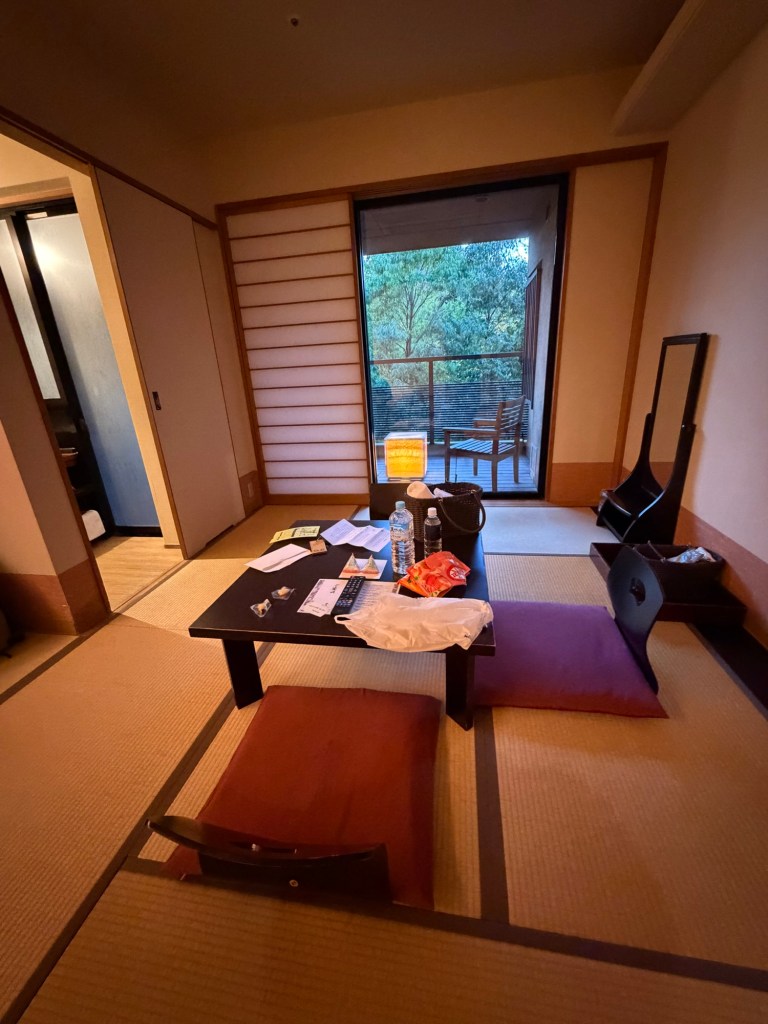
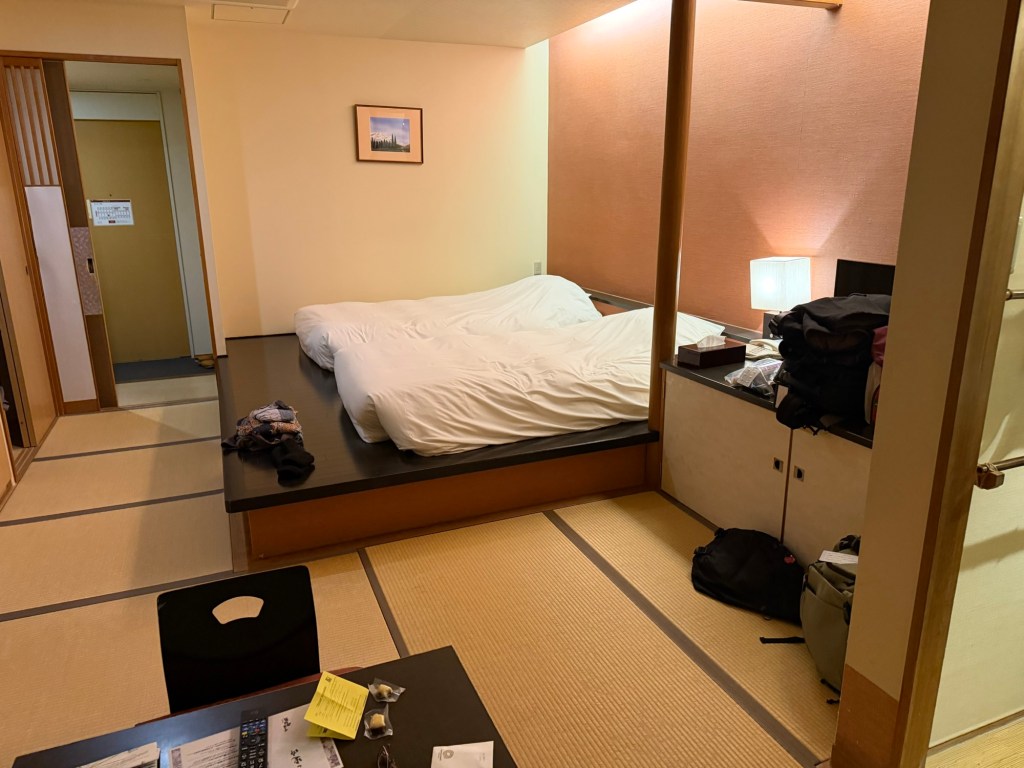
At long last we reached Hakone and our traditional ryokan lodgings for the night. When you entered your room you removed your shoes before stepping on the tatami-matted floors. The bedding was on a low platform, and the only seating was around a low table and was essentially a cushion on the floor with a seat back. We also had a wooden bathtub outside on our balcony had we wanted to use it.
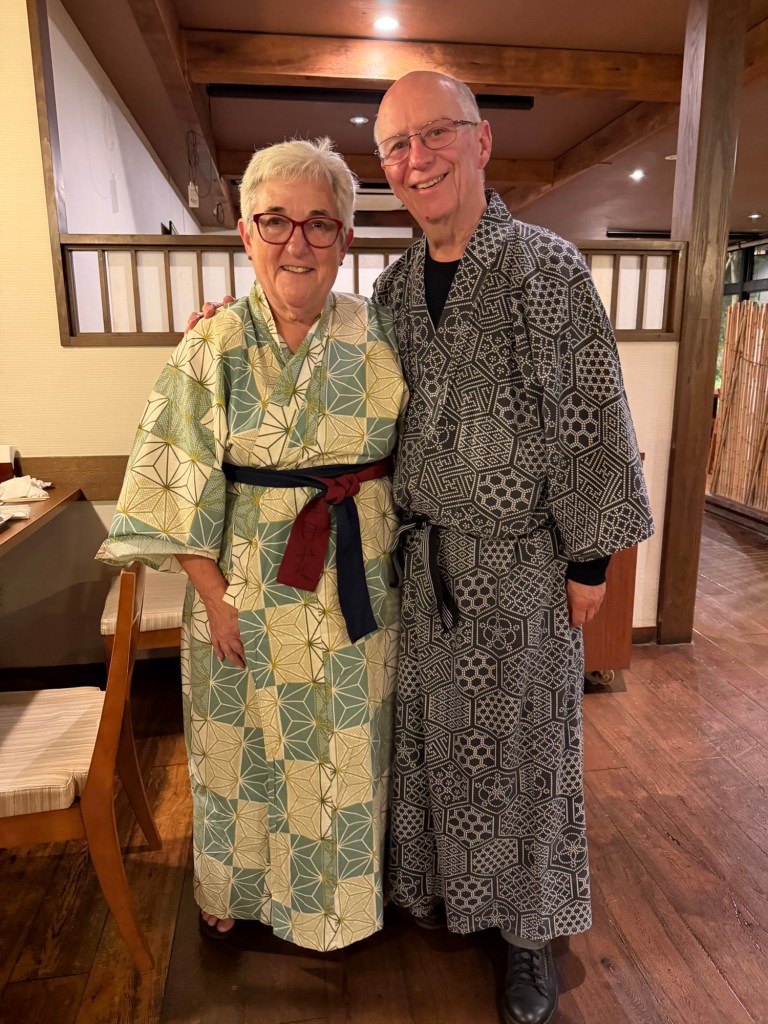
Playing dress-up. We wore our kimonos all evening including through dinner.

What was fun was that when we first checked in Dan and I got to pick out a kimono (a Yukiana robe made of lightweight cotton) that we would wear during our stay. It was hard to decide which one to select because they were all so colorful. Finding the correct size was easy. One size fit all and you would select your kimono based on your height. Dan and I both look adorable in our new clothing.

Our ryokan offered natural hot spring baths, both indoor and outdoor—men’s and women’s of course. There is a strict etiquette code in using these baths with the first rule being you go in naked. That was the hardest rule to overcome. Dan had no problem, but I was extremely happy that hardly anyone was at the bath when I showed up. I tried both inside and out. It was really was relaxing and my skin felt very smooth afterwards.

The entire group met for a Kaiseki dinner. Dinner consisted of multiple courses that highlighted seasonal and regional ingredients. Dan and I found the dinner to be overly soup oriented. The sashimi was good, but we found ourselves craving something that didn’t taste like fish, like a piece of chicken. Even the desserts are odd by our standards. There was something that looked like a small ball of ice cream without much flavor and a jello like substance with fruit. There is a reason the Japanese aren’t obese like us Americans. None-the-less, dinner was enjoyable.

First Day of Our Tour

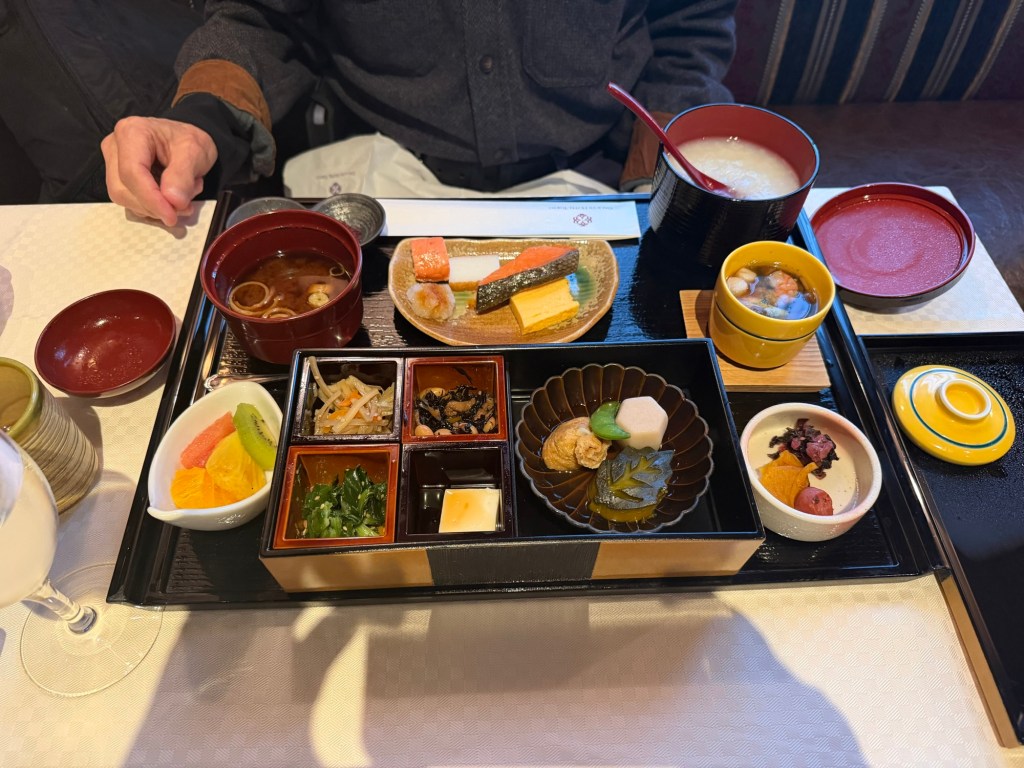
Today was the first day on our trip that we actually ordered breakfast. Dan and I figured that we should try a Japanese breakfast. Breakfast arrived in an assorted number of covered cups, plates, and a bento box. We could identify a few of the items, but to a large degree we had no idea of what we were eating. Breakfast included fruit, yogurt, rice porridge, assorted salads and small pieces of fish. To be honest it was an interesting experience, and we definitely had enough to eat, but once was enough

Japanese Breakfast

.

At 8:30 AM we went downstairs to meet our group by the Christmas Tree in the lobby. The hotel, and businesses all over Tokyo, were already decorating for Christmas. You wouldn’t know that only about 2% of the Japanese population was Christian. According to Masako, the Japanese people enjoy the beauty of the holiday, but have no religious sentiments about it. The fact is that most Japanese practice a combination of Shinto and Buddhism.

Weather-wise, we had been lucky to have blue skies and comfortable temperatures. Not today. It is raining with the temperature in the 40s. We were happy to have our rain jackets and puff jackets.

Shinto is the indigenous religion of Japan centers on sacred spirits of the natural world. It sounds very similar to the beliefs of Native Americans. These spirits are called Kami and they are all around us. The religion has no scripture or rigid moral code, but is deeply ingrained in the Japanese people’s way of life and cultural tradition. Buddhism, on the other hand, was introduced to Japan in the mid-6th century by the Koreans. Buddhism focuses on personal spiritual development and rebirth. The people of Japan embrace both, which is why you may often find a Shinto Shrine that celebrates life events like weddings and the blessing of young children for long fruitful lives, and Buddhist temples where funerals are held.

Our tour group is a very nice group of 24 people that are from all over the U.S. I would say the majority are older, but there is a family group that includes two young women. I get the sense that all of us will get along just fine. Dan and I are already getting friendly with a couple from Minneapolis.

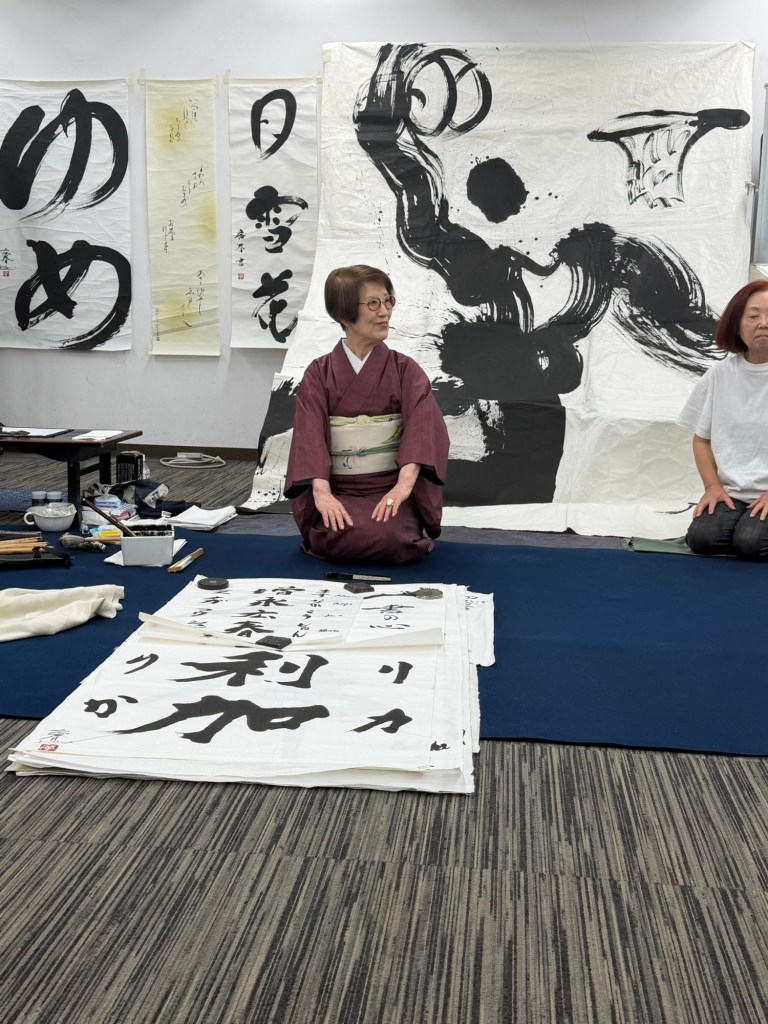
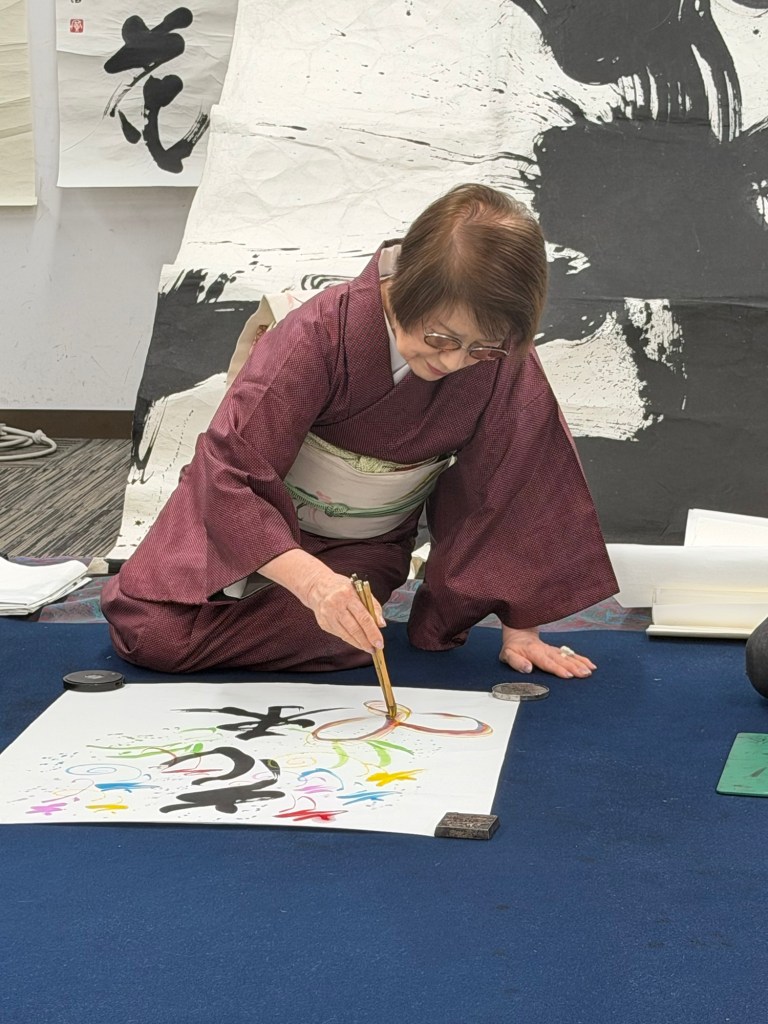
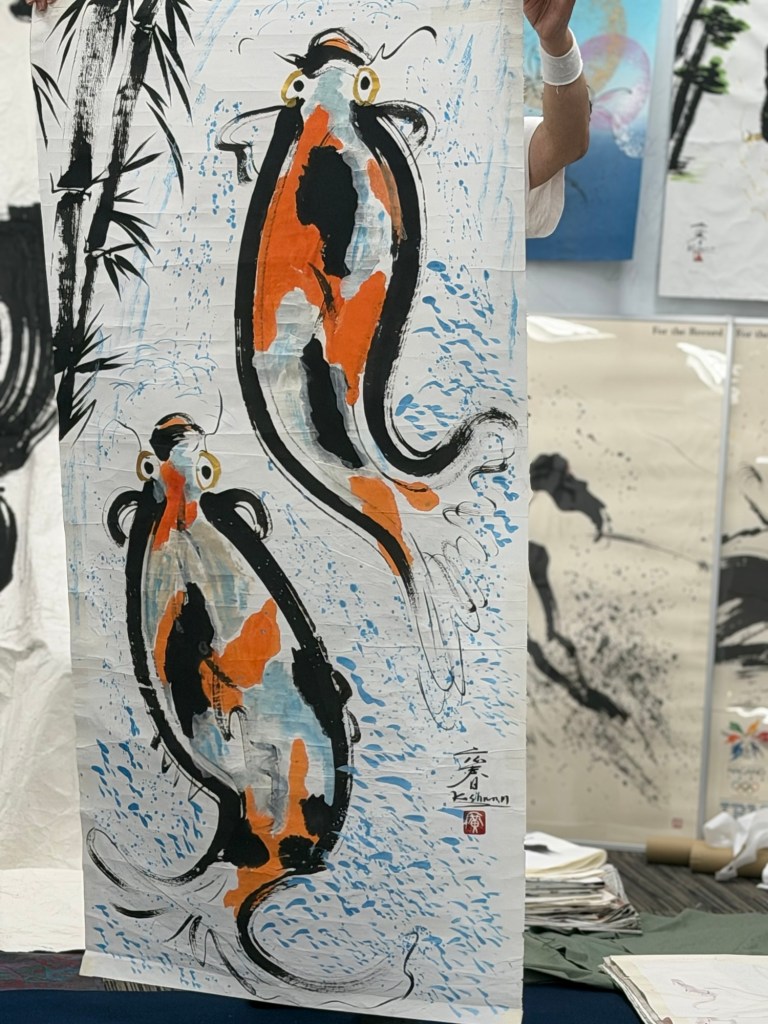
The very first activity was truly an enlightening experience. We went to visit the workshop of a reknown calligraphy artist, Koshen Masunaga. She explained (in Japanese) with Masako interpreting. We learned about how she developed her craft combining ancient calligraphy skills with her modern approach. Masunaga essentially developed her own calligraphy language that she calls Souboku, which “fuses together traditional and modern simple calligraphy bringing the letters to life.” We watched as she created artwork right before our eyes. Each of us received artwork based on our names that we are taking home with us.

It is nice in that our tour gives us free time to wander on our own. Today we were dropped off at Ginza Six, one of Tokyo’s most upscale department stores. Each brand has its own boutique. We didn’t stay there too long and instead headed to a well known stationary store called Ginza Itoya. The main store has 12 floors with the most notable being the 3rd where fountain pens are sold, and the 7th that is dedicated to fine papers. It was amazing and incredibly crowded. We made our way through several floors, but ran out of time.

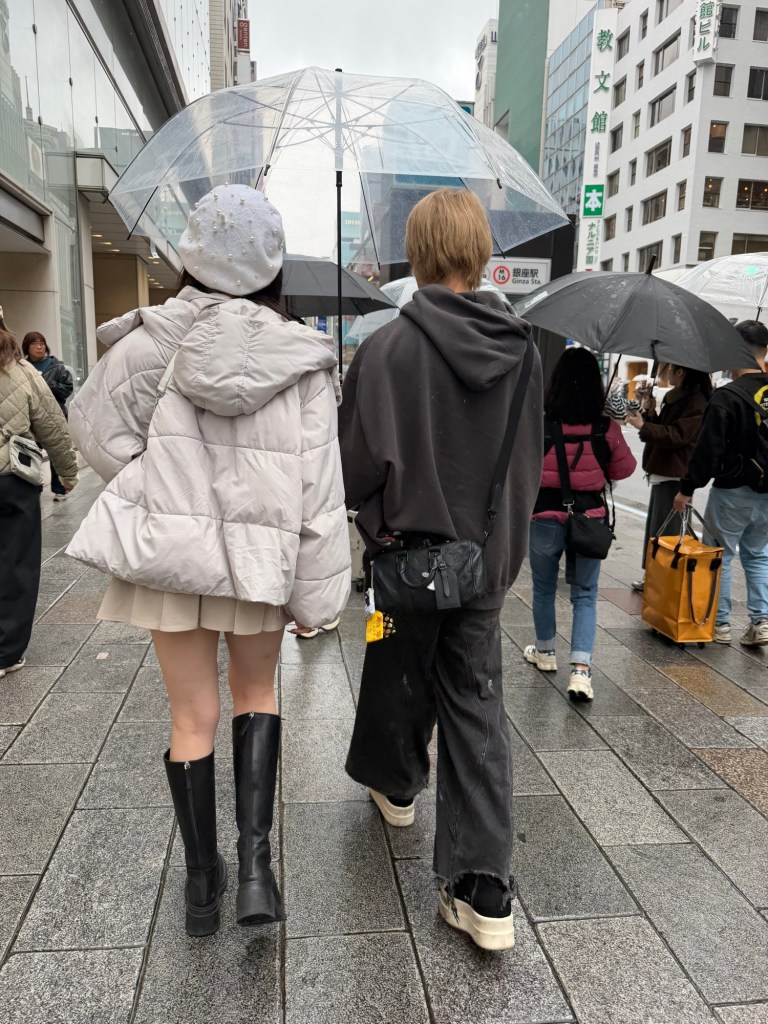
Young urban couple.

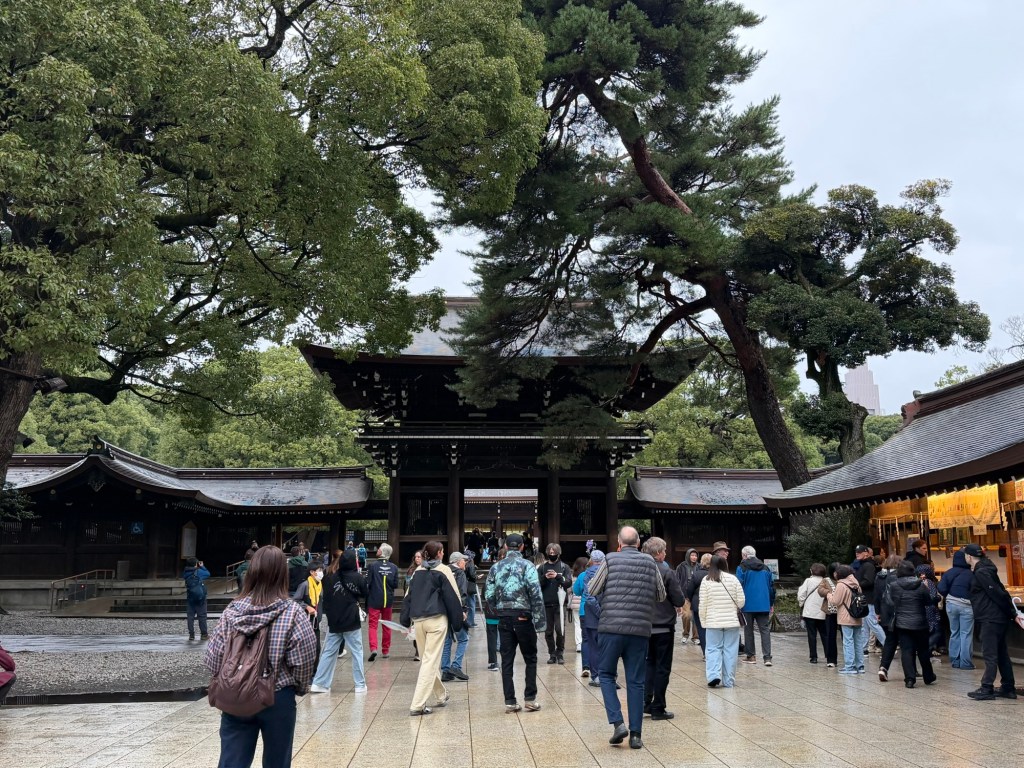
The Meiji Shinto shrine, completed in 1920, is the largest and most famous in Tokyo. The area consists of a peaceful enclave of temples and gardens dedicated to the late 19th century Emperor Meiji and his wife, the Empress Shoken. They are revered because they served “as the fundamental symbols and architects of Japan’s transformation from an isolated feudal state into a modern global power.”

Along with the shrine’s construction, roughly 100,000 trees from all over Japan were planted. Today is has turned into a massive man-made forest.

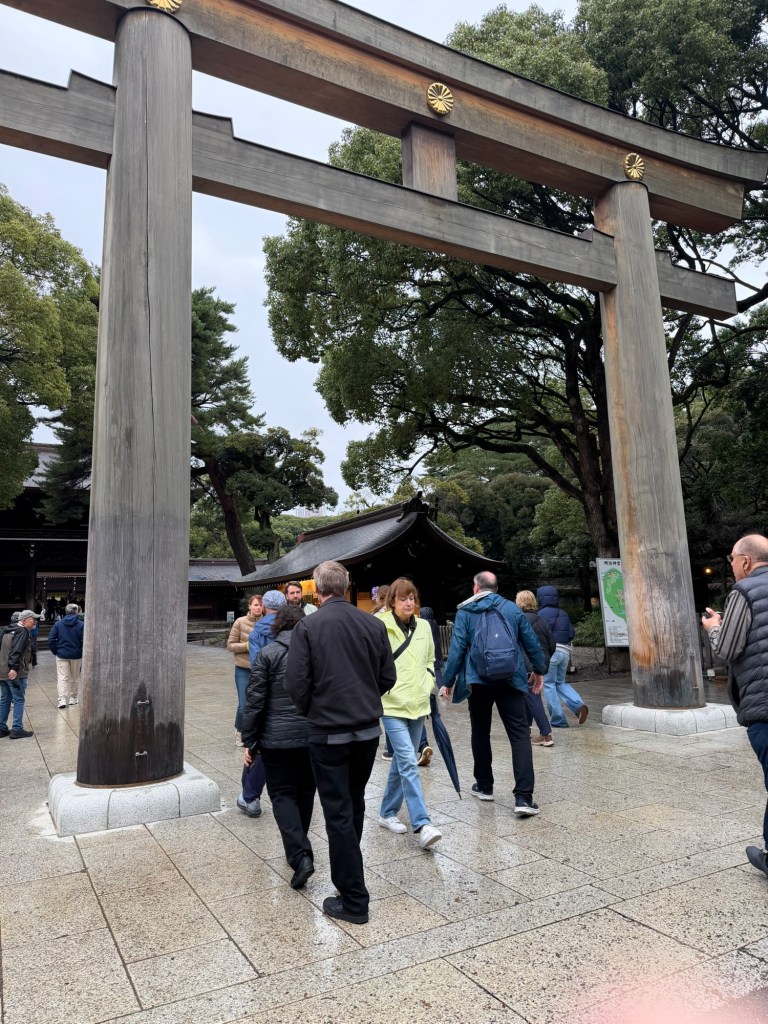
At the entrance to the shrine is a huge wooden Torii gate that signifies the boundary between the everyday world and sacred grounds. One should never walk in the middle of a Torii gate. That space is set aside for the spirits. You must also bow before entering. Marika also showed us how to wash our hands, and clean our mouths before entering the shrine. We were instructed on how to bow, clap twice to wake up the spirits, pray and then bow again. She pointed out a hug gong that is used during ceremonies. Unfortunately, no photos were allowed inside.

Tori Gate
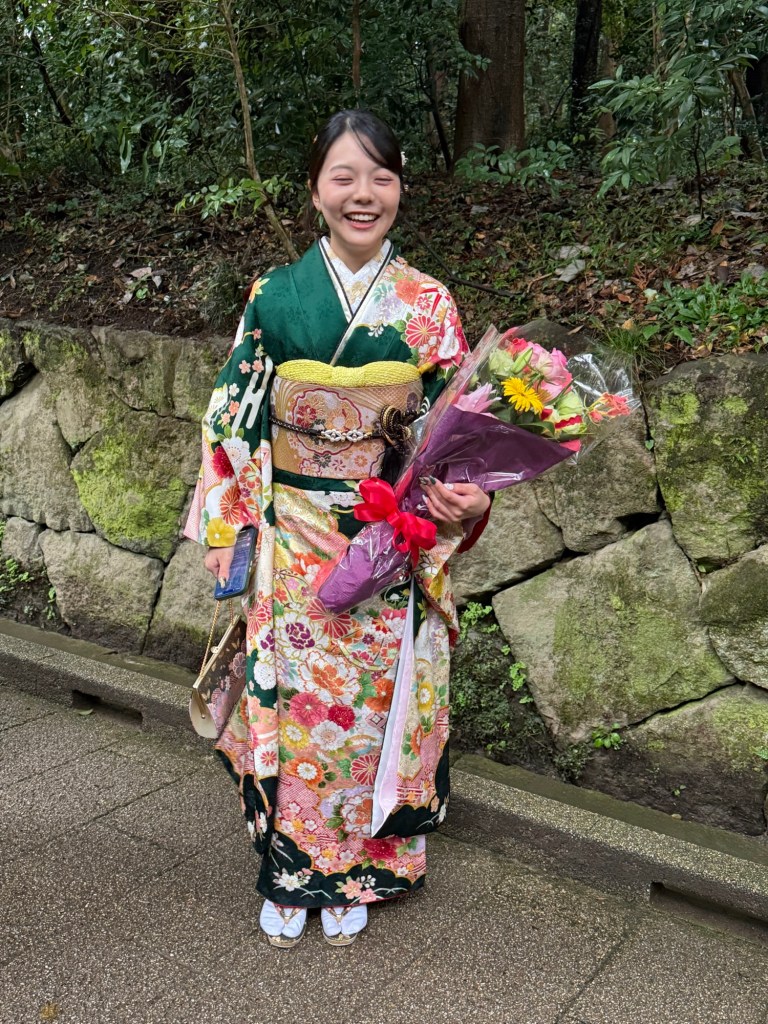
Celebration of a young women’s 20th birthday celebration.

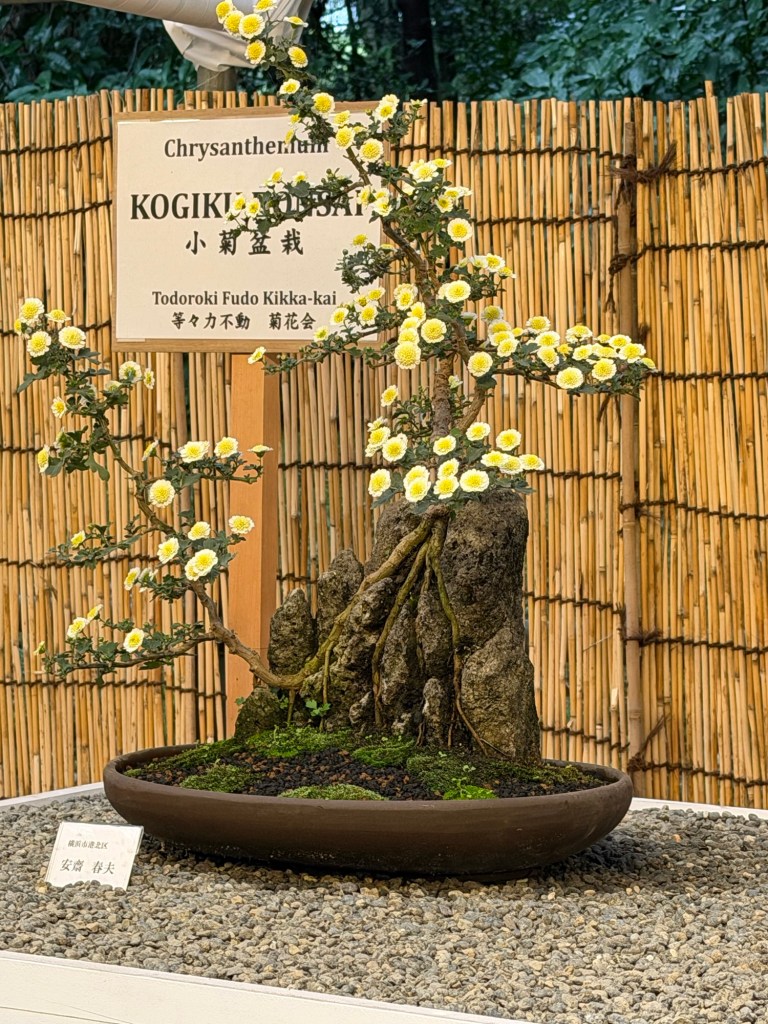
Chrysanthemums. There was a competition and some of the flowers were amazing

We were able to relax a little before the final event of the evening, our seven course welcome dinner. Each course was a traditional Japanese food. Much of which were fish. Over the past few days I feel as if I have eaten more fish than I’ve eaten in my entire life. Some of it delicious and others, not so much. Dinner was really quite good and took over 2 hours. It gave us the opportunity to get to know a few of our traveling companions a little better.

One of our many courses

Tokyo — a day with no agenda

Today we checked out of Tokyo Stay Ginza and took a taxi to our new residence, the Dai-ichi Hotel. It is also located in Ginza, but in a different neighborhood. This is where we will connect with our Odyssey tour group. Check-in wasn’t until 3:00 PM, so we left our luggage and headed out for the day.

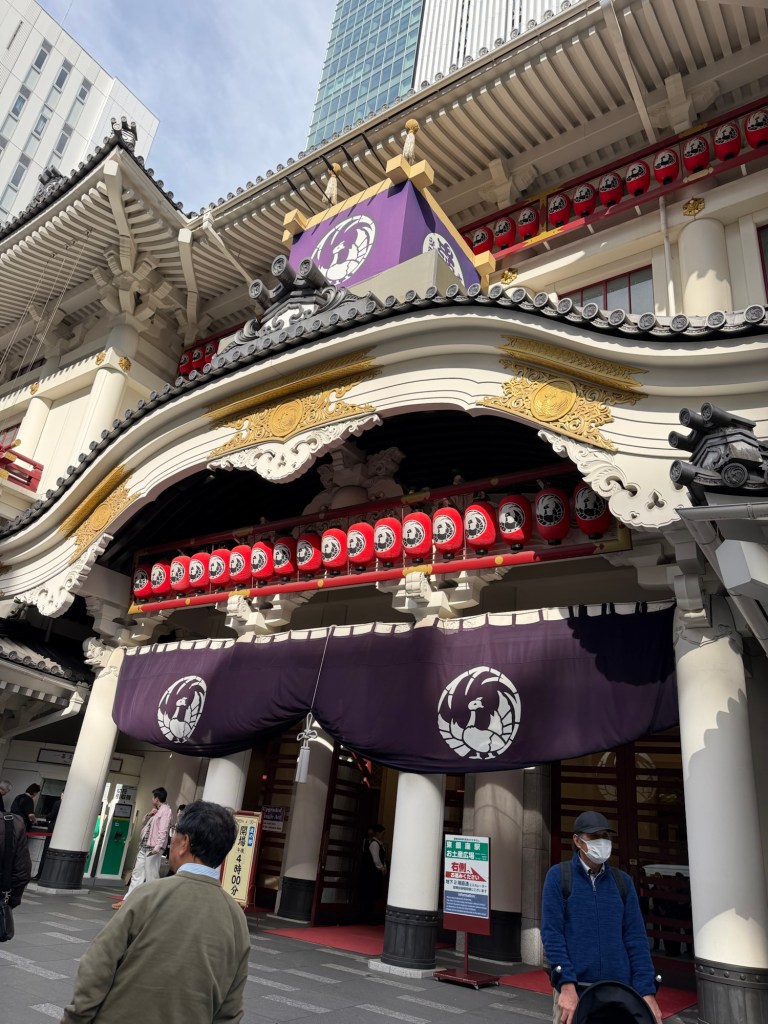
Not far from our old hotel, we had walked by a very large traditional-styled Japanese building, the Kabukiza Theater. The building was built in 1889 in which, Kabuki which is one of Japan’s great performing arts, is performed. Kabuki has a 400 year old of history. It was originally a style of dance developed in Kyoto in 1603.

The plays can last hours long, but the theater offered the option to see 1 or 2 scenes rather than the entire play. We decided to attend one of those abbreviated shows. While we enjoyed it due to its uniqueness, 2 scenes of it was more than adequate. For an extra fee we had a gadget that translated the actors’ words in real time. There is barely any movement on the stage. The actors used guttural speaking voices. Women cannot perform, so the men play women’s parts. There was an interesting setting change with the use of a revolving stage. The costumes were beautiful, but were extremely difficult to walk in since the fabric covered the actors feet. Many of the actors’ faces were covered in white, although being up in the balcony we were too far away to see them clearly. The audience clapped throughout the play and we couldn’t figure out why. Occasionally people in the audience would shout to the actors, but we have no idea why they did that either. The theater was almost full which was nice to see. Overall it was a worthwhile experience.

I had wanted to see what one of Japan’s major department stores was like. I had heard that they had amazing food courts. After the play Dan and I headed to Mitzukoshi. The store was filled with exclusive brands and was totally out of our price range. In the children’s department they were selling shirts for kids priced at over $300 US. However, the food court was quite amazing filled with prepared foods, specialty pastries, a gourmet grocery store, and a wide assortment of designer desserts. We selected a few items for lunch, but had to take our food up to the 13th floor in order to sit down and eat it. Actually we didn’t even get to sit down, as seating was limited. We were able to stand at a counter to eat. Not the most convenient or comfortable way in which to enjoy one’s lunch.

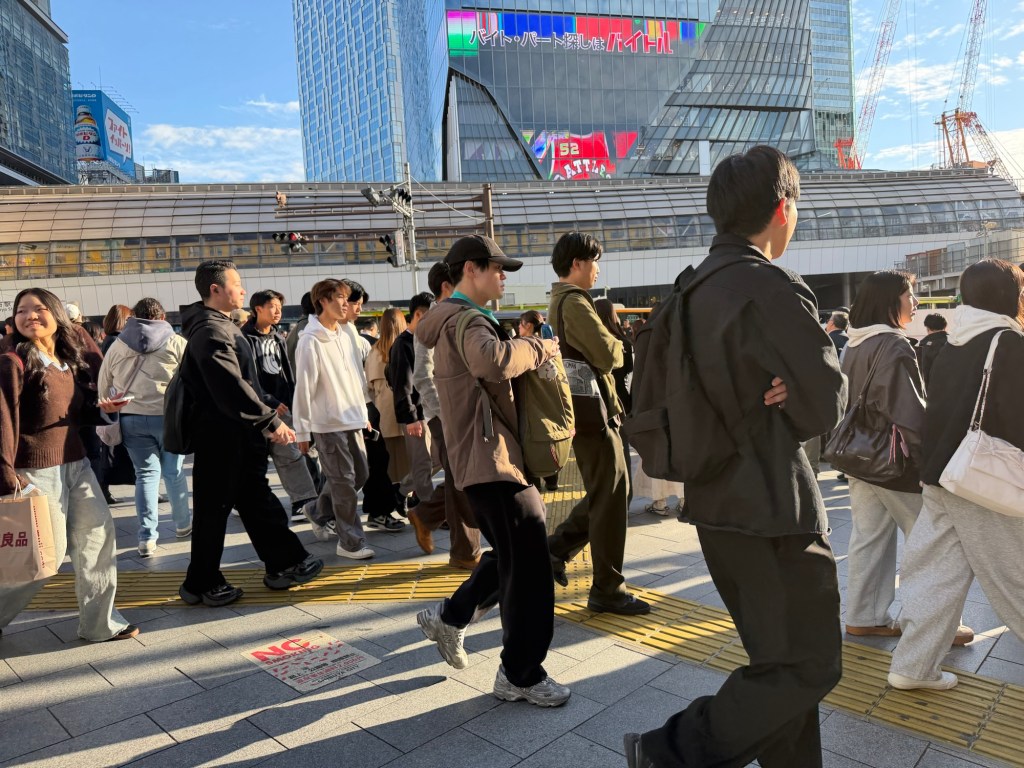
I had read about the Shibuya Scamble crossing and that’s where we headed to next via subway. It is famous for being the world’s busiest crossing where up to 3,000 people cross from all directions during a single green light. All vehicle traffic stops at the same time, allowing pedestrians to “flood” across the intersection in all directions. Even on a Sunday it was an amazing sight. It would have been better to go at night given all of the huge neon signs on many of the buildings, but it was still pretty impressive.

We spent time just walking around the neighborhood. For the first time we came across an I’m Donut shop. The donuts were recommended by several of the people that provided us with info regarding our trip. There was a short line, and we picked up a 1/2 dozen donuts to enjoy later.

After successfully taking the subway and finding the way back to our hotel, we were able to check in. This time we were taken to a desk where we met our tour director Masako, along with several other people on our tour. The tour officially begins tomorrow after breakfast.

Our hotel room is much roomier and fancier than our last. Before it got too late we headed out and found a street filled with restaurants located near by. I don’t remember if I already mentioned this, but Tokyo has the largest number of restaurants in the world. They are everywhere. Some independent databases estimate that there are up to 160,000 culinary establishments including unclassified small street bars and cafes. Even if you only count registered establishments there are 67,185 compared to 27,000 in New York and 44,000 in Paris. Picking a place to eat is problematic because there are so many places to select from. Tonight we happened to pick an excellent sushi place filled with locals. The woman next to us helped us navigate the electronic menu that had teeny, tiny type in English. We were successful and enjoyed a meal of fresh sushi. Then it was back to our hotel where we finished the last of our doughnuts for dessert and I settled in to try to catch up on my blog writing.

Kabukiza Theater
Not the best photo of Shibuya Crossing.

Food and more Food, plus Team Lab Planets

We seem to have turned over a new leaf in terms of waking up in the morning. For the second day in a row we have voluntarily begun our day at about 8:00 AM. We had to be at Ueno Train Station by 10:40 AM for our Food Tour. Not knowing how long it would take to get there, given it was rush hour, we left early arriving more than an hour early. By the way we have yet to experience a rush hour or traffic jam in this city.

The train station was filled with restaurants and shops, along with a Starbucks. We were able to crash there for a while and enjoy our drinks. The barista sprinkled chocolate on the top of my mocha, which was a nice touch. I also discovered that pre-paid Starbucks money doesn’t work in Japan?

When we headed out to find our tour we saw a couple across the way and immediately pegged them as fellow tour goers. We were correct, and it turned out that we would be a group of four. Our guide was a lovely young woman named Yukina, and the couple were Ari and Brandon from St. Paul, MN.

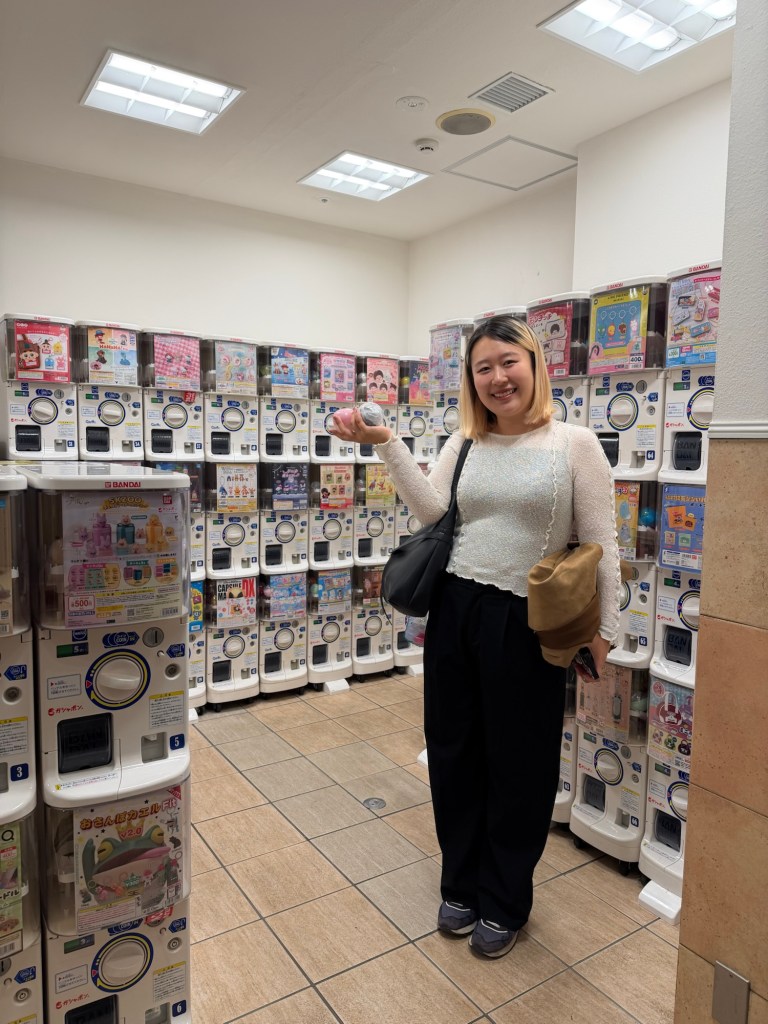
The food tour took place in the Ueno neighborhood near the train station, one of Tokyo’s largest parks, Ueno Park, and a market area called Ame Yayoko Cho. Sushi was to be our first stop, but we had to kill a little time until they opened at 11:00 AM. Yukina took that extra time to introduce me to the world of Gotcha, Gotcha. For a mere 400 or 500 yen ($3.00) you can be a proud owner of a toy packed within a plastic ball. I purchased 3 of them for my grandkids. Apparently adults in Japan have become collectors of these toys and can be quite competitive in collecting new ones that continuously are being released.

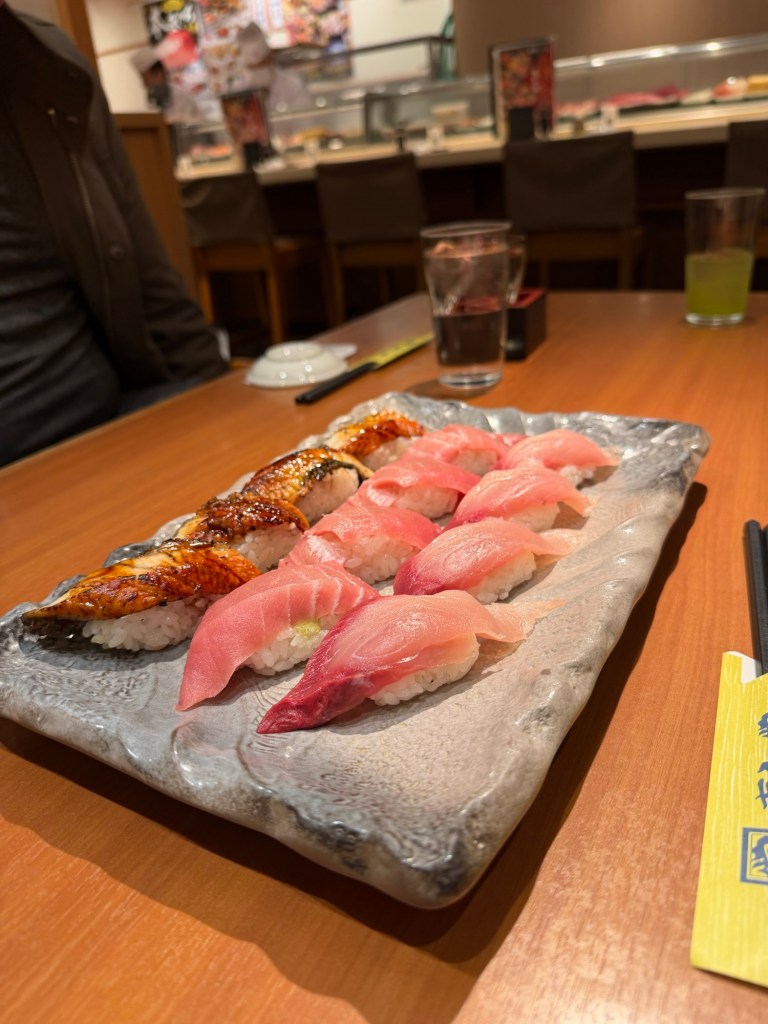
Back at the sushi restaurant, Yukina ordered flounder, yellowtail, medium fatty tuna, and cooked eel. Yukina said that it was the best sushi place in the area. I’d share the name of the restaurant, but all the signage was in Japanese. This has been a problem everywhere we have dined. It’s hard to share where you’ve been if you can’t find their name in English.

All of the fish were delicious, but Dan and I enjoyed the middle-grade fatty tuna the best. It had a creamy texture without any fishy smell or flavor. We learned that there are three grades of tuna sushi with the middle grade of fat being the most popular. Some favor the fattiest cut, which is almost entirely fat. The flounder was also very good, but the cooked eel was a little too strong a flavor for me.

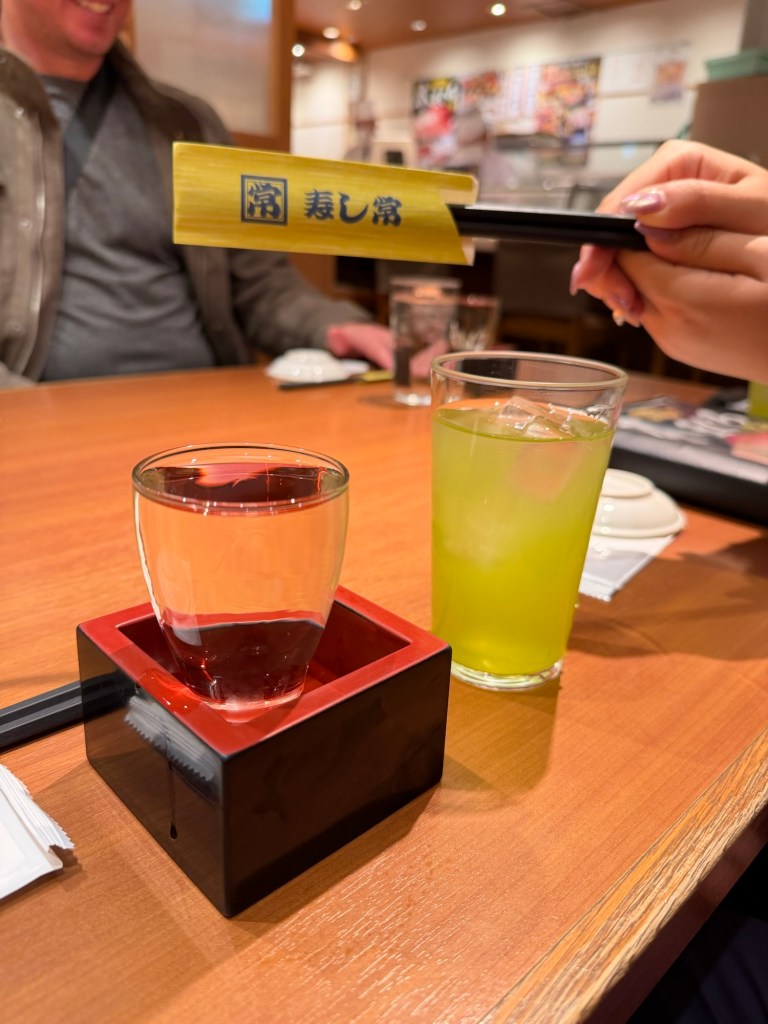
Despite the fact that it was not even noon, we were served some local dry saki. When saki is served it is poured into a small glass until it overflows. The overflow goes into a small box in which the saki glass is placed. As you drink you simply pour the overflow into your glass. The saki was very mild in flavor, but I didn’t need more than a few sips to know I had better set it aside. I wanted to enjoy the day.

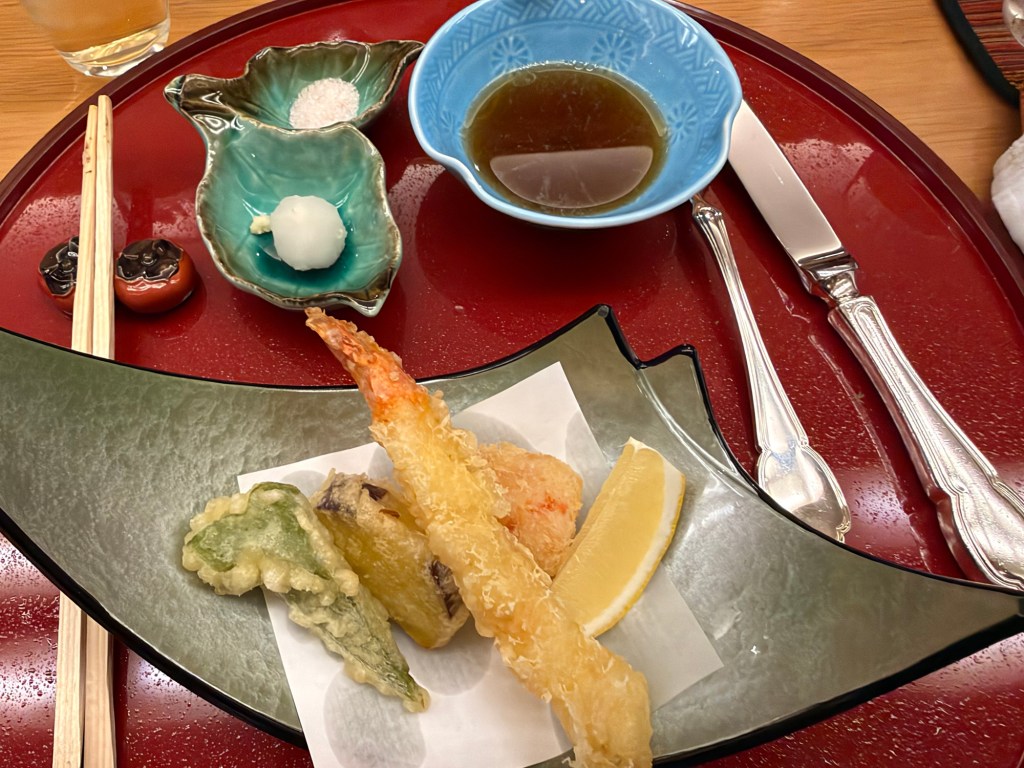
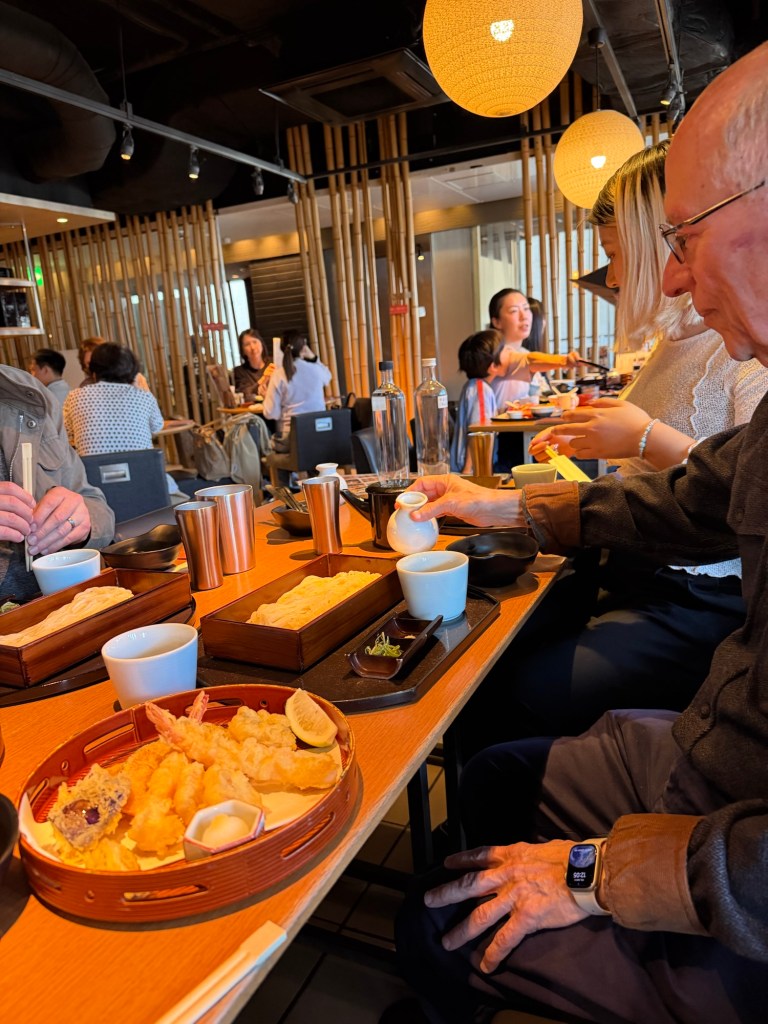
Our second stop was at a lovely restaurant where we sampled several tempura items: shrimp, pumpkin, white fish, eggplant and sweet potato. We were also served soba noodles and dipping sauce. I turned down the plum wine option, but Dan and I both enjoyed our non-alcoholic green tea.

Just behind the train station is Tokyo’s “premier cultural, historical, and natural oasis,” Ueno Park. In contains major national museums, a zoo, ancient temples, and over 8,000 trees. Sadly one thing is now missing from their zoo, their giant pandas. China recently reclaimed their loan of giant pandas due to politics. A similar thing had happened in the U.S., however, China recently sent two new giant pandas to the Atlanta zoo.

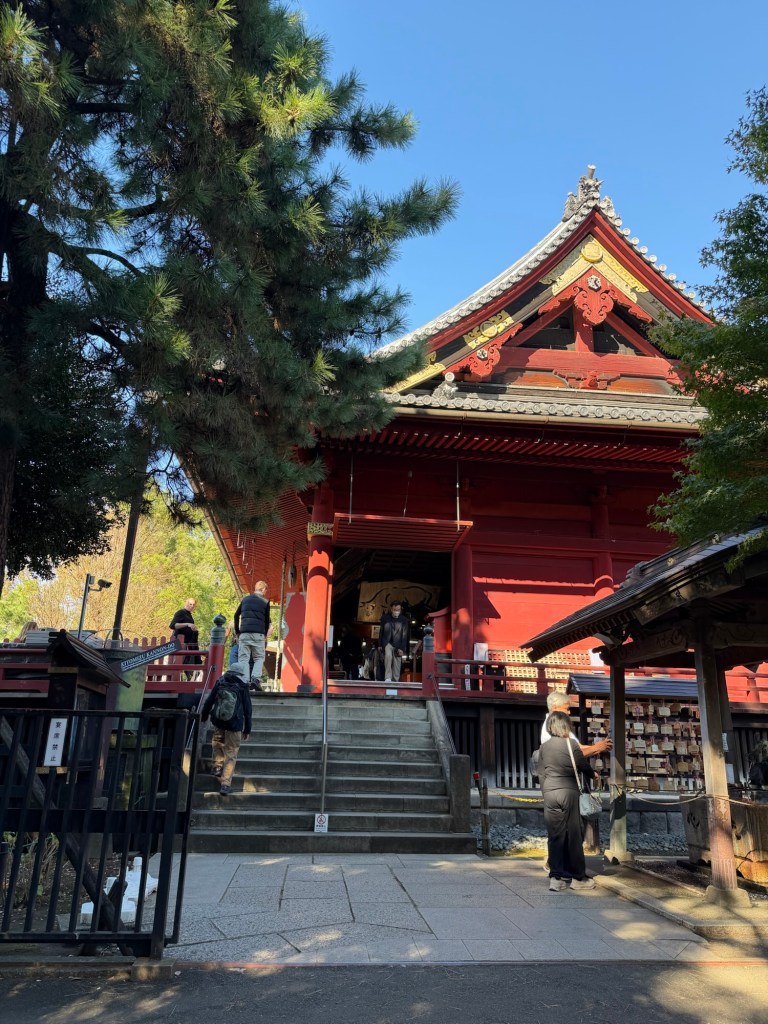
It was really nice that in addition to introducing us to Japanese food, Yukina included some cultural sights as well. She took us to see the Kiyomizu Kannon-do Buddhist Temple built in 1631. It is considered a place for good luck since it was one of the few buildings not destroyed during the bombing of Tokyo during WWII.

Temples are part of Buddhist worship. Their main focus is on the afterlife, ancestors, and spiritual awakening. At Kiyomizo Kannon-do you must first wash your hands before entering, and once inside you bow once. Inside the Temple they sold charms that were said to provide you with good health, financial success, or any other wish you might have. You could also spend a few coins and receive your fortune, which Dan and I did. According to Yukina our fortune was the 2nd best one you could have — unclear what that actually meant. However, if you didn’t like the fortune you received you could simply rid yourself of it by tying it to a tree in an area dedicated to unpopular fortunes.

Most of the trees are still green in Tokyo. Fall is running late this year because the summer was extremely warm and it rains a lot. The only trees changing color were the ginkgo trees which were all turning yellow. They are special because they are considered to be “living fossils” in that they are largely unchanged for over 200 million years. They can also live for 1,000 to 3,000 years. There was also a type of cherry tree that blooms in the Fall. While its blossoms were not very impressive, we could still say we saw cherry blossoms in Japan.

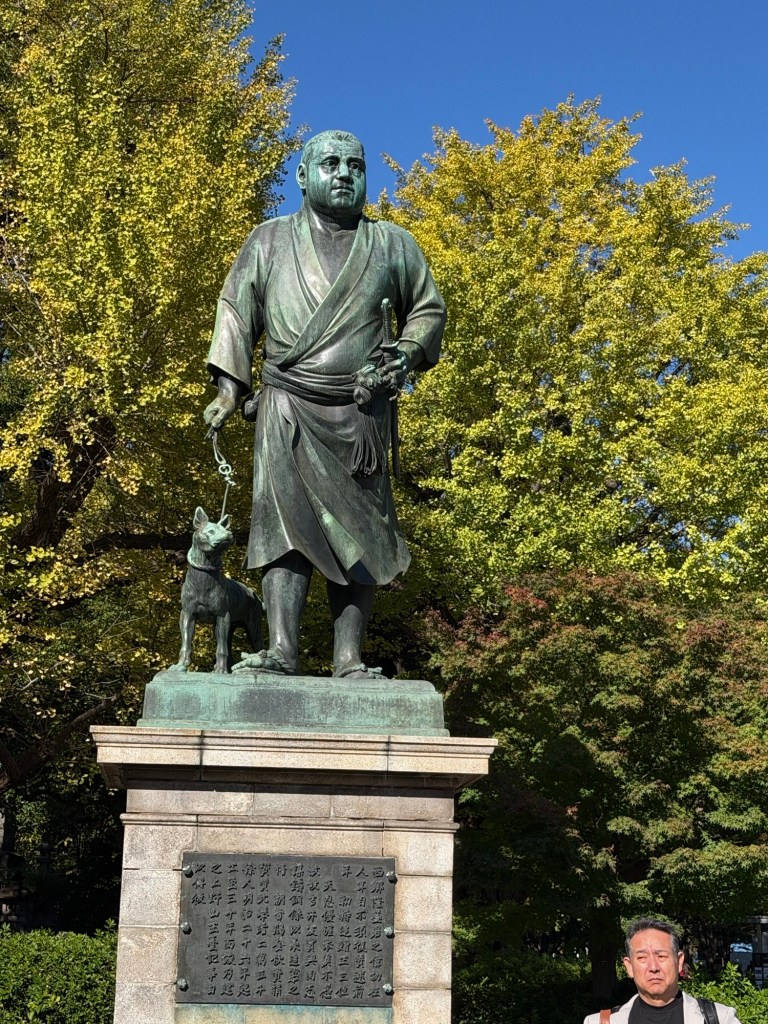
Before leaving the park, Yukina showed us a statue dedicated to the last Samurai, Saigo Takamori. He was a legendary warrior whose story inspired the movie, The Last Samurai staring Tom Cruise. Ironically he helped overthrow the Shogunate encouraging a modern government. He became disillusioned and ended up fighting against government forces. Badly wounded, he committed ritual suicide in September 1877. While the government considered him a criminal, the people thought him to be a hero.

On the way to our next stop we passed by a vending machine that sold insects for eating. Yukina said fortunately there weren’t too many of these machines around, but it is interesting that they existed in the first place. Just because we had reached the point where we could hardly eat another bite, that didn’t stop us from enjoying minced chicken on a stick with brown sauce and a raw egg on the side, pieces of chicken thigh meat with green onions on skewers, a very tasty cucumber salad and a potato salad. We also sampled some interesting drinks. Dan had a Calais soda, a local soft drink, and I tried a Yuzu sour. Yuzu is a type of citrus fruit.

The market area, Ame Yayokocho, is where we headed to next. We tried two styles of Japanese croquettes, one minced beef and the other potato. The meat and potatoes were encapsulated in a crunchy fried batter. Both were tasty, but made tastier by adding a kind of barbecue sauce or mustard. Turns out the mustard was mostly wasabi and very strong. Both Dan and Brandon learned the hard way how strong it actually was with both of them turning bright red after giving it a try.

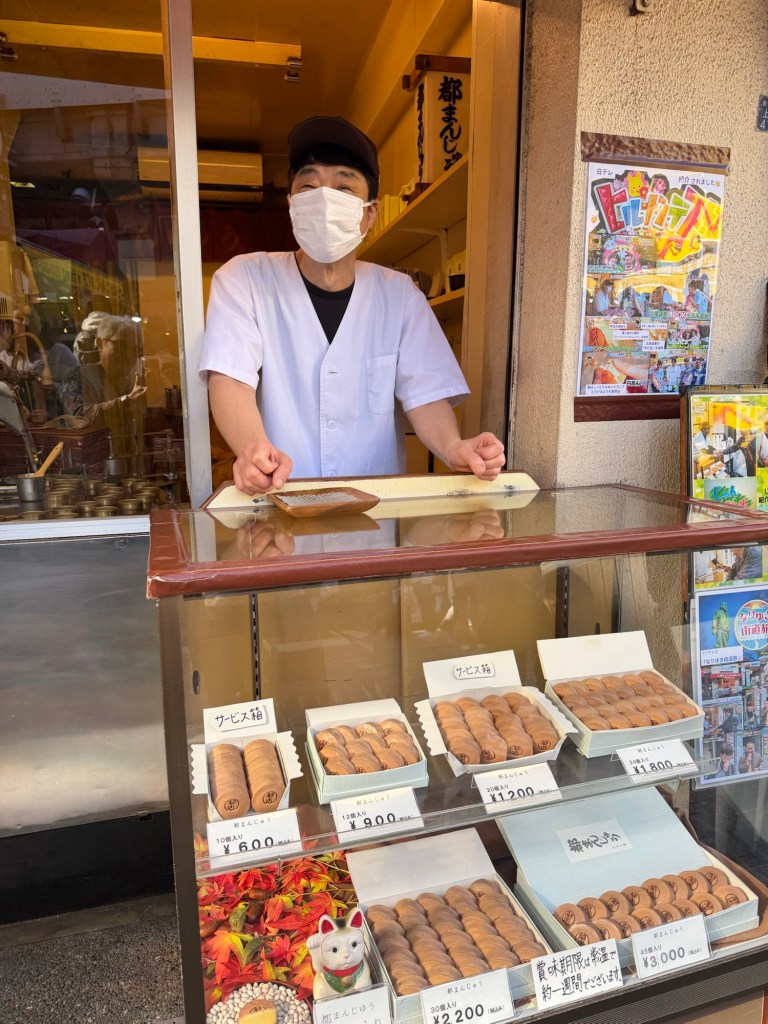
Our food tasting continued with famous white bean filled cakes by Manju Pastry. The cake was similar to sponge cake and the filling was slightly sweet.

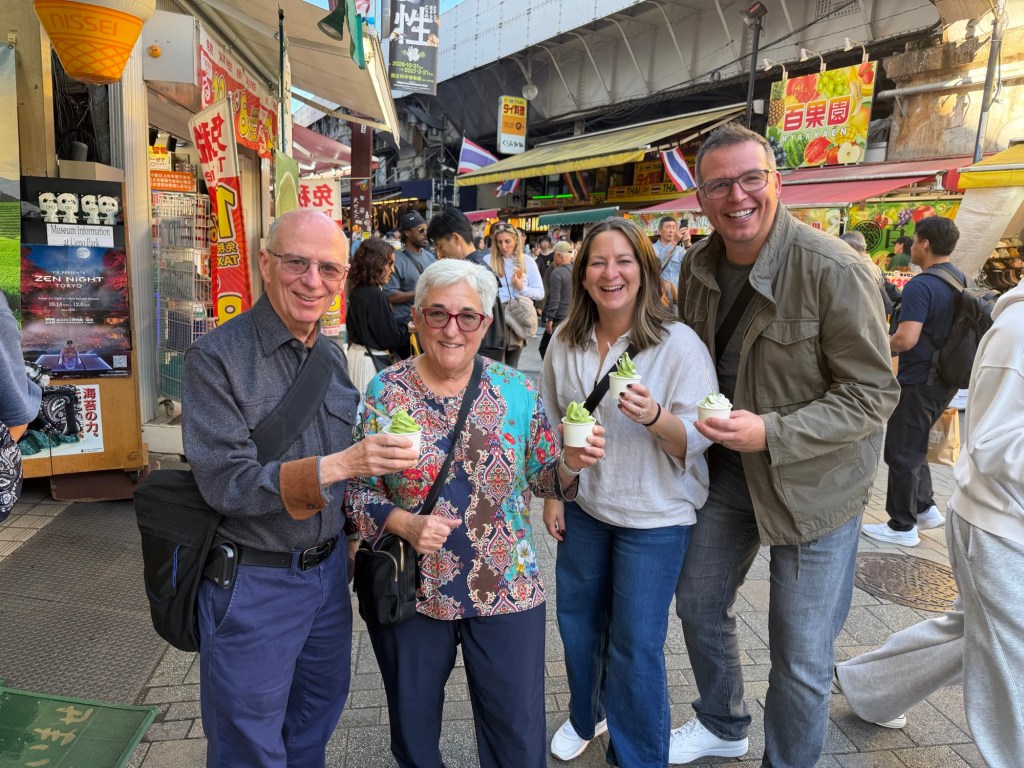
Lastly, there is always room for ice cream. Of course it couldn’t be ordinary ice cream, it was matcha ice cream. Dan really likes the matcha flavor. I found the ice cream refreshing, but it’s not my favorite flavors.

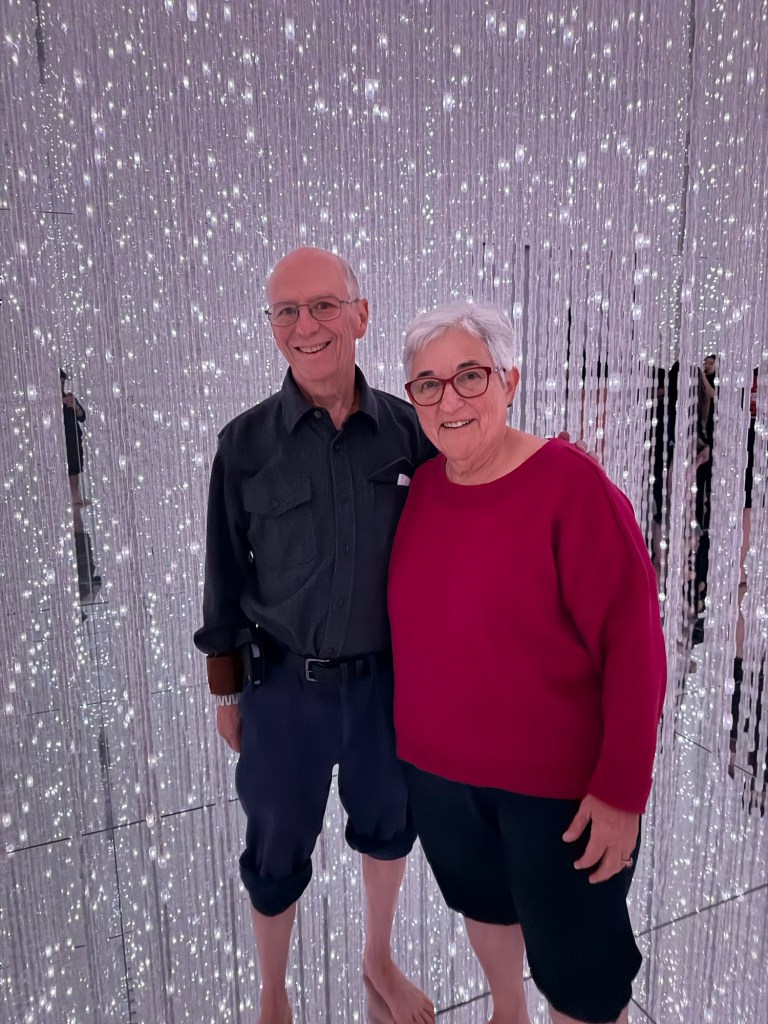
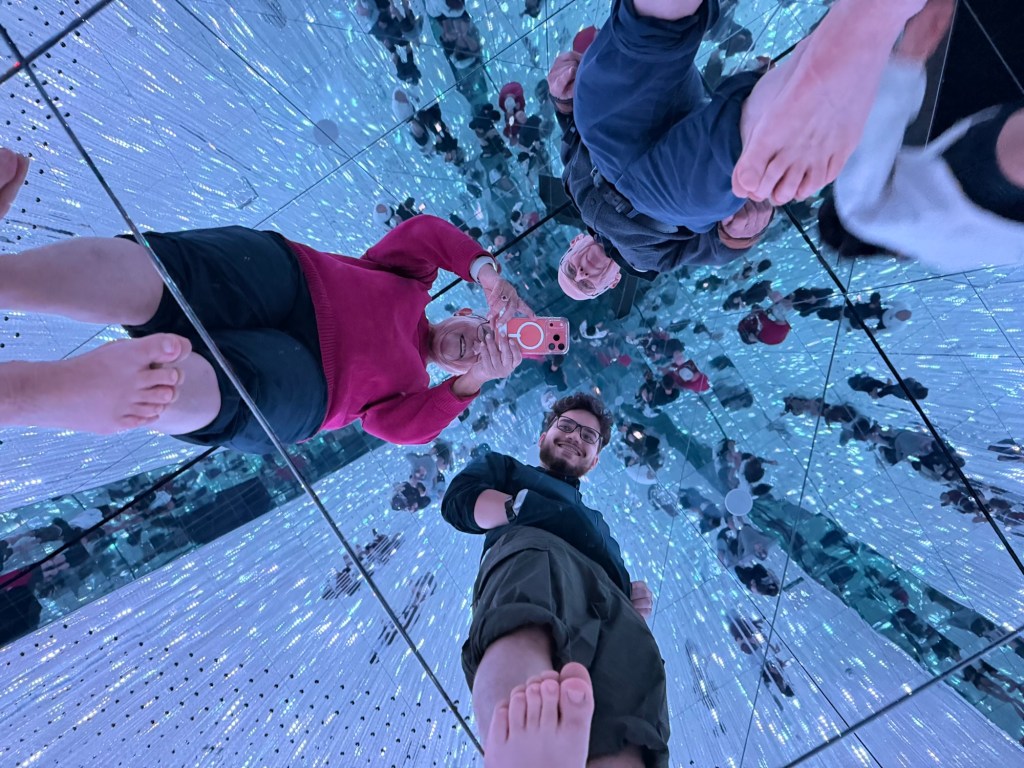
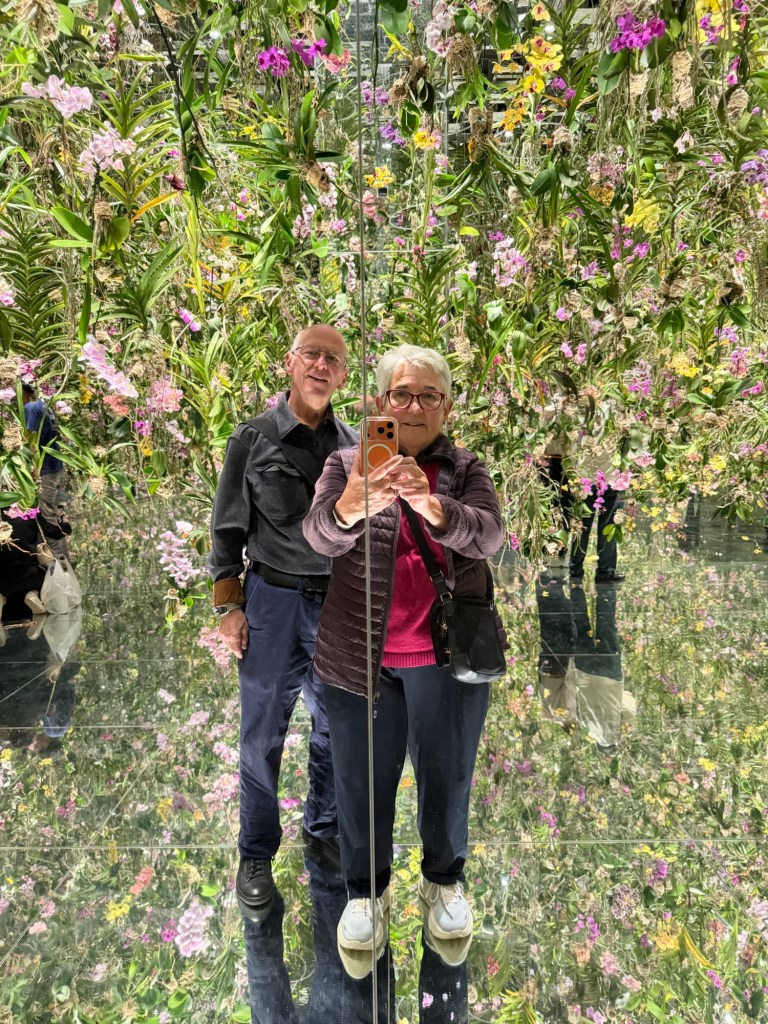
After saying our goodbyes to everyone, Dan and I walked around the market a bit more before braving the subway back to the hotel. Back at the hotel we actually rested a bit, but by 5:00 PM we were on our way to Team Lab Planets, a very interesting visual and tactile experience. You spend most of the time barefoot while moving along dark pathways that transition into different rooms. Sometimes you waded through warm milky water with neon coy fish swimming around your feet, or you were in a room with all sorts of flowers and leaves moving all about you. There was even a room for athletics. There was no way Dan or I could do any of those activities without risking injury. One room consisted of giant plastic balls that you walked between as they changed colors. Another was a room of mirrors and thousands of strings of crystals saturated with different colors. By the time we left we were pretty much exhausted from the experience.

Before leaving Dan and I shared a bowl of ramen from one of Tokyo’s top purveyors of vegetarian ramen—Vegan Ramen Uzo. I found it delicious, although Dan thought it a bit too spicy. We also said goodbye to a young Brazilian we befriended, Ricardo. We had met him while waiting in line and kept seeing him throughout the evening.

We easily caught a cab and made our way back to our hotel. It has been very easy to get taxis and we have found them to be reasonably priced. It is helpful to have the place you plan to go written in Japanese. Google Translate has been quite helpful in doing that for us. Also something unique about taking taxis in Japan is that you never open or shut a door. The driver has a lever that does that for you. They also always ask that you fasten your safety belts. That never happens back home.

Gotcha, Gotcha lesson given by Yukina, our guide
Flounder, Fatty Tuna, and Cooked Eel
Overflowing saki and green tea
Tempura and soba noodles
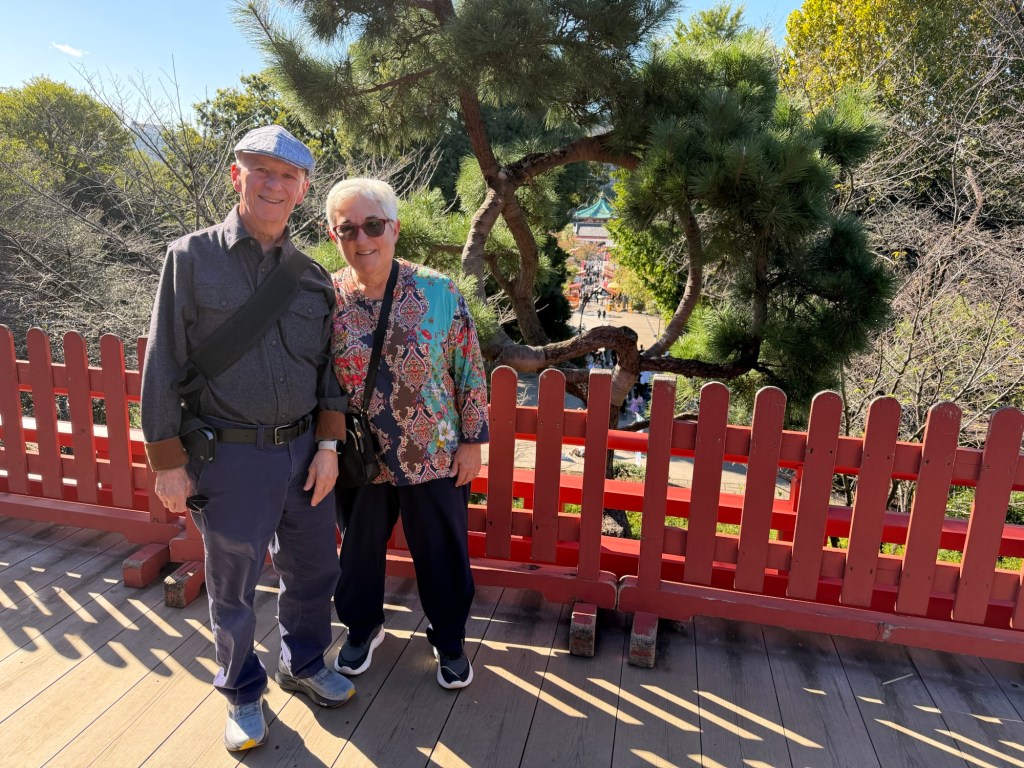
Looking through circular black pine tree toward another temple
The 400 year old Kiyomizu Kannon-do Buddhist Temple
The last samurai, Saigo Takamori
Owner of Manju Pastry
Ending our food tour with matcha ice cream
Enjoying Team Lab Planet exchibit

Walking barefoot with our friend from Brazil, Ricardo

Much of what we saw and experienced was beautiful.

The Tsukiji Fish Market and Kappabashi Kitchen Street

Neither of us had the best night’s sleep, but we got up about 8:00 to start our first full day in Japan. It was a 10 to 15 minute walk from our hotel to the Tsukiji Fish Market. It had originally been the largest wholesale fish market in the world famous for its tuna auctions and legendary sushi breakfast stalls. By the 2000s the market faced severe overcrowding, sanitation problems, lack of refrigeration and fire safety. In 2018 the wholesale fish market moved to a brand new facility in Toyosu. However, hundreds of historic street vendors refused to move, so now Tsukiji is an open air market selling an amazingly diverse array of foods and specialty items. You can make reservations to visit the Toyosu where you can see them auction tons of tuna daily. I decided seeing huge dead tunas would be depressing, even though Dan and I eat of tuna fish regularly at home.

Here are some things to be found at the Tsukiji market:

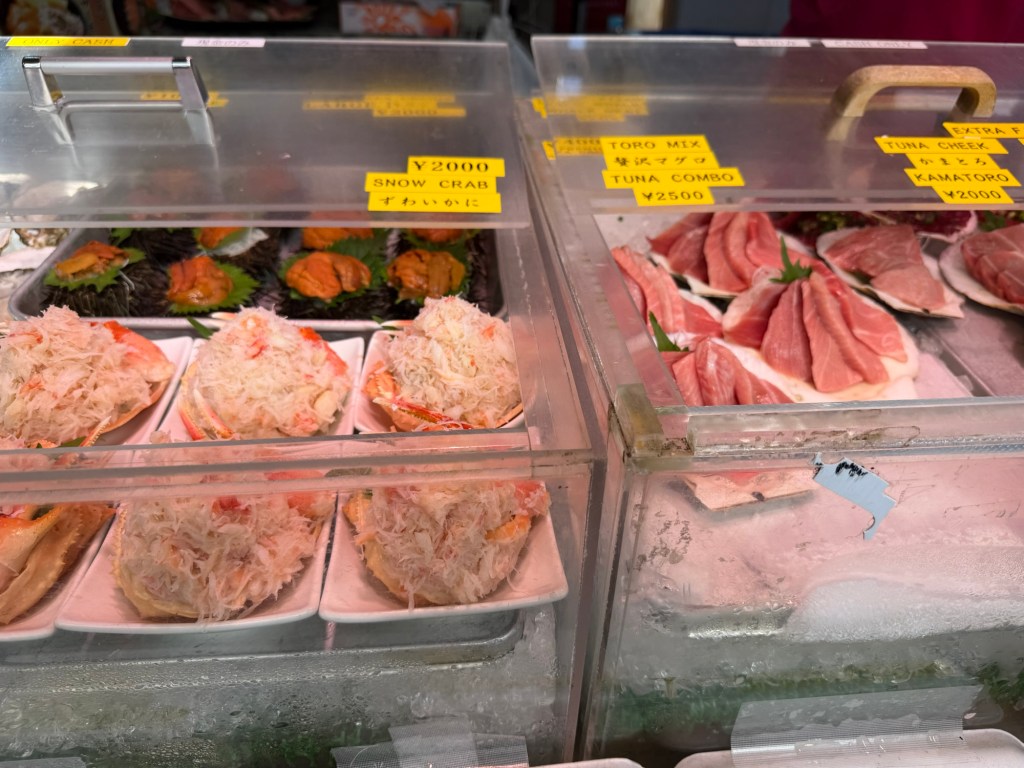
—- thick pieces of bluefin tuna (toro), sea urchins (uni), salmon yellowtail, octopus, squid, scallops, eels etc all ready to eat

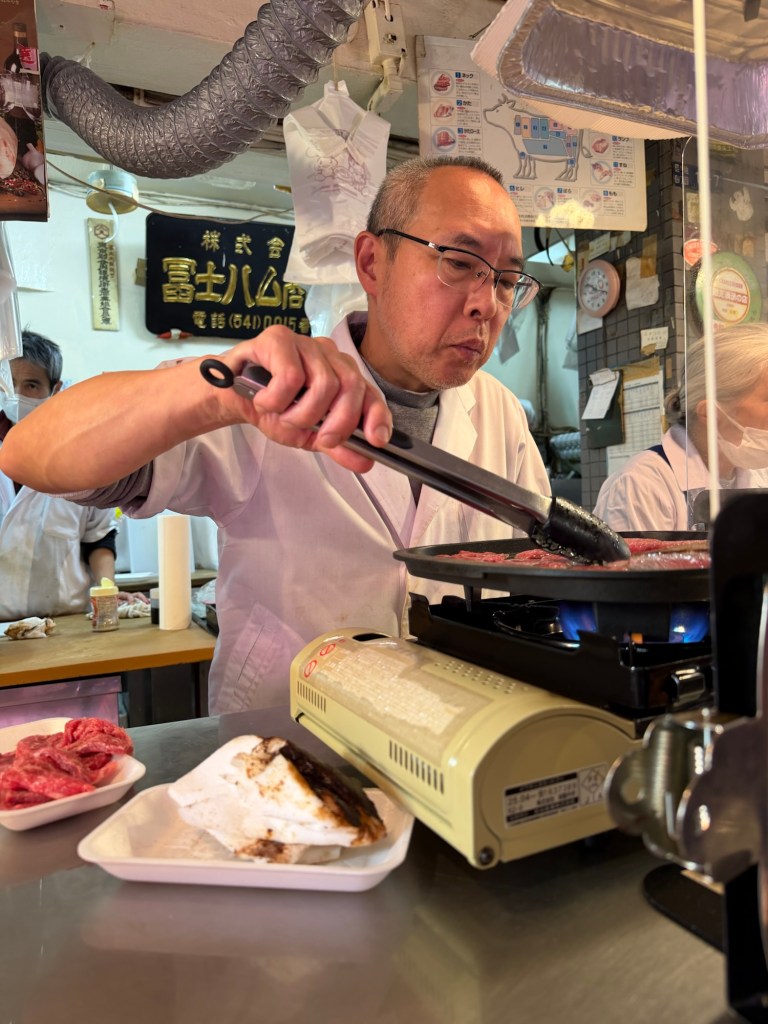
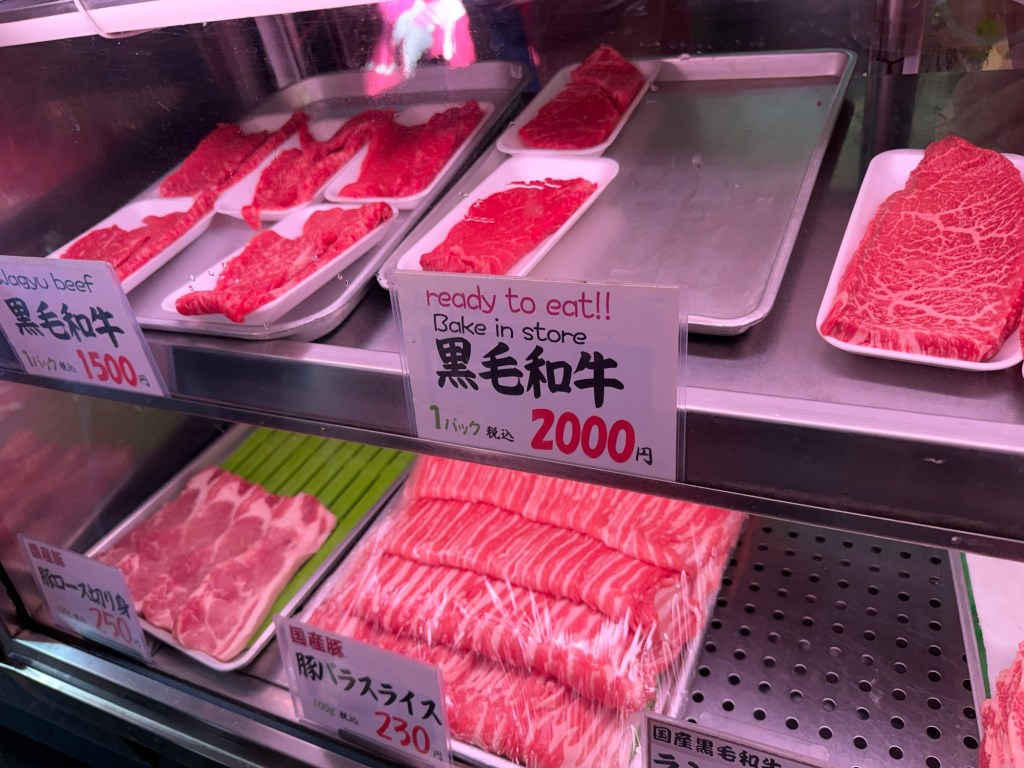
—giant oysters shucked on the spot, crab legs, and Wagyu beef grilled

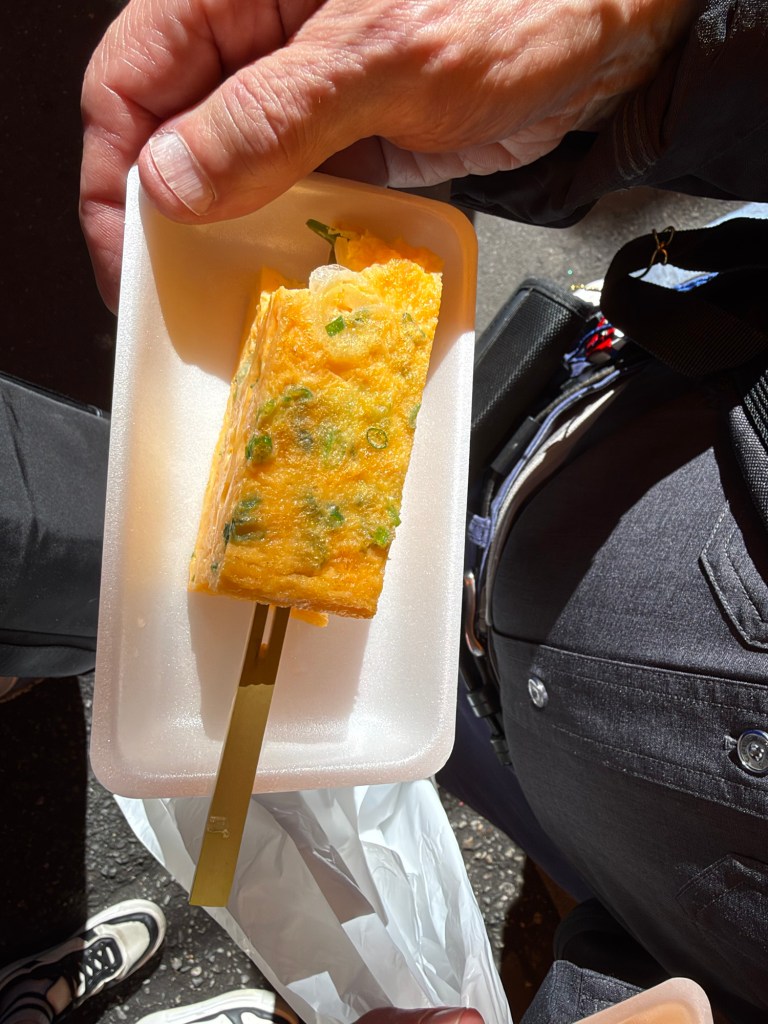
—Tamagoyaki — the market‘s famous sweet, layered rolled egg omelettes served warm on a stick

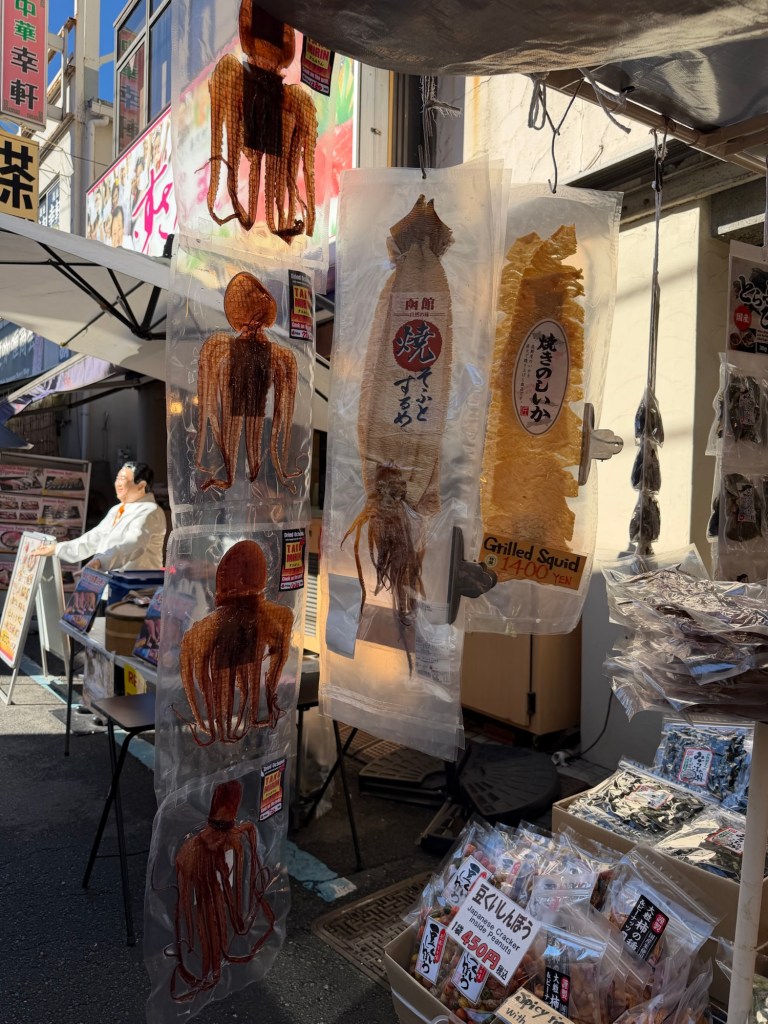
—all kinds of dried seafood, seaweed and condiments, and real grated wasabi

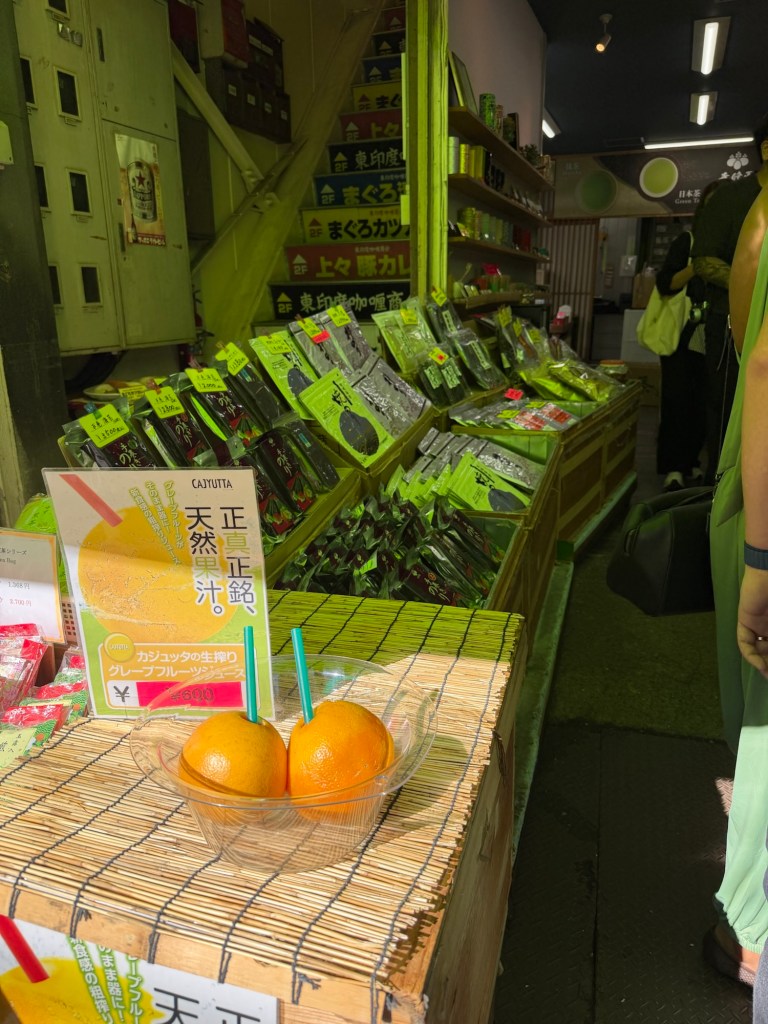
—Japanese tea and sweets including high-grade matcha powder. There is a currently a shortage of matcha in Japan caused by the exploding global and tourist demand for matcha lattes and matcha-infused treats. Powdered tea now accounts for 70% of Japan’s total green tea exports.

—Ceramics, hand-engraved chopsticks.

By the time we reached the market it was already crowded. We managed to try a few things while we were there: some of the largest grapes you’ve ever seen; shrimp dumplings; matcha tea; grilled wagyu beef; corn fish; and the famous egg omelettes. We never did manage to try the sushi due to long lines and the fact we weren’t hungry any longer. It was fun sampling so many different things it was well worth the visit.

We then headed to an area known for the ultimate in kitchenware and restaurant supplies — Kappabashi Street. Rather than do things the easy way we decided to give Tokyo‘s subway system a try. It was daunting. I’ve never seen so many arrows pointing in different directions, and stairways leading up, down, right and left. I think any tourist doing it on their own deserves a medal. I know we deserved a one. It was amazing that we were still taking to each other after that trip.

We actually did ok except for thinking we missed a subway stop and ended up getting off at the wrong stop. Getting back on to go in the right direction was an incredible effort on its own, but we managed it with a little help from the subway officials. The amount of English spoken here is much more limited than we had anticipated. The majority of people depend on Google Translate, which is helpful, but not the same thing as talking with someone.

Our main objective was to purchase kitchen knives and there were thousands of knives to be found. The price range was all over the place and you really needed a class in knife making to truly understand all of the differences. You had to take into account the quality of the steel, stainless or not, hand-made vs factory production or a combination of both, the purpose of each knife, the history behind the makers of the knives, and of course, pricing. We settled on a company called Kamata. We just liked their knives and staff. Rather than carry knives in our luggage for over 2 weeks we decided to ship them home. The best knives are available only in Tokyo, so we had no real choice other than to buy them today.

It was fun looking at the wide array of kitchen supplies, but after knife hunting we had enough shopping. We bravely headed back on the subway. I’ve been having a problem with Google Maps even though I downloaded them prior to leaving home. Most of the time it gives unusable directions, but this time it accurately told us exactly where to go. I wish I could trust it more. Now that no one uses maps, if Google doesn’t work, you’re in trouble.

One example of how Google hasn’t worked for us is that I put in the name of a store and Google told me it was 11 minutes from our location. Wrong! It would have been over an hour’s walk to get there and after already having walked over 16,000 steps we had enough for one day.

Dan had wanted to head back to the hotel after dinner, but I made him take a detour into what we thought was a drug store. In reality it had more cosmetics and employees than a Sephora. The place was two stories tall and the entire second floor was beauty supplies. Hopefully it was accurate information that I uncovered that stated drug stores carry high quality products at much lower prices than those found in more specialized stores.

Once again we were too tired to enjoy a “nice” meal. We settled on a place frequented by locals that served Udon and tempura. We weren’t too sure about the place given that you took a winding steps down into a basement, but it actually got quite crowded by the time we left. Very reasonably priced and tasty.

No other field trips for us today. Our room has a small washer/dryer so we are washing a few things even though we’ve only been gone 2 days. Why not? Tomorrow is another very full day.

Grilling our Waygu Beef
Fresh crab and tuna
There was so much green tea/Matcha that the store turned green
Dried seafood — kind of creepy
Omelet on a Stick—Tamagoyaki
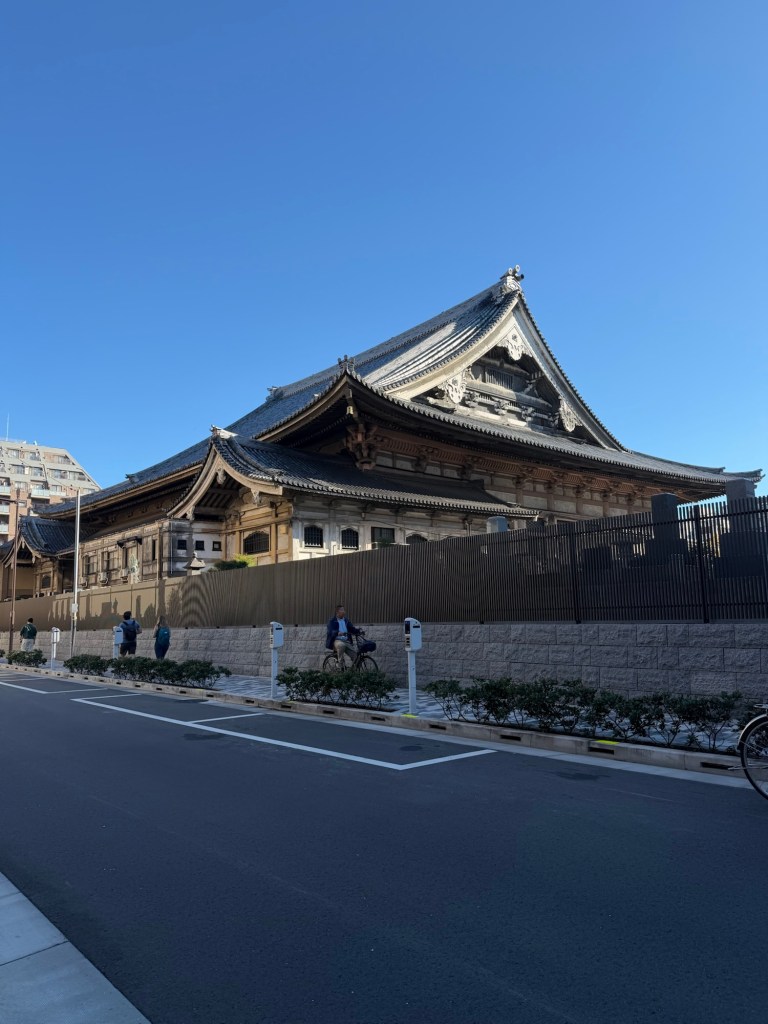
The Joseon Tongsinsa were diplomatic missions dispatched from Joseon-dynasty Korea to Japan. It was first founded in 1591, but due to fires, earthquakes, etc. it was destroyed several times and rebuilt in 1939 by the famous architect Chuta Ito.
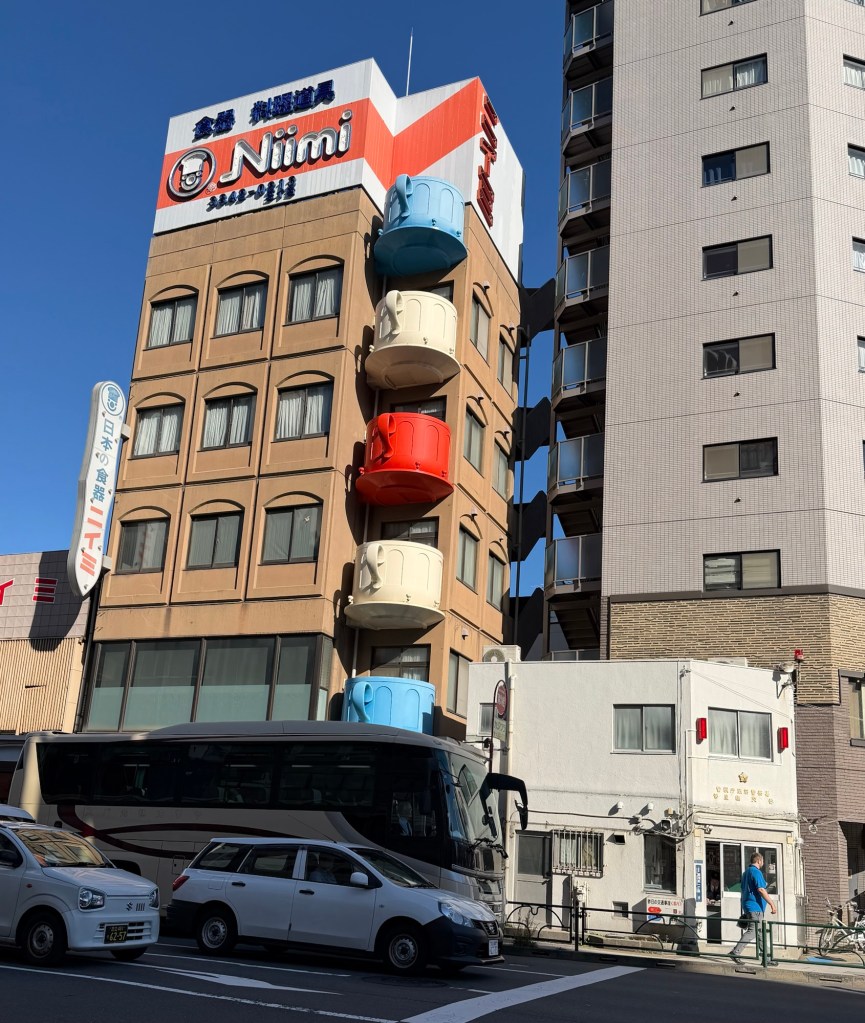
Coffee cups on a building in the kitchen district.
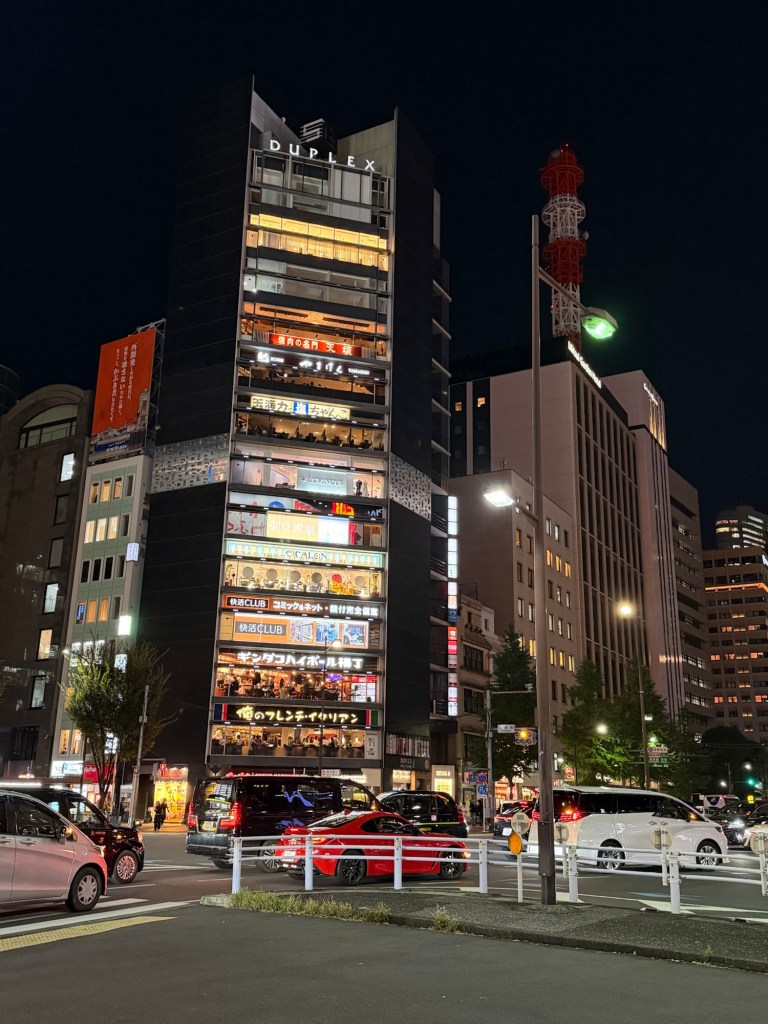
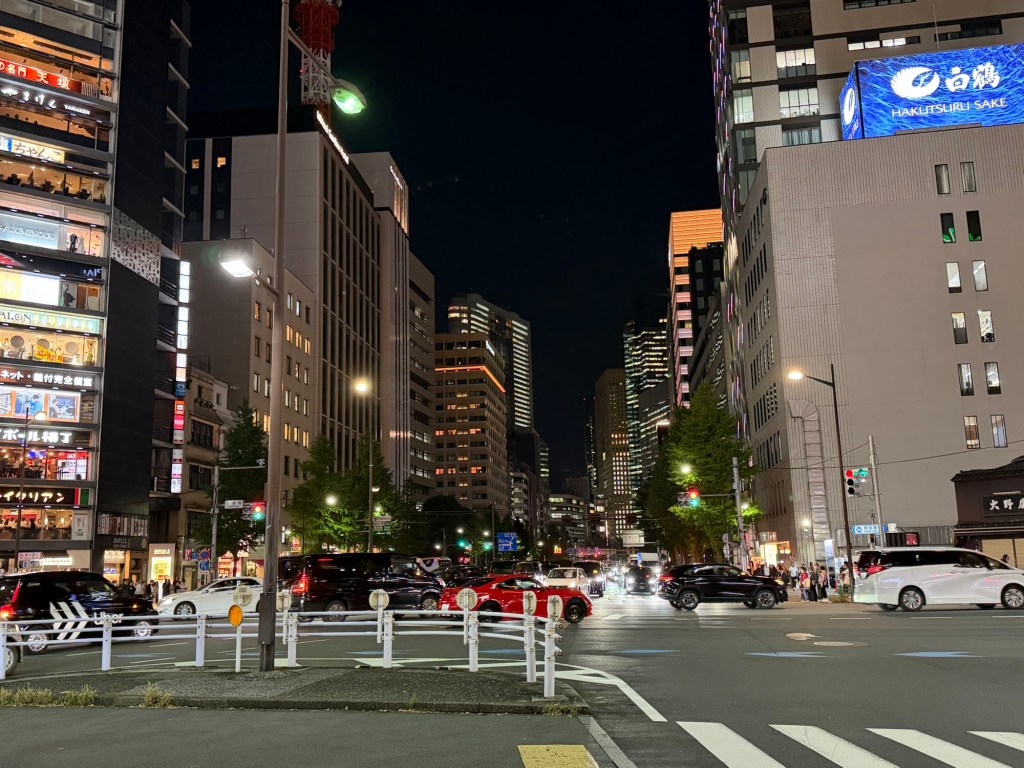
Buildings near our hotel at night, Different restaurants were on different floors of the brightest lit building.