At 62 degrees and cloudy, the weather today should feel almost like home. We are covering a lot of territory by bus today. We will be visiting sites that will give us a sense of what life was like in Japan prior to WWII. Thatched roof houses were not uncommon in the countryside until about 70 years ago. That started to change after WWII and people migrated en masse to cities due to modernization and industrialization.
People continue to live in these homes and work together to preserve Gassho architecture. They were built to withstand harsh winters and earthquakes, however, they were susceptible to fire. Many of them were relocated from a nearby village that was razed to make way for a dam. It was enjoyable strolling amoung these unique building, some of which have now been turned into shops and restaurants.
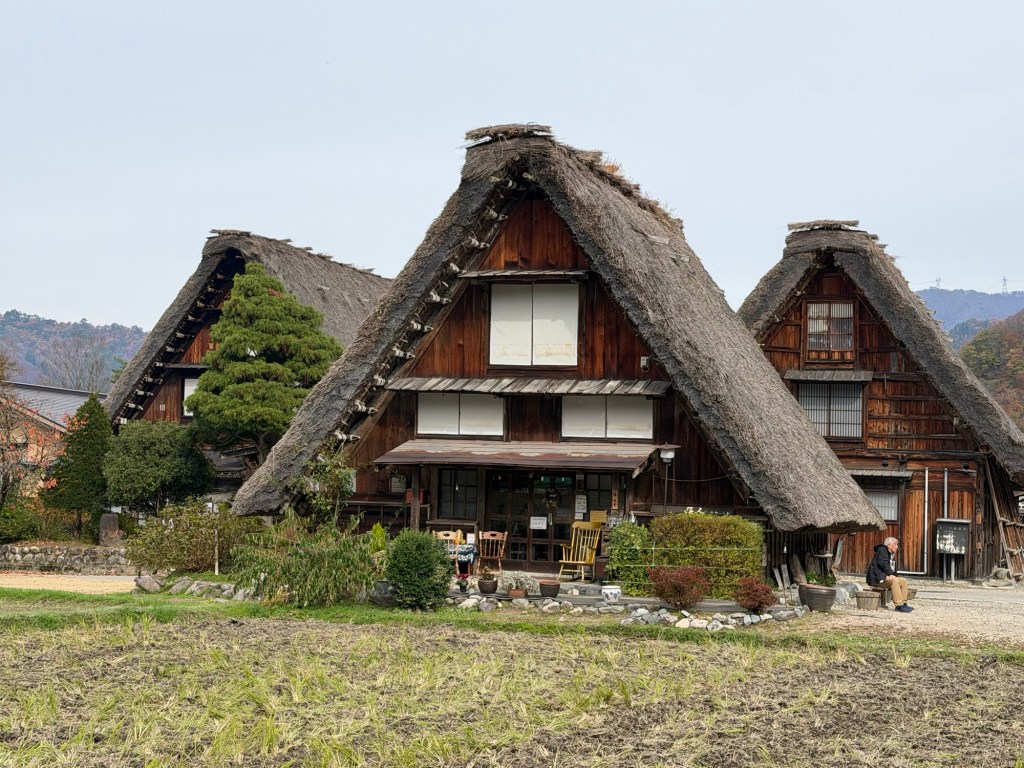
A home with a thatched, steep roof is called a Gassho style house. In Shrakawa and Gokayama Village, both located very closely to each other, there were 1,850 homes prior to 1945, now there are only about 180 left. No nails or metals were used in their construction. All the joints on the second floor and up were fastened with vines and straw ropes. The thatch is made from pampas grass and lasts about 25 years. Due to the difficulty in getting the correct materials to build the roof, along with the limited number of people who know how to do the work, they are costly to replace. Fortunately the government offers funds to the homeowners, allowing them to take care of their properties.
Both villages are considered UNESCO World Heritage sites. This area of Japan was renown for the quality of the silk it produced. The upper levels of Gassho homes were used for the raising of silkworms. The silk industry no longer exists in these villages, or in the country of Japan for that matter.
The Iwase family opens their home to visitors. Located in Gokayama, it has been designated an important cultural property since 1958. The house was built by Choemon Fuji about 300 years ago and took 8 years to complete. At the beginning of the Meiji Era (1868-1922) the family changed their name to Iwase. Until 1910, as many as 36 people lived in the house. The Iwase family still resides in this home. Happily the current owner’s son has agreed to take over responsibility of the home when his father retires. It’s nice knowing that the home will remain in the family.
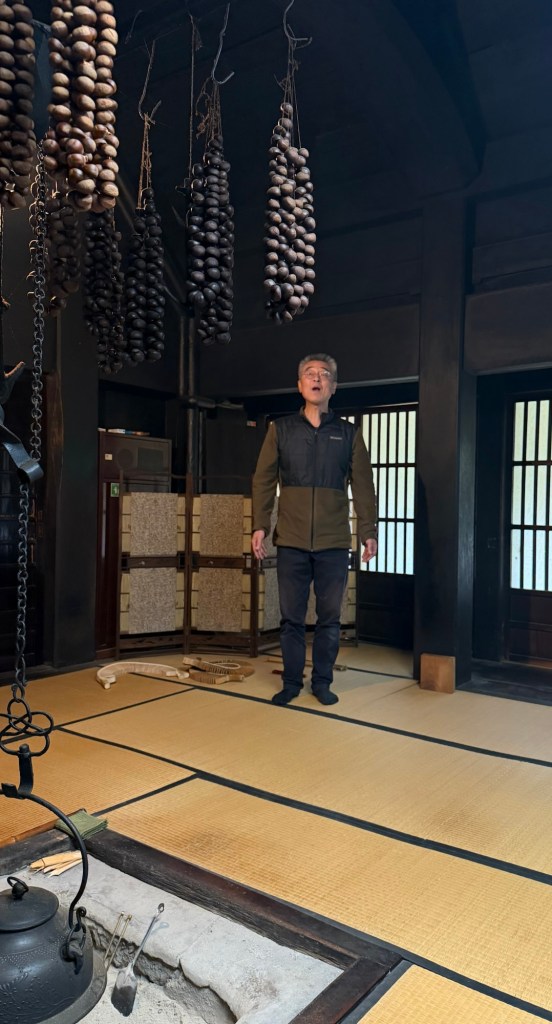
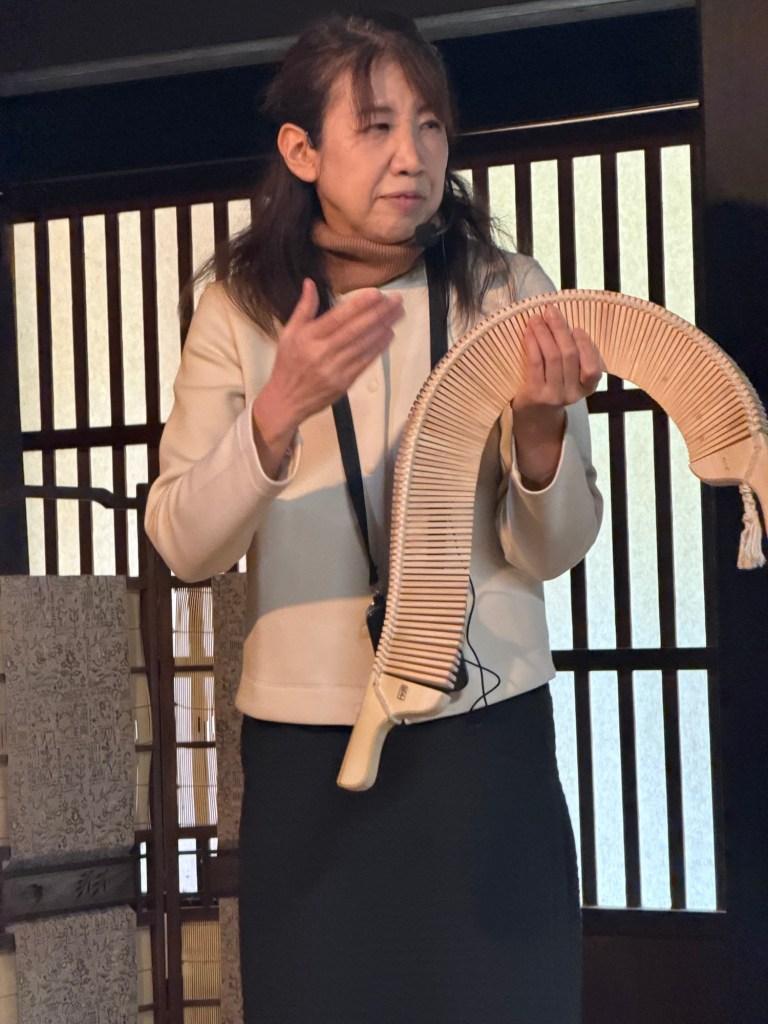
After Mr. Iwase spoke to us about his home, his wife introduced us to some simple, traditional instruments. We then watched a brief performance with Mr. Iwase dancing and playing the binsasara, while his wife sang and played another instrument. We all got the opportunity to try out the instruments, and of course, to purchase them.
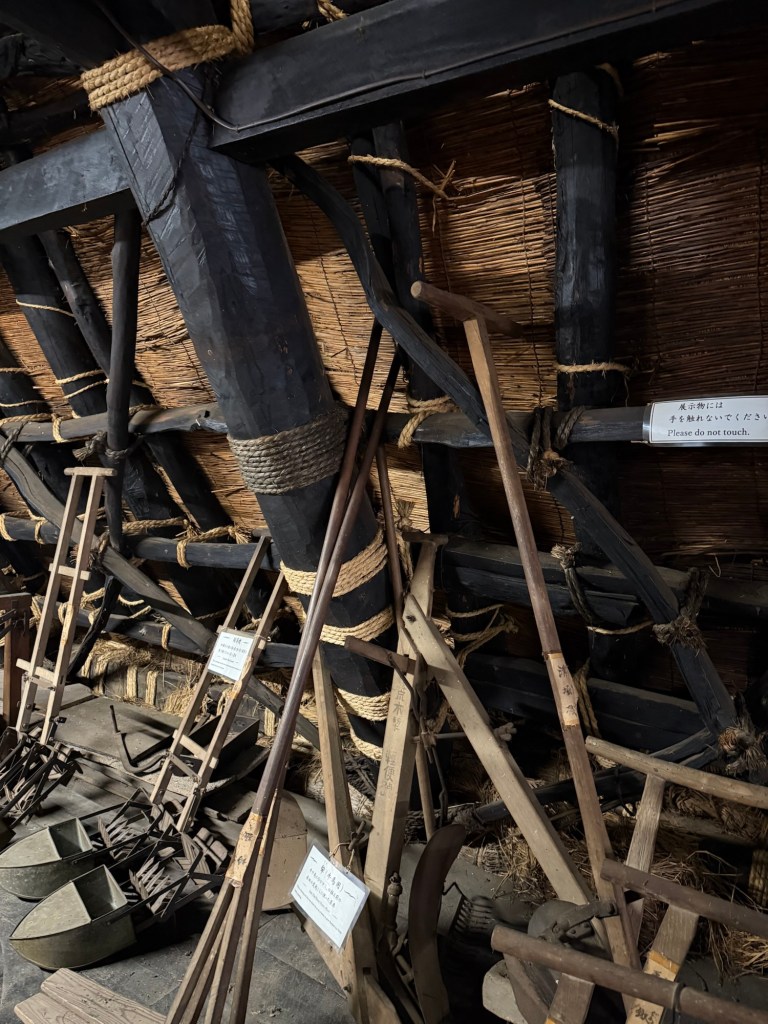
Those of us that were a daring (and perhaps not so smart) were allowed to take a steep and slippery ladder up to the next level. The room was enormous and it looked as if it were part of a sailing ship. The wall and roof were supported by huge logs wrapped in rope.
We enjoyed a bento meal near Gokayama Village and were able to take a photo of the village from an overlooking hillside. Kanazawa is a popular destination because its old buildings survived WWII due to its out-of-the-way location in-between the mountains and the Sea of Japan. Along with Takayama, it is one of the best preserved Edo period castle towns and is a hub for traditional arts and crafts. In fact, our first stop in Kanazawa was to learn about washi paper making.
All of us enjoyed our visit to the Japanese Paper Experience House in Taira, just outside of Kanazawa. Etchu Kokushi or Gokayama Washi are traditional names for hand-made paper that comes from this region of Japan. This paper is made from a mixture of Kozo fibers a type of mulberry tree), and a viscous extract of the Torora Aoi (a relative of the Hibiscus plant). “This mixture gives the paper its beautiful appearance and highly prized usability.”
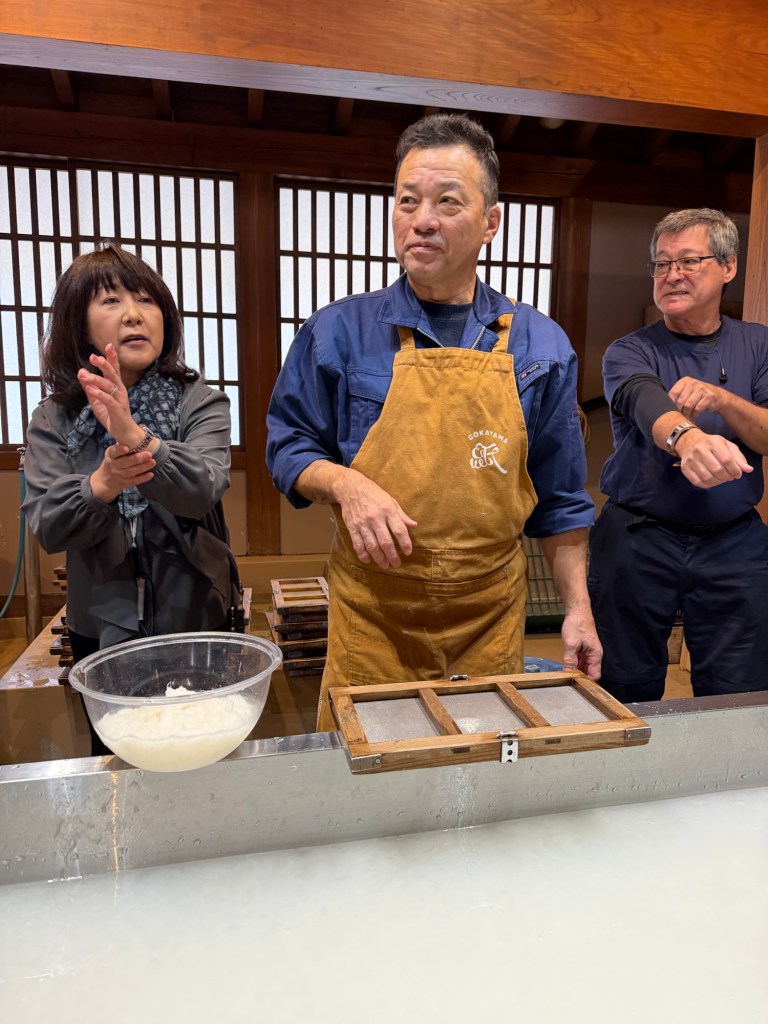
Gokayama Washi has a history going back over 1,200 years. So much effort goes into the making of this paper its hard to understand how people figured out how to make it in the first place. We saw a video that showed how the mulberry branches were collected. The bark was then peeled off the branches all by hand. The branches were then placed on snow in order to be bleached, then boiled, rinsed, and beaten to loosen the fibers. The thickening agent was then added, followed by scooping, straining , shaking, pressing to drain water and then drying. Most of the work is done by hand.
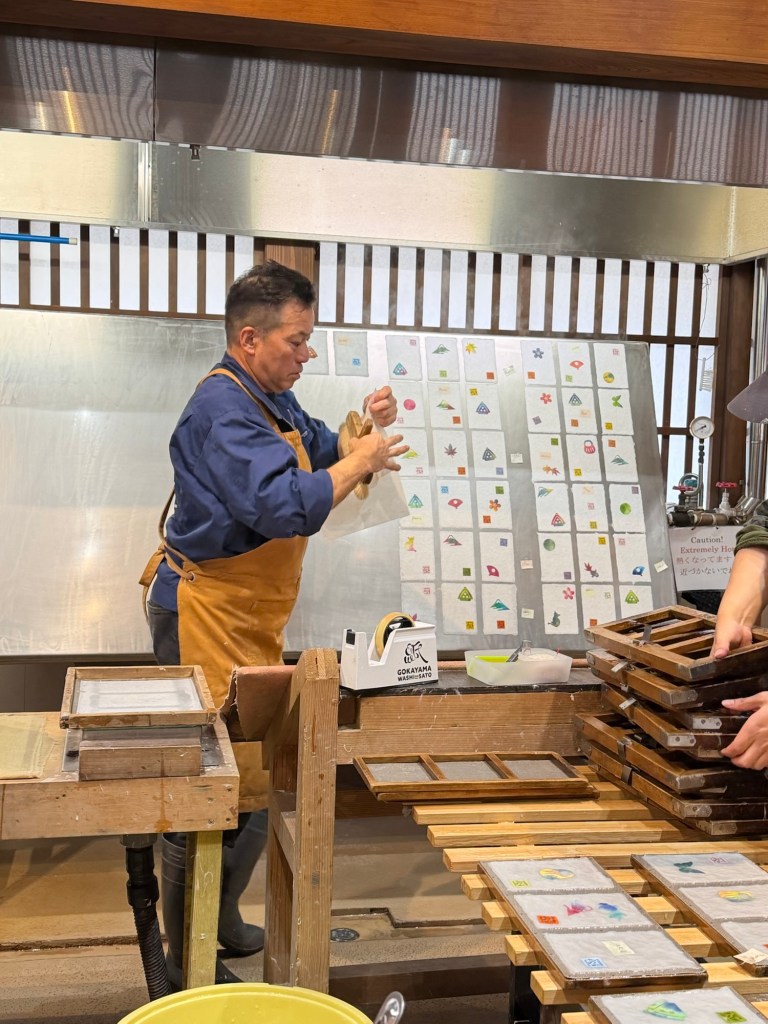
After the presentation we all had a chance to make some postcards made from washi paper. Frankly all we did was dip postcard sized screens into a bath of washi mash several times, and shaking the screen in between the dips to remove excess water. After 3 dips, and shaking, we placed some paper decorations on our sheets. Our instructor carefully removed them from our screens and hung them against a hot surface. Before too long, our postcards were finished.
Taking our handmade gifts with us, we were directed to their showroom. (There has either been a gift shop or showroom associated with almost every stop we have made.) It was amazing to see how many beautiful things can be made out of paper. We are finding it hard to resist buying things here in Japan. The handicrafts here are made so beautifully, and with such skill, there isn’t anything quite like it at home.
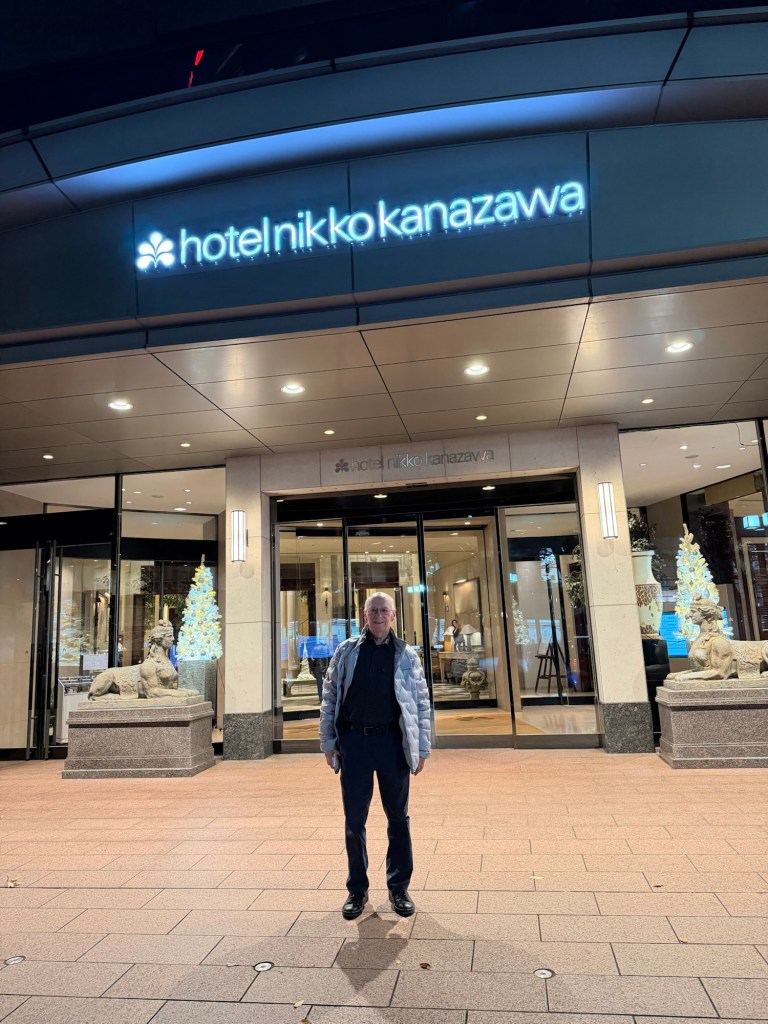
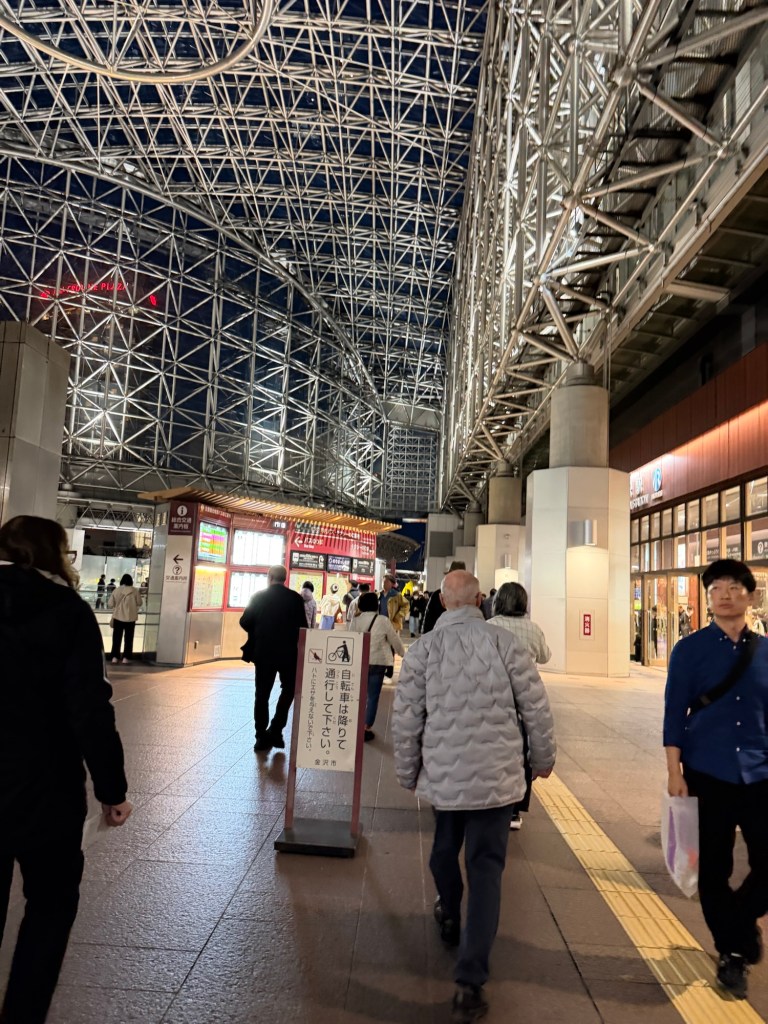
It was an enjoyable day, but we were happy to arrive at our hotel, the Hotel Nikki Kanazawa. It was a very nice hotel right near the geodesic dome-like train station. That night we enjoyed a lovely buffet with our group.