
JUNE 30, 2025
Now I was about to find out whether or not the time I spent using Duolingo to help refresh my Spanish skills would be of any help to us on this trip. Until today everyone spoke English. We arrived at the Cabo San Lucas airport without anyone holding our hands. We were clueless in terms of checking our luggage and finding our gate. When I asked a question in my broken Spanish, the answer would be given to me in Spanish traveling at the speed of light. Only when the person slowed down to a glacial pace could I even grasp a sense of what they were telling me. Fortunately my reading skills were much stronger (ok, really only a little bit stronger). However, I am glad to report that we were able to check our luggage and find our gate in plenty of time to catch our Volaris flight to Mexico City.
We were lucky that some of Mara and David’s friends were on our flight. With their help we located the area in the airport where one could call an Uber or catch a cab. Rather than experiment with Uber (it would have been my first time using the app) we ended up taking a taxi to our hotel/apartment, The Frida Boutique by Viadora.
The 30 minute ride to our hotel was in bumper to bumper traffic. We couldn’t help but notice how green the city was with parks and playgrounds to be seen along the way. We had expected smog, but the skies were clear and we could see that the city was surrounded by mountains. Mexico City sits at an altitude of about 7,400 feet and is located within the Trans-Mexican Volcanic Belt, also known as the Sierra Nevada. Other mountain ranges include the Sierra de Guadalupe to the north and the Sierra de las Cruces to the southwest. Several of the mountain peaks are inactive volcanoes that are part of the Pacific Ring of Fire.
Mexico City is the most populous city in North America with a population of close to 22 million people. It is one of the most important cultural and financial centers in the world. Mexico City was founded by the Aztecs around 1325 on a group of islands in Lake Texcoco. It is the oldest capital city in the Americas. Originally named Tenochtiitlan, it was almost completely destroyed by the Spanish in 1521. Using the stones and foundations built by the Aztecs, the Spanish redesigned and rebuilt the city in accordance with their own standards. In 1585 it became known as Ciudad de Mexico (Mexico City) and was an important player in the Spanish colonial empire.
Mexico’s journey from being a Spanish territory to independence is too complex to cover in this blog. It took place from 1910 to 1920 and involved some colorful characters such as Pancho Villa. It will suffice to say that it culminated with the drafting and signing of the Act of Independence of the Mexican Empire on September 28, 1821. This document formalized Mexico’s declaration of independence from Spain ending 300 years of colonial rule.
Our apartment/hotel, the Frida Boutique, was located in the charming Condesa neighborhood on a quiet gated side street. From the very start the staff couldn’t do enough for us. Our spacious suite was perfect for two couples. We each had our own bedroom and bathroom, plus there was a kitchen, laundry room, living room and patio on the roof. Now we just had to wait for Amy and Steven’s arrival.
In the meantime, Dan and I went out to explore our neighborhood. Condesa takes its name from the title of the Countess of Miravalle, Doña María Magdalena Catarina Dávalos de Bracamonte y Orozco. I just wanted to write down her name — impressive isn’t it? There were tree lined medians and beautiful art deco and “California-colonial-style buildings.” The impressive Parque Mexico was just a short walk from our hotel. Plenty of shops, restaurants, small grocers, bakeries, bars, and a huge bookstore were located close by. You did, however, have to watch your step. Unlike in the U.S. where trees are often cut down if their roots lift a sidewalk; here trees came first, not sidewalks.
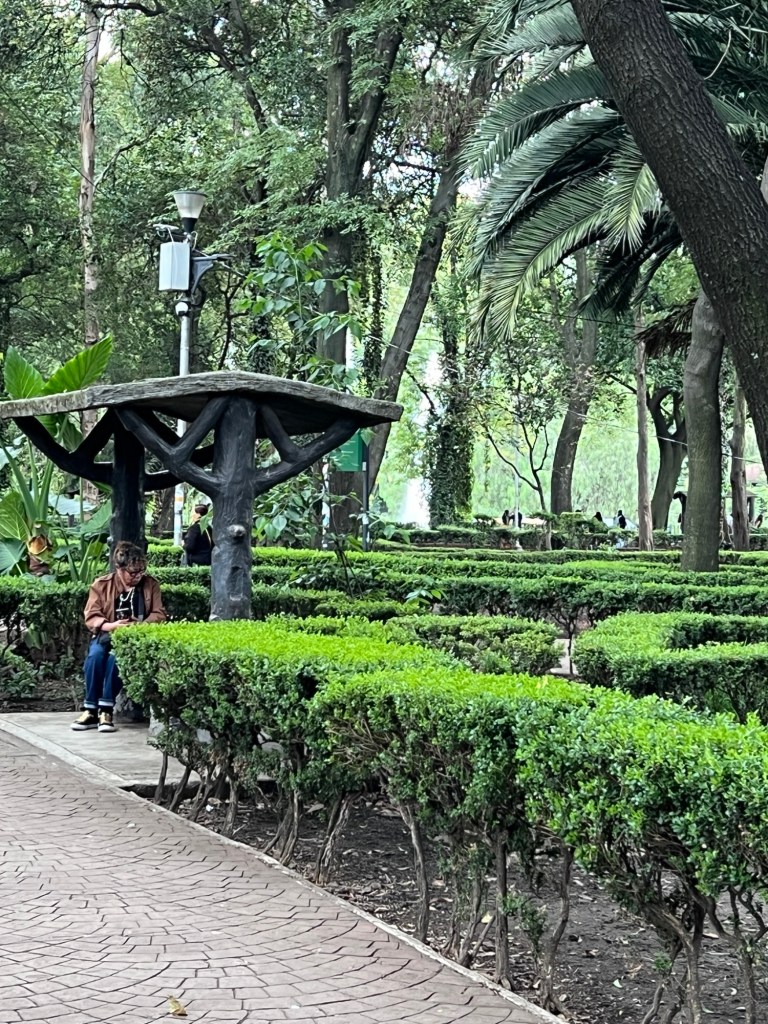


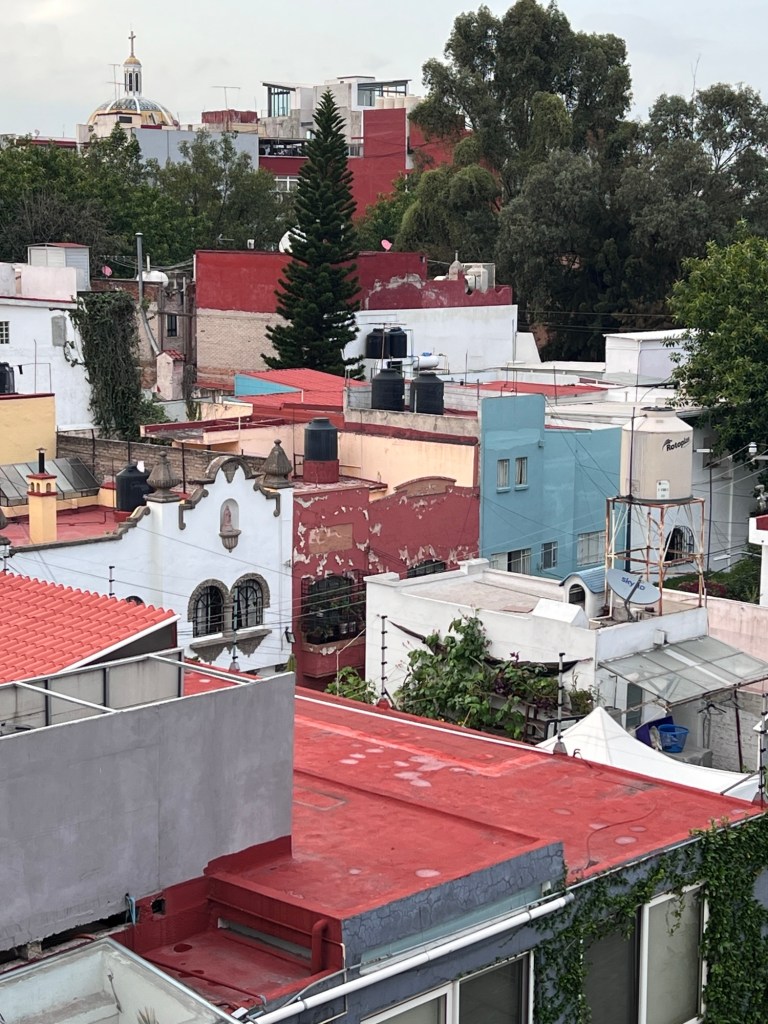
OUT OF OUR BEDROOM WINDOW
Amy and Steven arrived just in time for us to walk to Azul Condesa for dinner. The chef, Ricardo Munoz Zurita, is known as the “Prophet and Custodian” of traditional Mexican cuisine. We all enjoyed a Magarita, and shared guacamole with onion, serrano chile, coriander and tomato. We opted not to have grasshoppers on top. Most of us ordered the “legendary” Qaxacan black mole with chicken, which was delicious.
On our way back to our hotel we had to be very careful navigating the uneven sidewalks, but we made it back without any injuries.

 BY THE WAY WITH WENDY & DAN