Day 21 Venetian Islands & St. Mark’s at Night

Dan got some relief from his cough last night, which made both of us feel optimistic. It’s a shame we didn’t get to see much of Bologna, but that couldn’t be helped. Today should be an interesting one as we board the bus and head toward Venice.

This was the last bus ride of our trip and the last stop at an AutoGrill rest stop. The rest stations in Italy far exceed those in the U.S. AutoGrills are fantastic! We got to experience them several times on our travels. There is a mini grocery store, a cafe where you can get espresso, fresh sandwiches, baked goods, and hot food selections. Plus there is an area to where you have the choice of tons of packaged food stuffs and toys. There was a huge candy selection with some tubes of cookies or chocolates measuring 3 feet long. We were amazed to find several stacks of Lindt chocolate bars each measuring 12” x 3-1/2” x 1/4” thick for 4.99 Euros each. I bought two. I wish I had taken pictures of the place. In addition, the restrooms were nice and clean.

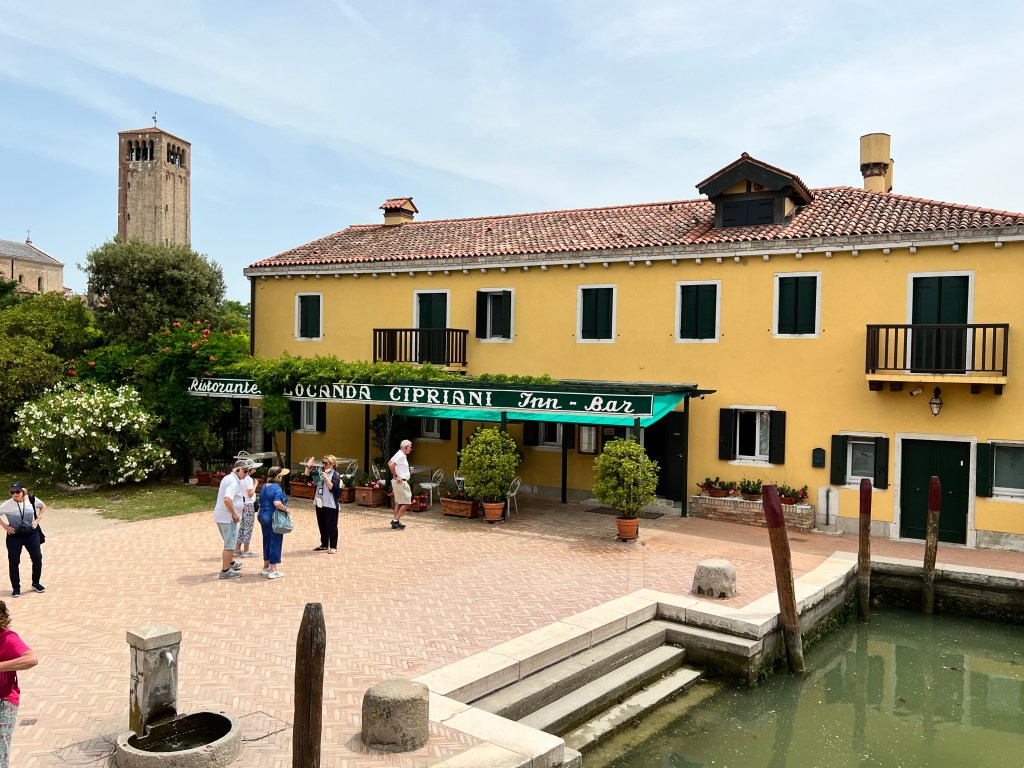
You can only go so far with a bus when traveling to Venice. It was time to say goodbye to our driver Alfredo, and board our private boat to begin exploring the Venetian Lagoon and its islands. Our first stop was the Isle of Torcello where we we had lunch at the lovely Locanda Cipriani restaurant.

Torcello is the birthplace of Venice. It was the first place people fleeing the barbarian hordes settled. Today, however, only about 20 people live there. It is a peaceful place with many families packing their small boats with food and drinks and heading there for a picnic. To get to our restaurant we strolled along a canal for about 15 minutes.

Ristorante Locanda Cipriani

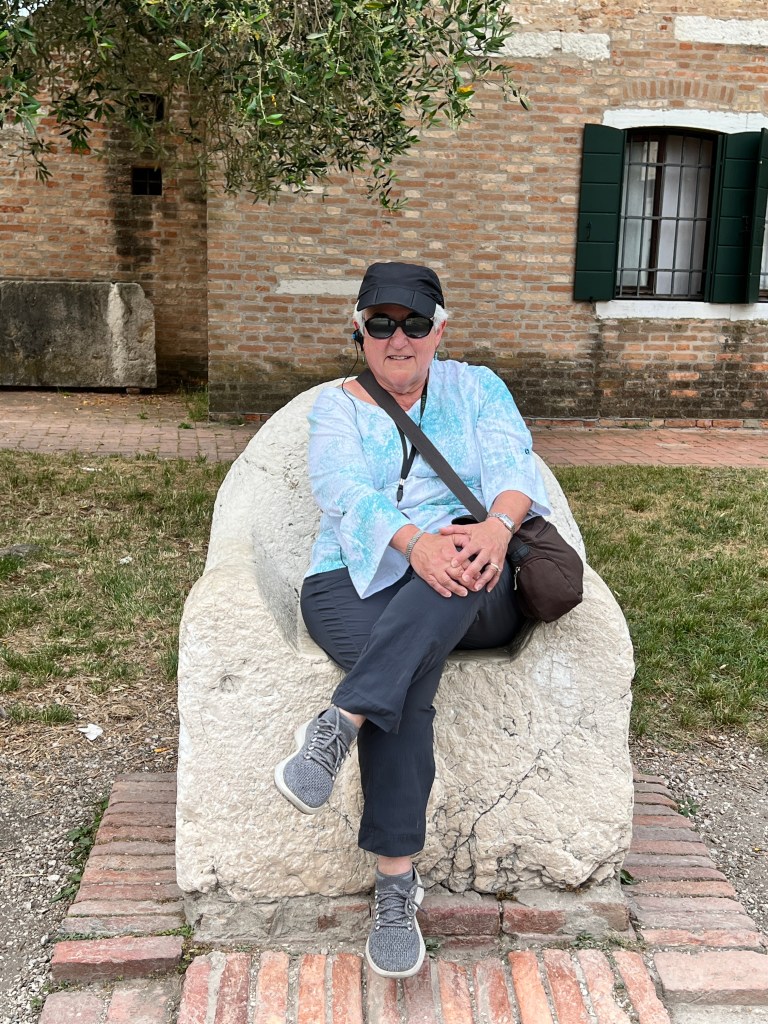
We had a wonderful lunch and had a little time to explore the gardens, and the small church Chiesa di Santa Maria Assunta. The church was originally erected in the 7th century. Inside (no photos were allowed) was a wonderful Byzantine mosaic from the 11th century. Near the church there was a stone chair that is said to have been sat upon by Attila the Hun, and now by me.
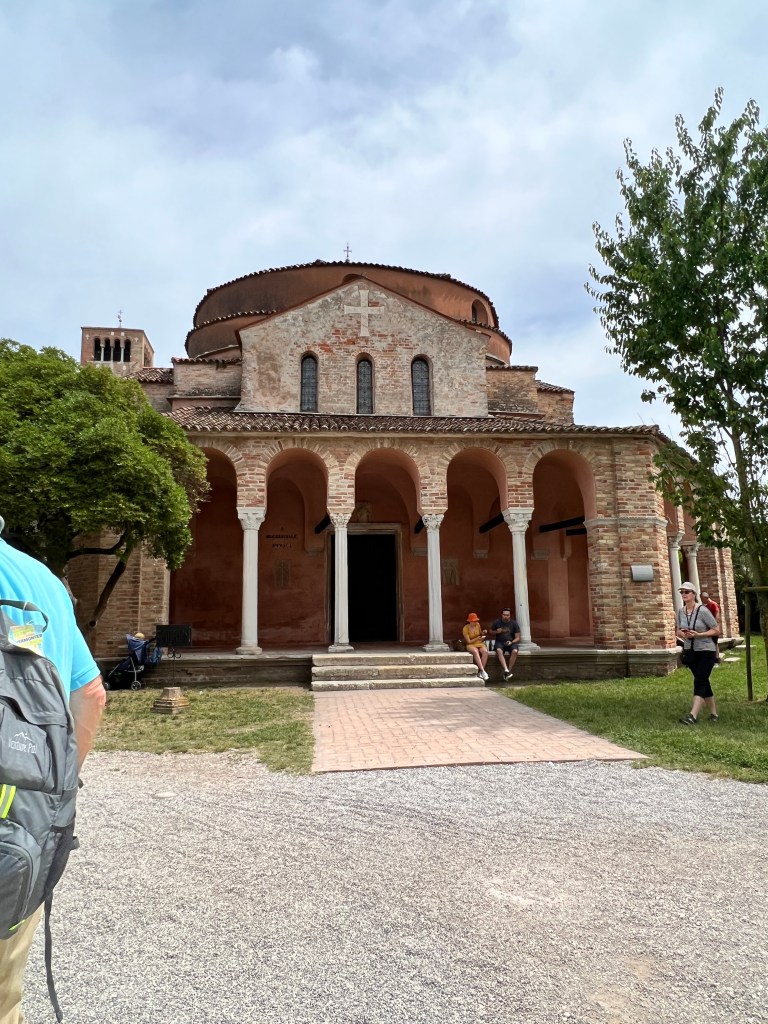
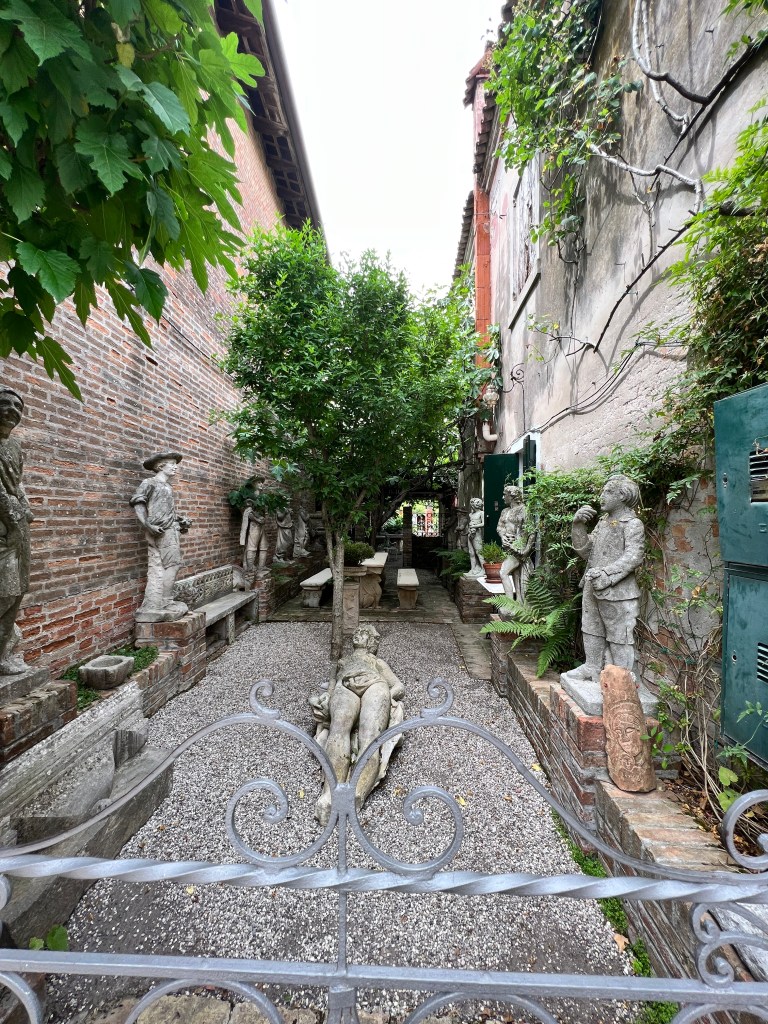
Chiesa di Santa Maria Assunta
Strange alleyway near church
Me and Attila the Hun sat here.

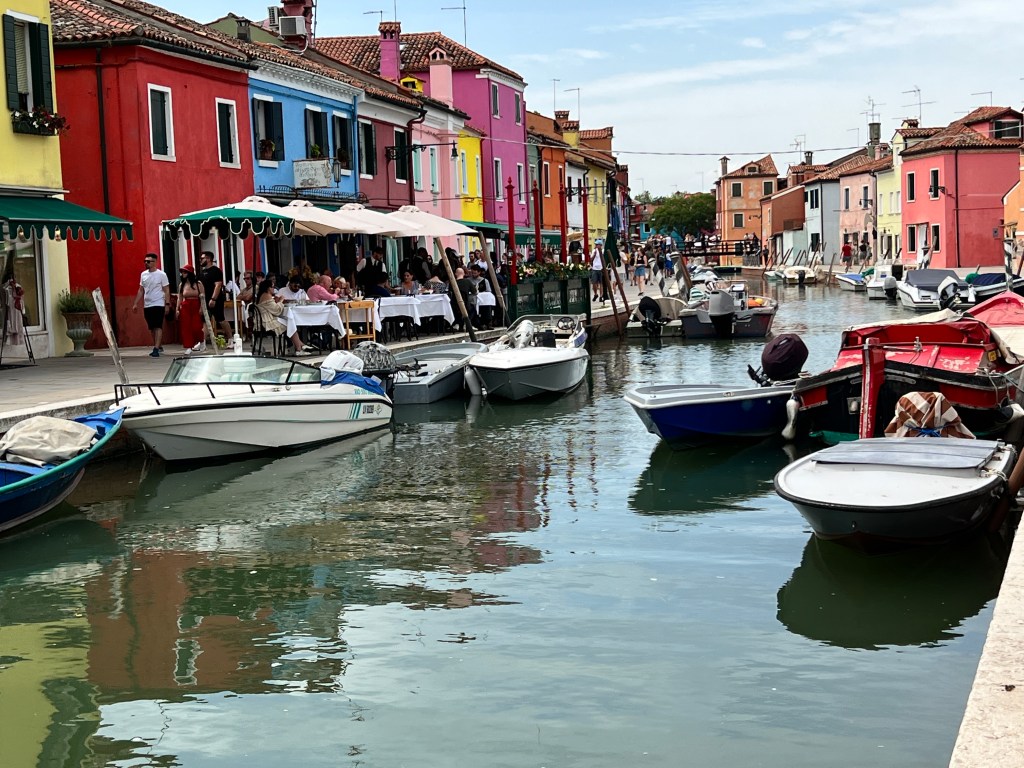
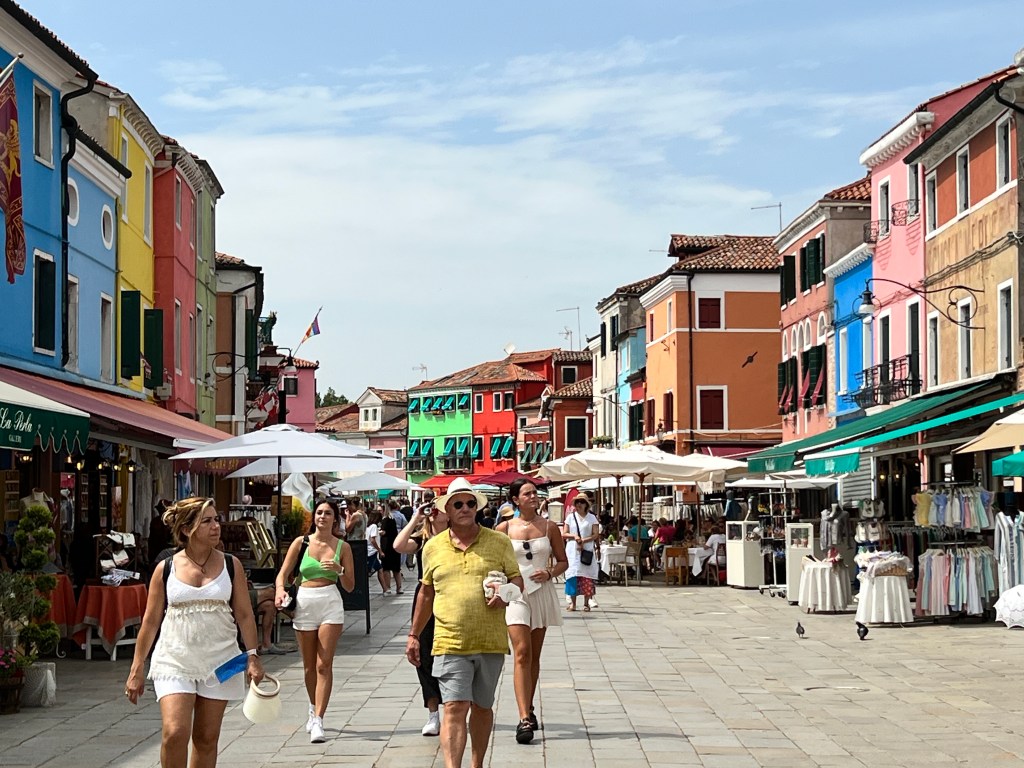
Our next island hop was to Burano. It is known for its lacemaking. The colorful village is a perfect place to explore. The main Piazza Galuppi is filled with tourists and shops selling locally produced wine and lace. We found a lovely shop selling Murano glass called Over the Colour. Since Burano was as close as were going to get to Murano, where glass is produced, we purchased a number of very pretty pieces of jewelry that are supposedly manufactured at their Murano location.

Approaching Burano, including its leaning tower.
Piazza Galuppi
Colorful and Charming
Canal running through Burano

Why are the houses painted such vibrant and different colors? Supposedly fishermen decided to paint the facade of their homes with an identifying color in order to be able to return there without worrying about entering the wrong home even with the thickest fog or even if they were somewhat inebriated. Residents are not allowed to change the color of their homes. It was enjoyable just walking about this charming place. It even has its own leaning tower.
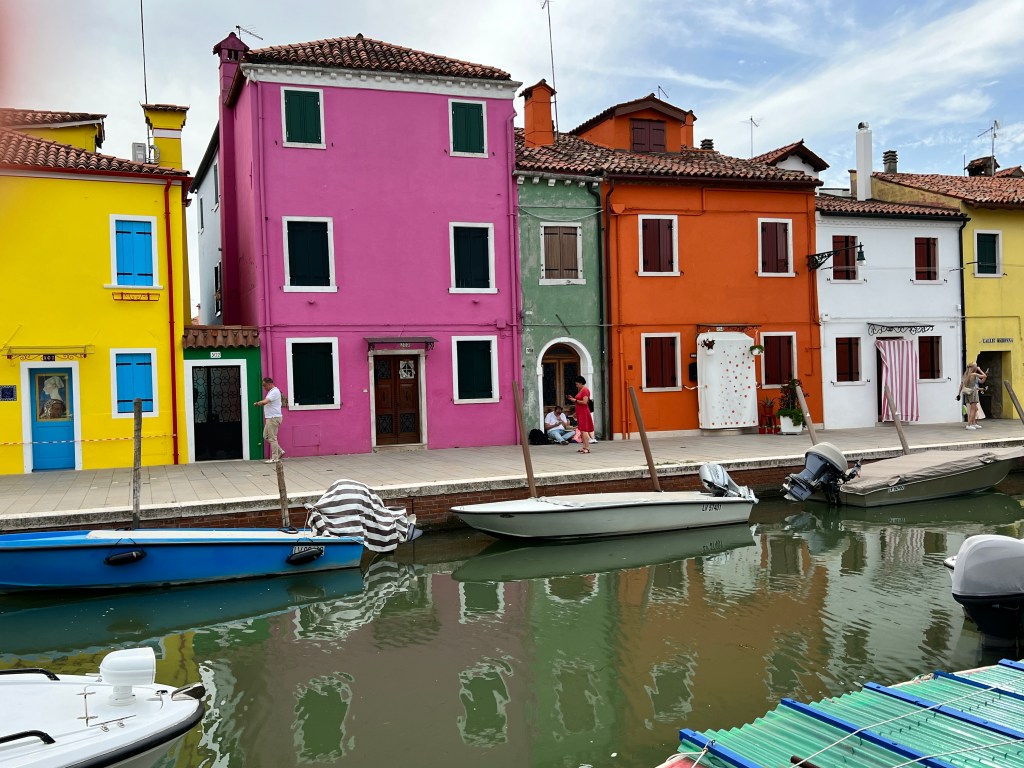
More color and charm
More color and love.
Leaning tower of Burano

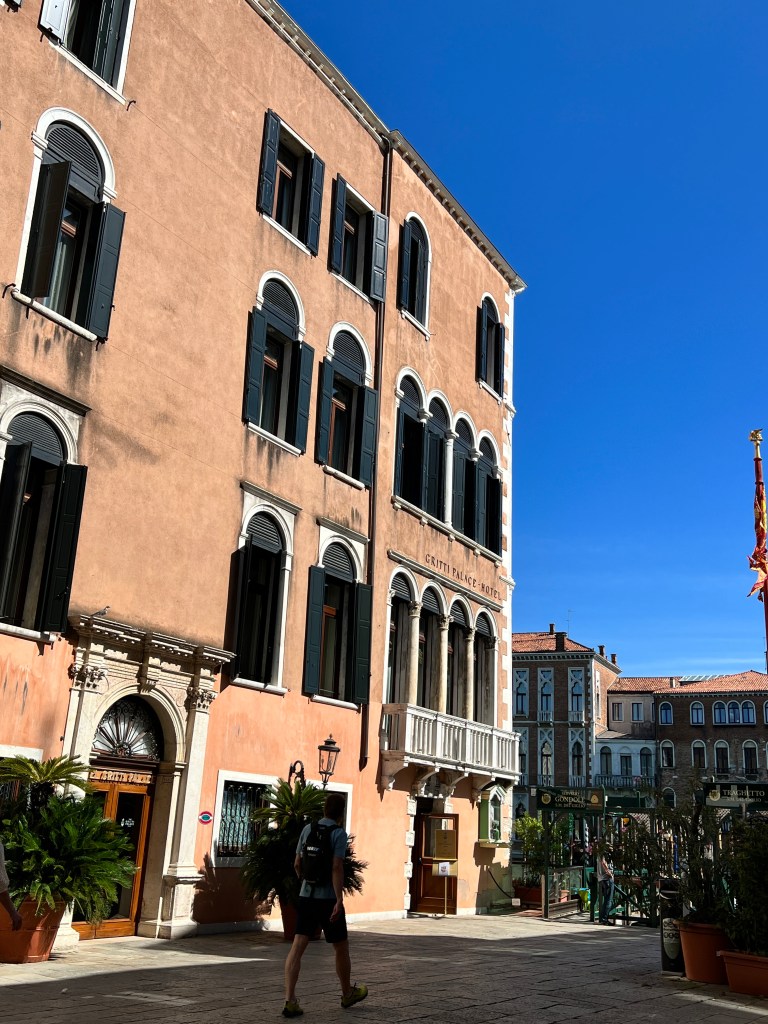
It was time to board our boat again. We were dropped off at the dock of the beautiful Hotel Gritti, which sits directly on the Grand Canal. Dan and I took a quick walk around our new neighborhood. and grabbed a tomato mozzarella sandwich from a local shop. Venice is jammed with tourists, narrow streets and shops, but what is super nice is that there are no motor vehicles to run you over.
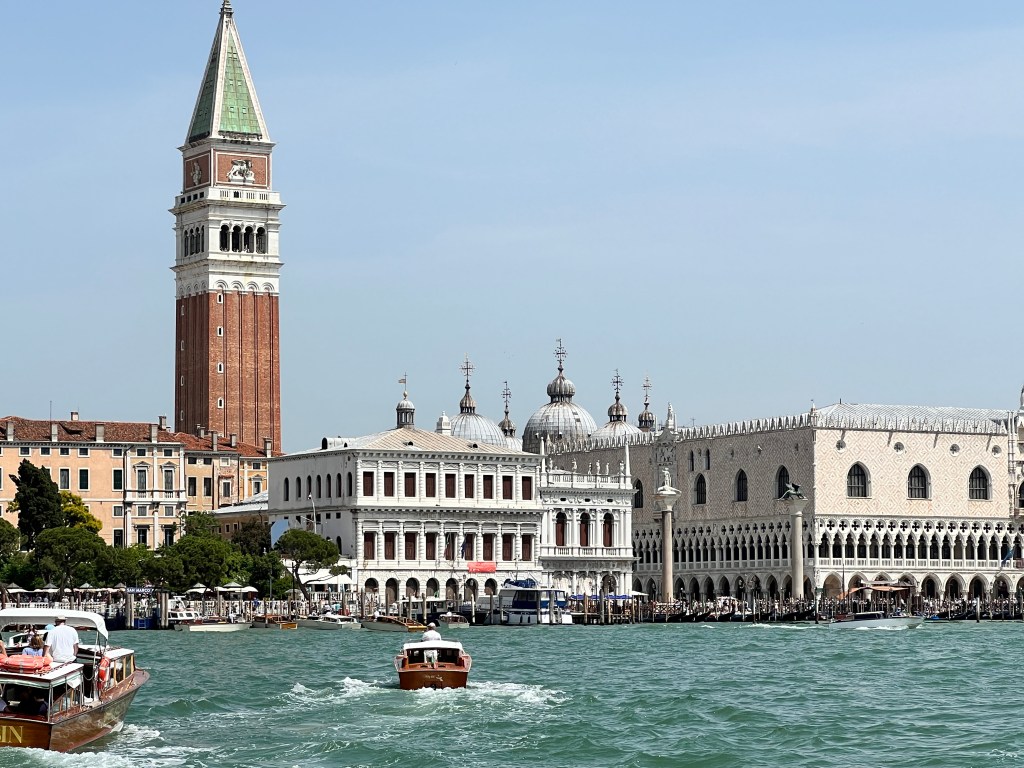
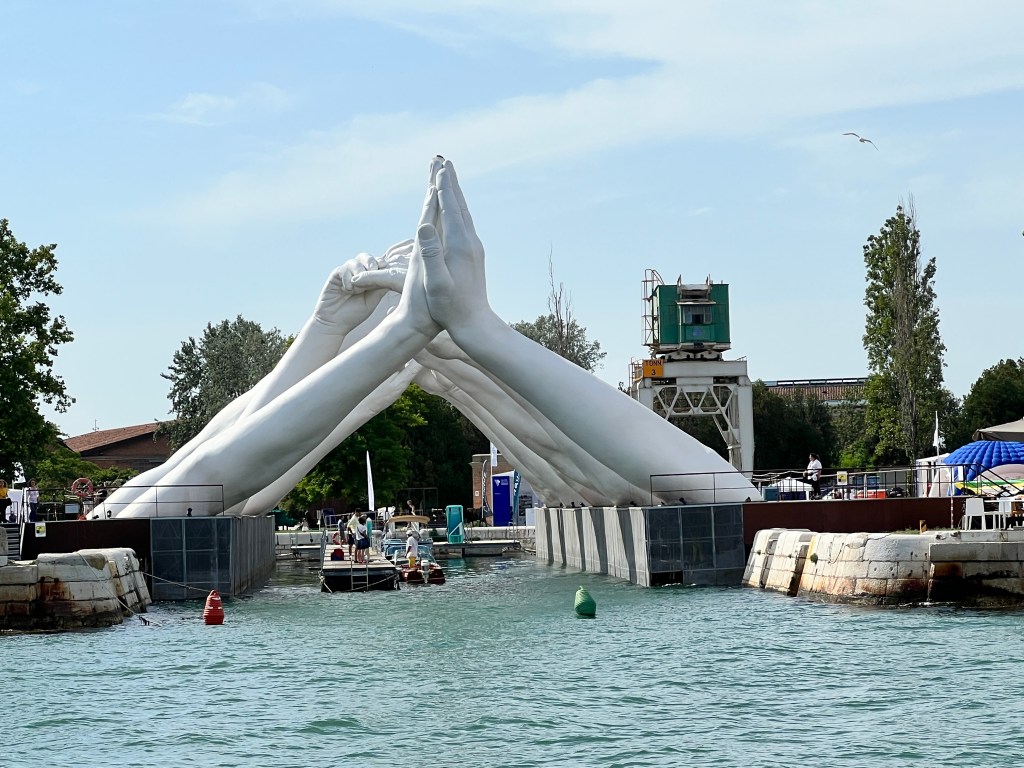
Our approach into Venice
Hand Sculpture by Lorenzo Quinn as seen from our boat arriving in Venice
Hotel Gritti

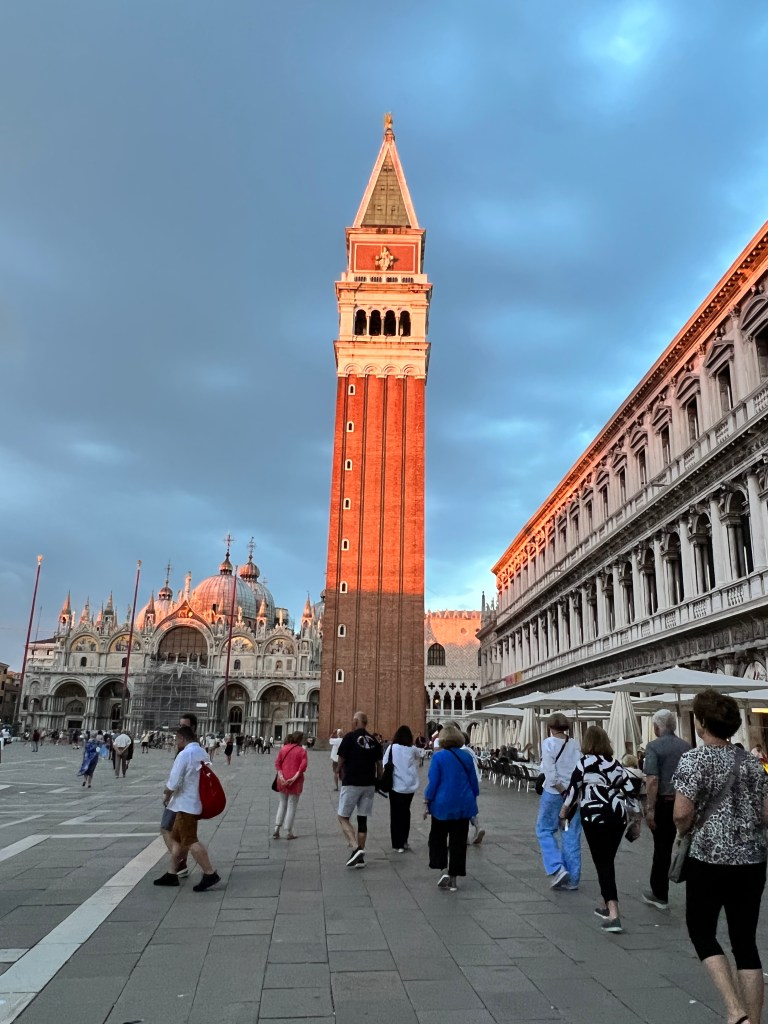
We had a chance to rest up a little bit before heading out to our evening activity, a visit to St. Mark’s Square (Piazza San Marco) and St. Mark’s Basilica. At just before dark we arrived at the immense St. Mark’s Square with the last of the day’s light hitting the Campanile. The grand square is surrounded by historic buildings, the Doge’s Palace, the Correr Museum, Torre dell’Orologio (clock tower) and St. Peter’s Basilica. At night there was also live music streaming from two cafes on opposite sides of the square.
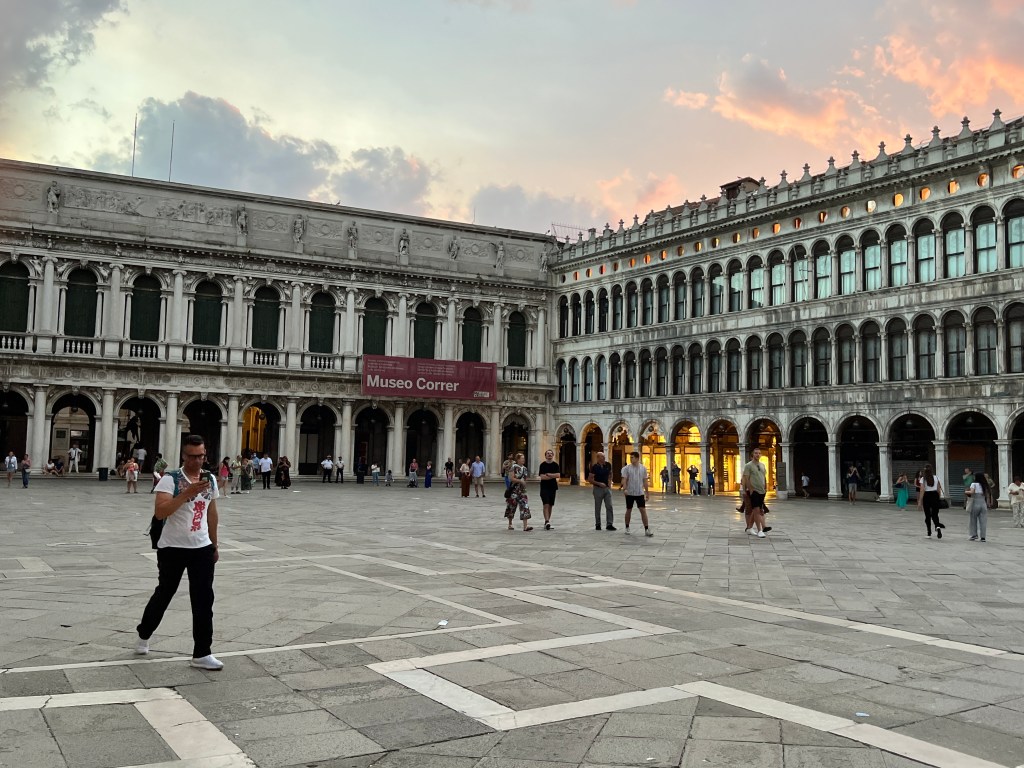
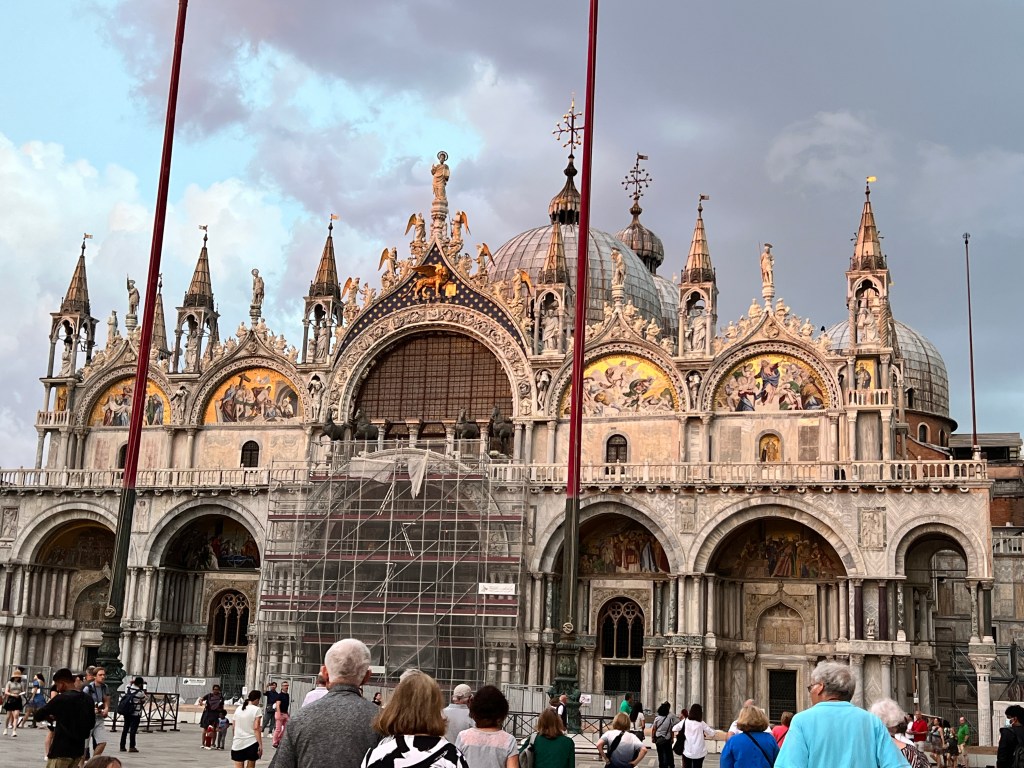
St. Marks Square
St. Marks Basilica
Campanile Bell Tower

As we waited to enter St. Mark’s Basilica, The Torre dell’Orologio (The Clock Tower) built in 1496, started to mark 9:00 PM. Two bronze men (Moors) swing their mallets hourly. It was then our time to enter the Basilica. Built in the 11th century it is decorated like a Eastern Orthodox Church, but is Catholic. The story goes that Venice needed a way to increase its status in the world. One way was to obtain the relics of someone truly special to represent the city. So, they went to Alexandria and stole the body of Mark, a writer of the New Testament. His body was hidden in a pork barrel. Since about 830 A.D. the saint’s bones have been housed on this site. However, several years ago his crypt was moved upstairs due to flooding.

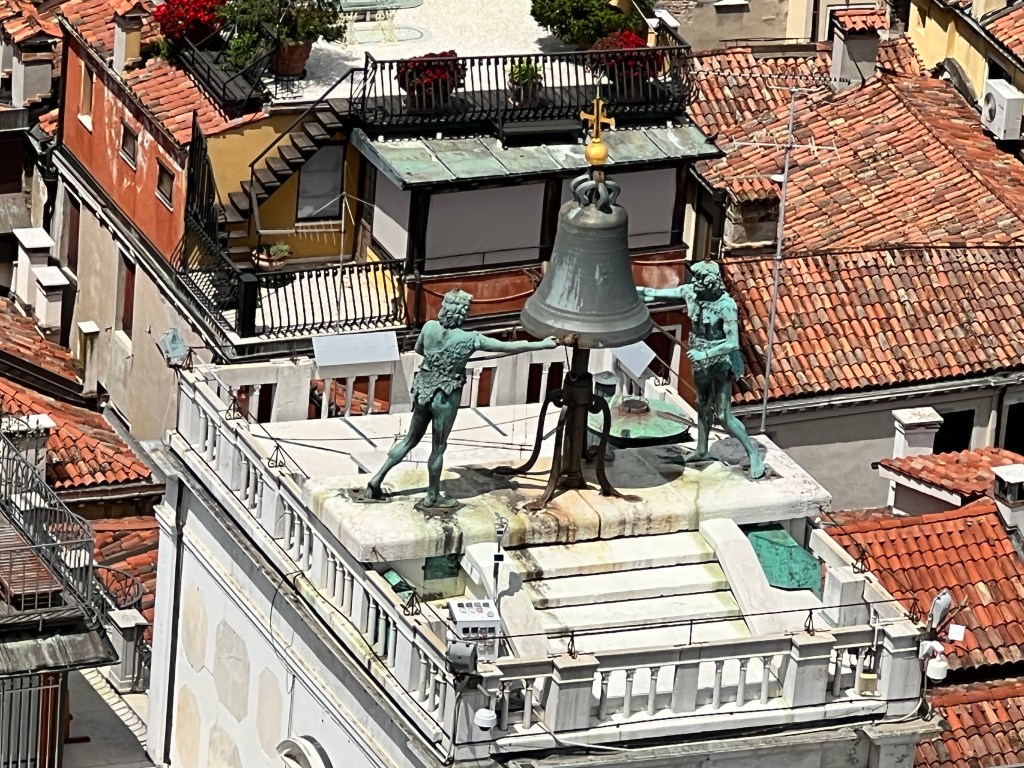
Torre dell’Orologio
Ringers of the bell taken from top of Campanile

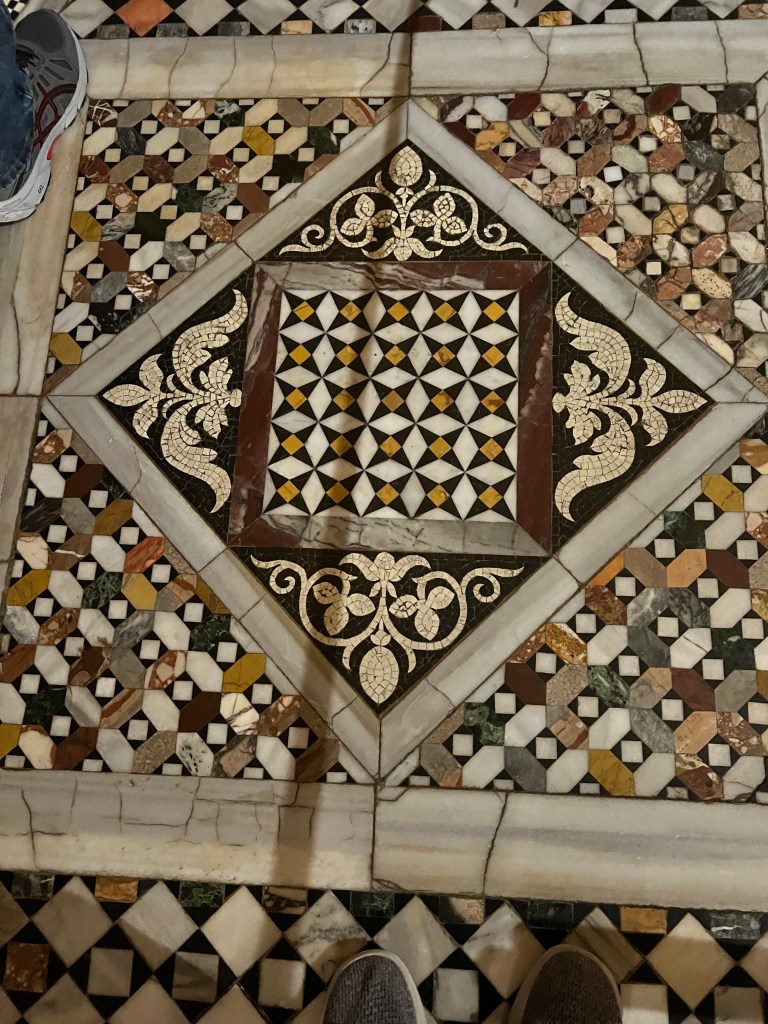
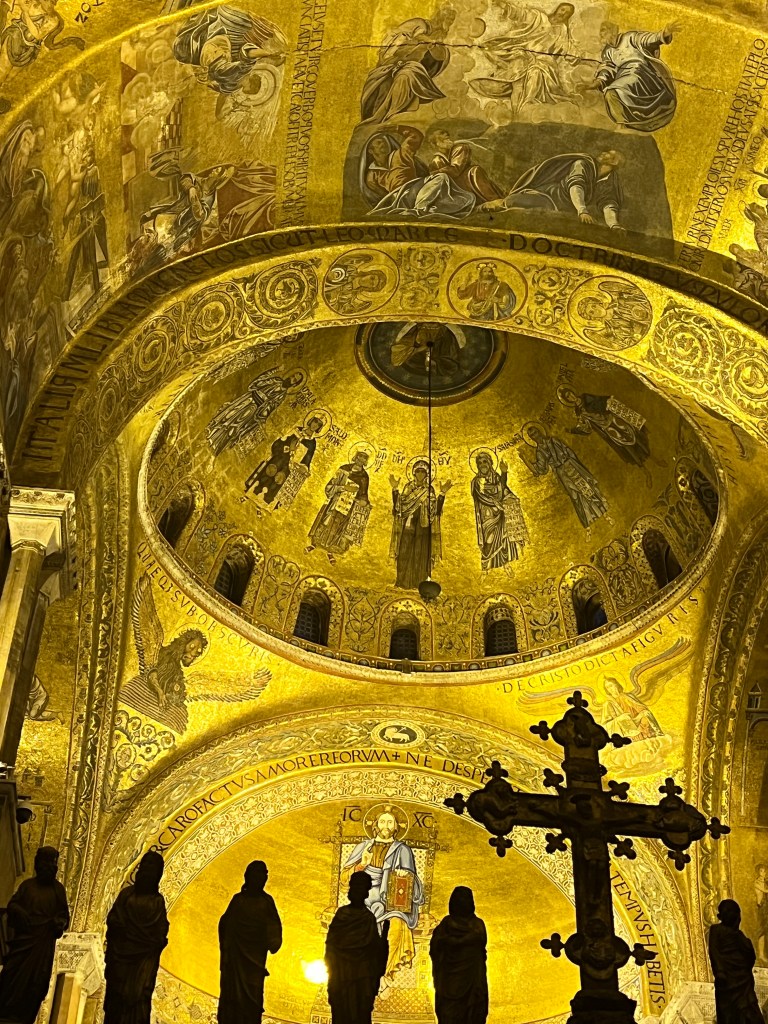
We sat facing the front of the church. It was kept dark as we sat and then all the lights were turned off. Slowly, area by area lights were turned on surrounding us in light and gold. It really was a incredible sight. The mosaics sparkling in all directions. The amount of time, and money involved in the construction of this place is almost impossible to imagine. The gold mosaic tiles were all cut slightly differently in order to catch and reflect more light, enhancing the effect of lanterns, candles and sunlight. Several mosaic scenes were pointed out to us such as the mosaic of Noah’s Ark and the Great Flood, and The Ascension Mosaic in the center of the central dome in the heart of the church. Even the floor is mosaic with geometrical designs. The floor has suffered from so much movement over the years it rises and falls like waves, so you have to watch your step.
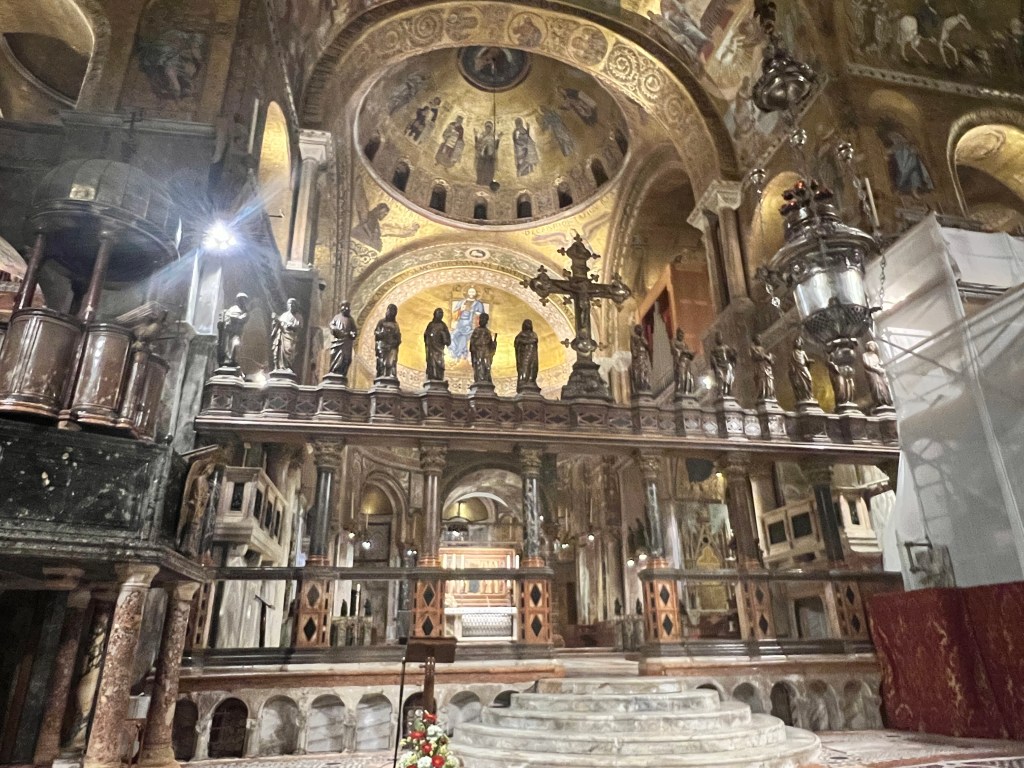
St. Mark’s Altar
Ceiling at St. Mark’s Basilica

Ceiling St. Mark’s
Floor in St. Mark’s

Saint Mark’s remains now lie beneath the high alter. Above the altar is the Golden Altarpiece which only faces the congregation a few times a year. It is made of 250 blue-backed enamels with religious scenes, all set in a gold frame and studded with 15 rubies, 300 emeralds, 1,500 pearls and assorted sapphires, amethysts, and topaz.
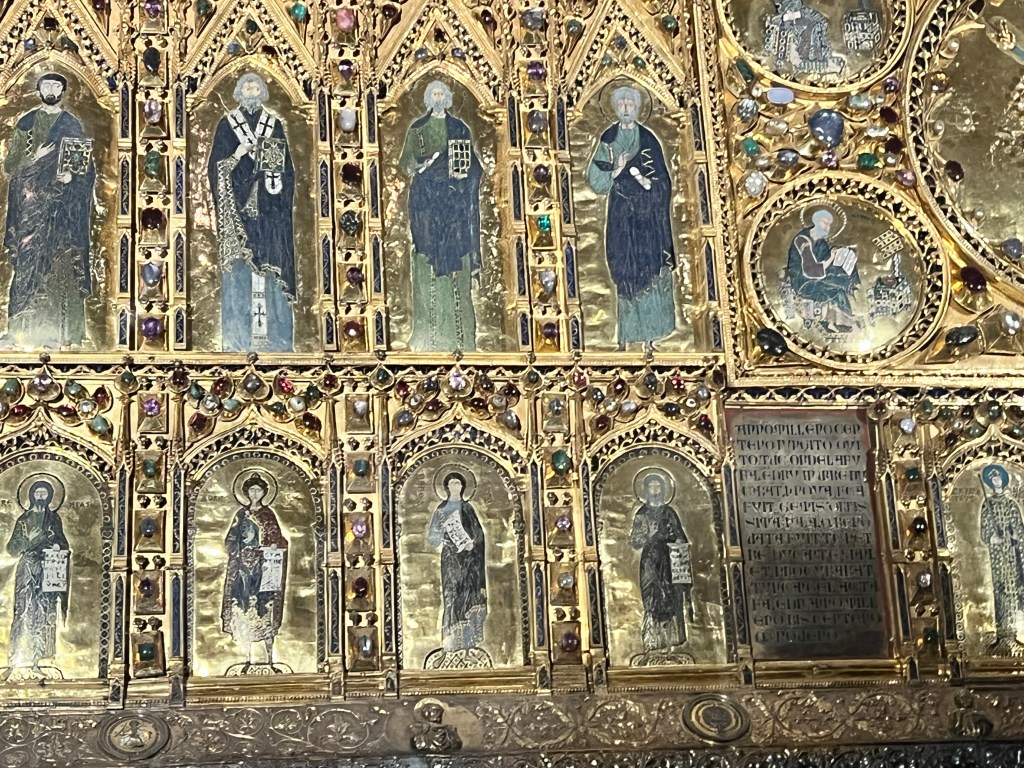
Golden Altarpiece

An interesting aside is that there are some that think the remains are actually those of Alexander the Great. Even if they opened the crypt, there may not be enough remains left to test, but the Church will not allow it. They believe it is Mark and that is the way it is going to stay.

Our time was up at St. Marks and all of us then headed back to the hotel. Tomorrow is our last day in Italy, and except for dinner, we are free to explore on our own.

Day 20 Taking it easy in Bologna

We were up at 8:00 AM and I went down to the front desk to ask for the best way to contact a doctor. I was told that they would contact the hotel doctor, and even though he was on vacation, he should get in touch with us this morning.

After waiting until close to noon, I went back downstairs for an update and was told that the doctor had not called them back. I must admit I got angry asking why we had not been updated, and that I was upset that an entire morning had gone by without doing anything to help my husband. I told him that there must be alternatives that we should be looking into. Doing nothing was not an option.

The young man at the hotel admitted he should have kept us informed and made several phone calls, none of which amounted to anything. I went upstairs completely expecting Dan and I would have to go to a hospital emergency room when the phone rang. The hotel doctor would be calling our room directly.

Dr. Stefano Crooke called within a minute of that conversation and spent a long time on the phone with Dan. He prescribed some medications that he thought might help until we could get home. His English was perfect, and he was asking all of the right questions. We were very grateful he took time from his vacation to give Dan a call.

We checked with the hotel desk for the nearest pharmacy, and had them make an appointment for Dan to take a COVID test. Then off we went in search of drugs. As I mentioned earlier, it is easy to spot a pharmacy because they are clearly marked with large green crosses. There was one close to the hotel. It is interesting that the pharmacist handed back the prescription after filling it. Does that mean we could go elsewhere to have it filled again? Or would computer records prevent our doing so? Dan also had a COVID test that came back negative.

I think talking to a competent physician, and getting new drugs that should help quell his cough, made us both feel better. We decided to take a walk so we could see a bit of Bologna. Down the street from our hotel were two leaning towers from the 12th century located in the Piazza di Porta Revengnana.

Two Leaning Towers

The Torre degli Asinelli and the Torre Garisenda were strategically located at the point of entry to the city. The Torre degli Asinelli was built in the 11th century and named after the family that commissioned it. At over 97 meters it is the tallest in Italy. The two towers used to be interconnected with a walkway and suspended passageways. They are both learning, but in opposite directions. During WWII the Asinelli tower was used as a watch tower. During bomb strikes volunteers were positioned on top to observe where bombs hit so ambulances could be dispatched quickly. Apparently leaning towers are not uncommon. I am not sure why the leaning tower of Pisa became such an icon.

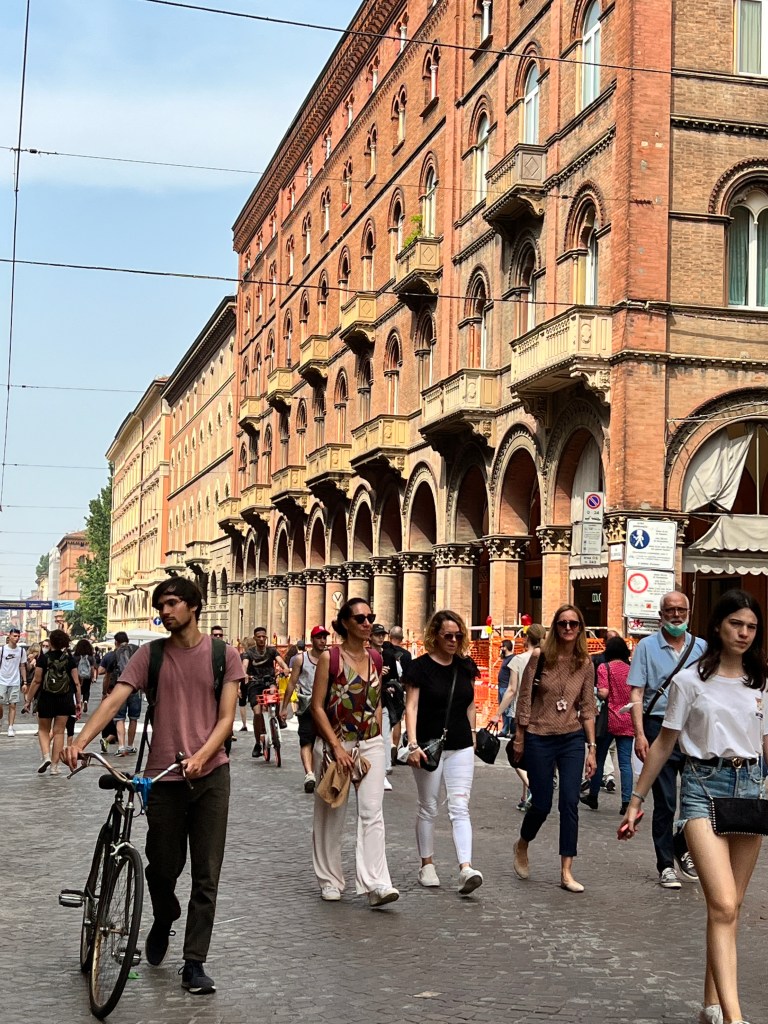
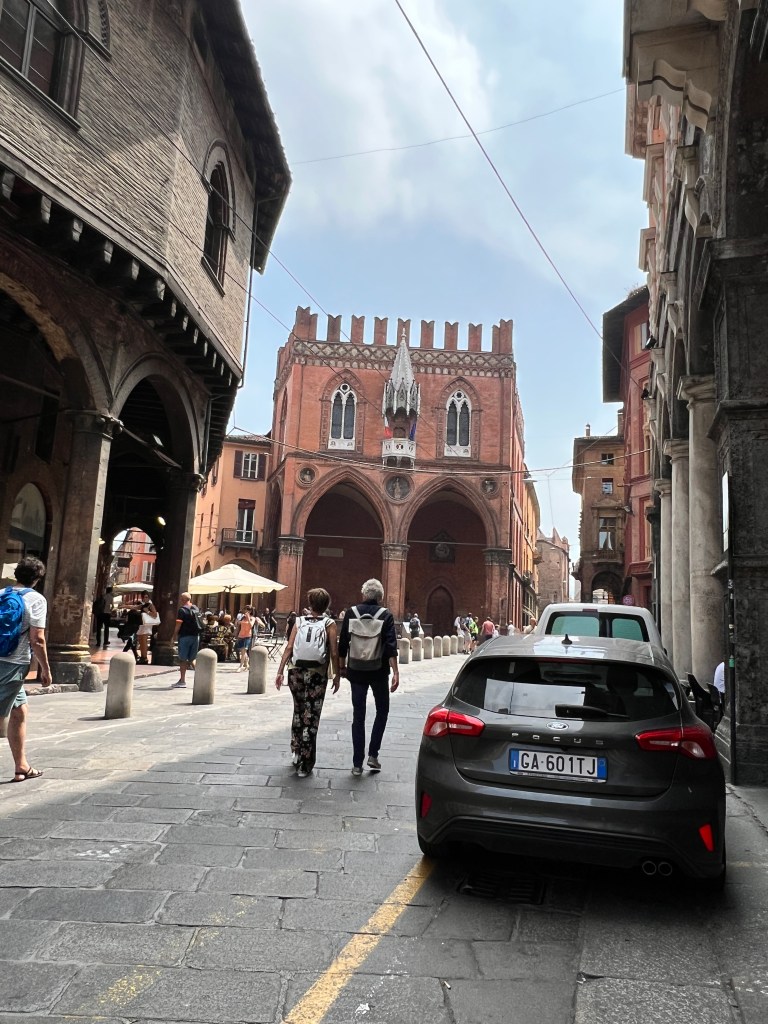
Bologna is a city of porticos. They are really a nice idea since they keep you dry from the rain and they protect you from the hot sun. In addition, they are architecturally attractive. We walked by the Piazza and Palazzo della Mercanzia. The old market district was right in front of the palazzo. The palace, built in 1391 was used for customs and taxes. Judges of the Merchants would use the small balcony when reading verdicts and communications to the public.

Porticos
More porticos
Palazzo della Mercnzia

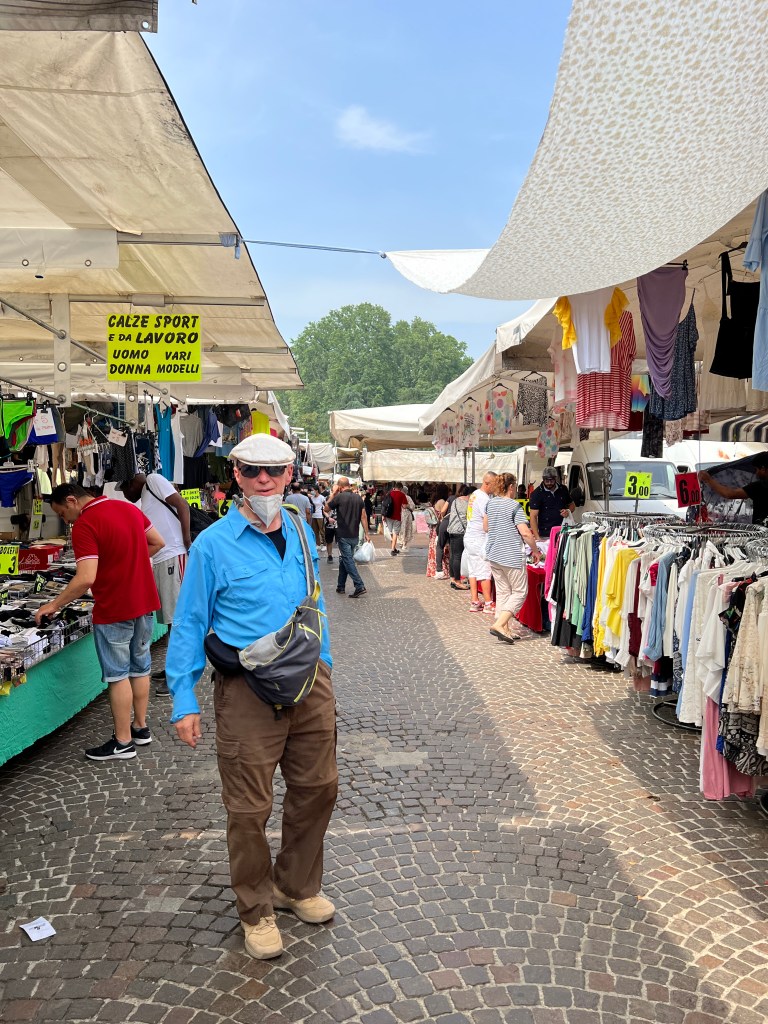
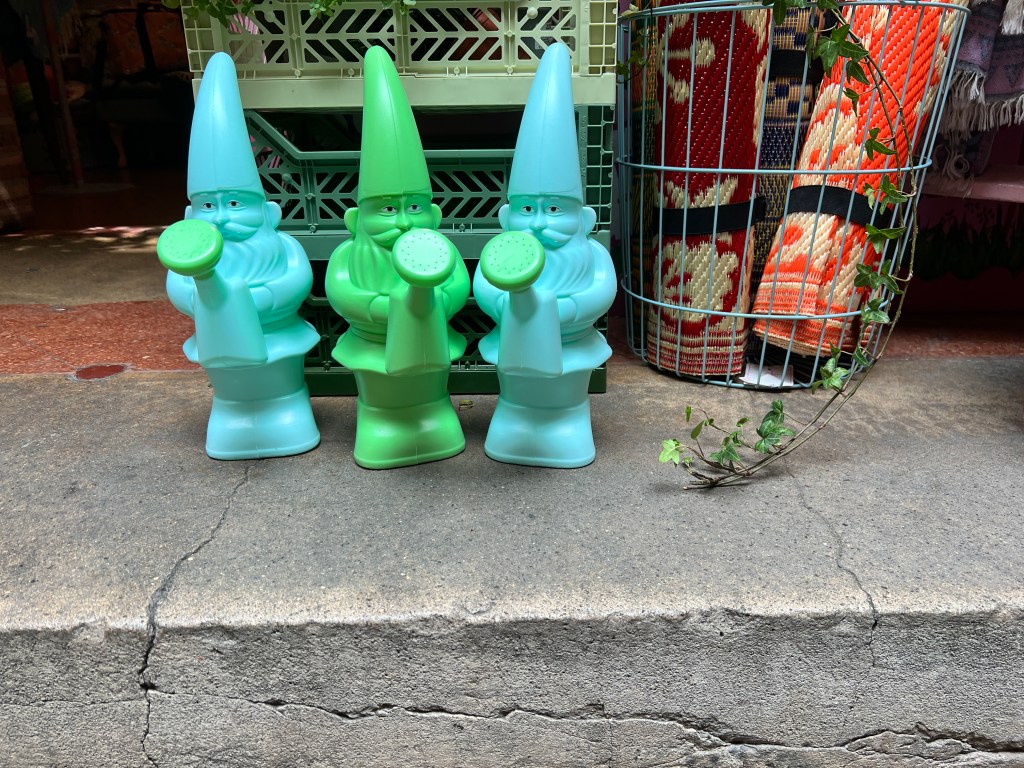
We walked through the Piazza Santo Stefano. It is a pedestrian zone often used for cultural events, flea-markets and concerts. There were some interesting shops along the way selling unique items such as plastic garden gnome watering cans. We also stopped for pizza at Fra Diavolo whose signage read EAT PIZZA, MAKE LOVE. Left over from the 60’s? We also passed by a huge outdoor market selling all kinds of wares including clothing, shoes, glasses, kitchen supplies, etc.

Garden Gnome Watering Cans

On our way back to the hotel we paid another visit to the Piazza Maggiore. This time we saw a street artist playing classical music on an electronic piano in the middle of the square. We also saw a streaker get arrested after making a mad dash across the square. Just another late afternoon of frivolity in Italy. After such entertainment it was time for a cooking class.

Piazza Maggiore

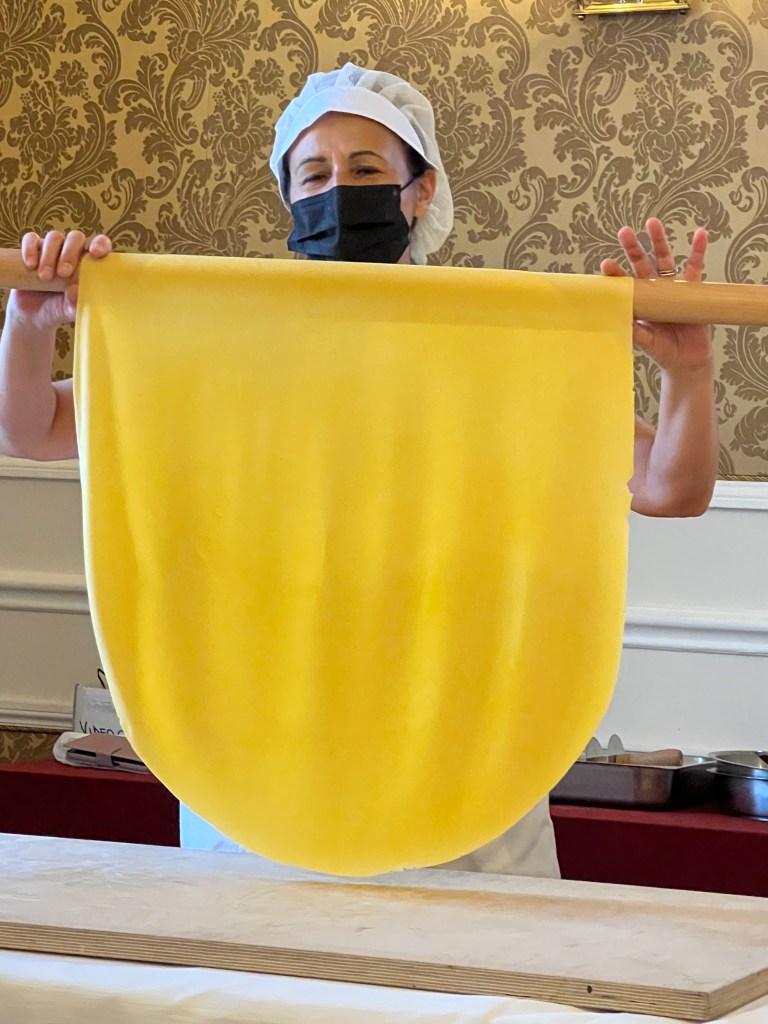
The head chef of the hotel, along with the hotel’s expert pasta maker, gave us a quick lesson on how to make Tagliatelle with Bolognese Ragu and Rice Cake. The pasta maker was very talented. She created a ball of dough made from white flour, semolina flour, and eggs. While the chef and his translator explained how to make Ragu, she continued to work the dough. Eventually it was turned into a large, extremely thin sheet. She then showed us how when the dough is cut in a certain way and rolled or twisted in a certain way it can be turned it into a variety of different types of pasta. It was like a magic trick. Dinner that night was at the hotel’s beautiful dining room and consisted of the recipes they showed us how to make. All delicious.

Not sure I’ll ever try doing this at home.

Dan is giving his new meds a try tonight. Hopefully we will both get to sleep. Today did give us an opportunity to rest up and our travel companions feel more relaxed knowing that Dan tested negative.

Day 17 Bergamo, Vino, and Verona

We could have used a few more days of destressing in Stresa, but that isn’t how Tauck tours work. It was another early morning departure. I was up at sunrise, a very unusual event for me to witness. Then after breakfast it was back onto the bus as we headed out into the countryside toward Bergamo.

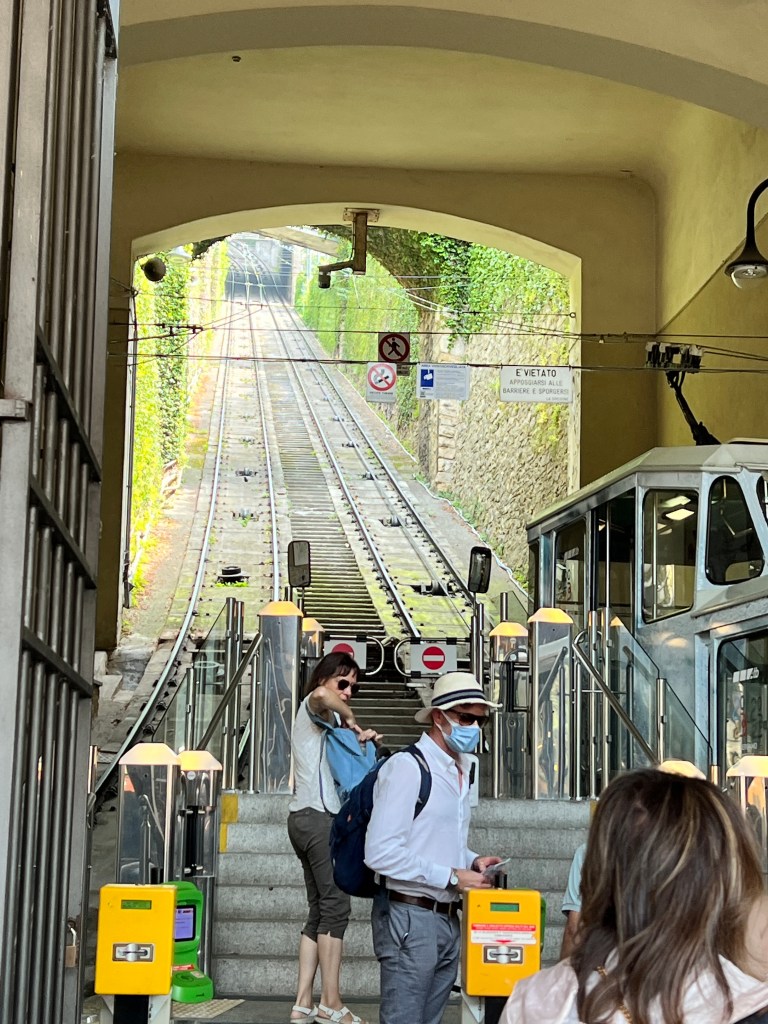
Bergamo has a split personality. The upper city, Citta Alta, is a medieval and Renaissance town up on a hill. Down below is Citta Bassa, mostly built in the 19th and 20th centuries. Our guided tour was in the old part of Bergamo. In order to reach it we had to take a funicular up a steep hill.

Funicular up to Citta Alta
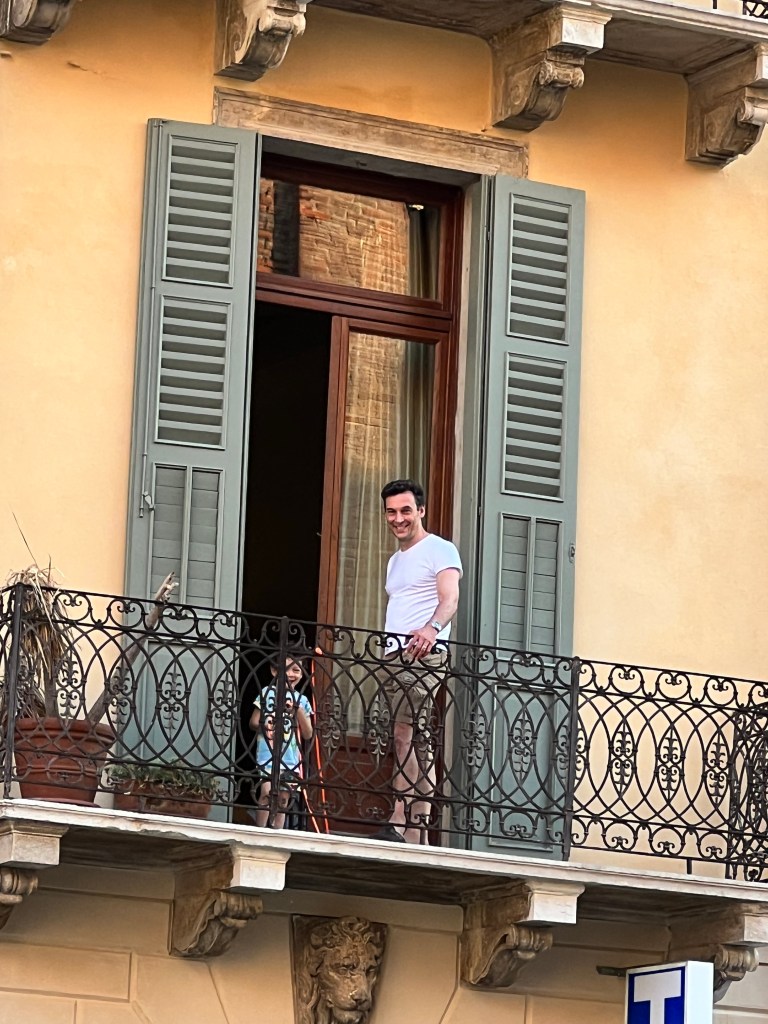
People still live in the Old City

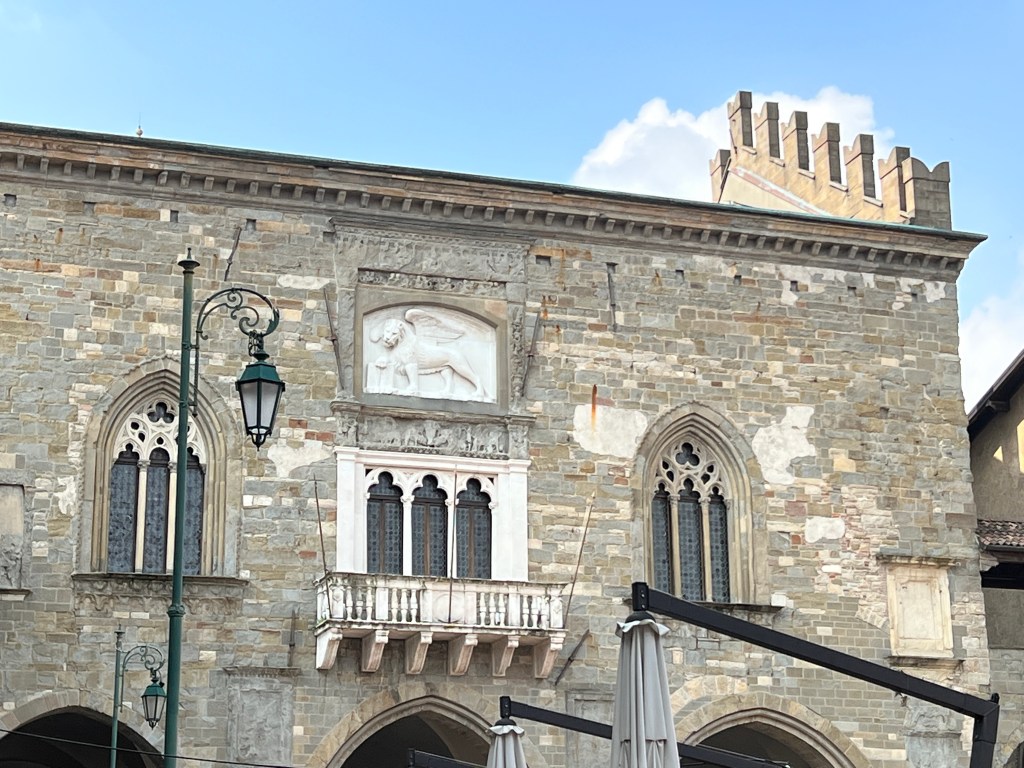
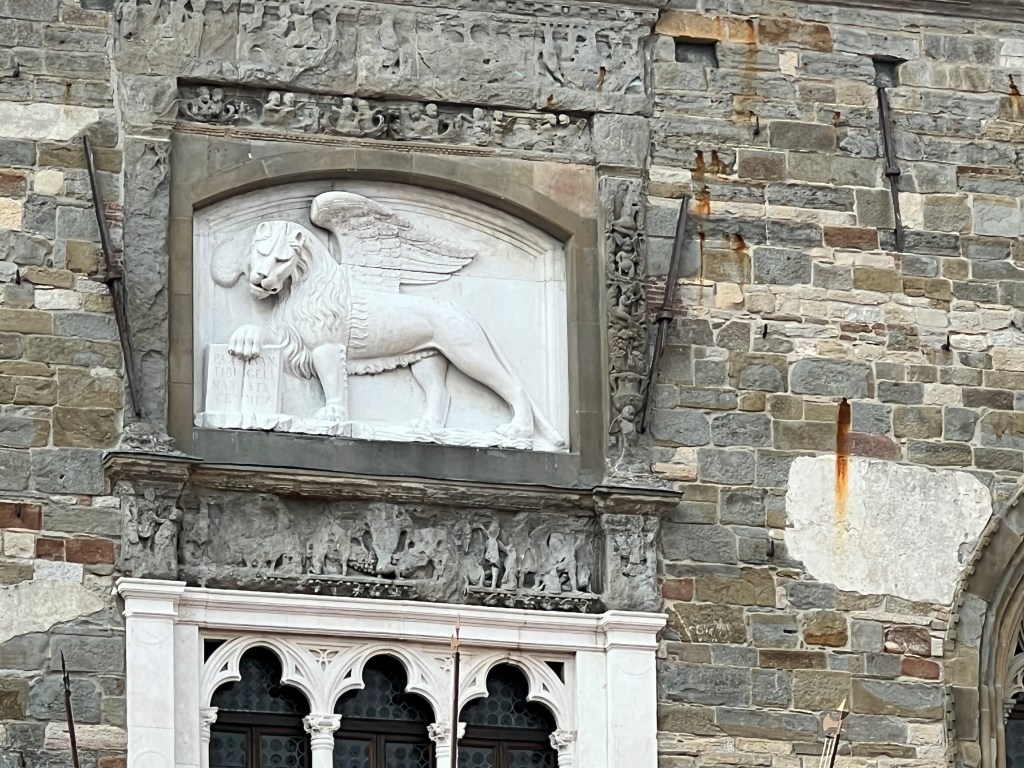
The old part of the city is surrounded by a 16th century Venetian wall. Our tour guide led us to the beautiful Piazza Vecchio, the hub of Bergamo’s political and civic life from medieval times. The 12th century Palazzo Della Ragione (Court of Justice) was built by the Venetians who ruled from the 13th to late 18th century,. It is said to be the oldest communal palace in Italy. You can see the Lion of St. Mark, the symbol of the Venetian Republic, on the building. There was also a meridian line under the arches of the palazzo.

Palazzo Della Ragione (Court of Justice)
Venetian Lion

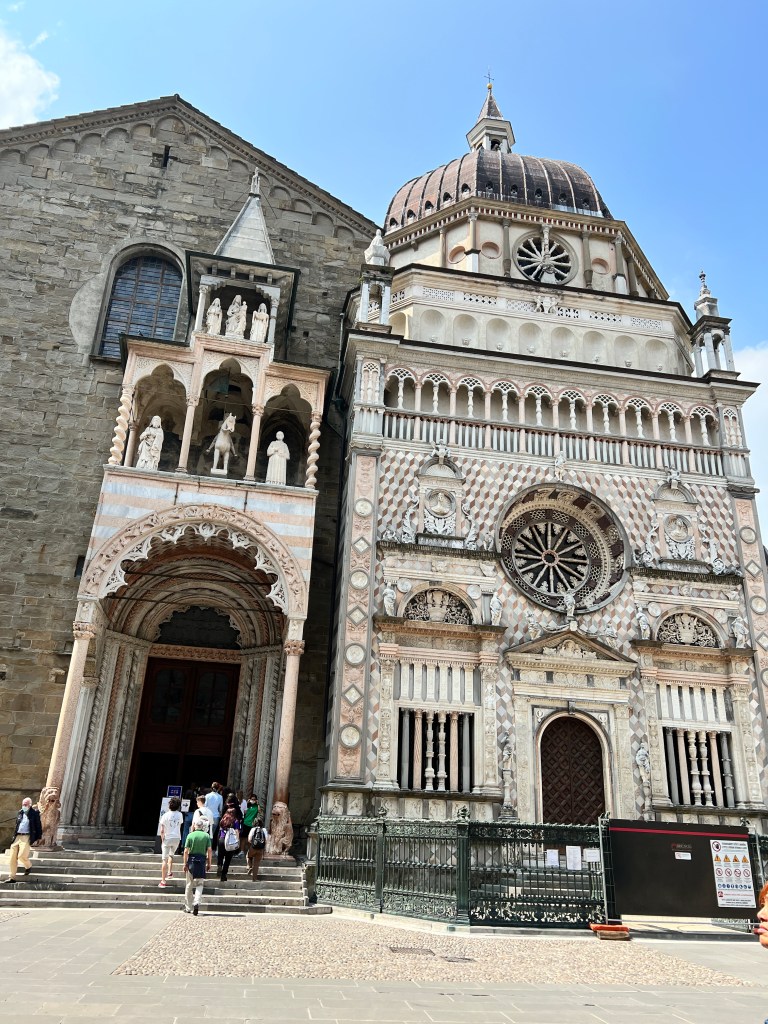
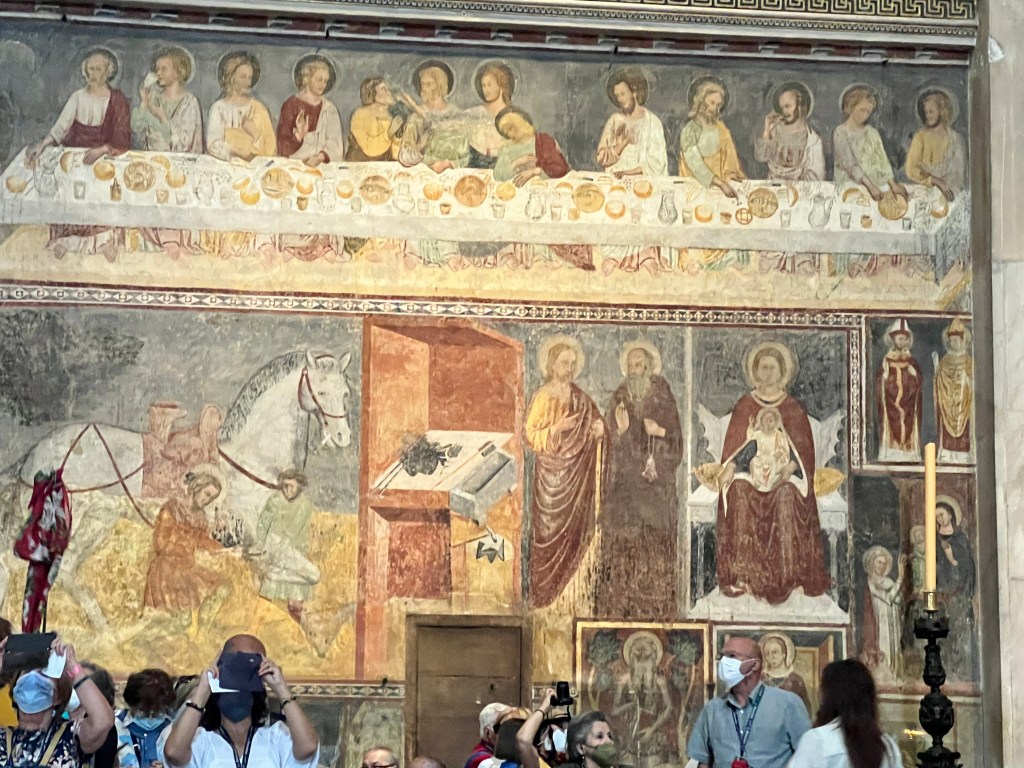
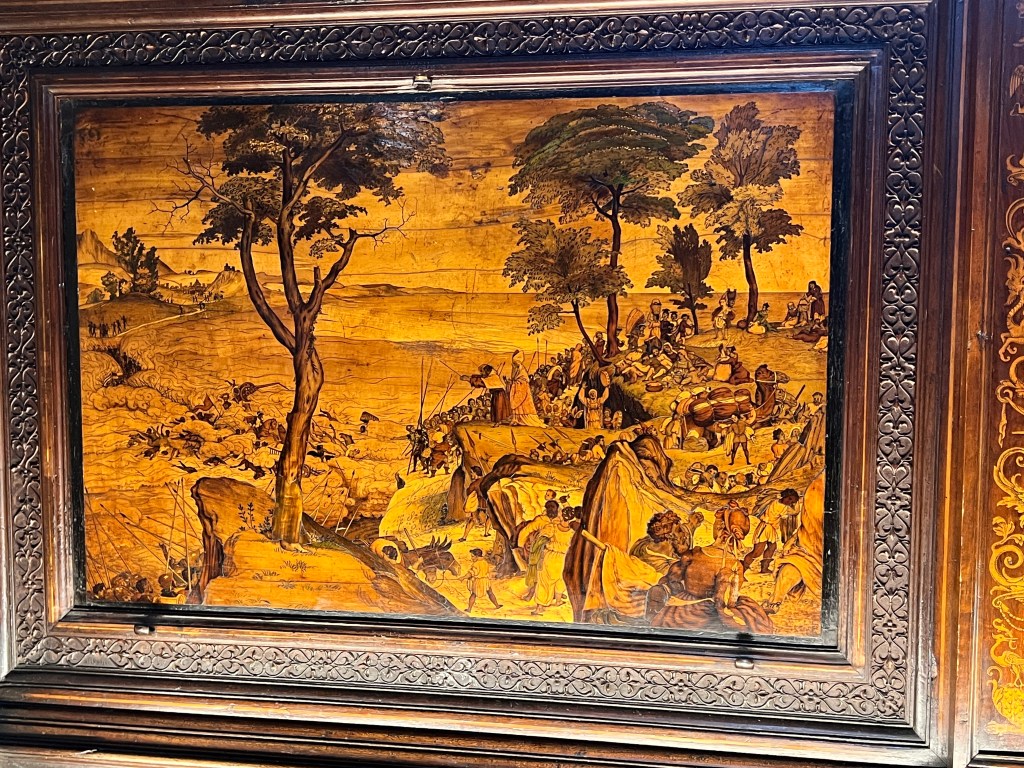
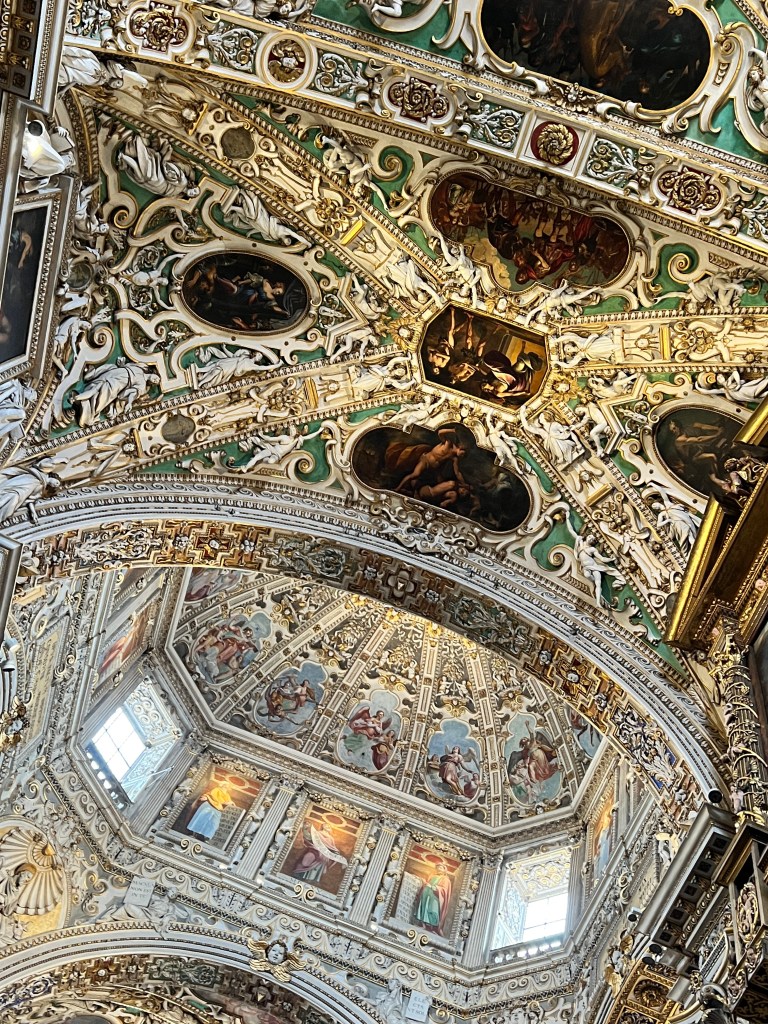
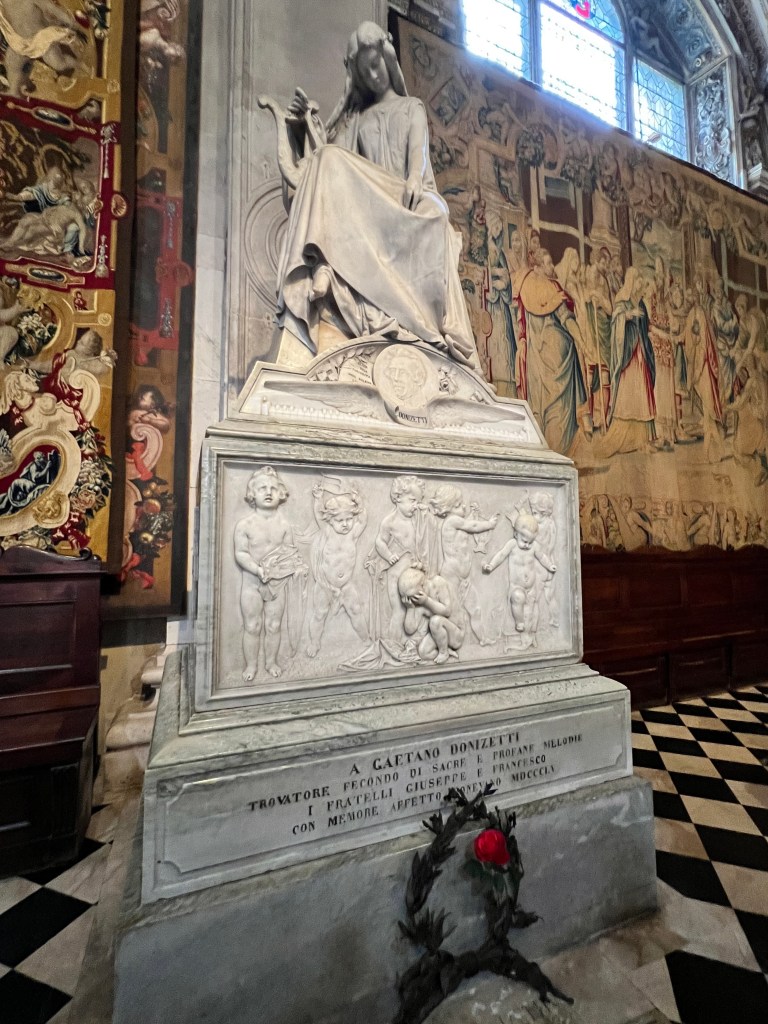
We walked through the arches of the Palazzo Della Ragione to reach the Piazza del Duomo and the Basilica di Santa Maria Maggiore. The church is filled with ornate Baroque giltwork. It really was a hodgepodge of excessive decoration. There were Renaissance tapestries, intricately pieced together inlaid wood pictures, the tomb of Gaetano Donizetti a popular composer in his time, and a simple fresco fragment that depicts the last supper.

The entrance to the Duomo is on the left and the Cappella Colleoni is on the right.
Tapestry
Tomb of Gaitano Donizetti
Inlaid Wood picture
Opulent Decoration of Duomo ceiling

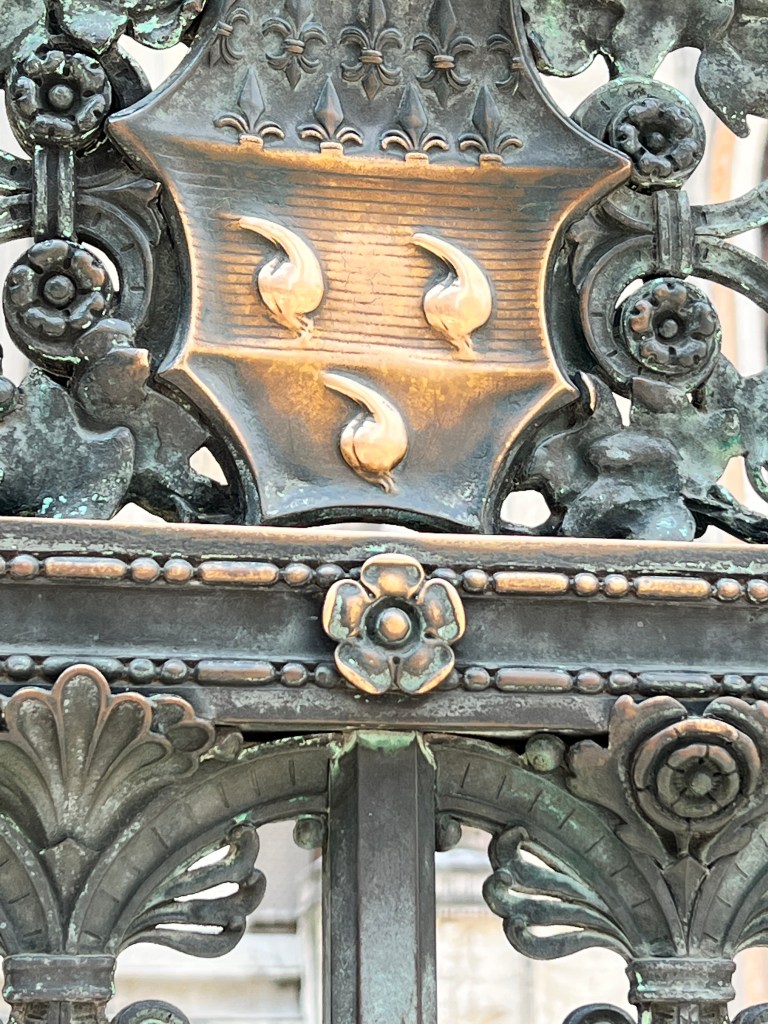
The Cappella Colleoni, located near the basilica, is the burial chamber for Bartolomeo Colleoni. He was a mercenary who fought for the Venetians. As a reward for his loyalty he was given Bergamo to rule as he wished. On the front gate pictured below you can see the coat of arms of the Colleoni family which consists of three testicles. Colleoni means testicle. It’s not clear why there are three. There is no evidence that Bartolomeo suffered from any congenital anomaly. Perhaps three was simply more powerful than two. Some believe that it is good luck to rub them, which is why they are shiny. One guide book stated that “it is the closest one can get to touching a medieval mercenary’s testicles.” I passed on that one.

Colleoni Coat of Arms

As a treat, Scott purchased some famous Bergamo pastries for each of us to try, Called Polenta e Osei, they are made from sponge cake using maize flour, covered with yellow marzipan and then dusted with crystals of yellow sugar. Inside is a chocolate and hazelnut cream. The chocolate shapes sitting on top in an apricot jam represent birds. It is a very complex dessert and a very sweet one as well.

Polenta e Osei

After our tour we had about an hour to explore Bergamo on our own. I purchased a white blouse that I just happened to spot in a shop window. It was then time to take the funicular back down to our bus. Our destination was a wine tasting and lunch at the Cantina al Rocol in the Franciacorta wine region.

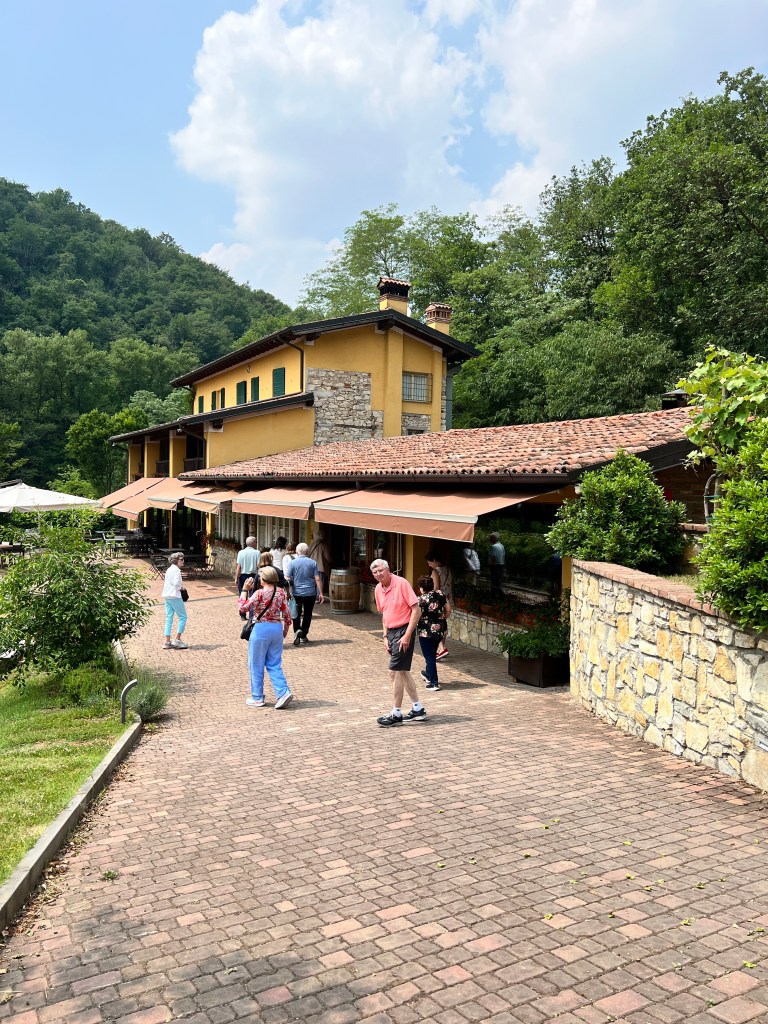
Cantina al Rocol

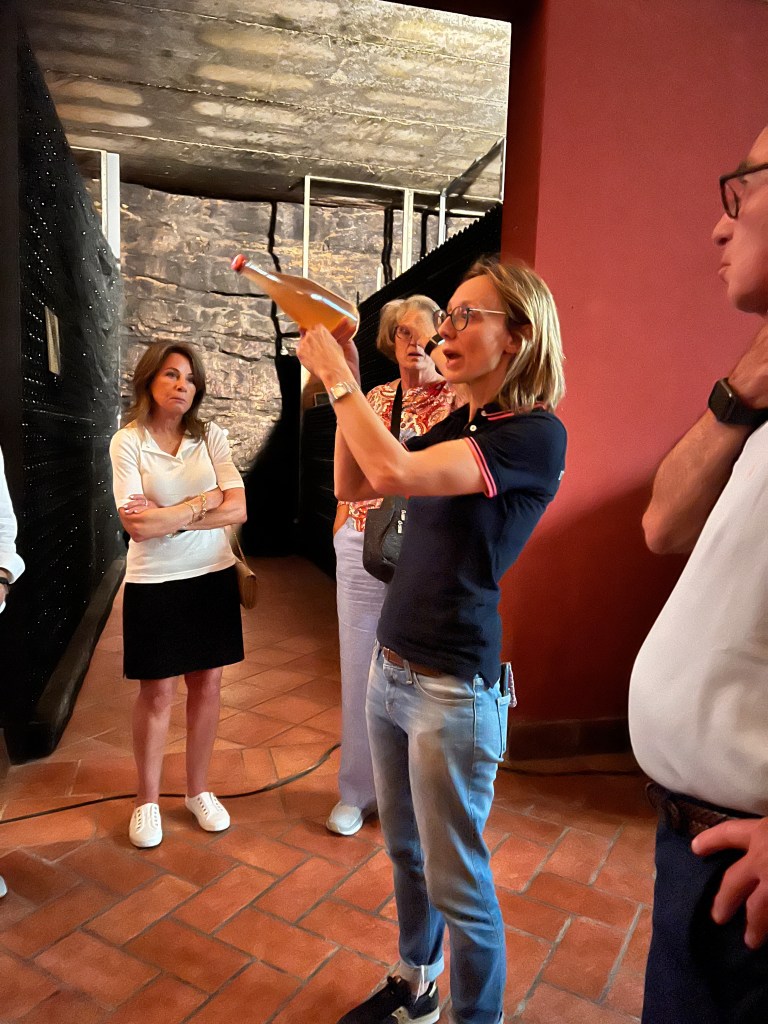
The Castellini family has owned the vineyard and winery since the beginning of the 20th century. I believe it was Francesca Castellini who gave us a tour of their facility. She explained how their main product is Franciacorta wine. Franciacorta is a sparkling wine similar to champagne. Francesca stated that they produce it in exactly the same way champagne is produced, but since it isn’t made in that region of France it cannot be called champagne. The family also produces other wonderful wines. All of their wines are made from grapes grown in their vineyards including Charadonnay, Pinot Blanc, and Pinot Noir.

Francesca explaining the wine making process
Franciacorta in storage

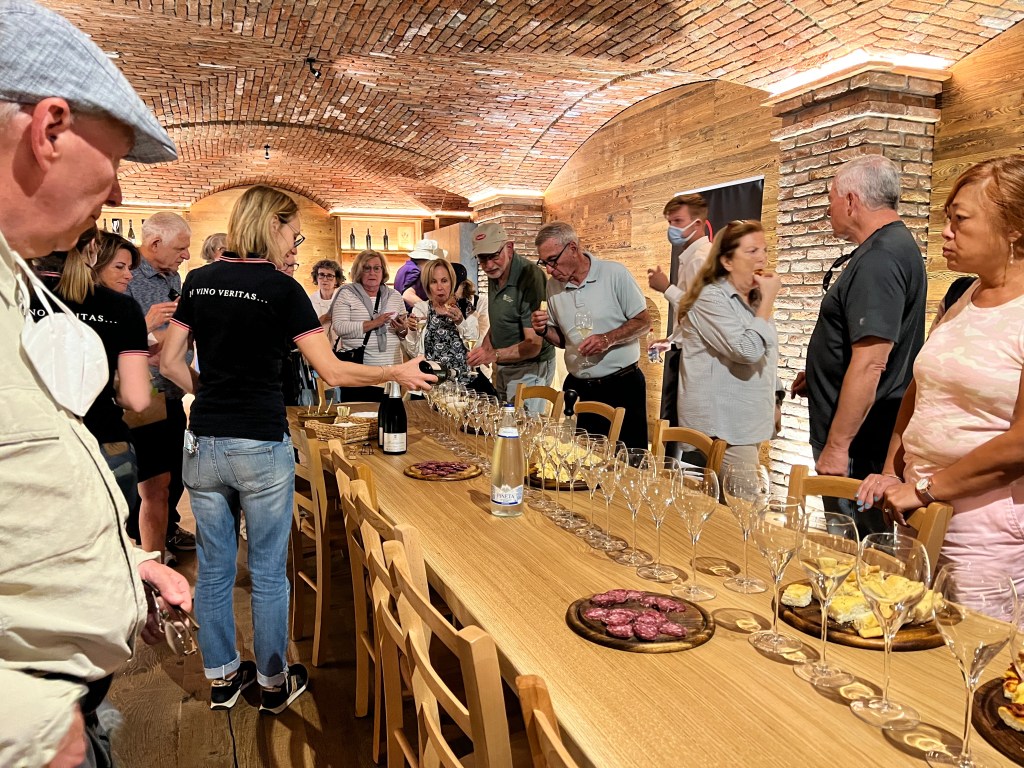
We had the opportunity to try their wines with various delicious tidbits. First there were several items of cheese and meats followed by an absolutely fantastic pasta. Simple but delicious. This is one agritourismo that I think would be a wonderful place to stay.

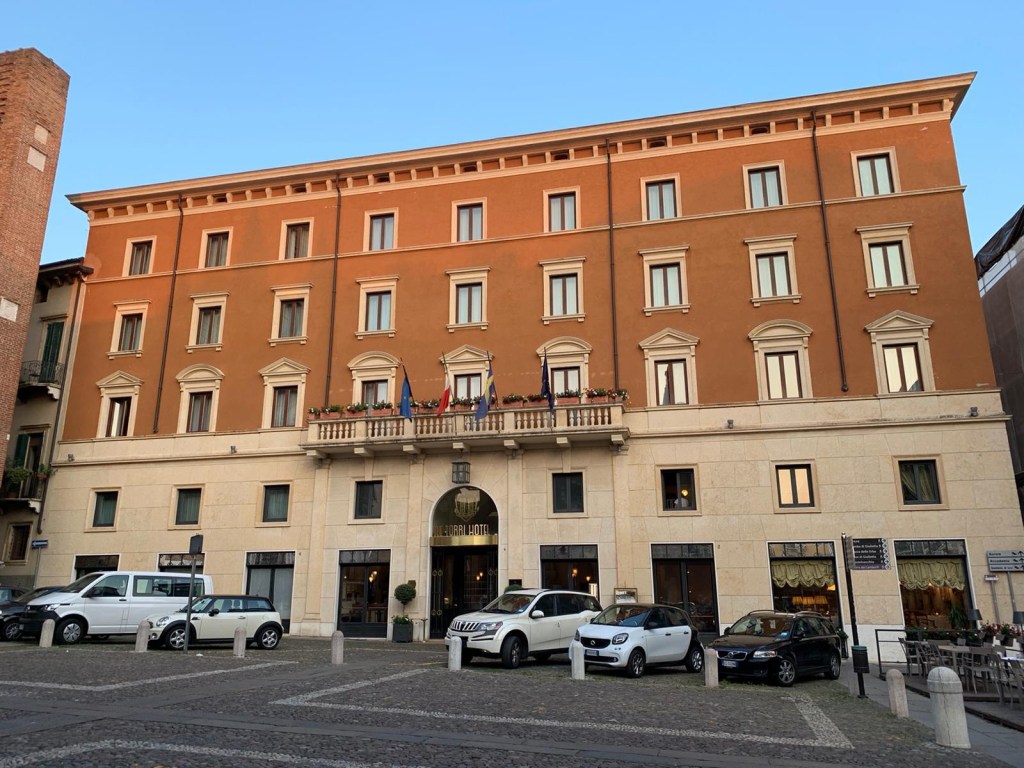
Finally we were heading to our final destination, Verona. Our hotel is the Baglioni Due Torre. Buses are not allowed in the historical center of town, so vans had to transfer us to the hotel with our luggage to follow. According to my friend Eileen, the hotel building dates back to the 1300’s and has hosted people such as Mozart,, Goethe, and Garibaldi.

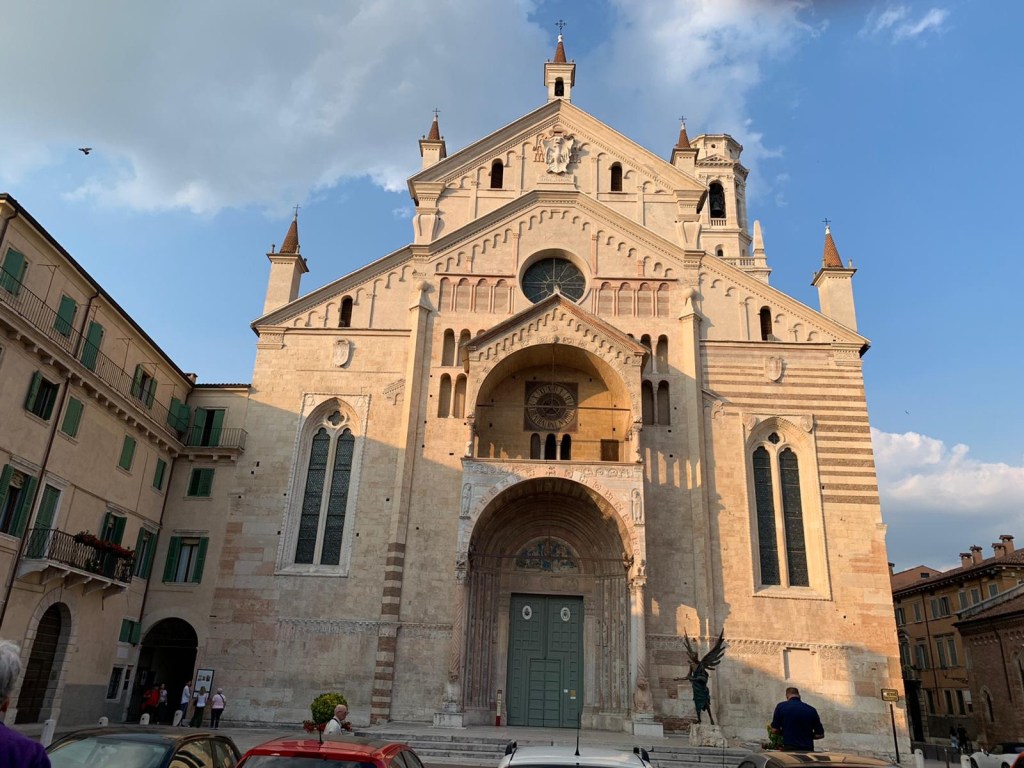
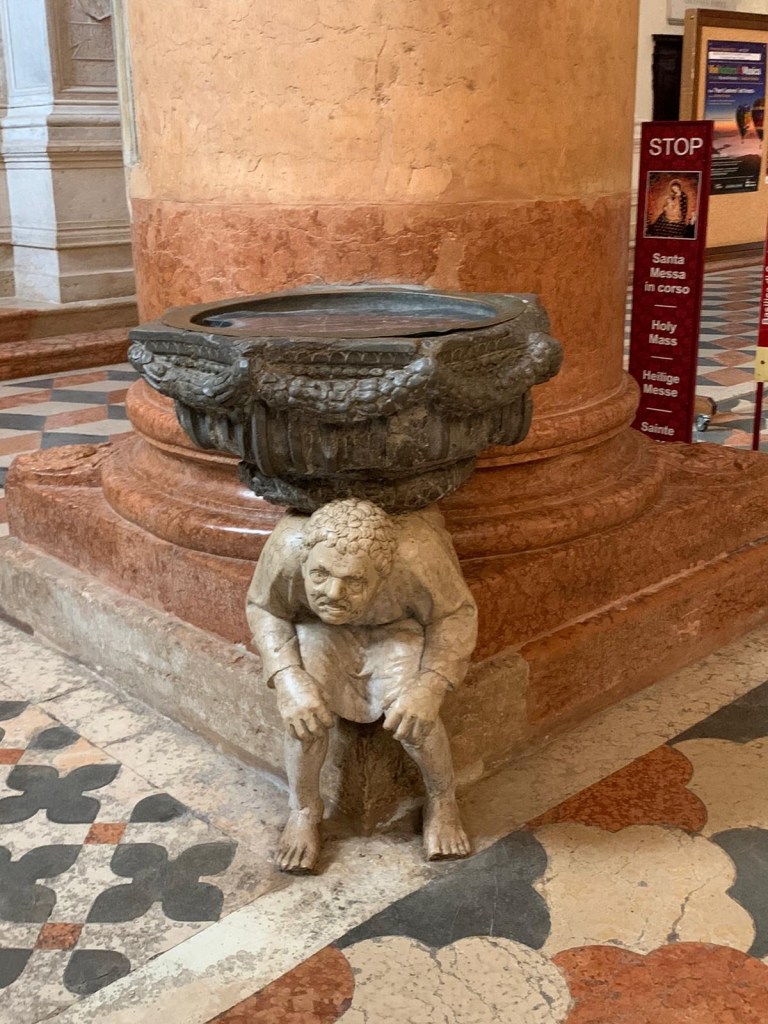
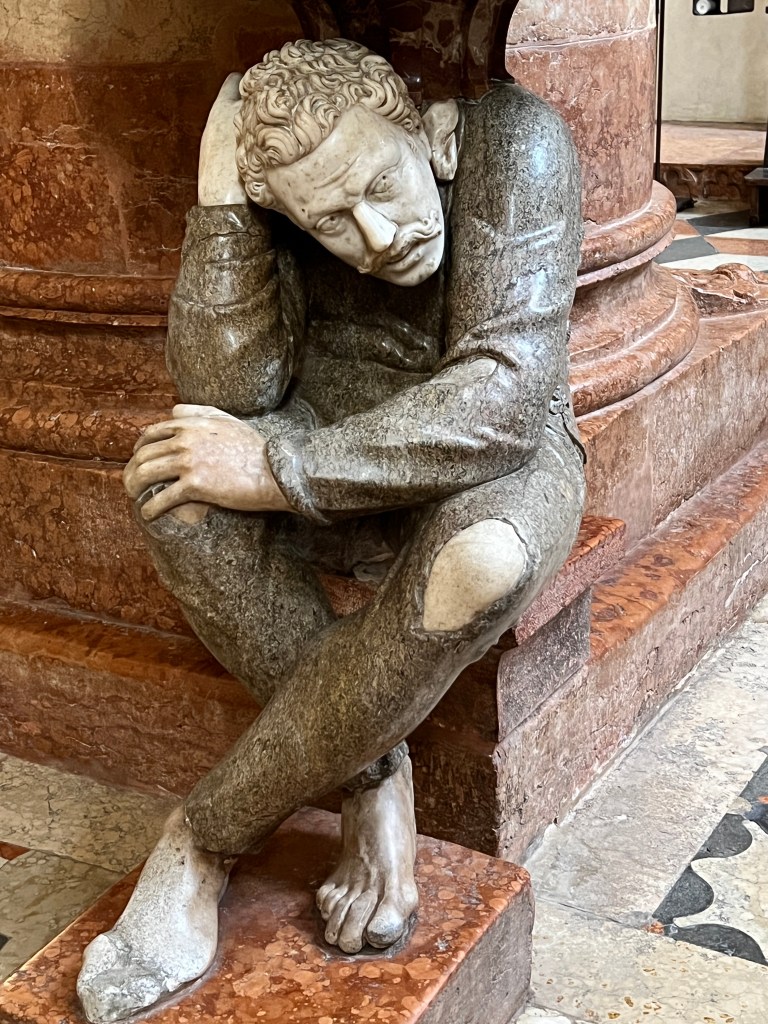
It was early evening when we arrived, so Eileen, Jim, Dan and I did a little exploring. We visited the Basilica di Santa Anastasia and got to see it right before closing. In around 1290 the order of the Dominicans began the building of a convent and the basilica. It took two centuries to build and only the facade was never completed. The inside of the church is quite impressive. Of particular note were two sculpted grimacing hunchbacks holding holy water basins on their backs.

Basilica di Santa Anastasia
Hunchback holy water basin holder
Another hunchback holy water basin holder

We then looped around and headed toward the Adige River and the Ponte Pietra, or Stone Bridge. The Roman bridge was completed in 100 BC and is the oldest bridge in Verona. The arch at the far left is the only one which escaped destruction in 1945. However, the original marble stones were dredged from the river and used to rebuild it.

Across the Adige River are Roman Theater ruins and the Costello San Pietro

On the other side of the bridge we attempted to visit what was once a Roman theater. It appeared to be under reconstruction and closed to the public. Above the theater is the fortress, Costello San Pietro. The original was destroyed first by the French and then the Austrians. What we now see was a barracks/fortress built by the Austrians in 1840. Near this part of the river was where boats full of grain would unload in order to be milled by the water wheels located along the river.

We then headed back toward the hotel. Dan, Jim and myself ended up eating dinner at a pasta place called La bottega della Gina located near our hotel. We selected three different pastas and shared them like one would Chinese food. The best dish was the one with Parmesan and truffles. Mmmmm Good! The leftovers were packed up and shared with Eileen. Eileen was busy writing her daily recap on What’s App, as for me, I choose to eat rather than write. Arrivederci until tomorrow.

Pasta Excellence

Day 19 Parmesan, Ferraris, Balsamic Vinegar and Bologna

Today is going to be full of visual and sensory experiences, and it is another early morning departure. As we make our way to Bologna, we will visit a Parmigiano Reggiano cheese factory, mingle with Ferraris, and learn about the production of balsamic vinegar all of which are located in Modena.

The moment you enter 4 Madonna Caseificio dell Emilia you are overwhelmed with the aroma of CHEESE. Established in 1967, the company is the largest cooperative in the area. It is best known for its Parmigiano Reggiano D.O.P., along with other dairy products. Throughout its nine century history the processing and ingredients for making parmigian cheese has remained unchanged. It is 100% natural and made with cow’s milk, rennet, and salt with different ages of maturation from 12 months up to 36 months. Older maturations can be special ordered. Each age of maturation offers different flavors.

Goodness in production process
In front of some rejected wheels

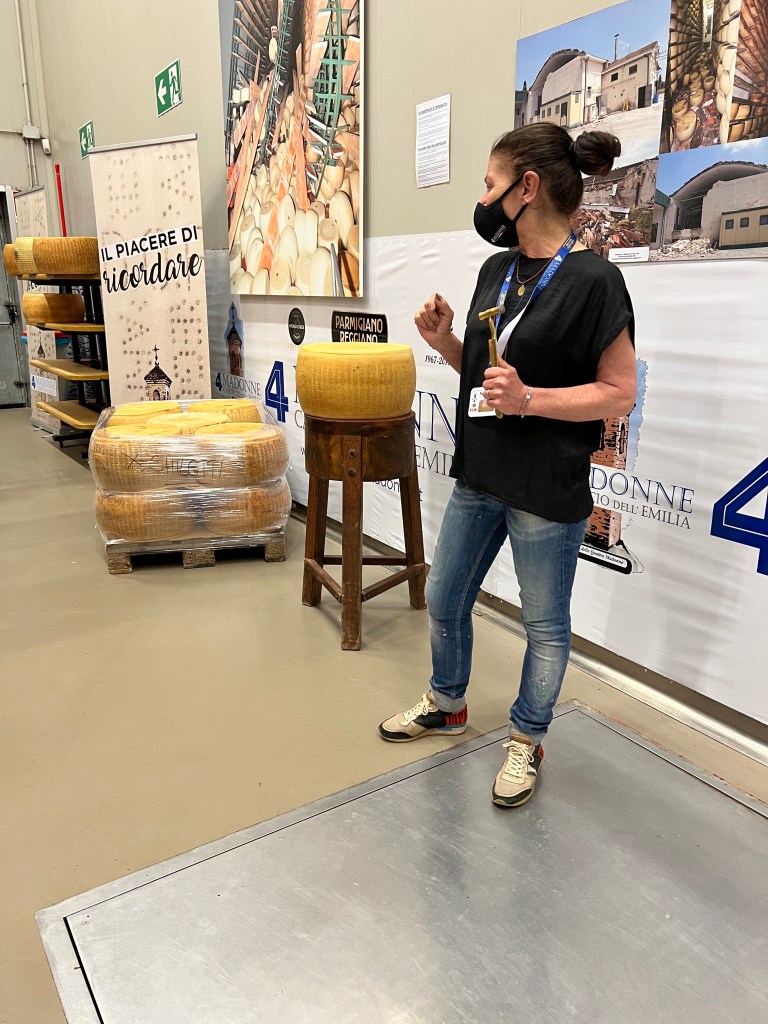
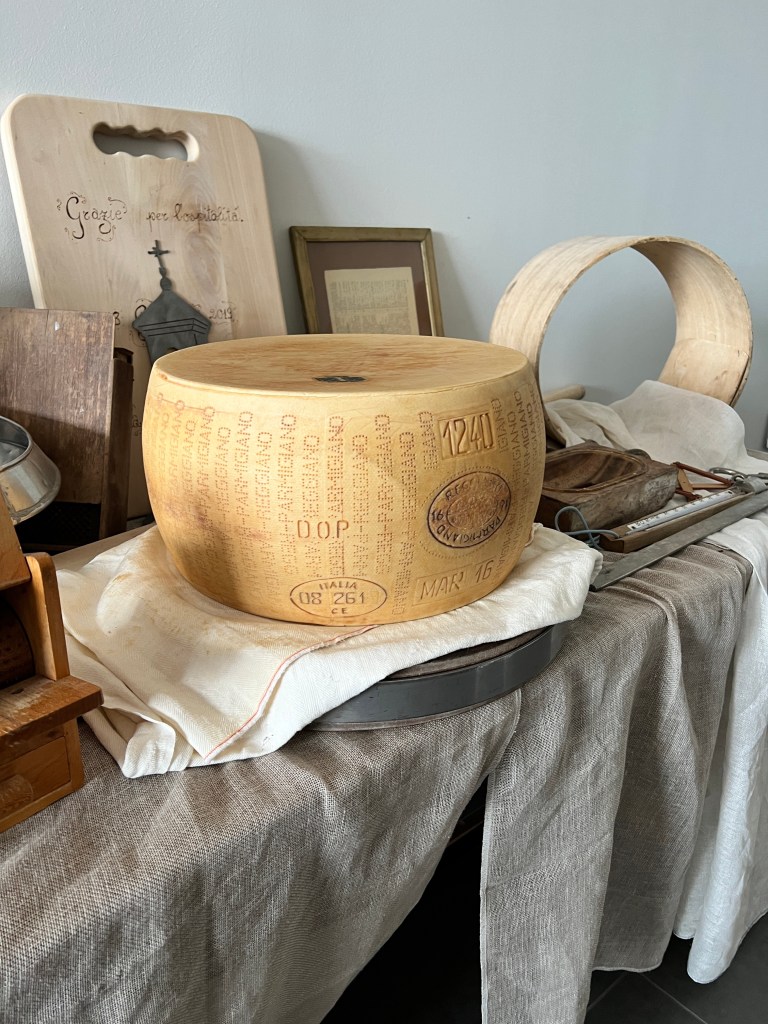
Just like champagne can only be given that name if produced in the Champagne region in France, the same goes with Parmigiano Reggiano. It must be produced in the provinces of Parma, Reggio Emilia, Modena, Bologna (to the west of the Reno River) and Matua (to the south of the Po River). It isn’t until the end of 12 months of maturation that a wheel of cheese is subject to quality inspection and can receive a grade selection mark that it is truly Parmigiano Reggiano. An expert examines each wheel individually with a small hammer. You can tell the quality of a wheel of cheese based on the sound it makes when gently hit. Once approved the rounds are fire-branded with the indelible mark that guarantees quality.

Note small hammer that is used to grade wheels
Seal of Approval

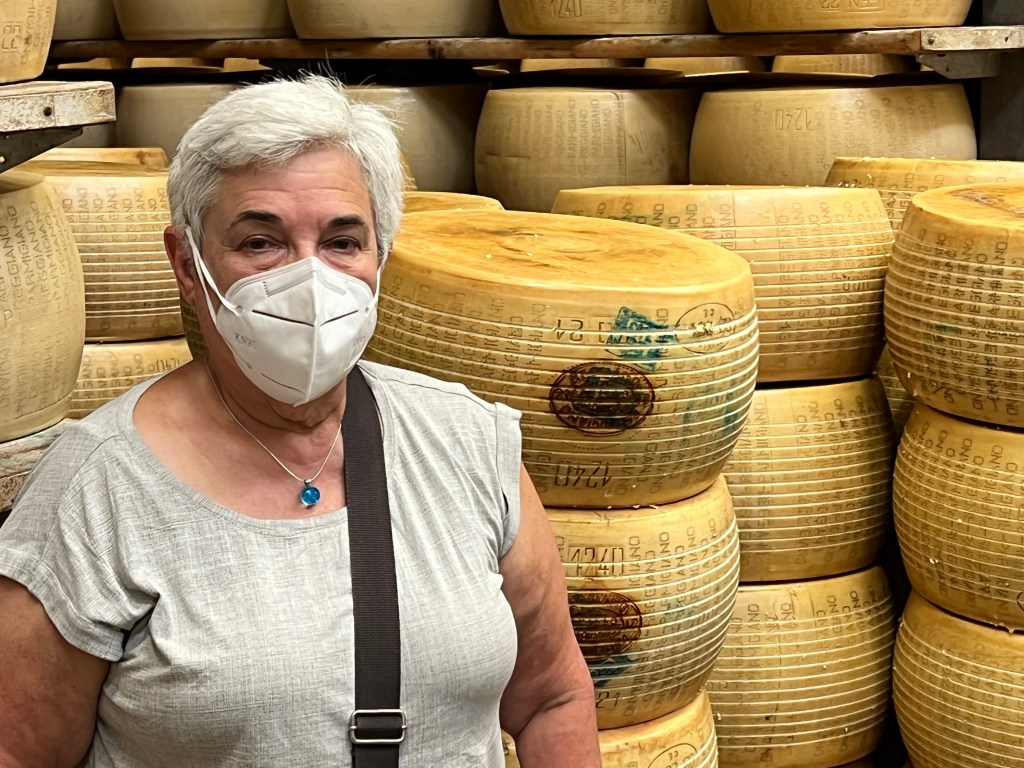
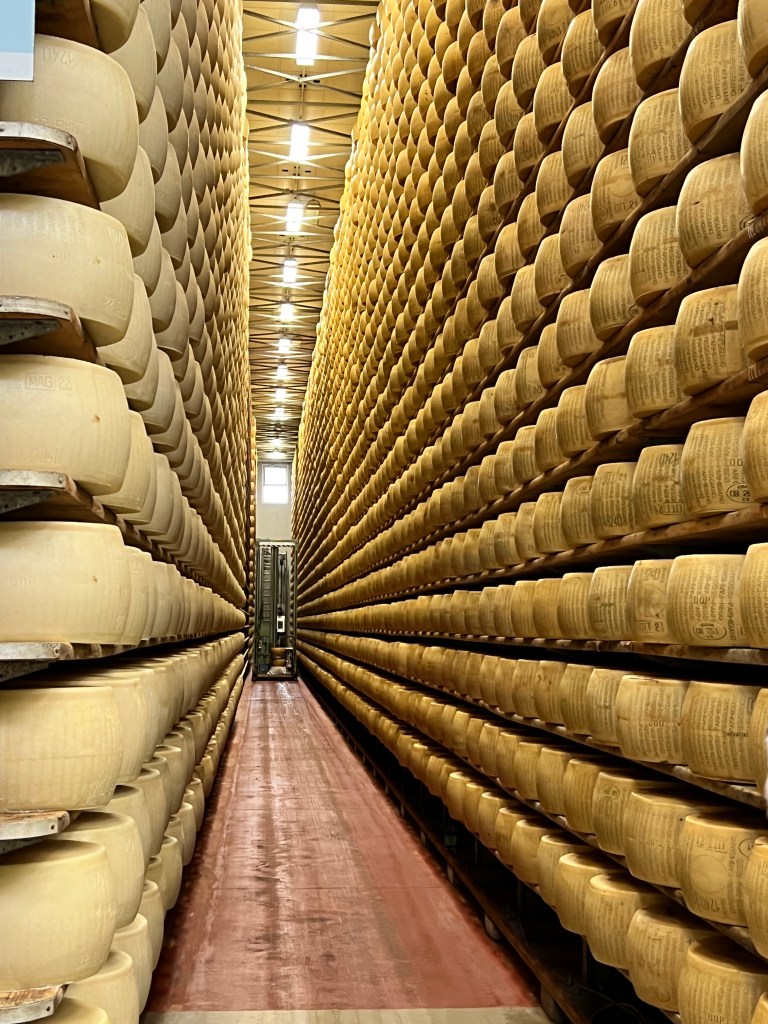
After a tour of the production and warehouse facility (33,000 wheels of cheese are stored) we were given the chance to taste a variety of aged Parmigiano Reggiano, ricotta and creamy Parmigiano. The creamy cheese was even better than delicious. We discovered that the cheese served alone with sauces, jams, balsamic vinegar and meats is wonderful. At home we only serve it on pasta or in recipes, now we have another easy appetizer to try. To Dan and I the older the cheese the drier and saltier it became, so we preferred the younger versions. If properly wrapped we were told that the Parmigiano Reggiano could make the journey home, but we were afraid to do so.

33,000 Wheels of Parmigiano Reggiano

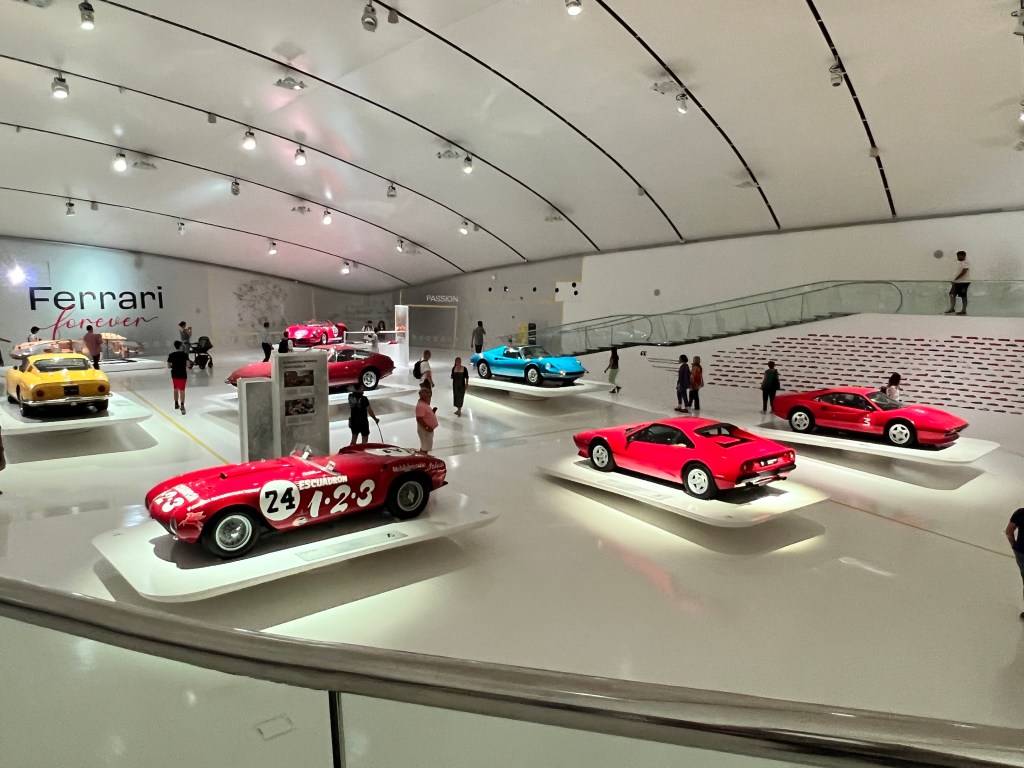
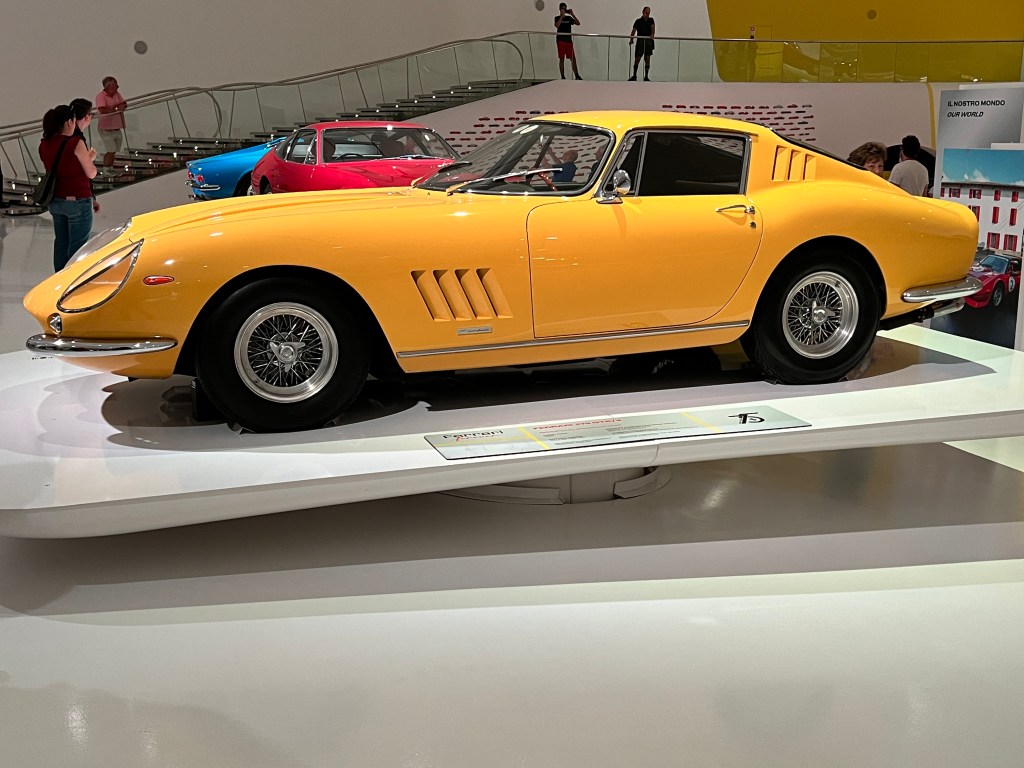
Italy is renown for design whether it be for clothes or cars. At the Museo Enzo Ferrari Modena the physical beauty of the cars is what impressed us the most. As for speed, we all know that they are fast. Still mostly handmade, about 14 cars are made daily compared with Ford that makes between 8,000 to 10,000 daily. In fact the only part of the manufacturing process that is automated is the connection of each vehicle’s valve mechanics. Their newest entry to the market will be a high performance SUV. About 8,400 Ferraris are sold per year.

The museum opened in 2012 and is dedicated to the life and work of Enzo Ferrari. The house where Enzo Ferrari was born in 1898 is part of the museum, although we did not go inside. Enzo’s son, Piero Ferrari was the brains behind the project. The museum building itself was worth the visit. The roof is modeled after the hood of a car, not to mention it is bright yellow.

Museo Enzo Ferrari Modena

Another taste treat awaited us at Boni’s Acetaia. Since the early 1900’s generations of the Boni family have been producing balsamic vinegar. Over the years, new wooden barrels have been added to create a line of balsamic vinegar products aged from 7 up to 130 years. The Trebbiano grapes are harvested by hand and its juice allowed to naturally ferment. The balsamic vinegars differ because of aging and the different woods used to make casks. Our guide, one of the family members, said the entire process takes place naturally, and the main thing he has to do is be patient and wait until the product is ready.

Just as there was with the certification of Parmigiano Reggiano cheese, the same is true with balsamic vinegar. The very shape of the bottle can tell you if it was certified or not. Boni sells certified bottles along with their own non-certified version. The non-certified of course costs a little less.

We were offered tastes of balsamic vinegar aged 7, 15 and 30 years old. The older it is the more fragrant and thicker it becomes. I have to admit that when I tried the 30 year old product I started to choke — it was too strong for me. In the past people made their own balsamic vinegar primarily for medicinal reasons. When a child was born new barrels were started that would be ready for them when they reached adulthood. It is highly nutritious, and supposedly good for the digestive and respiratory tracts.

After the tour we enjoyed a simple lunch that included cherries and fresh salad. Of course we used balsamic vinegar and olive oil for the salad dressing. Having fresh salad was a wonderful change. For some reason we haven’t had much in the way of fresh veggies on this trip.

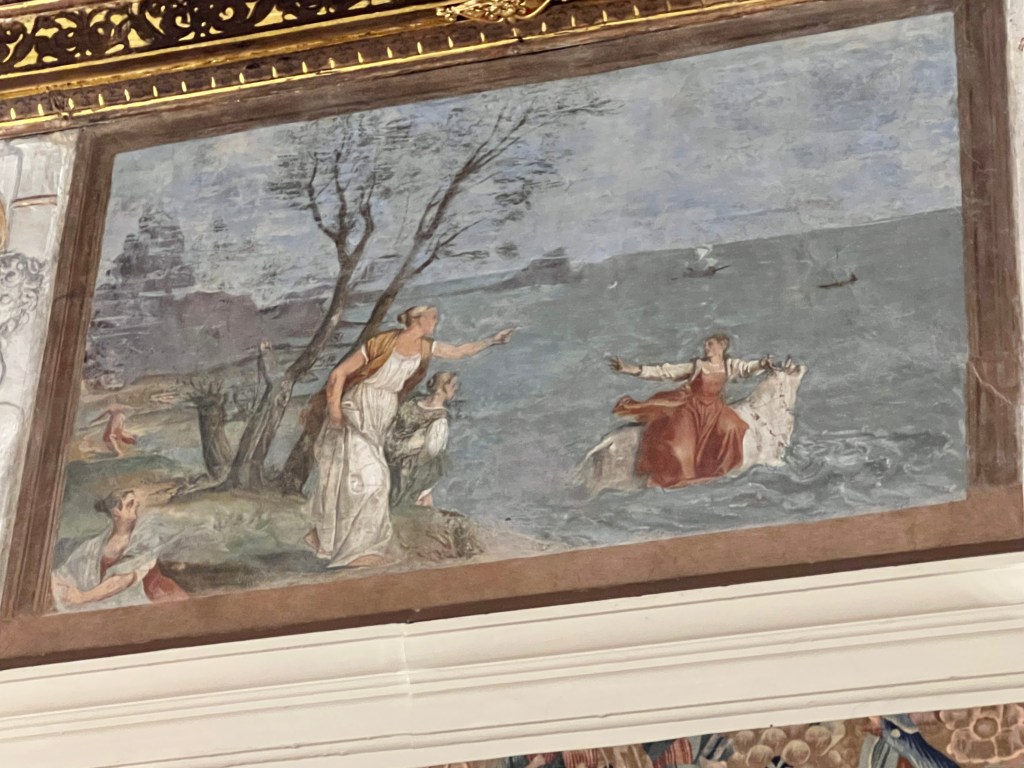
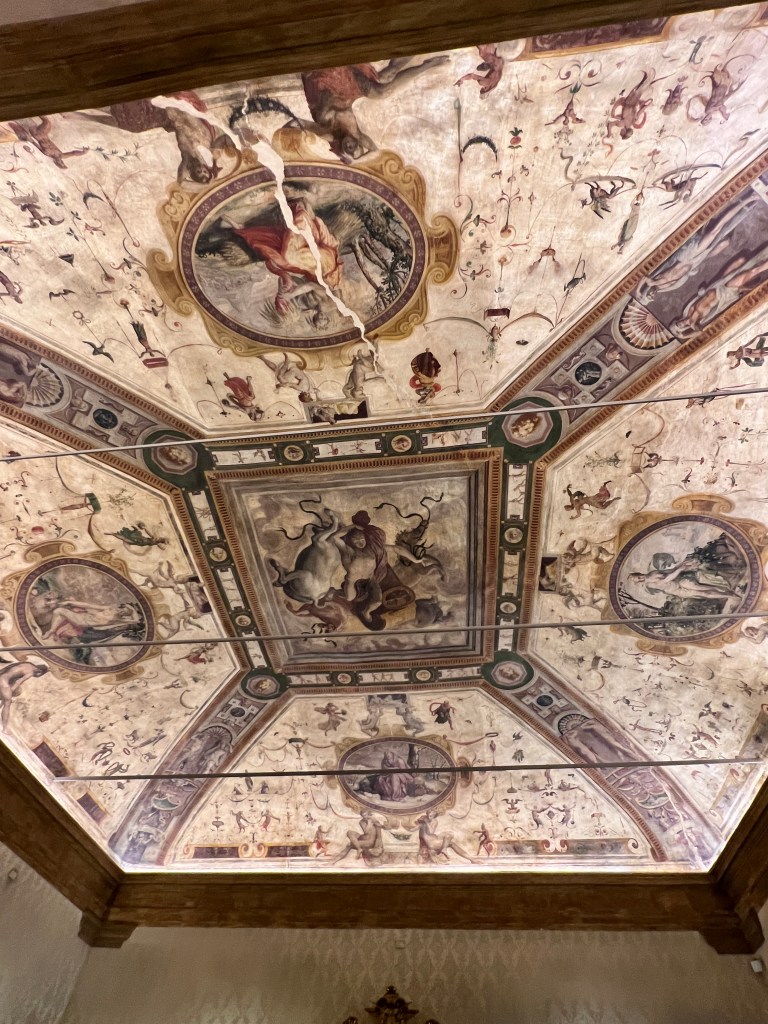
At long last we arrived at our hotel in Bologna, the lovely Grand Hotel Majestic. The building was turned into a hotel in 1909. Shortly after we arrived we were given a tour. Our guide informed us that on October 1944 an explosion was set off in an attempt to destroy a Nazi commando base posted in the hotel. Part of the building was destroyed. He then took us to a beautiful frescoed room called the Little Room of Europe, probably the first commission entrusted to the brothers Agostino and Annibale Carracci. It is thought to have been arranged on the occasion of the wedding between Filipino Fava and Ginevra Orsi’t wedding in 1579, but not actually painted until about 1584. The paintings depict the story of the birth of Europe. The paintings and ceilings are original. We were also taken to the hotel’s main dining room which was also beautifully decorated with paintings.

Birth of Europe
16th Century Ceiling
Hotel’s Restaurant Dining Room Ceiling

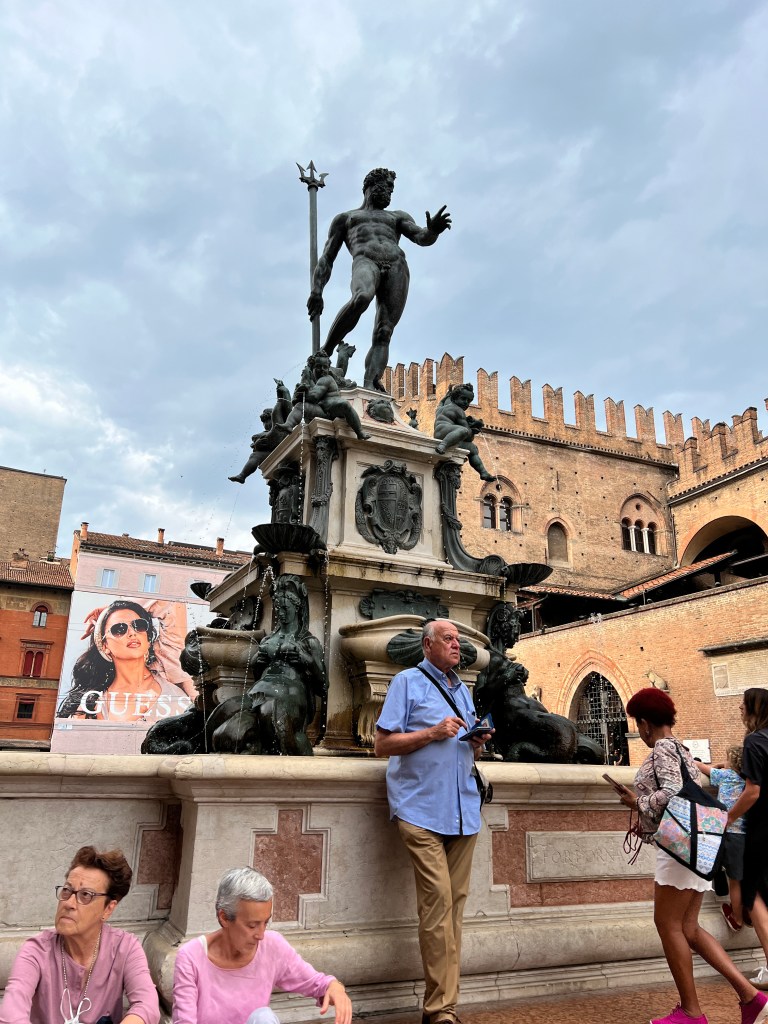
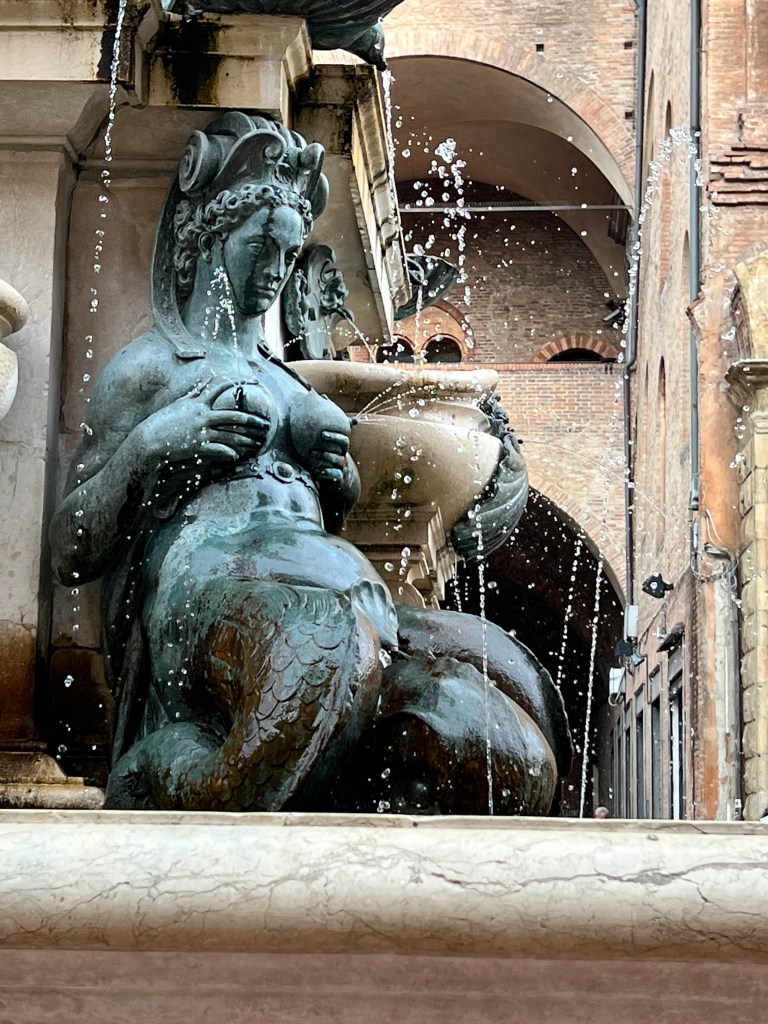
Dinner at Ristorante Montegrappa “da Nello” wasn’t until after 7:00 PM. We took a walk into the nearby Piazza del Nettuno, in the historic center of Bologna. This is a college town, so the streets are full of young people generating lots of good energy. In the center sits the Fountain of Neptune. It is an example of the Mannerist style of the mid-1500’s. Besides the powerfule Neptune situated at the top of the fountain, there are four lactating Nereids (sea daughters of the old man of the sea), who are holding their breasts from which jets of water emerge. Very impressive fountain to say the least, but not sure how it gained approval from the Catholic Church.

Fountain of Neptune
Lactating Nymph

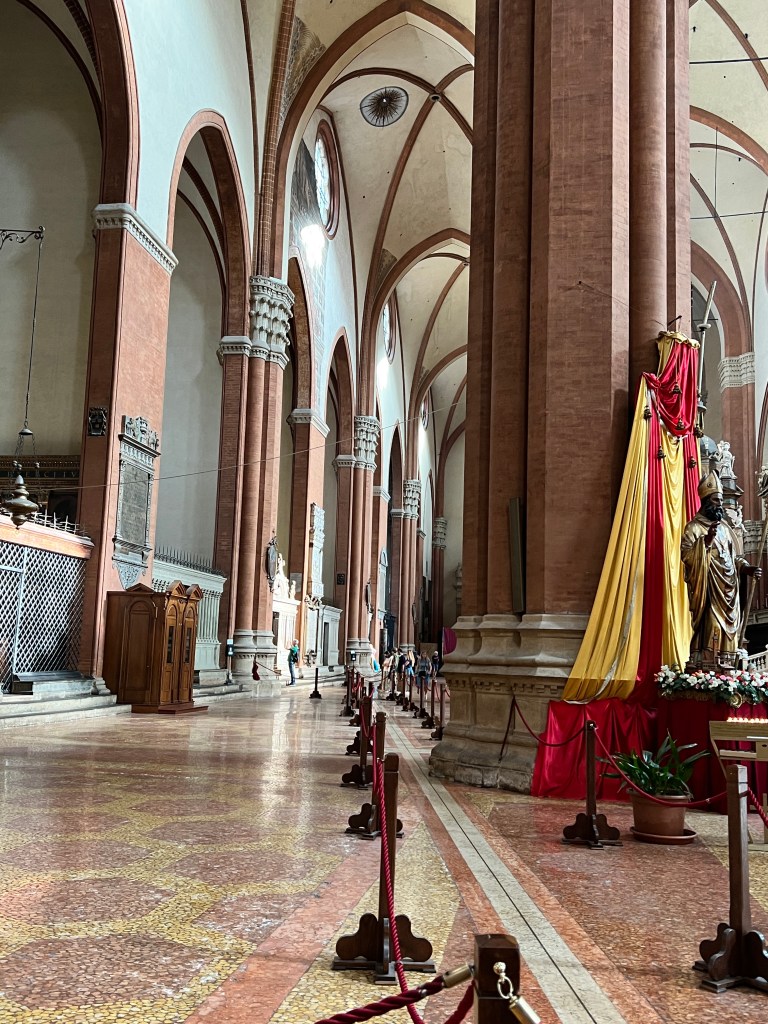
It is a bit confusing but I believe the Piazza Neptune sits within the larger Piazza Maggiore, which is surrounded by important buildings of medieval Bologna. This includes the Basilica di San Petronius which we visited along with Eileen and Jim. The Basilica is Bologna’s largest and most important church, dedicated to the 5th century bishop and the city’s patron saint, St. Petronius. Construction began in the 14th century, but it was never completed.

Basilica di San Petronius

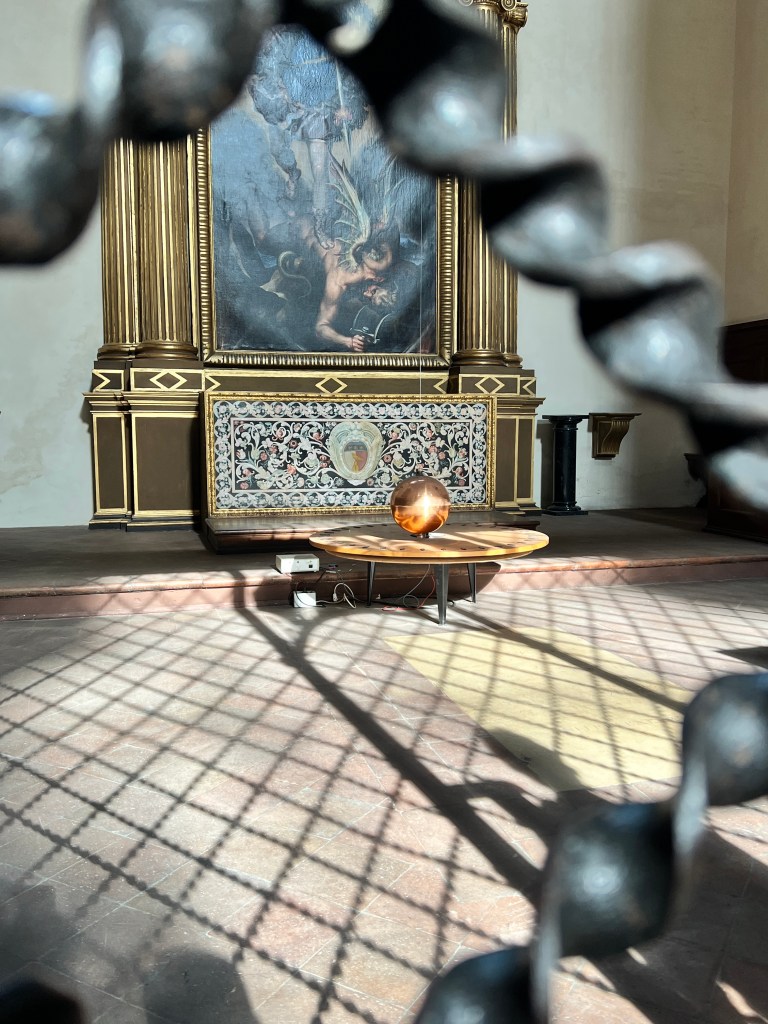
Not quite as impressive inside as many of the other churches we have visited, it did have a few features we found interesting. A ball hung on a wire showing the earth’s movement, something that one usually finds in a science museum. It also had a long meridian clock. We’ve seen several of these throughout Italy. Each day the sun aligns perfectly with a hole in the basilica’s ceiling sending a ray of light that lands on the line at exactly noon. The time of the year can also be determined by where on the line the light falls as it veers towards either end of the line approaching each solstice.

Rotation of the Earth
Meridian Clock and hole in basilica’s ceiling

Dinner was at the Ristorante Montegrappa “da Nello,”a quick walk from the hotel. We enjoyed a local specialty of fried zucchini flowers which was very good. What began as a nice quiet dinner evolved into a very noisy one as three families with several children each sat at a large table near us. The children were well behave, but loud. What else we had that night for dinner is just a blur. It has been a very long day and we returned to our room directly after dinner.

Unfortunately it was not a good day for Dan. His cough troubled him throughout the day. We think the fumes from the cheese and balsamic vinegar factories set him off, along with air conditioning. Tomorrow we are going to forgo the tour of Bologna and once again try to have him seen by a doctor. In addition, we’ll find a pharmacy to give him a COVID test to put our fellow travelers more at ease, as well as ourselves.

Day 18 A Day in Verona

We are looking forward to today’s guided tour of Verona. Verona is an interesting town because you can stand in one spot and see Roman ruins, along with medieval, renaissance and baroque buildings all at the same time. No bus ride for us today. After breakfast we met our guide in the lobby of our hotel and headed out.

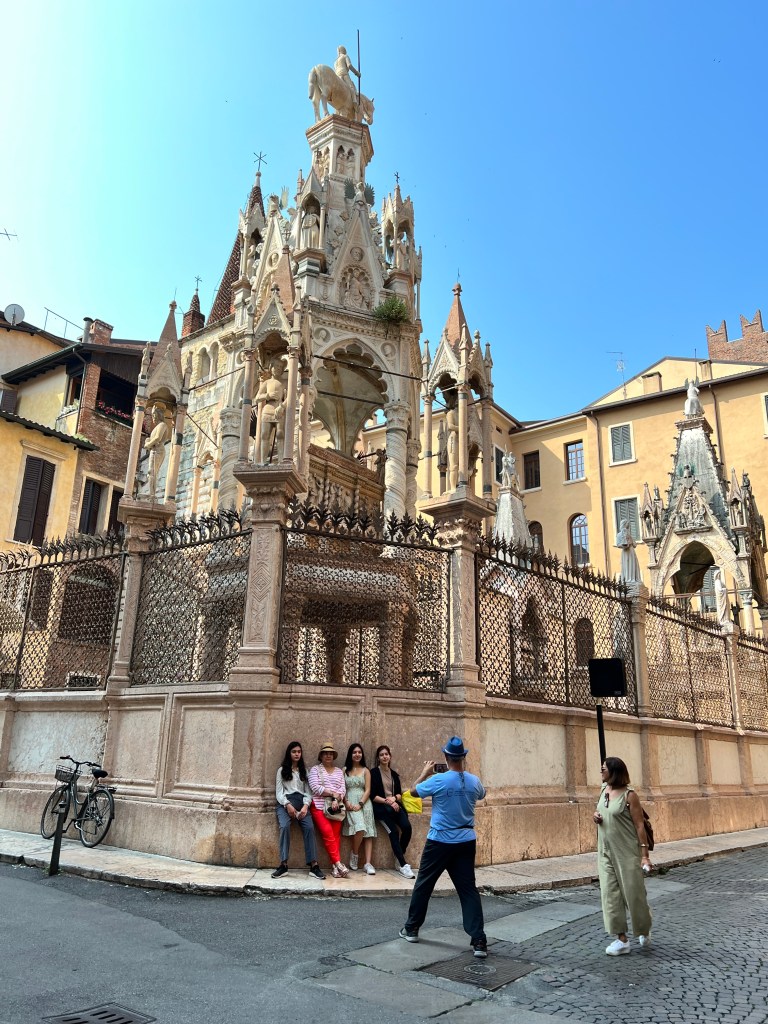
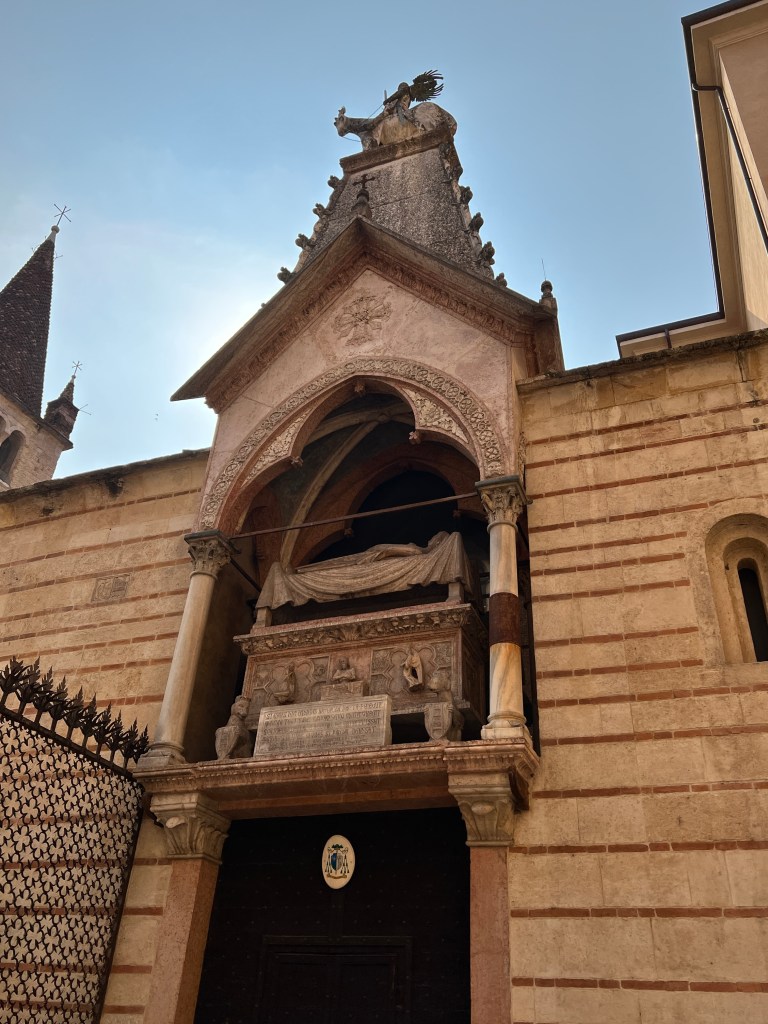
Verona had its own true intrigue. Feuds between the Montecchi and Cappellos families were real and served as models for Shakespeare’s Montagues and Capulets. Just like the Medici in Florence, Verona’s Scaligteri family was responsible for the city’s 13th and 14th century cultural and political power. Our first stop today was at the tombs of the Scaligeri family. By building their 14th century gothic funerary complex upon pillars they guaranteed that they would always be looked up to. The tombs are protected by wrought iron fences that incorporate a ladder emblem into the design. The emblem represents the family’s original name of della Scala “of the steps.”

Scaligeri Tombs
Another Scaligeri Tomb

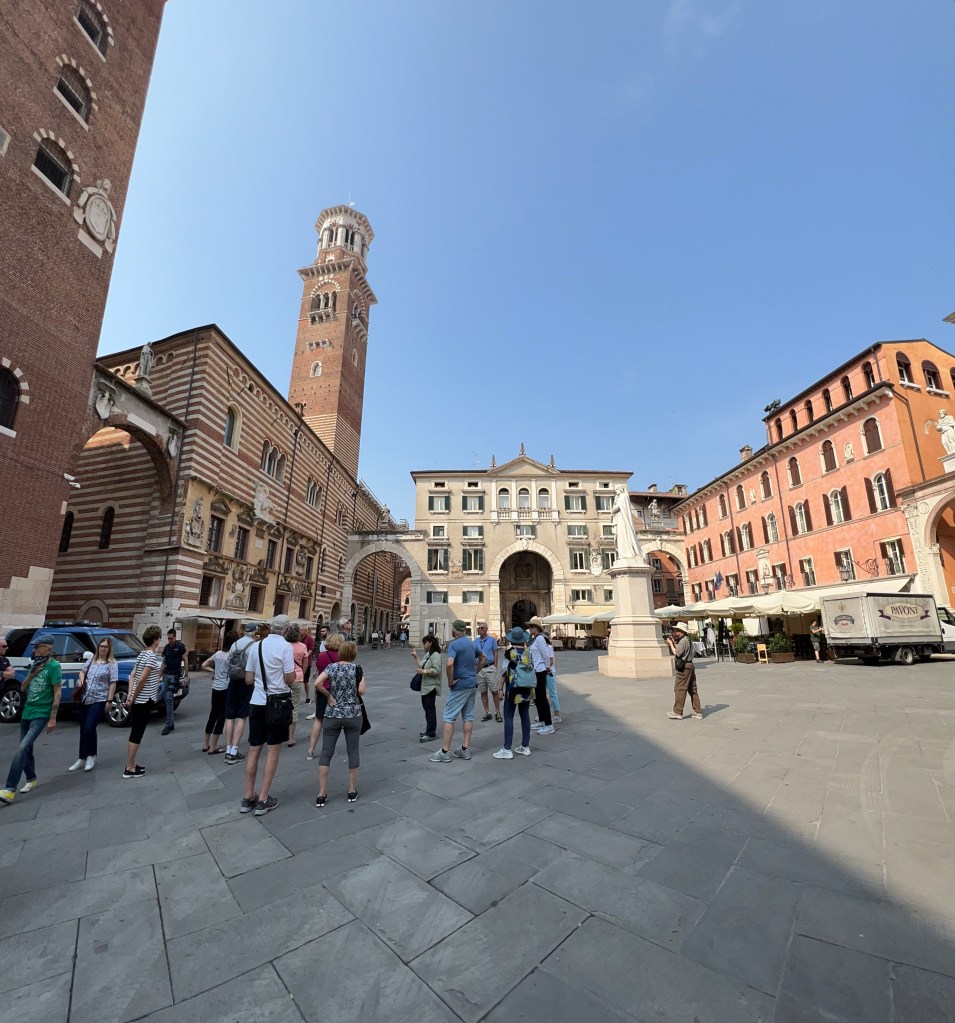
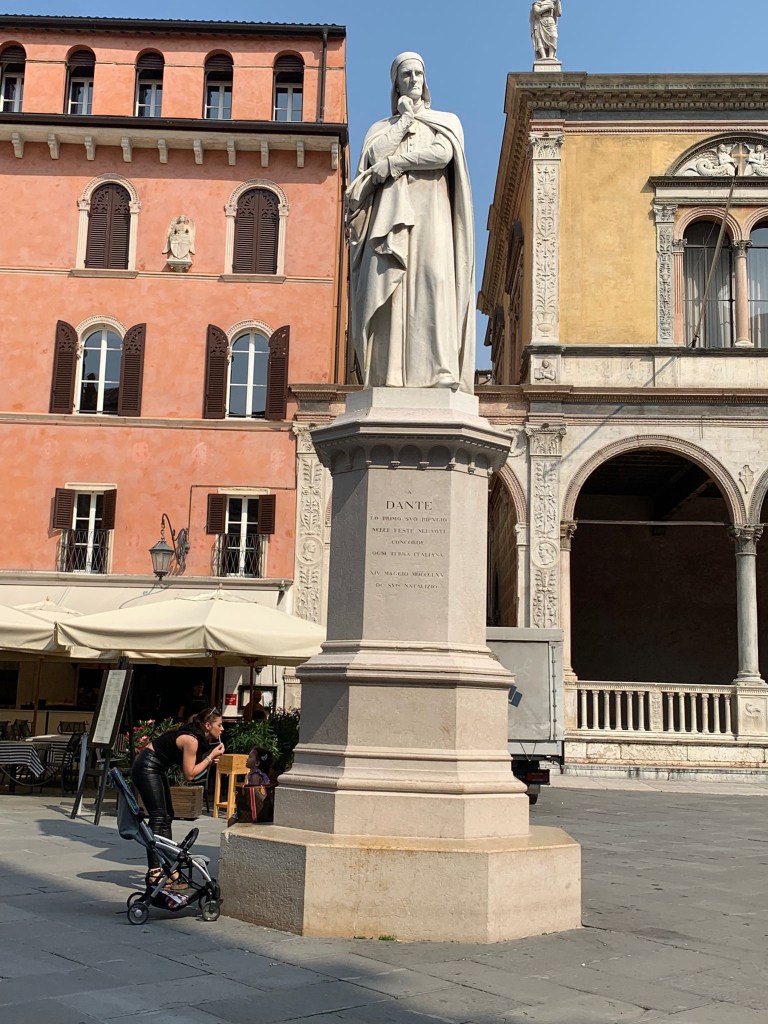
In the Piazza dei Signori is the oldest building in the square, the 12th century Romanesque Palazzo della Ragione with its tower, Torre dei Lamberti. It is often called Piazza Dante since a statue of Dante Alighieri stands in its center. The buildings in this square span five centuries.

Piazza dei Signori
DANTE IN HIS GLORY

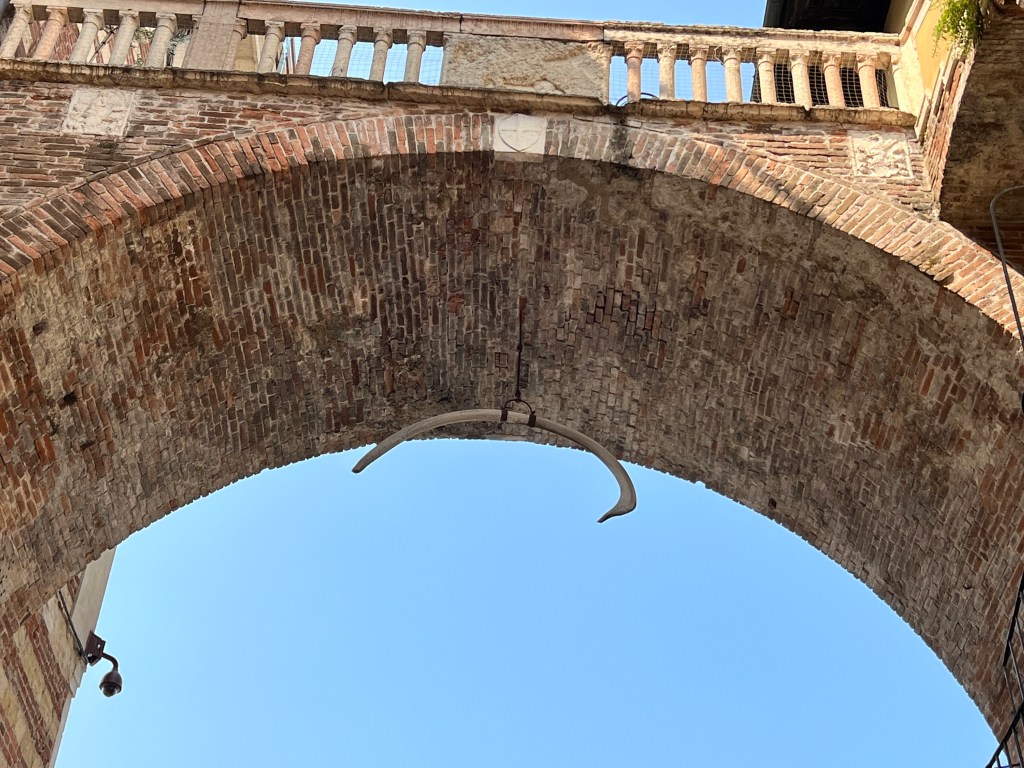
One quirky sight is a whale’s bone that has been dangling from an arch between Piazza Erbe and Piazza Signori since at least 1700. No one seems to know why or how it got there. The walkway above the arch allowed safe passage for judges and magistrates between their homes and city hall so they didn’t have to associate with common riraff. It’s claimed that it will fall on the first innocent person to walk under the archway. If that were true it certainly would have happened by now? Or would it?

The famous whale bone

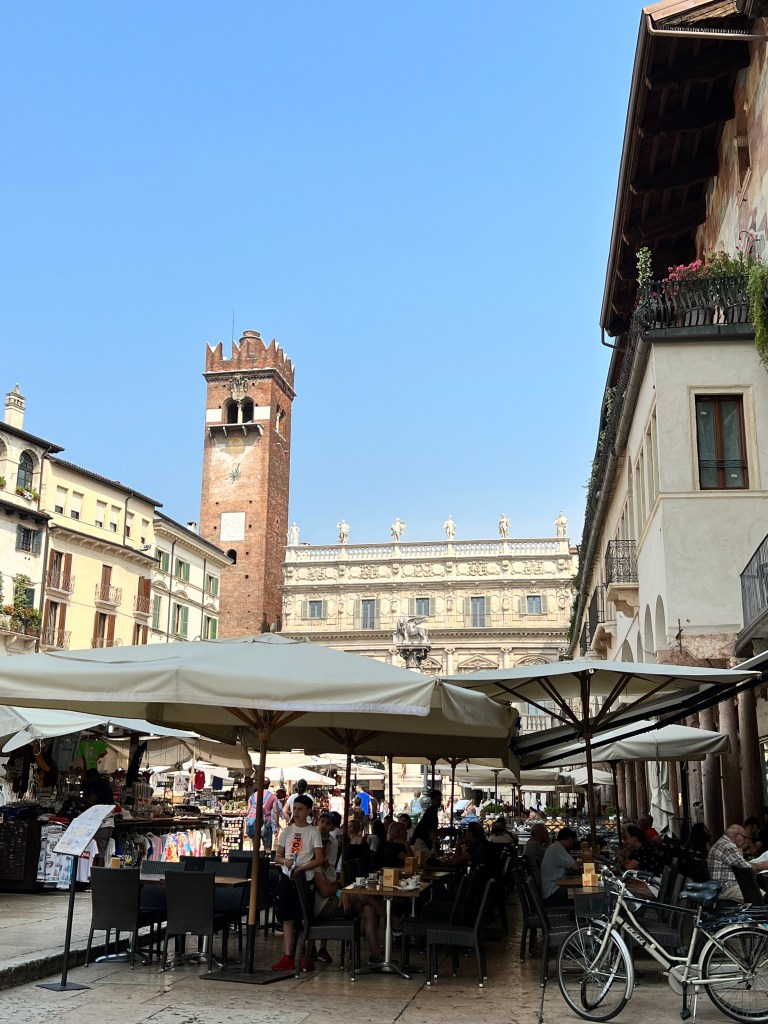
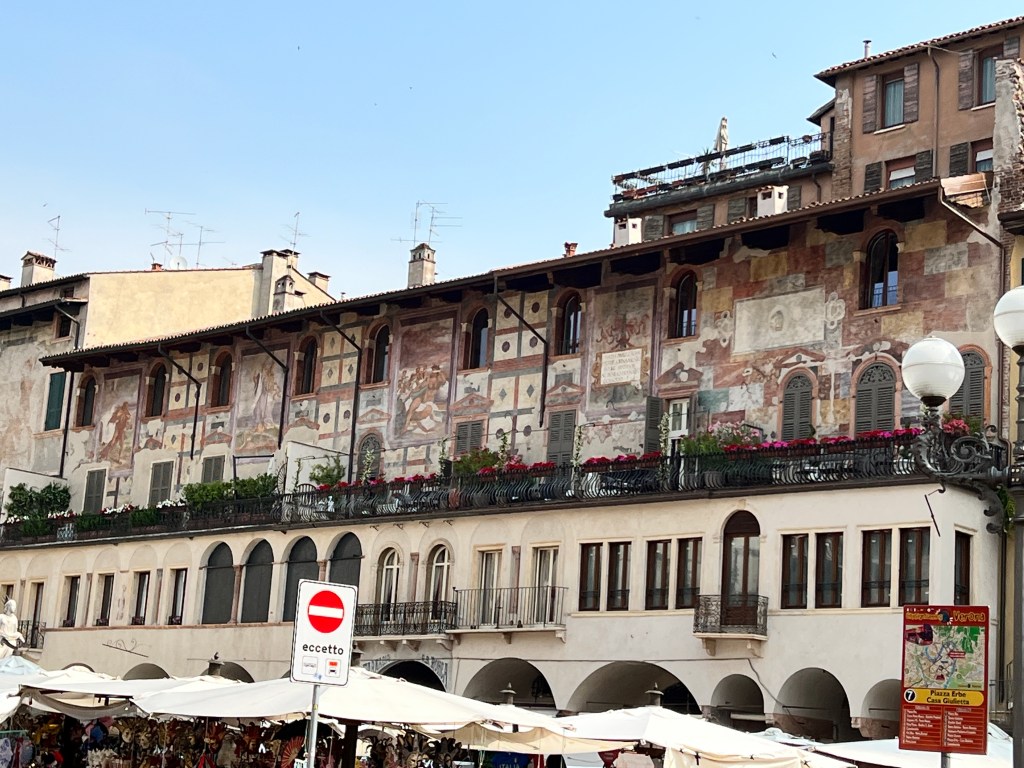
The Piazza Erbe was once the town’s forum during Roman times. It is still used as a market square. The fountain in the middle has provided water for 2,000 years. The Renaissance buildings were supposedly painted by students of Raphael in the 13th century.

Piazza Erbe — Ghilbelline roof line on tower.
Painted Renaissance Buildings

At the risk of boring everyone, there is one small piece of history I found of interest. In the Middle Ages, nobility had to choose whether they would support the holy Roman emperors (Ghilbellines) or the popes (Guelphs). In general, Guelphs tended to come from wealthy merchant families, where Ghibellines were predominantly people whose wealth came from agriculture. There is a lot more to this story, but it gets too confusing to write about in one paragraph. Our tour guide mentioned that buildings that had crown like decorations near their rooflines meant the residents were Ghilbellines or pro-emperor.

Another way families would show off their power was to build towers. Verona once had several hundred towers, but the powerful Scaligeri family forced the other nobles to lop off the tops of their towers. Only the Scaligeri were allowed to keep theirs intact. To make matters even worse, the Scaligeri used the bricks from the toppled towers to make roads.

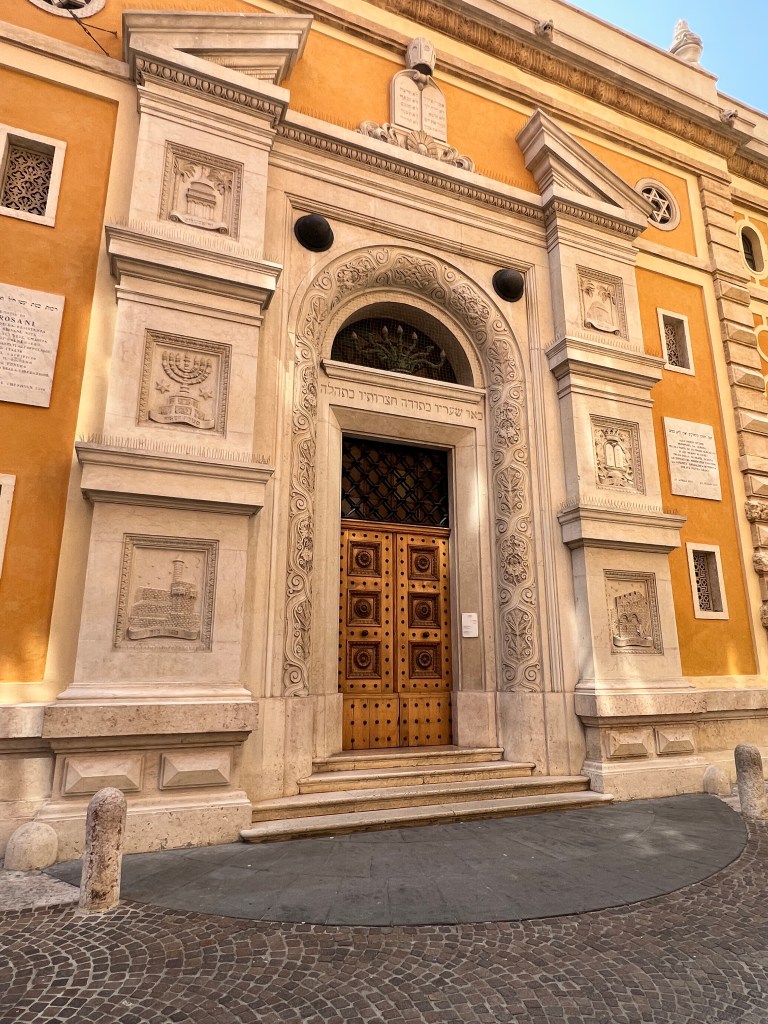
Near the Piazza Erbe is Verona’s main synagogue. First traces of Jewish presence in Verona dates to before the 10th century. The neoclassical building was built in 1864 in the center of what used to be the ghetto. It is still in use and not generally open to the public. The gates of the ghetto were demolished with the arrival of Napoleon’s troops in 1796. Under Austrian rule they were not reintroduced, but it wasn’t until Verona became part of the Kingdom of Italy in 1866 that full social equality was achieved. With the exception of a few buildings, the entire ghetto was torn down.

Verona Synagogue

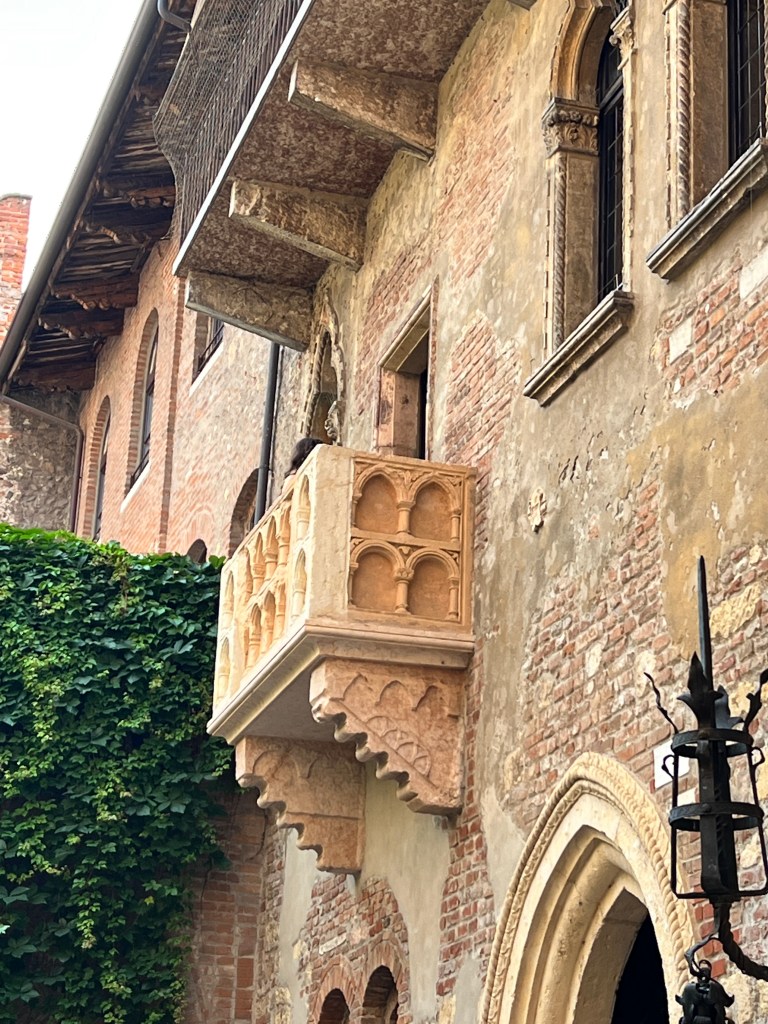
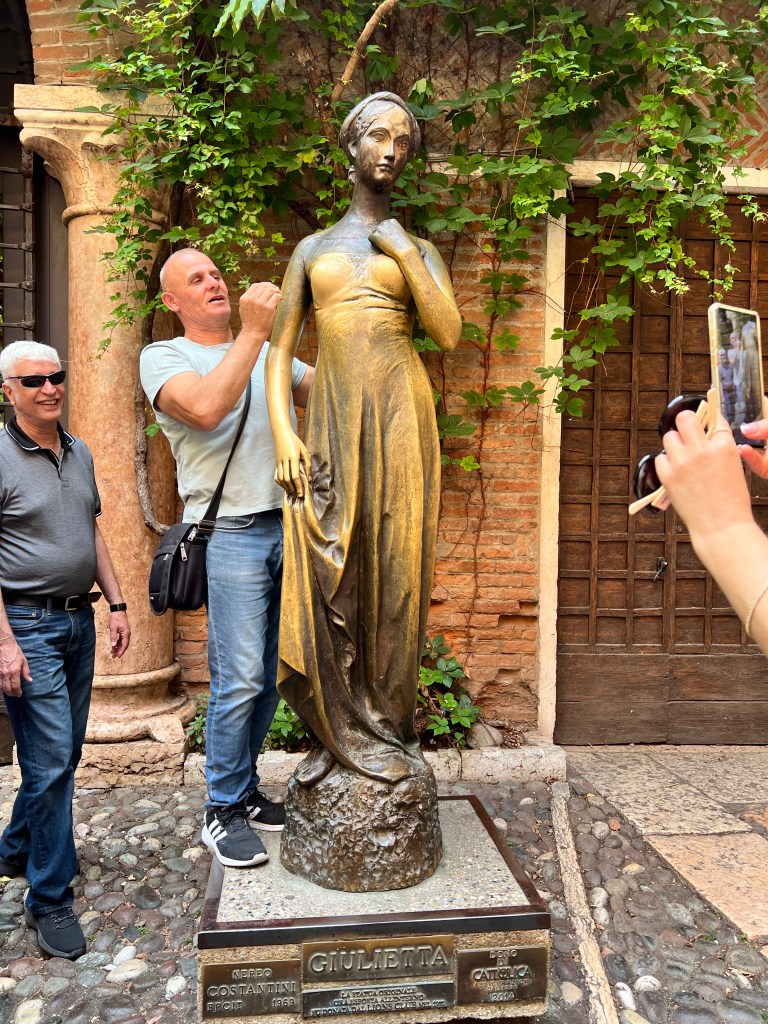
The second most popular tourist sight in Verona is the House of Juliet. People from all over the world pose on the balcony, wait their turn to caress Juliet’s bronze breasts, or write a letter to an imaginary woman. There is even a group of volunteers that answer all of Juliet’s mail. The balcony was actually created in the 1930’s for a movie.

Juliet’s Balcony
Juliet and her popular breasts

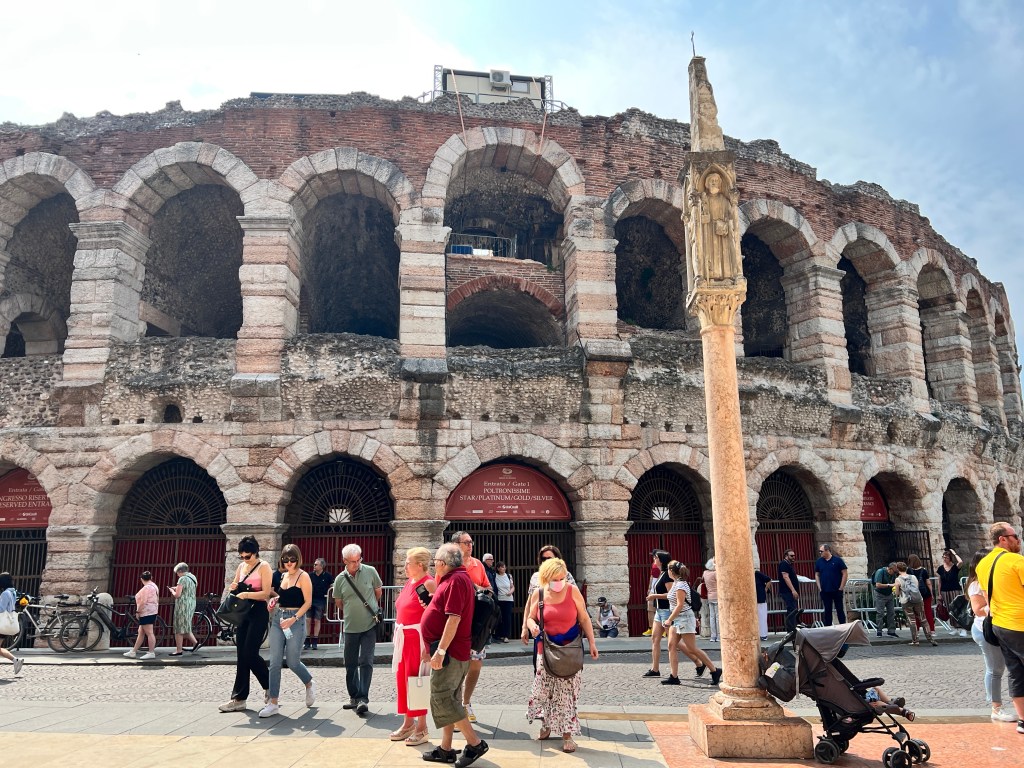
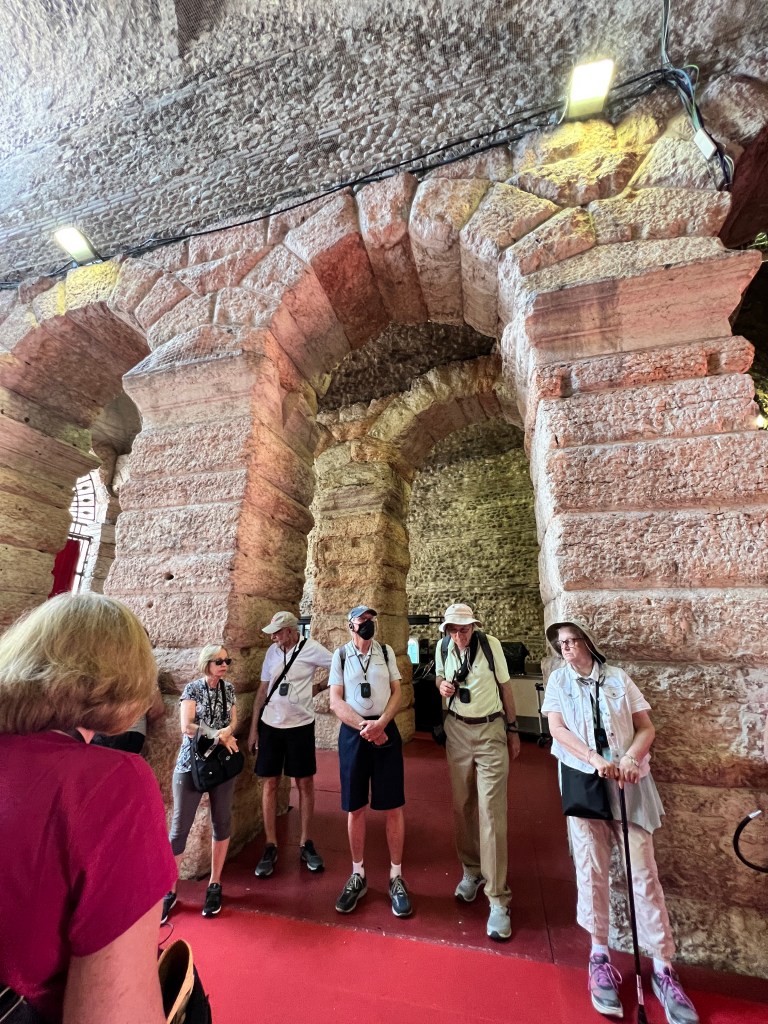
Piazza Bra means “big open space.” It is in this space that we visited Verona’s amphitheater. It is the third largest Roman arena in Italy. Most of the stone is the original pink marble. The stadium was used for gladiator battles and medieval executions. Today it hosts plays, an opera festival, and rock concerts seating up to 25,000 people.

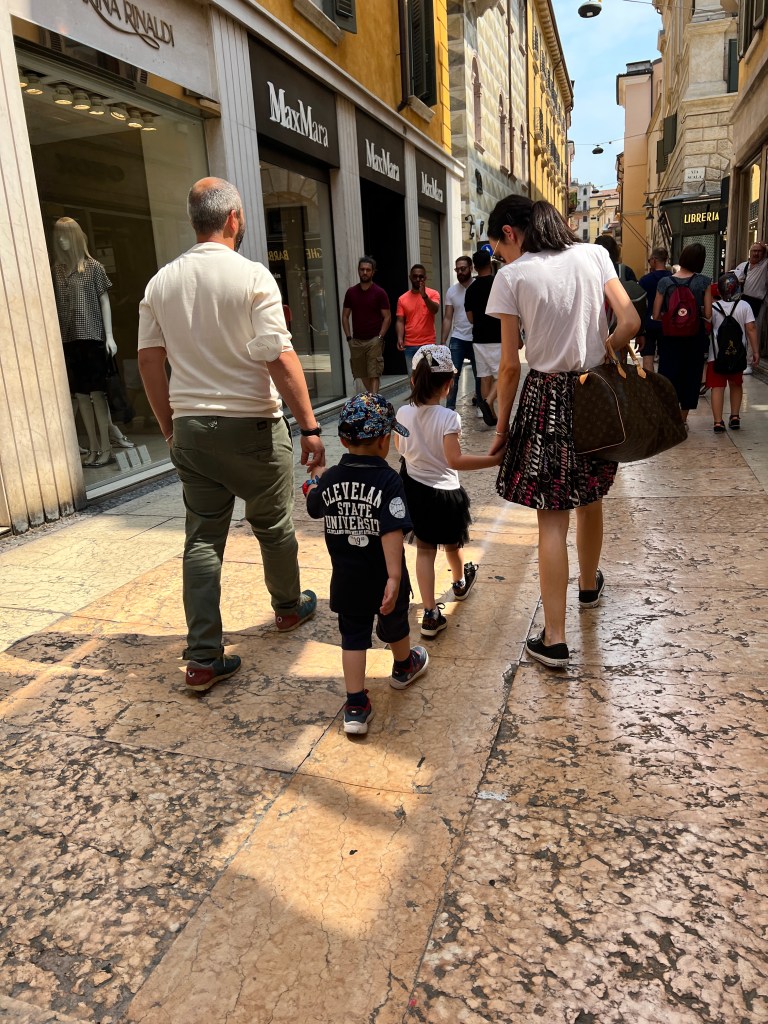
At the tours end, Dan and I spent a little time hunting for gifts for our grandson. It is easy to find gifts for girls, but 10 year old boys, not so easy. We ended up buying him a t-shirt that says gladiator on it and a key ring with a gladiator’s helmet at the market in Piazza Erbe. Yes, I was getting desperate. We also walked along one of Verona’s primary shopping streets before heading back to the hotel to rest until our next activity at 5:30.

Shopping on Via Mazzini — Check out the boy’s t-shirt. Turns out the Italian family had never heard of Cleveland State University.

In one of the meeting rooms at the hotel we had a surprise session with the author of Letters to Juliet by Ceil Friedman and her sister Lise Friedman. Ceil is an expat from the U.S. living in Verona. She wrote the book in order to better understand why truckloads of letters were addressed to a person that never existed — Juliet, Verona, Italy. Why were people compelled to write to Juliet, and what kinds of advice did they seek? In addition, she discussed how a cadre of volunteers, many of whom were men, leave no letter unanswered. Ceil’s presentation was very enjoyable. The book served as an inspiration for the 2010 movie of that name.

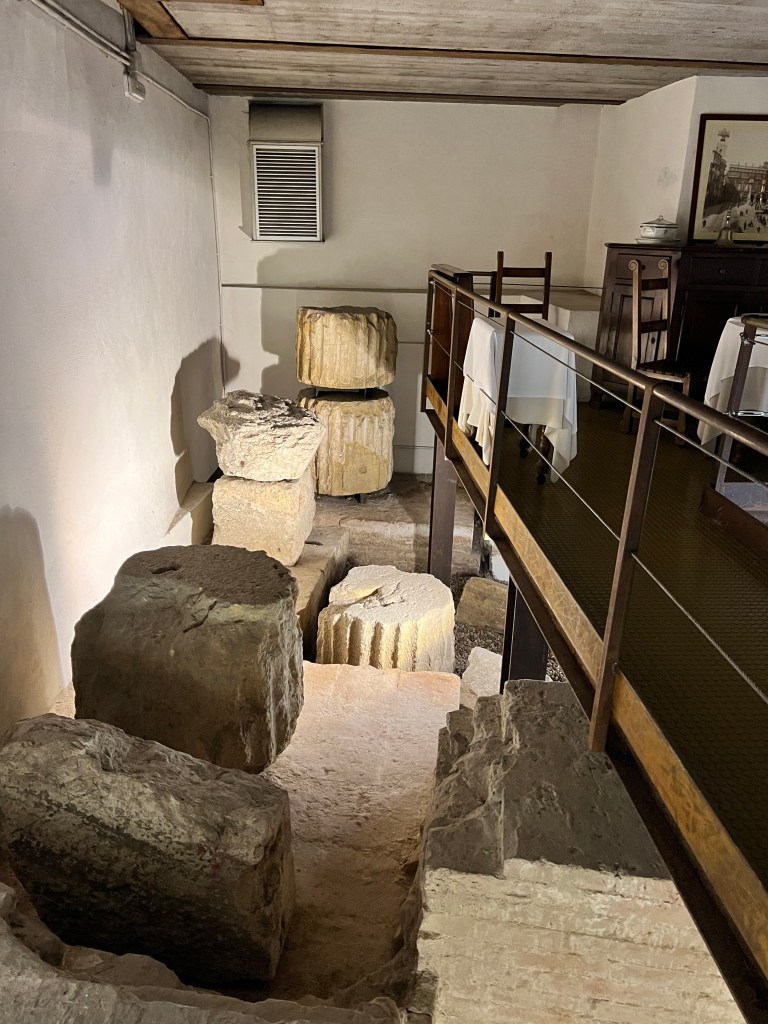
Dinner was at the Ristorante Maffei. Before we sat down, Scott took us for a short excursion down the basement. Down below were Roman ruins at what was then street level. You could even request a table next to the ruins if you were so inclined. This is not unusual. Almost any time you dig down, ruins are found. In fact, whenever a new road or building is being built ruins are almost always found. A team of archeologists is always brought in to access the site and determine what needs to be saved, etc. Dinner was wonderful.

Roman ruins in the basement of Ristorante Maffei

Day 16 Lake Maggiore & The Islands

The view from our hotel room is lovely and breakfast couldn’t have been nicer. The only down side is that Dan’s cough that began in Florence is getting worse. The hotel will be sending in a doctor to take a look at him at about 3:30 PM when we return from today’s excursions.

A short walk along the promenade along the lake and we reach our boat for the day. We immediately head toward Isola Bella a privately owned island with its exquisite Villa Borromeo. Count Vitaliano Borromeo started construction of his baroque palace and gardens in 1632. Today the Borromeo family lives in Milan, but spends several weeks on Isola Bella each summer. Their blue and red flag was flying, so we believe they were in residence during our visit.

Villa Borromeo

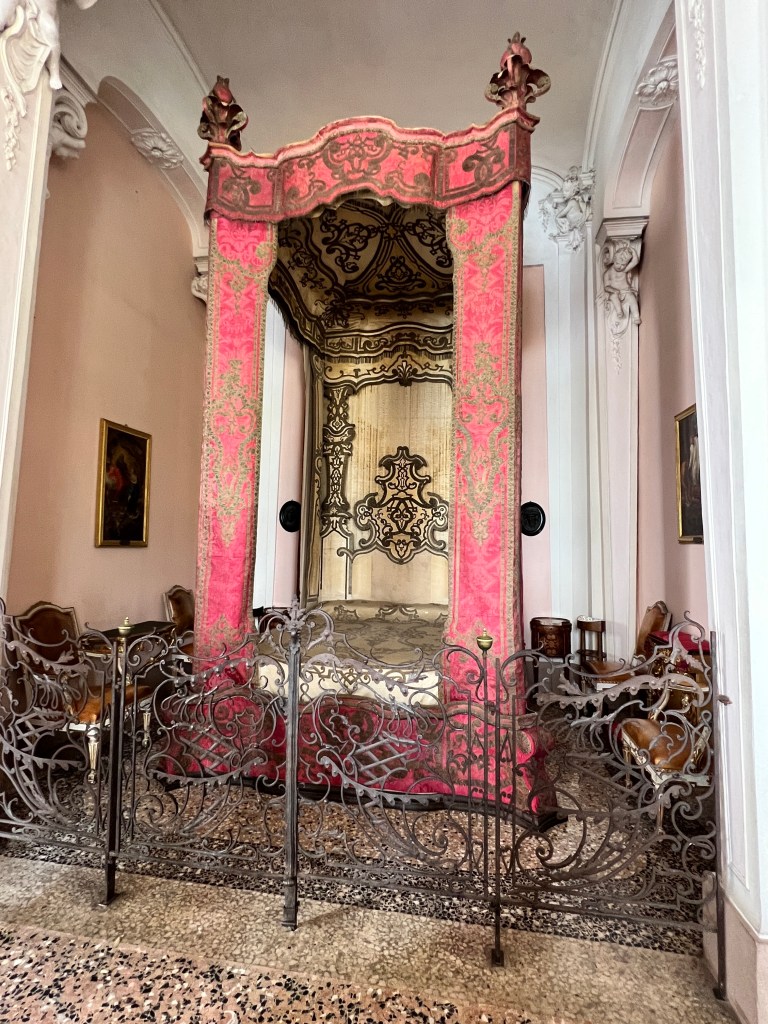
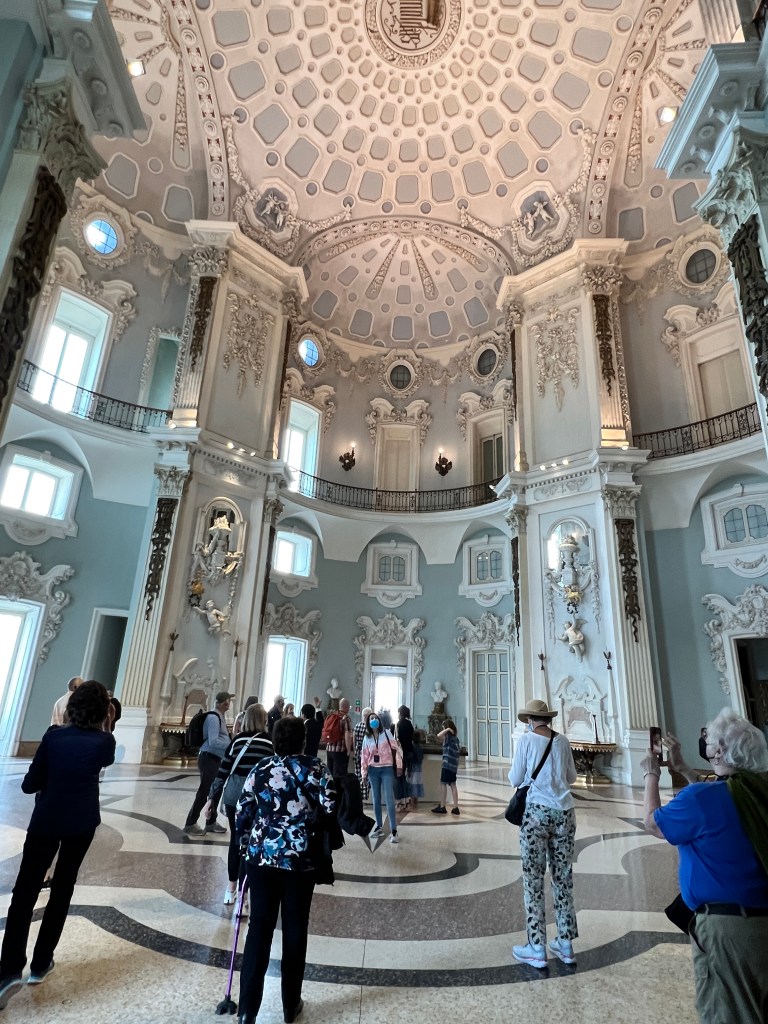
The Villa couldn’t be more baroque or more opulent with each room more elaborate than the next. Highlights of our guided tour included a bedroom where special guests would stay including Napoleon in 1797. The Music Room with its fantastical harpishord was used to host the 1935 Stresa Conference where Mussolini, French Minister Laval, and British Prime Minister Ramsey MacDonald met to discuss the violations of the Versailles treaty by Germany. It resulted in a condemnation of Germany. Unfortunately it amounted to nothing since Mussolini later attacked Ethiopia and joined forces with Hitler.

Napoleon’s Guest Bed
Music Room where 1935 Stresa Conference was held
80’ Tall Rotunda

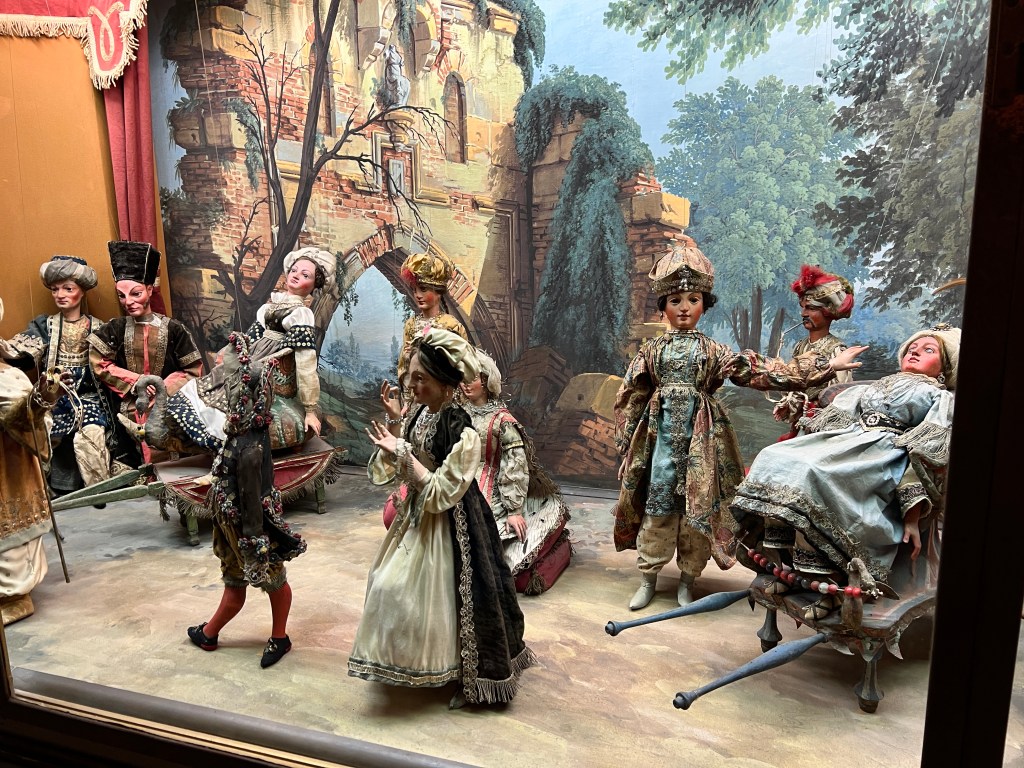
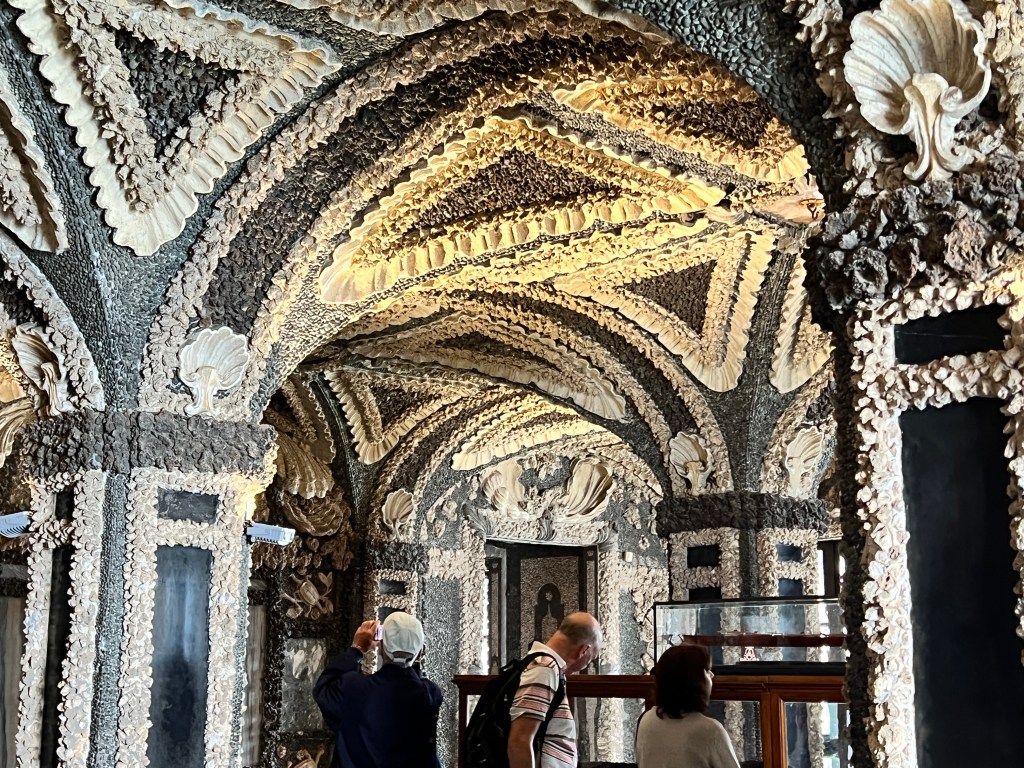
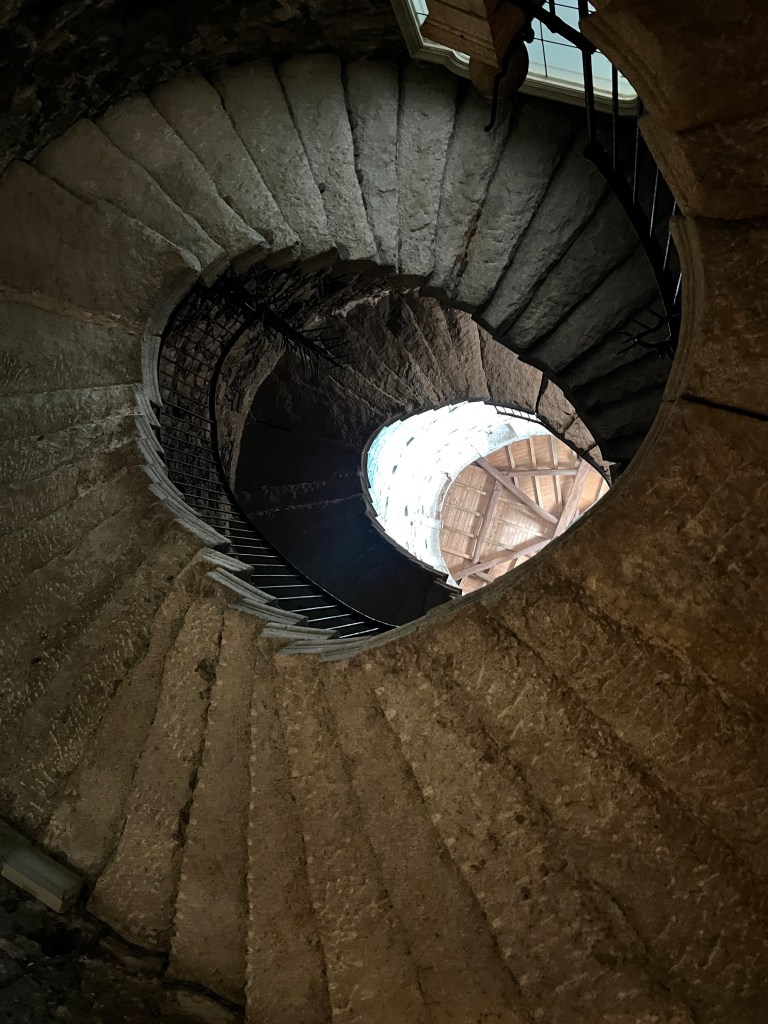
Other points of interest in the Villa included a small table that was decorated with mini mosaic tiles. It supposedly took 19 years to make and was a gift given by Pope Leo XII. There was also a large room filled with 16th century Flemish tapestries. Downstairs was an amazing collection of marionettes and unique cave like grotto rooms. The 18th century rooms are decorated floor to ceiling with black and white stones with a shell motif. There are no windows and the rooms provided the family with a cool refuge from the summer heat and housed some of their artwork. This includes the marble statue of the Sleeping Nymph by Antonio Canova. There is also a unique cantilevered stairway from the 17th century fortress that predated the building of the Villa.

Mosaic Table
Grotto with Sleeping Nymph
Cantilevered Stairway

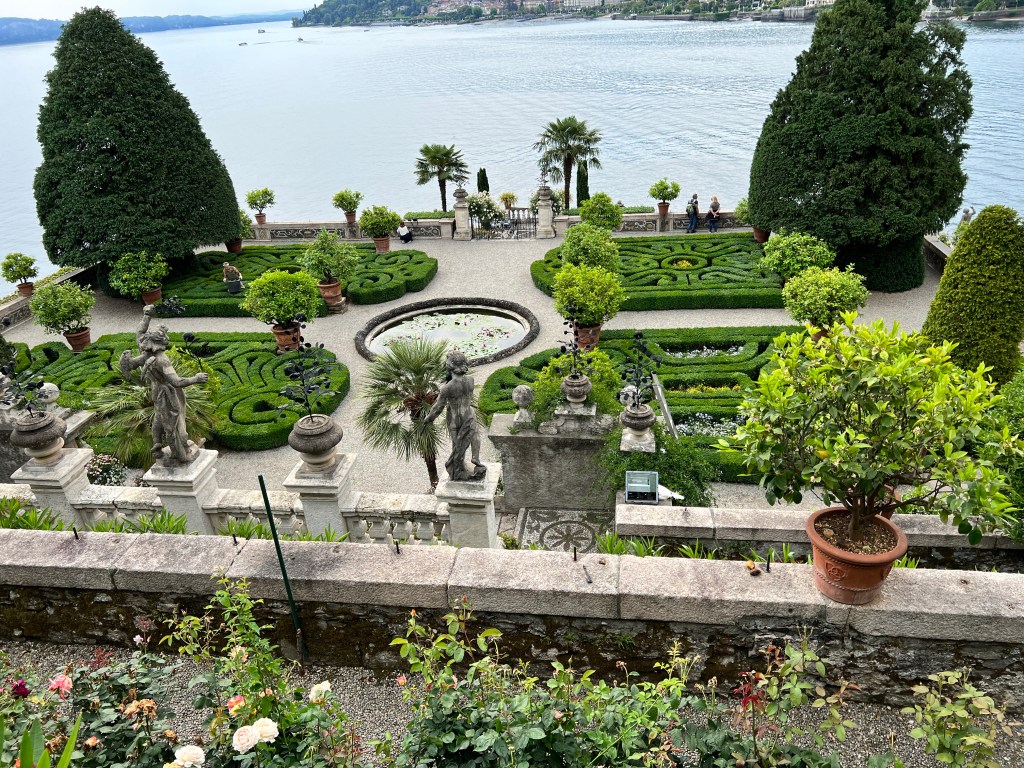
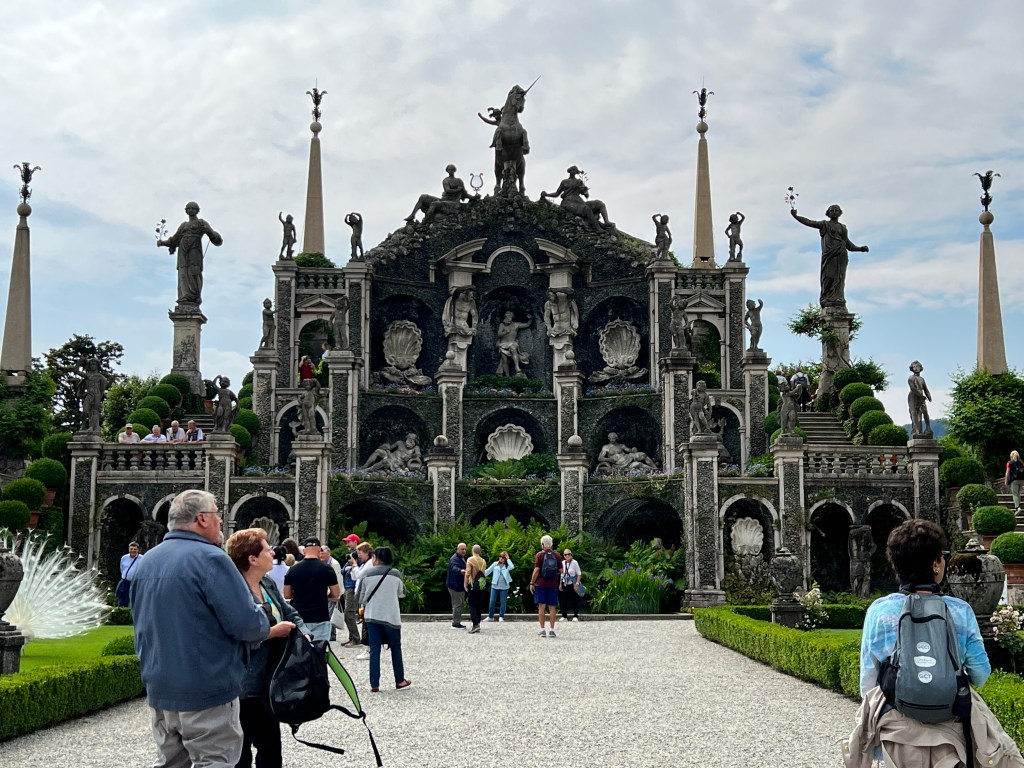
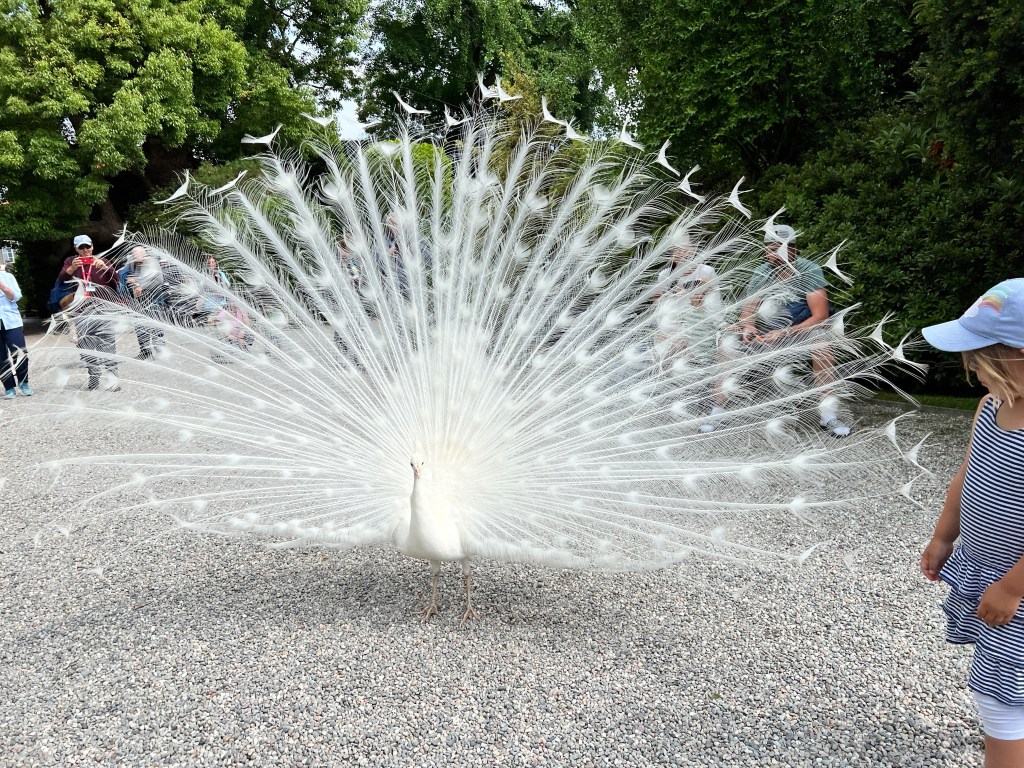
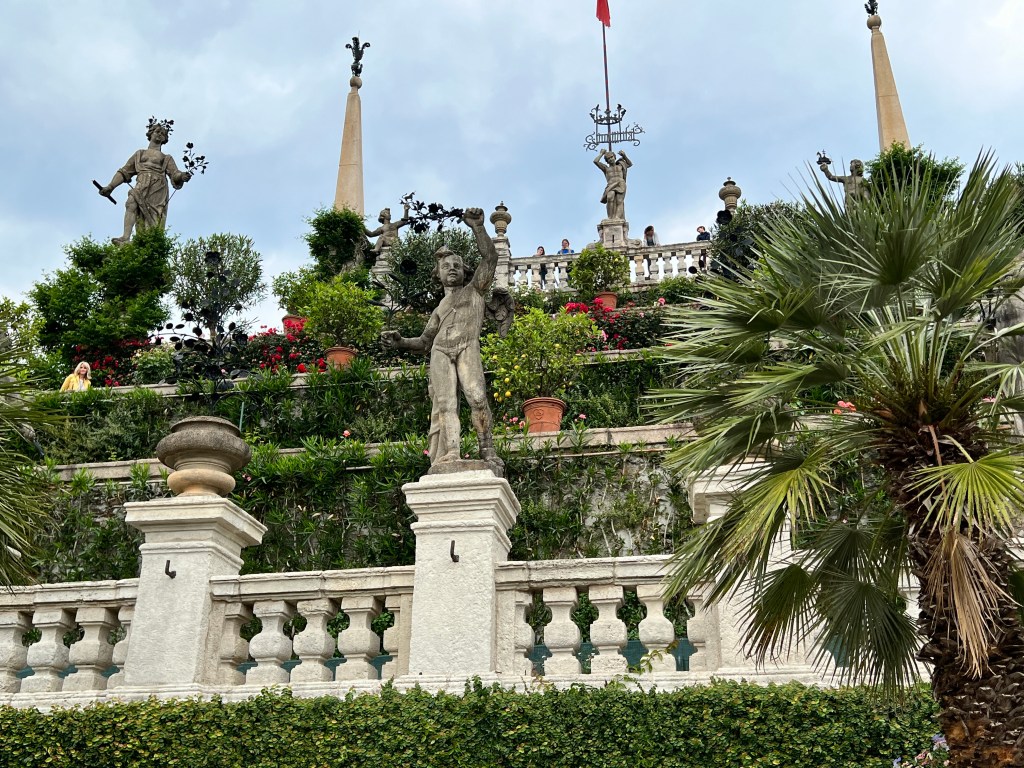
Now it was time to explore the vast garden with its wandering white peacocks. We enjoyed walking about the terraced gardens, which even included an aviary filled with love birds. It was a little bit of paradise.

Terrace crowned with the Borromeo family unicorn
White Peacock in his glory
Terraced garden with family flag flying

Our tour director keeps us busy, so before we knew it we were back on the boat headed on to our next activity, lunch on Isola Pescatori. There really wasn’t much on the small island except restaurants and scenic views. Lunch was not very good. The lake white fish was terribly salty and the dessert was tasteless. The location, however, was lovely.

After lunch we headed back to Stresa. Nothing was planned for the rest of the day. We returned with time to spare before Dan’s 3:30 doctor’s appointment. In the meantime we contacted Dan’s doctor’s office back home in order to see if it would be ok for him to take the antibiotics I brought from home. They basically gave the ok for us to do so. When the local doctor arrived he came with a young man from the hotel to act as a translator. The doctor spoke no English and the young man didn’t know medical terms, so the whole thing was a bit awkward. The doctor checked Dan over and prescribed the same antibiotic I had brought from home plus some cough medicine.

After such a busy day, and large lunch, we really weren’t in the mood for dinner. During our search for a drug store — which was easy to find because they are marked with large big green crosses — we went to a grocery store. We bought some small bottles of Aperol spritz, crackers, cheese, and bananas. I had asked for a regional cheese at the deli counter and was given some Toma del Mottarone. It turned out to be quite flavorful, but also quite stinky.

I was also on the hunt for the famous Margharitine di Stresa cookie. It is basically a shortbread cookie sprinkled with powdered sugar and either shaped round or like a daisy. It was developed in 1857 on the occasion of Princess Margherita’s first communion. In a small bakery located on a side street I spotted a tray of them. I bought a few for our dessert and some to share.

It was a nice change having a relaxing evening in our room and enjoying our cheese and crackers on our balcony. Eileen and Jim stopped by and tried some of our tasty, but stinky cheese and cookies. It wasn’t such a bad idea to have some down time given Dan’s cough. Hopefully he will sleep tonight.

CORRECTION; Florence was always at war with its neighbors especially Siena and Pisa. It was brought to my attention that my Day 9 blog incorrectly stated that Florence had tasteless bread because it didn’t want to buy salt from Siena. It was Pisa that controlled the salt trade, not Siena. There is a quote that came up more than once during our trip that makes it clear there is still disharmony between Tuscans. “Meglio un morto in casa che un pisano all’uscio.” “Better to have a death in the family than a Pisan at your door.” Message here is don’t bring a boy or girl from Pisa home to meet your parents if you live in Florence.

Day 15 The Lakes

Our luggage had to be tagged and ready for pickup by 7 AM. By 8 AM we were on the bus heading toward Lake Como with our final destination Stresa on Lake Maggiore. The Villa Carlotta in the town of Tremezzo was our first stop.

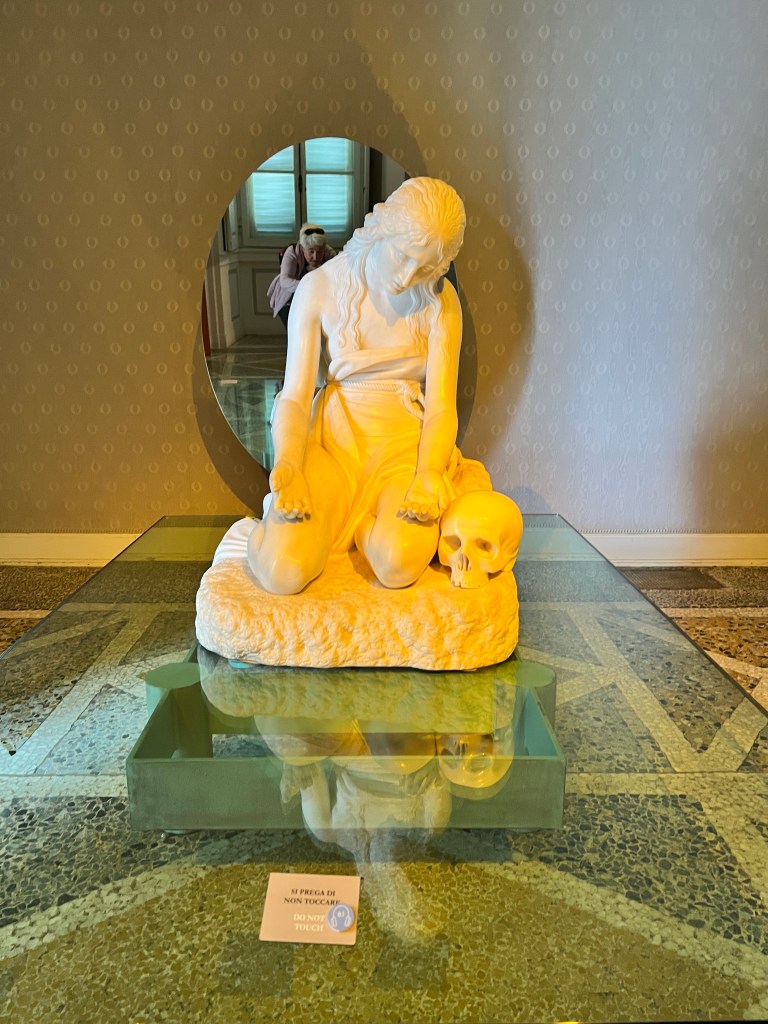
The Villa was built at the end of the 17th century by the marquises Clerici of Milan. It is now known for its botanical gardens. We took a quick look at the artwork inside and the home’s elegant Neoclassical interior. One of the most important pieces was the the Magdalena Penitente statue by Antonio Canova. Unfortunately with only one hour to see everything, we really only got a quick glimpse of what was inside.

Villa Carlotta
Magdelene Penitente by Antonio Canova

Every path took you to a different garden. The map shows 12 gardens to explore, but we saw only a fraction of them. This was rather frustrating because I happen to love visiting gardens, and the few we saw were beautiful.

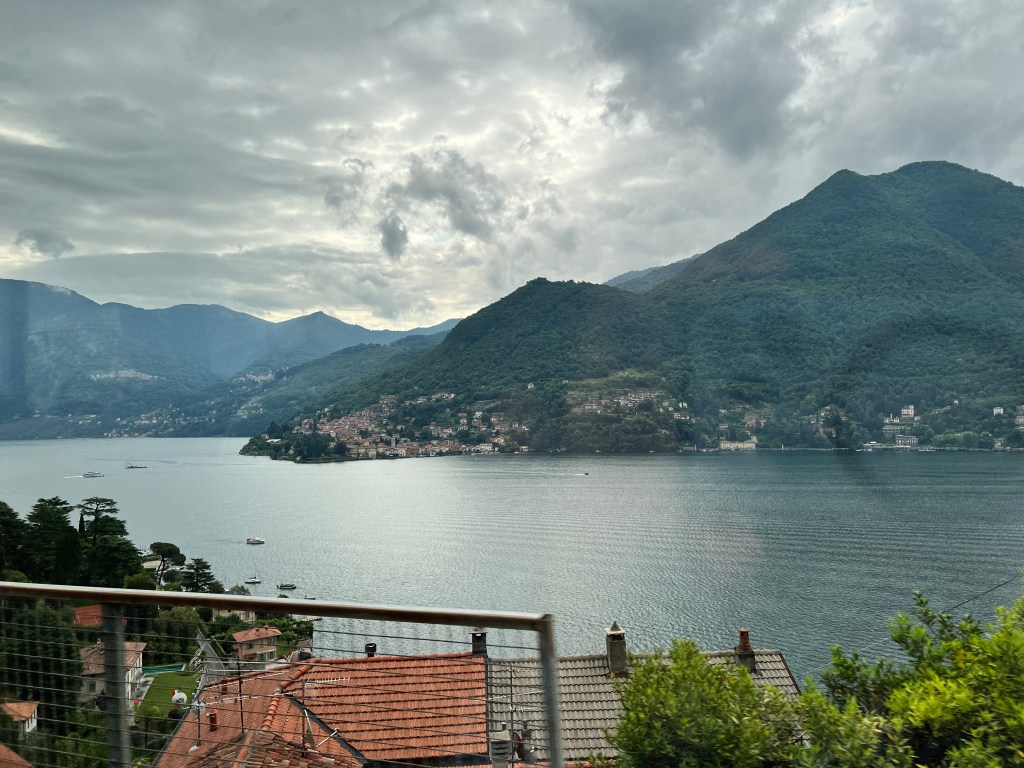
View of Lake Como from Villa Carlotta

We then boarded a private boat that took us across Lake Como to the town of Bellagio, the self proclaimed ‘pearl of the lake.’ It was a charming small town that we had the chance to explore on our own. We stepped into the church on the Piazza Della Chiesa, the Basilica di San Giacomo.
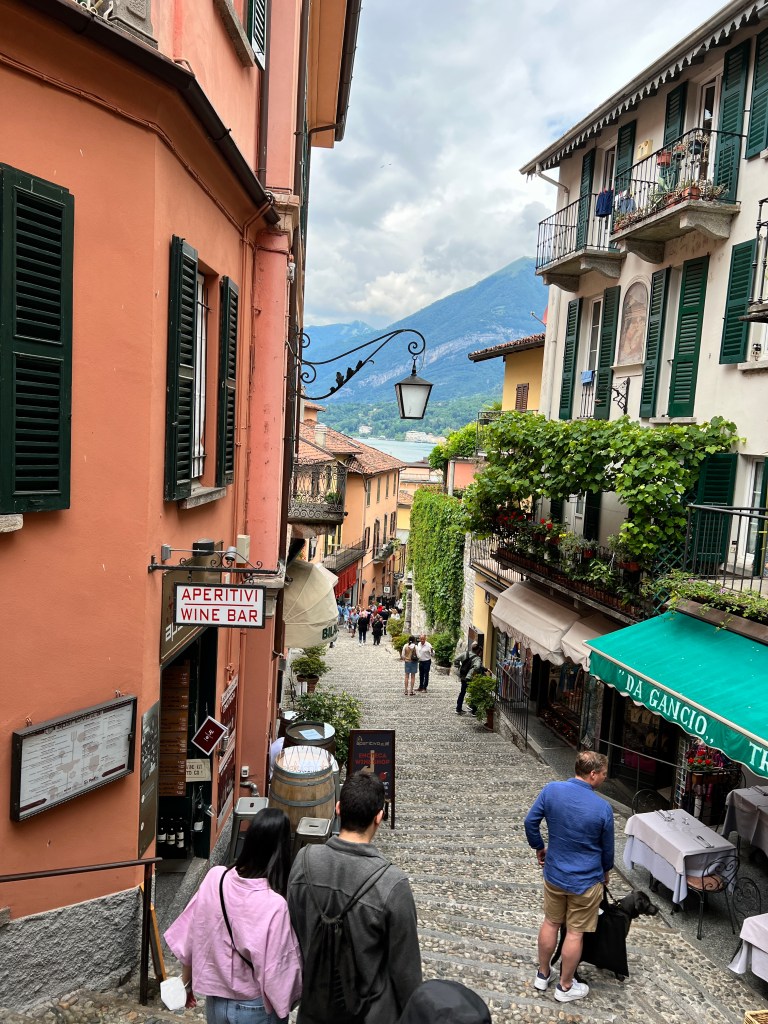
Streets of Ballagio

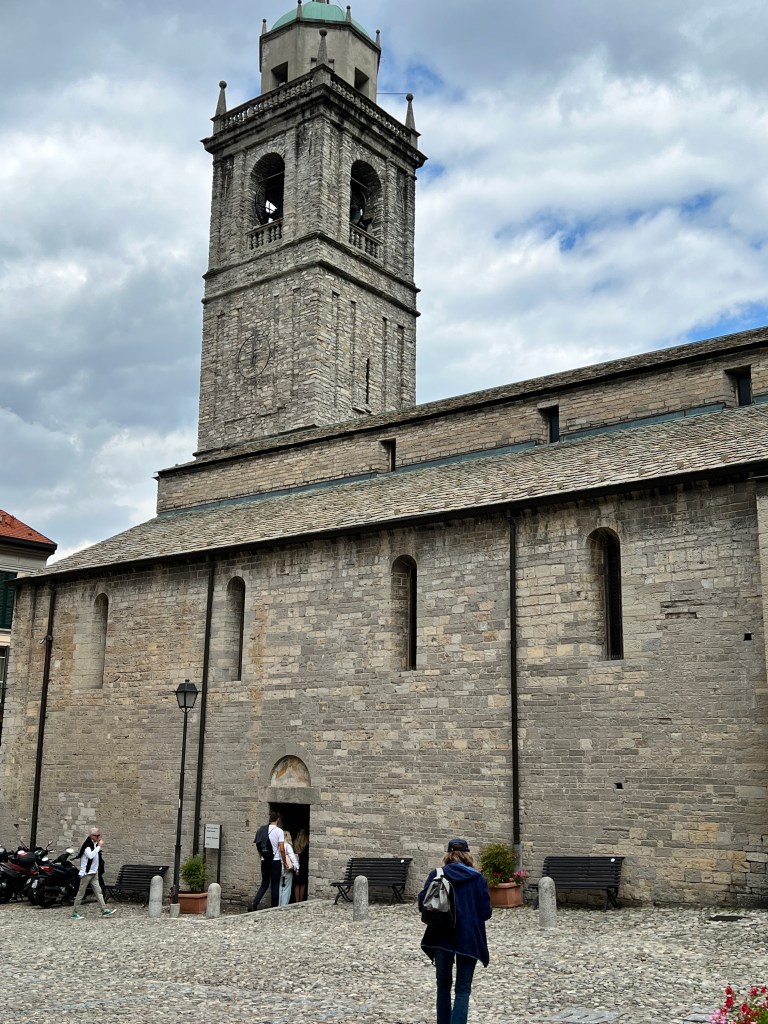
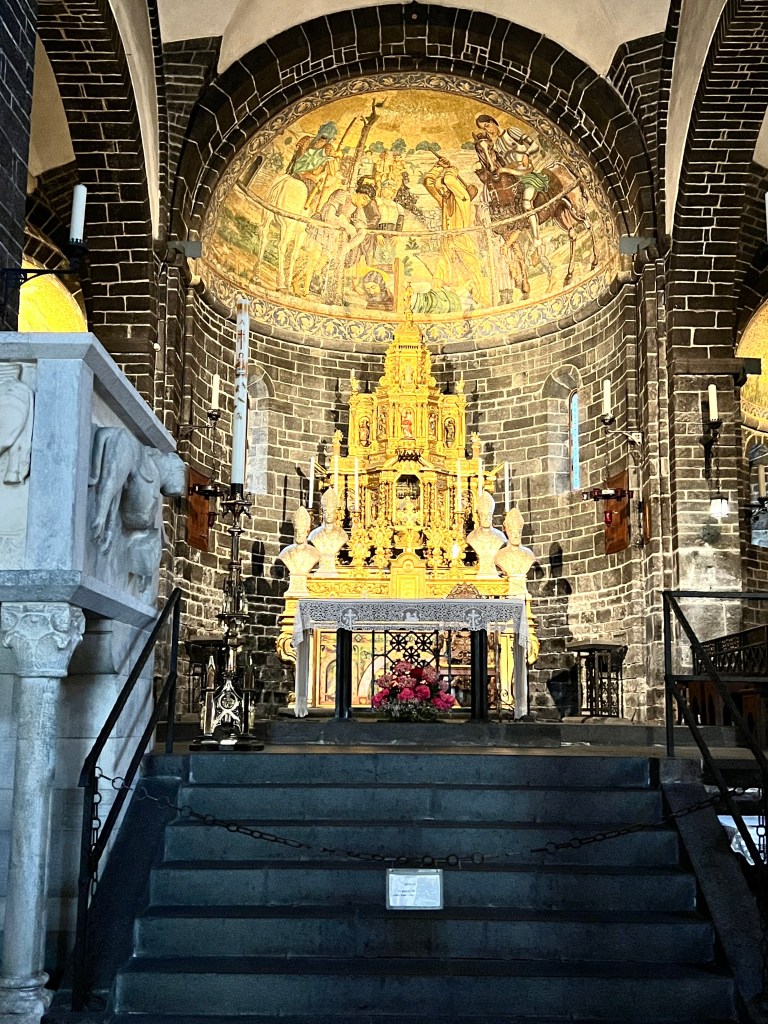
According to the tour books, the church is one of the finest examples of Lombard-Romanesque with an intact apse. While the parish dates back to the 12th century, the structure underwent restorations during the 17 century. Our wanderings eventually took us along the edge of the lake looking across to the Swiss Alps.

Basilica di San Giacomo
12th Century Apse

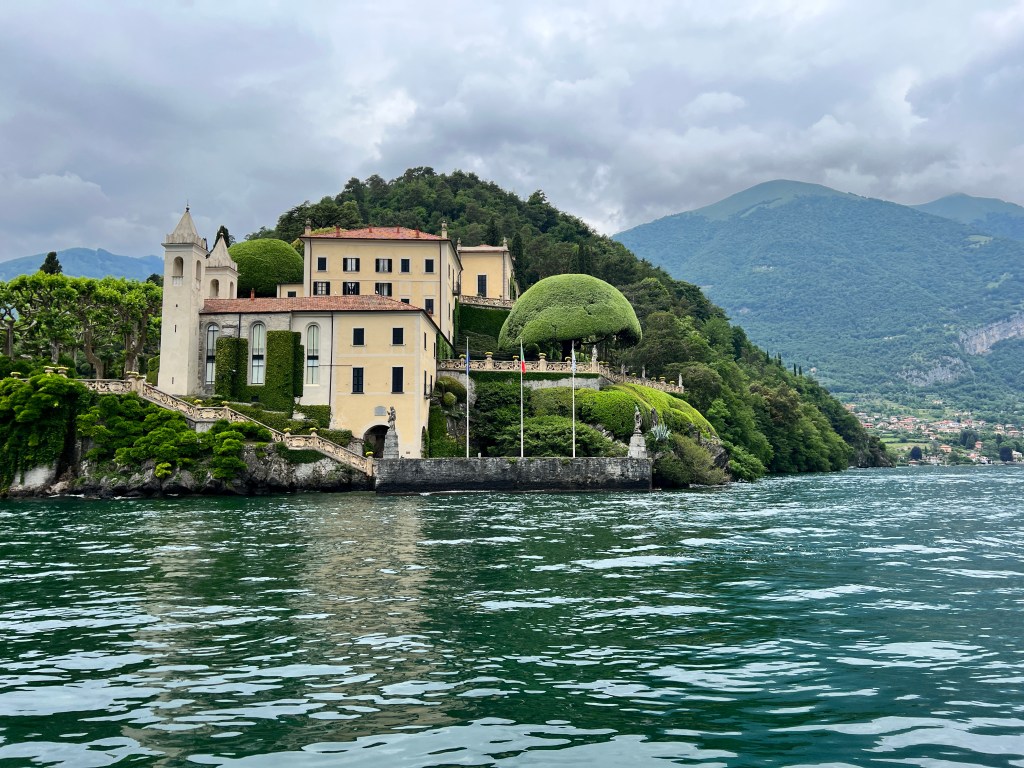
Before we knew it, it was time to board another boat for a cruise to The Grand Hotel Des Iles Borromees in Stresa. On the way we sailed past villas of the rich and famous, including that of George Clooney.

George Clooney’s Home

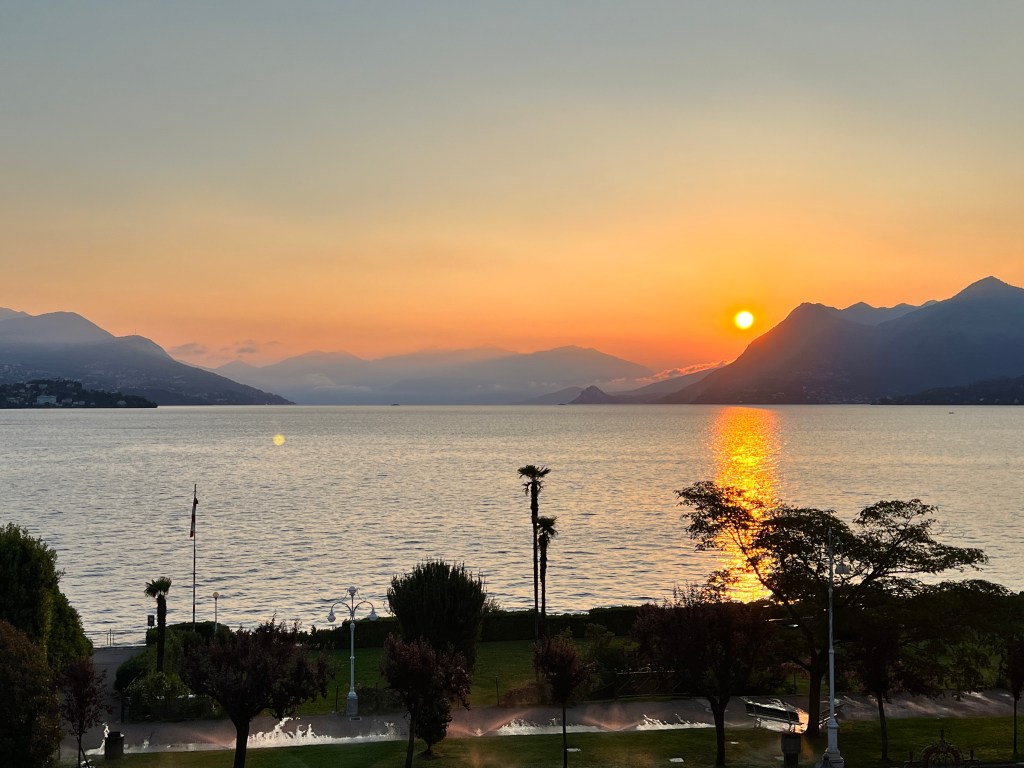
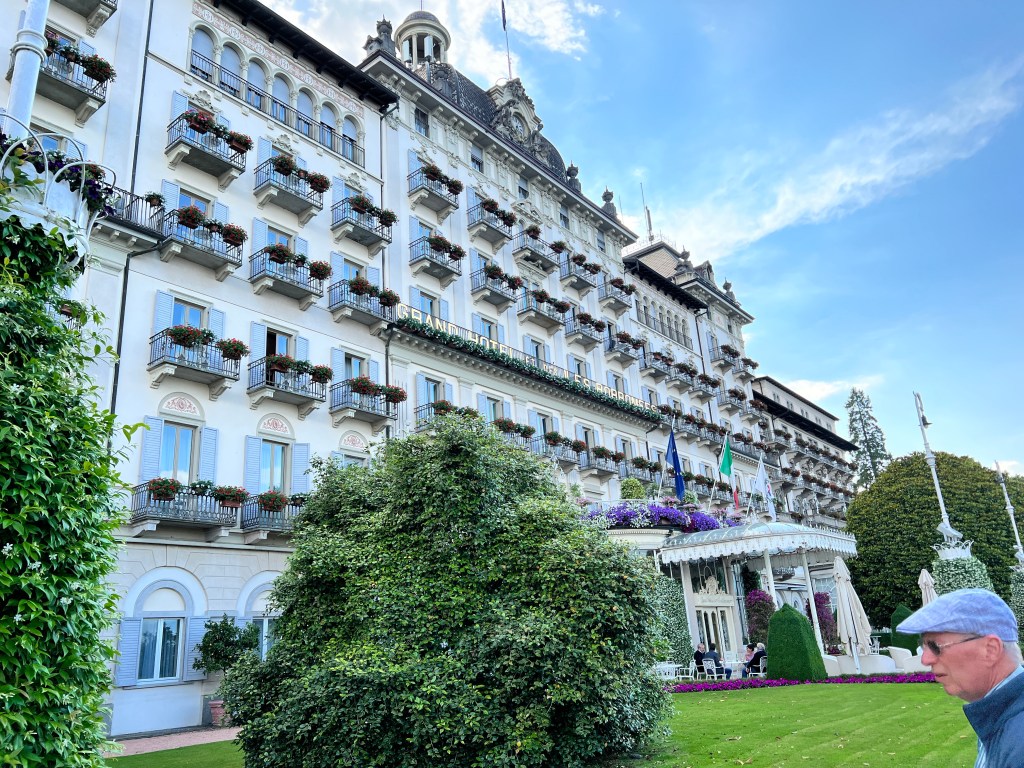
In Stresa, we checked into a beautiful room with a balcony overlooking Lake Maggiore. The hotel was built in 1863 and has hosted some of the worlds most famous personalities including the Vanderbilts, Rockefellers and Morgans and now Dermers. One of its most famous visitors was Ernest Hemmingway who stayed in a suite at the hotel while recovering from shrapnel wounds in his legs. Apparently he returned frequently. There is a suite named after him, and the bar bears his name.

Hemingway Bar
Grand Hotel Des Iles Borromees in Stresa

We had a lovely dinner at the hotel and we were able to turn in earlier than usual. Another busy day was on the schedule for tomorrow.

View out on our balcony

Day 14 Exploring Milan

By 8:45 AM breakfast was over and we gathered in the hotel lobby as Scott handed out our Vox listening devices. We were to keep these as constant companions for most of our Tauck travels. Lesson over, we headed out to our bus and met our driver Alfredo. He would be be with us throughout our trip.

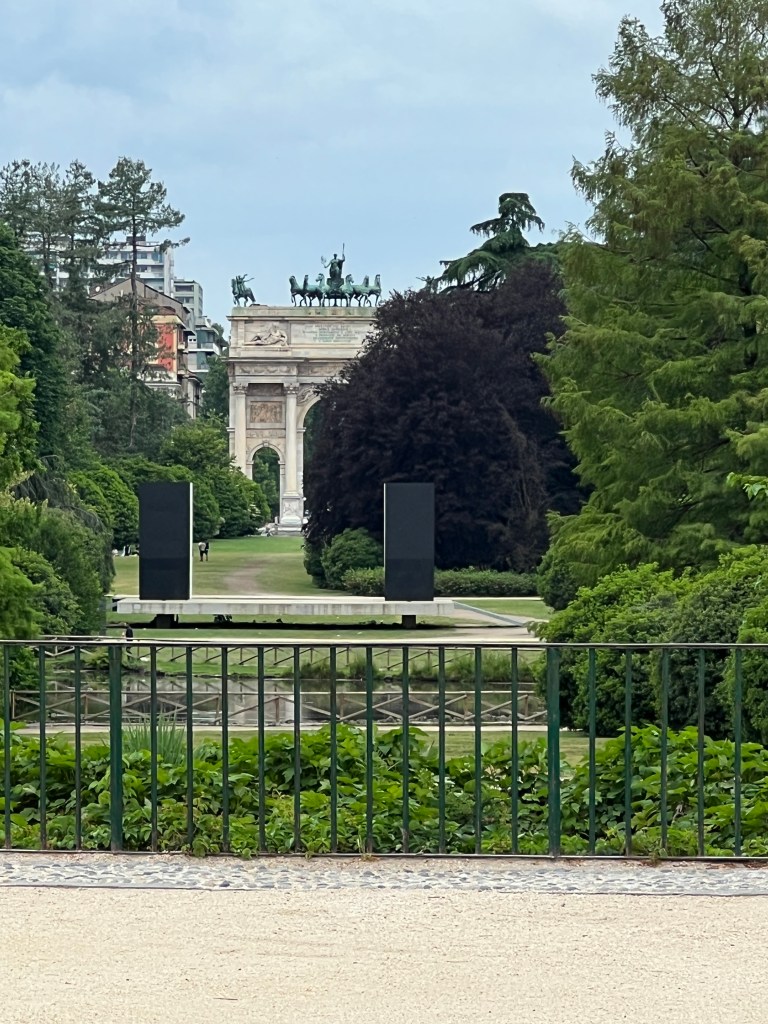
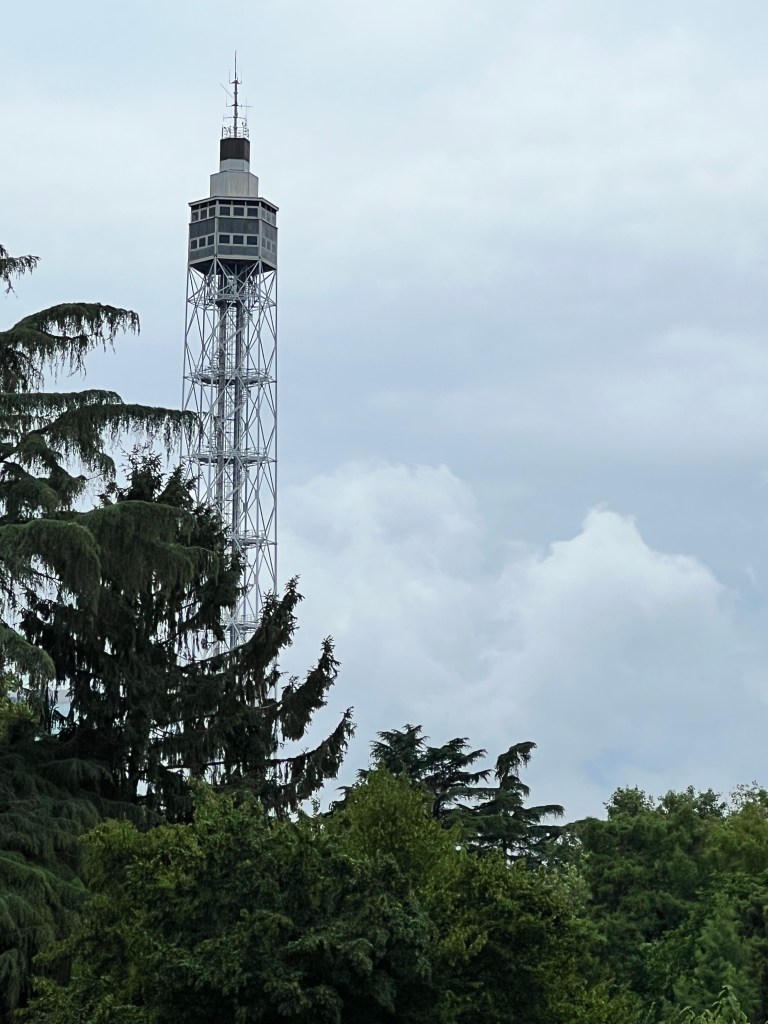
The day was supposed to start with a quick bus tour of Milan. Due to a race, however, many of the streets had been blocked off. Our guide still managed to point out a triumphal arch begun in 1807 in honor of Napoleon. Turns out the Italians didn’t care for Napoleon very much so that when the arch was finished in 1838 it became the Arch of Peace in honor of the coronation of Ferdinand I as King of Lombardy-Venetia. Another landmark was the Torre Branca (Branca Tower) built by Benito Mussollini in 1933. You can go to the top via an elevator for panoramic views of Milan. We also drove by some modern pieces of art
Modern art on city street

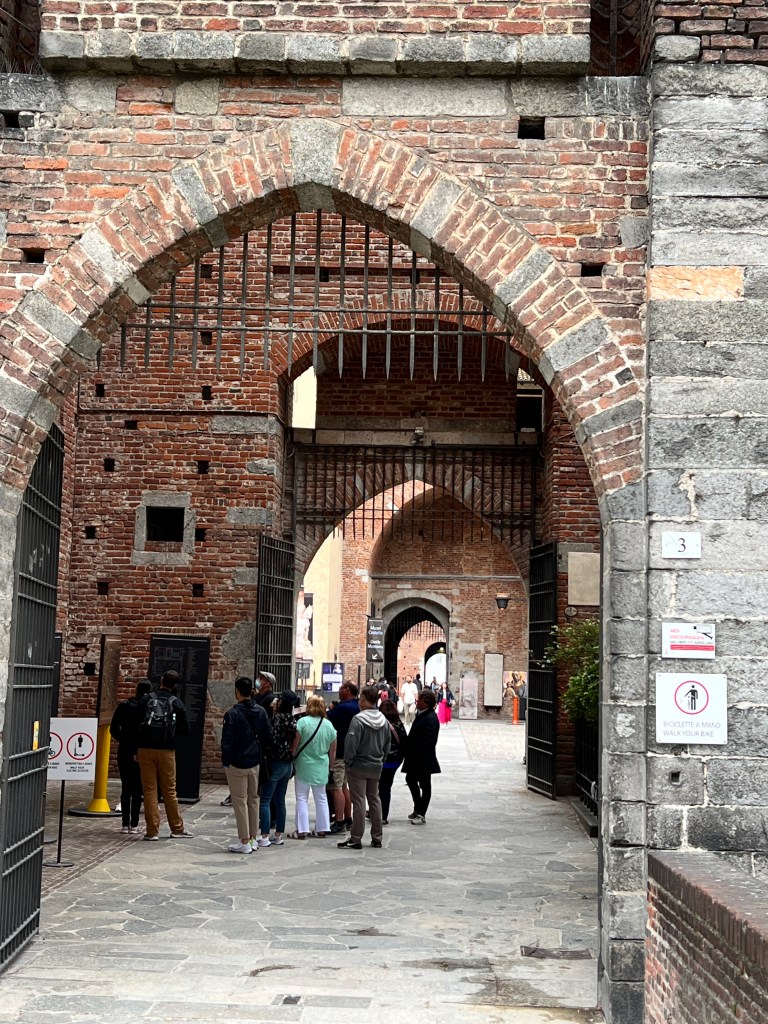
The first stop of the day was at the Sforza Castle. It was built in the 1300’s as a military fortress and was originally surrounded by a moat. Defenses were escalated by the Sforza duke in 1450 in anticipation of an attack by Venetians. The family built their Renaissance palace into the fortress. Leonardo da Vinci lived there when he served as a military engineer contributing to the design of the ramparts. The Castle is now primarily museums.

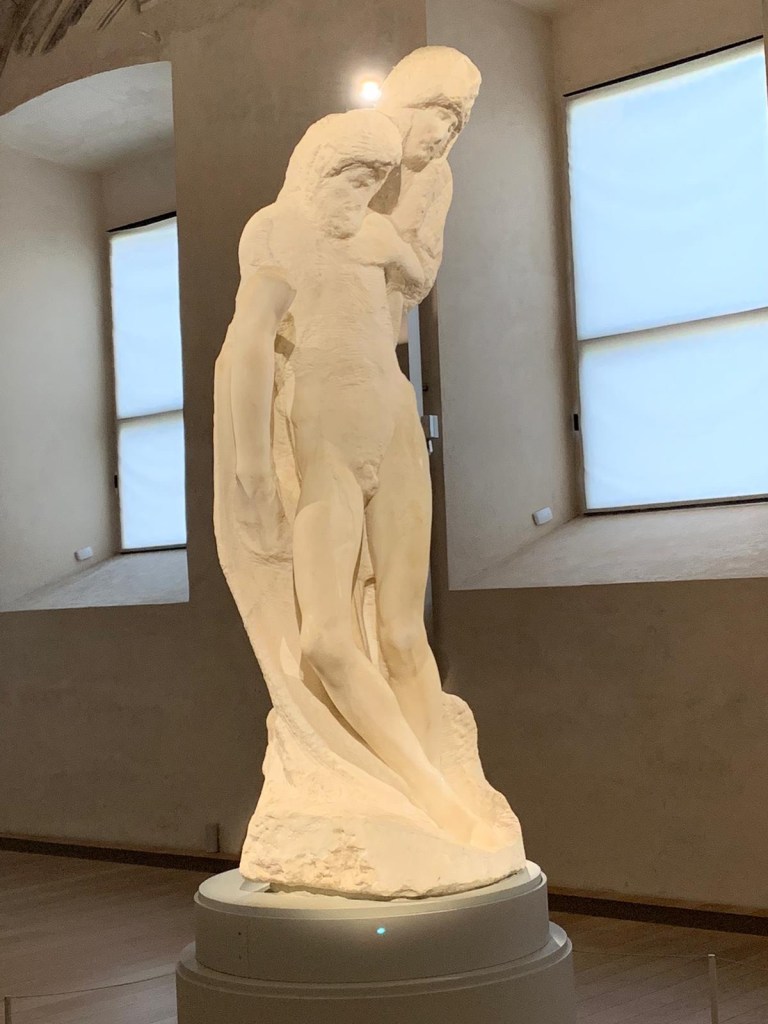
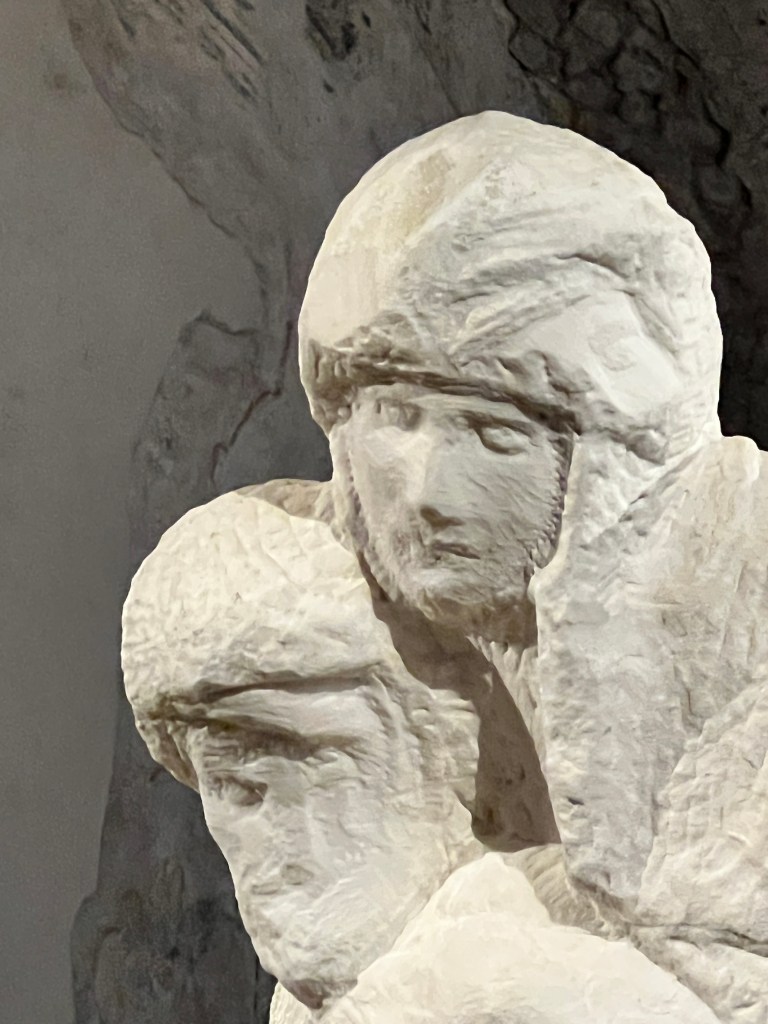
After learning of the history of the Castle we were guided to the highlight of the museum, Michelangelo’s Pieta Rondanini. This was Michelangelo’s 4th Pieta, and he died in his late 80’s while still working on it. (According to Rick Steves, “a Pieta by definition is a representation of a dead Christ with a sorrowful Virgin Mary.”). It sits in a room that was once used as a hospital for sick Spanish soldiers. The fact that it is unfinished makes it more interesting than the perfect Pieta in the Vatican. It’s roughness forces you to use your imagination as to what Michelangelo’s intentions may have been. There is an extra arm, and it isn’t clear which direction Jesus is facing. In addition, the two bodies appear to merge into one. It was wonderful being able to view this sculpture without the usual crowds.

We headed back toward the hotel where the bus dropped us off at the Piazza Della Scala. It is connected to the main square of Milan, Piazza del Duomo and is named after the famous Teatro Alla Scala Opera House. In the middle of the piazza sits a monument of Leonardo da Vinci. Our guide spent a lot of time reviewing each of the panels of the statue highlighting Leonardo’s life.

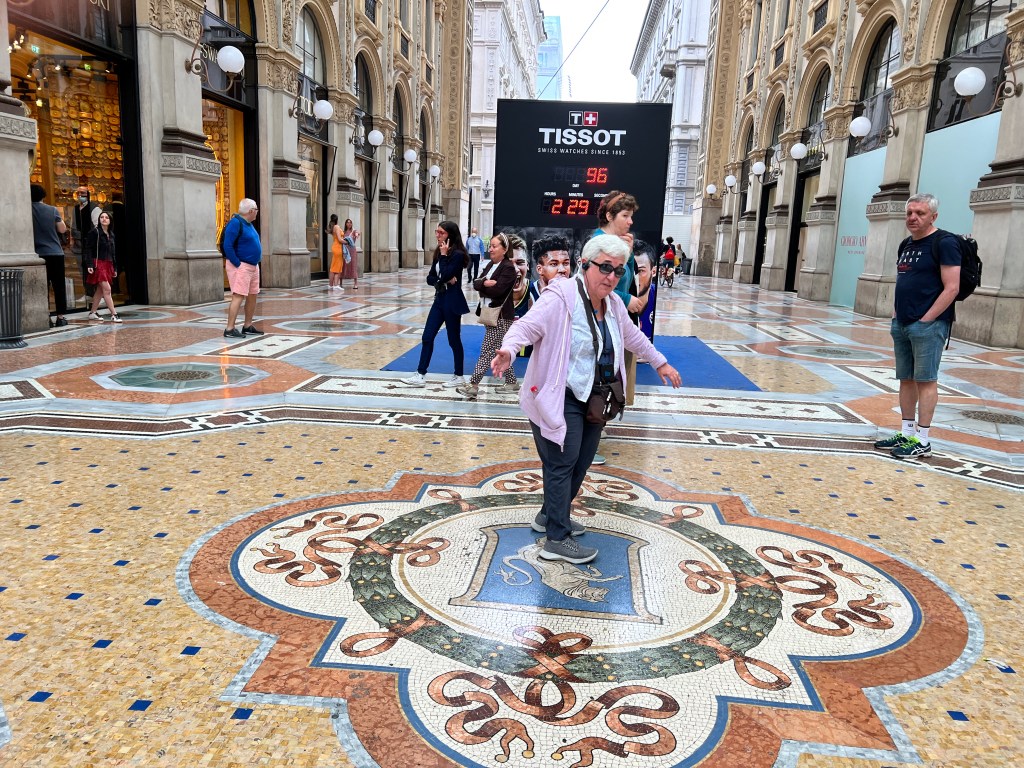
A tour of the Galleria Vittorio Emanuele II came next. It was named after Italy’s first king of the Kingdom of Italy and is Italy’s oldest active shopping gallery. It is filled to the brim with high end stores, i.e. Prada, Gucci, etc. Our guide told us how it was designed and built by architect Giuseppe Mengoni between 1865 and 1877. At only 29 years of age, he fell off scaffolding the day before the gallery opened and died. One story is that his body fell on the part of the mosaic floor featuring a Torino (little bull). It is supposed to be good luck if you step on the bulls testicles and spin clockwise two times. Evidently it is a popular thing to do because the mosaic must be replaced every few years.

Good Luck?

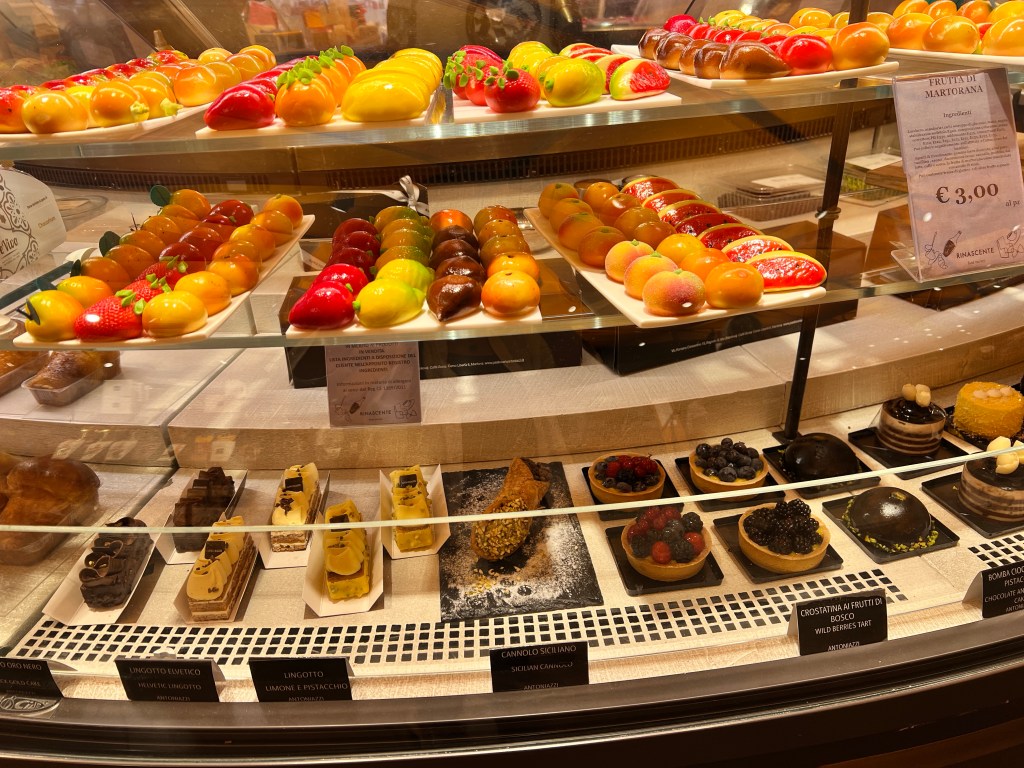
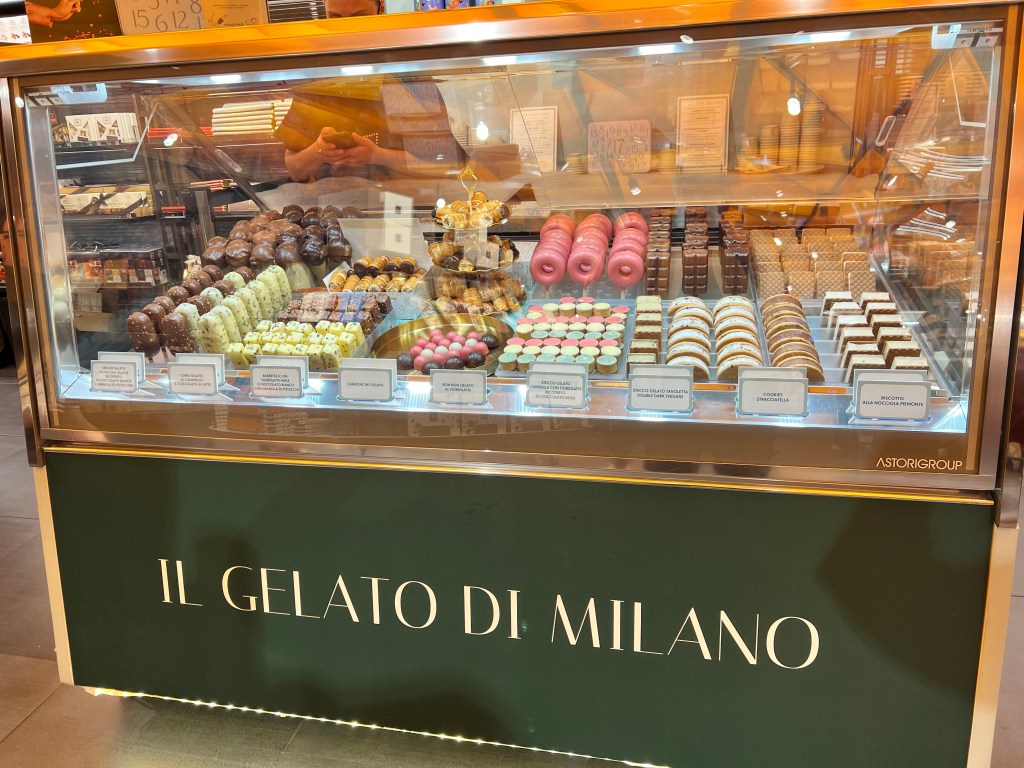
The formal tour was now over and we were free to do as we pleased until 4:30. Scott recommended going to the Rinascente food court for lunch, which is where we decided to head. La Rinascente is a collection of high-end stores with Italian and international brands in fashion, accessories, beauty, home goods and food. Just going up the escalator was a visual treat as we passed displays of clothing, shoes, furniture, etc. On the top floor were several restaurants and kiosks offering foodstuffs from gourmet gelato, to incredible baked goods. We ended up sharing a delicious eggplant and cheese hot sandwich.

Pastries anyone?
Fancy Gelato

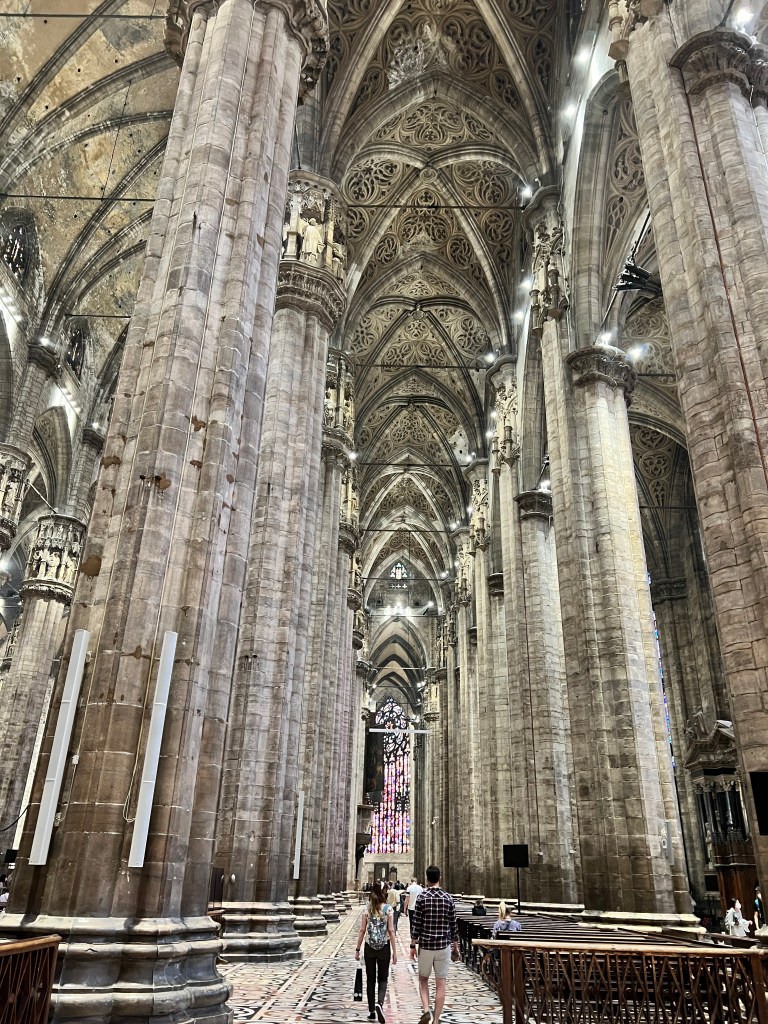
We still had some time on our hands and thought we should go inside the spectacular Milan Duomo. At first we were going to sneak in for free with a group heading to mass, but we decided to take the honest way in and purchased tickets. The ticket was only to see the inside of the church, although one could take an elevator up to the roof.

Inside Milan’s Duomo
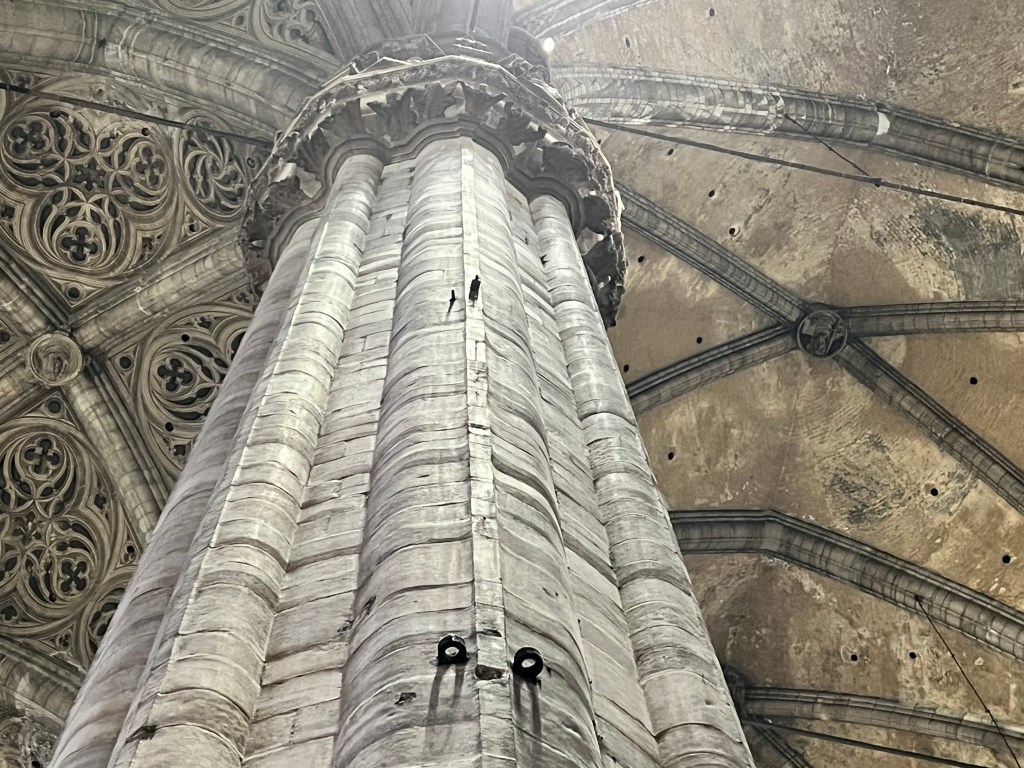
Massive Column

The Duomo was started in 1386, but wasn’t finished until 1888. I was correct in thinking it was built in the gothic style. In fact the entire edifice is enormous and quite spectacular. There was damage done to the church during WWII and some stained glass windows needed to be replaced. A rather macabre statue can be found inside. It is a statue of a bald St. Bartolomeo, an apostle and 1st century martyr, skinned alive by the Romans. It was carved by a student of Leonardo da Vinci, and almost looks like a anatomy dissection.

Time for the highlight of the day. We are about to go see Leonardo da Vinci’s Last Supper. According to Scott is is extremely difficult to get tickets, but we lucked out. The painting is located in Santa Maria della Gracie a church and Dominican convent. The Sforza family from the Castle written I wrote about earlier, hired Leonardo to decorate the dining hall of the monastery.

Unfortunately the technique Leonardo used to paint the walls using egg whites began deteriorating within 6 years of its completion. During WWII sandbags were lined up against the wall in an attempt to prevent its destruction. The church was bombed and much destroyed, but the painted wall remained unharmed. A 21 year restoration project completed in 1999 cleaned away 500 years of touch-ups and the results are remarkable. Each figure in the painting has a story to tell.

The Last Supper

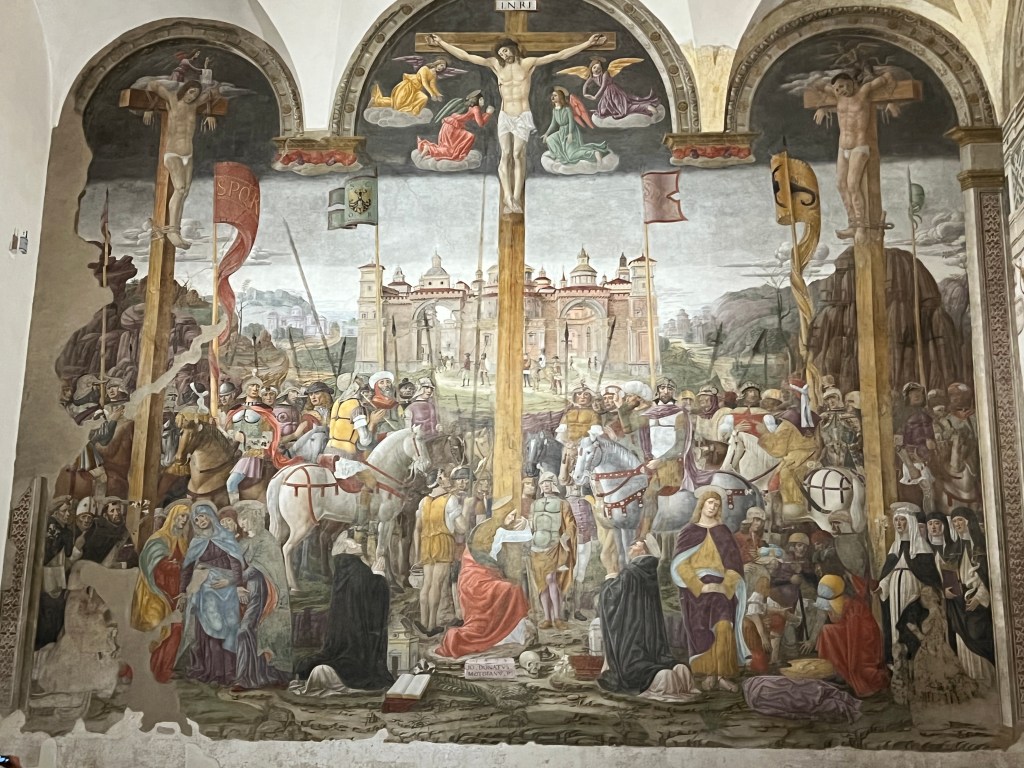
One last tidbit about the painting that our guide told us about. The Dominicans actually destroyed part of the painting by putting a door under where Jesus is sitting in 1652. Apparently they felt the painting was too far gone to be saved. Also across from Leonardo’s works is a Crucifixation scene by Giovanni Donato da Montorfano painted in 1495.

Painting by Giovanni Donato da Montofano

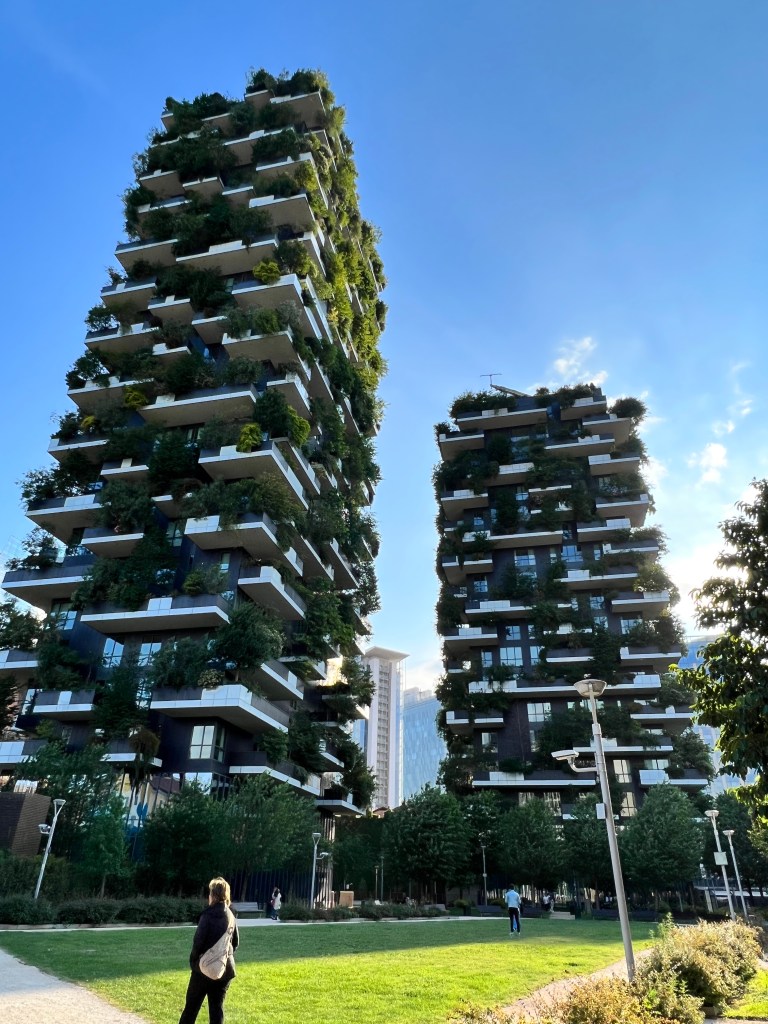
This evening Paul made reservations for us at restaurant called Bosco Verticale located in the Porto Nuova district of Milan. I had read about buildings covered with trees, but I had never seen any until now. Quite incredible, as was our dinner. Fresh tomato soup with ricotta, artichoke with some kind of cream sauce, and fresh pesto pasta that was incredible, I don’t remember dessert, but I’m sure it was phenomenal. After dinner they gave us some homemade digestifs lemoncello and another one made from berries. I would definitely recommend this restaurant to others.

Vertical Forest Apartment Buildings

Day 13 On to Milan

For the first time since we left home we had a relaxing morning. Our train to Milan wasn’t until 11:55. It was a quick taxi ride to the train station where we connected with Terry and Paul. They had stayed at a different hotel the last night in Florence. This time we traveled business class. Except for the ability to easily change or cancel a ticket, there really wasn’t that much of a difference from standard class seats.

As expected, a Tauck representative was there to transfer us to our hotel, the Grand Hotel et de Milan. No more three star hotels for us. Our room was lovely, but not overly large. One thing we’ve discovered on this trip is that the bathtubs in many hotels stand over 2 feet high. Why? I can attest to the fact that it’s a challenge for someone 5’ tall to get in and out. I guess Italians really like filling up their bathtubs.

Note: At most of our hotels we were given a thin pair of slippers. If there was turn down service, we would find our slippers carefully placed on a towel on the floor on each side of the bed. How could we toss them out? We ended up bringing about a dozen pairs back with us.

Milan is Italy’s banking center, and is an international fashion capital. The hotel is situated very close to the Piazza del Duomo and the Piazza Della Scala, so we decided to take a quick walk before dressing for dinner. Tonight is our welcome reception.

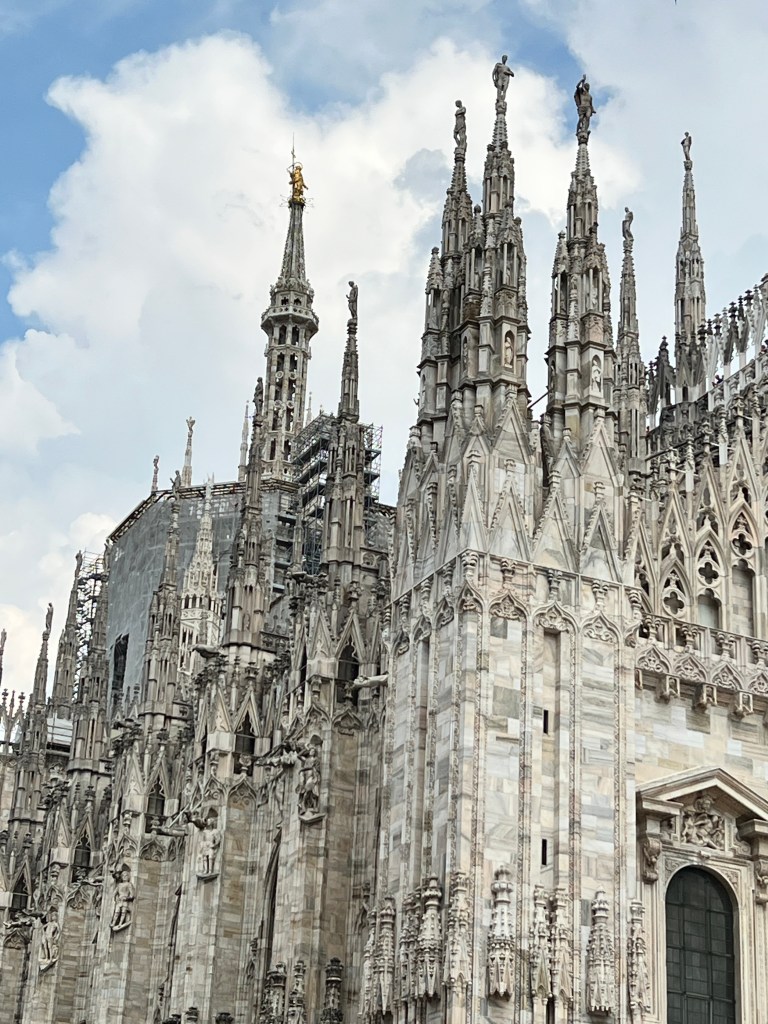
The famous La Scala Opera House was just down the street from our hotel. The Piazza del Duomo is large, but so is the Duomo. It is also extremely ornate like a gothic cathedral. According to Rick Steves the church has more than 2,000 statues inside and another 1,000 outside, plus fifty-two 100 foot tall pillars representing the weeks of the year. It was built to hold 40,000 worshipers.

Milan’s Duomo
Just a little ornate.

Sitting across the way from the Duomo is the Galleria Vittorio Emanuele II, a glass domed arcade filled with shops, restaurants, and people. We stopped at a nearby cafe and enjoyed drinks and a delicious salmon appetizer on flat bread. I had asked for an iced coffee and ended up with some kind of coffee martini drink. It wasn’t what I ordered, but it sure was yummy.

Galleria Vittorio Emanuele II
Salmon on Flat Bread
Ice Coffee?

Our evening began at 6:30 back at the hotel. There are 24 people in our Tauck group and they come from all over the U.S. It seems like a very nice group. I sure hope so since we will be spending a lot of time with each other. Our tour director is Scott Bishop Falcone.

Day 12 On our own in Florence

NOTE: I’m certain you’ve noticed that I have not been posting daily. My main focus has always been to enjoy our vacation. After a day of exploring it was time to relax and go to bed, not write. As a result, I only covered about half of our trip before returning home on Tuesday, June 7th. Despite the fact my ramblings will not be in real time, I have decided to keep writing. My daily notes and photos should allow me to recreate our days in Italy fairly accurately. So the Italian adventure continues even though we are safely home.

This is our last day in Florence and we have it entirely to ourselves. Another beautiful day of blue skies, but also increasing temperatures. Today will be in the upper 80’s. We enjoyed another pleasant breakfast in our hotel’s outdoor dining area. It was then time for another walk into town where we once again crossed the Ponte Vecchio. We have a 10:30 AM Brunelleschi Pass that allows us to climb the Duomo, visit the Baptistry, Campanile, and Museo e Santa Reparata.

Another Note: It just occurred to me that when I was in Italy 50 years ago the Ponte Vecchio was full of expensive gift shops. Today all the stores appear to be high end jewelers. The crowds are still there, but the vibe is quite different.

It was smart purchasing tickets in advance in order to avoid long lines, but, as usual, we had a bit of a problem finding the correct line to stand in. There is a line for purchasing tickets, and multiple lines based on the time of your Skip the Line ticket. Signage was terrible, if it even existed, so we relied on fellow line waiters to verify we were in the right place.

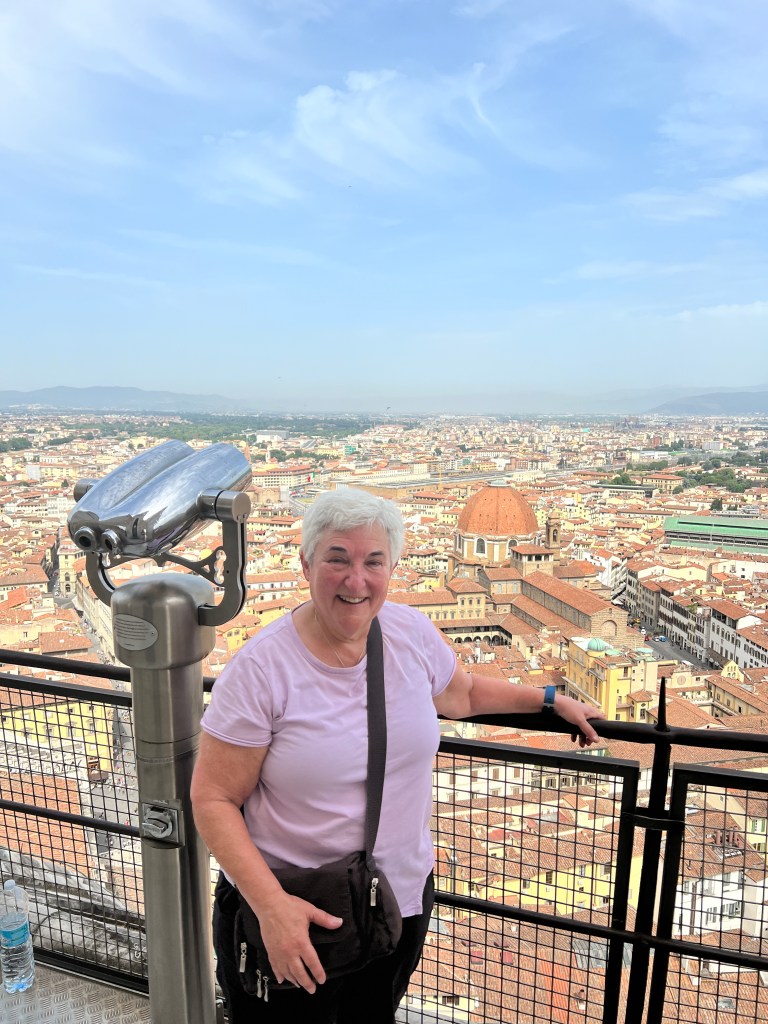
When it came time for us to start our climb, Dan decided he better not go ahead with it. I thought I’d give climbing the 463 steps a try. Three quarters of the way up, I got a closeup of the dome’s artwork. Huge images of hell loomed over my head, which was a bit unsettling. Since I was concentrating on the climb, however, I didn’t spend much time admiring Brunelleschi’s dome within a dome. When completed in 1436, the it was a true wonder, and became the model for domes to follow from St. Peter’s to the U.S. Capitol.

While not the quickest climber in the group, I did make it to the top. The views overlooking Florence were lovely, but I didn’t have much time to admire the views as the stay up top was timed. Going down was an easier, but dizzier experience. Lots of narrow stairways going around and around. It was relief to reach the ground.

I did it! I climbed the Dome.

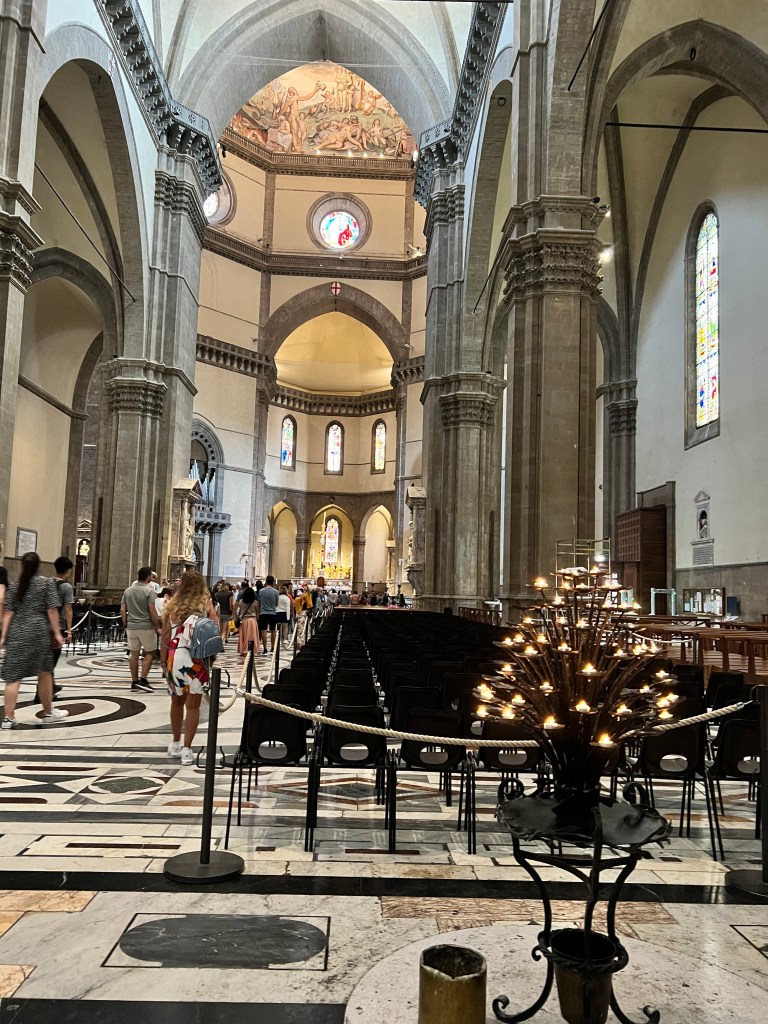
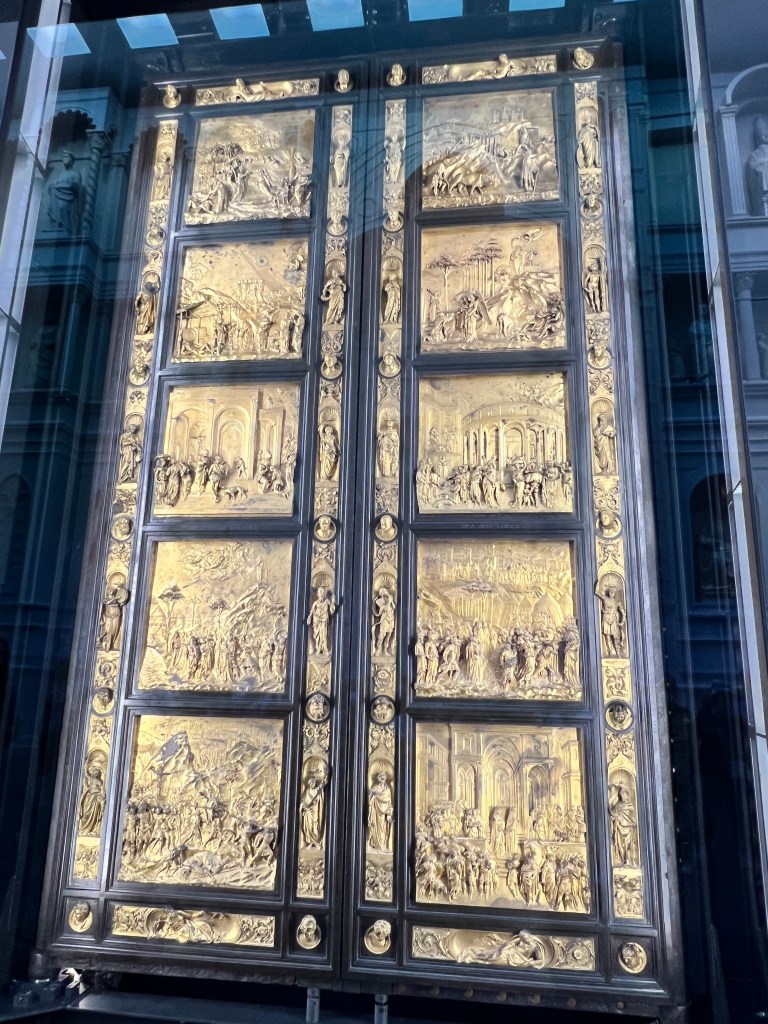
After finding Dan, we paid a quick visit inside the duomo. Compared to other churches, it is more impressive on the outside than inside. Ghiberti’s bronze panel doors on the Baptistry, however, are impressive. The originals are safely kept inside the Duomo Museum.

Inside the Duomo

Just as was done for the design of the dome, a competition was held to find the best artist to create the North doors of the Baptistry. Ghiberti won over Donatello and Brunelleschi. Panels on the huge door depict 28 scenes from the New Testament. It was so well received Ghiberti was asked to do the East door. That door, the Gates of Paradise, was even more spectacular. These panels tell stories from the Old Testament, and include his self portrait and that of his son.

What amazed people at the time of the doors creation was their depth of perspective, as well as realism. Ghiberti was the illegitimate son of a goldsmith and spent more than 50 years creating the two sets of Baptistry doors. The job required a large workshop of artists and artisans. Each panel is bronze with a layer of gold on top.

Gates of Paradise by Ghiberti
Ghiberti’s New Testament

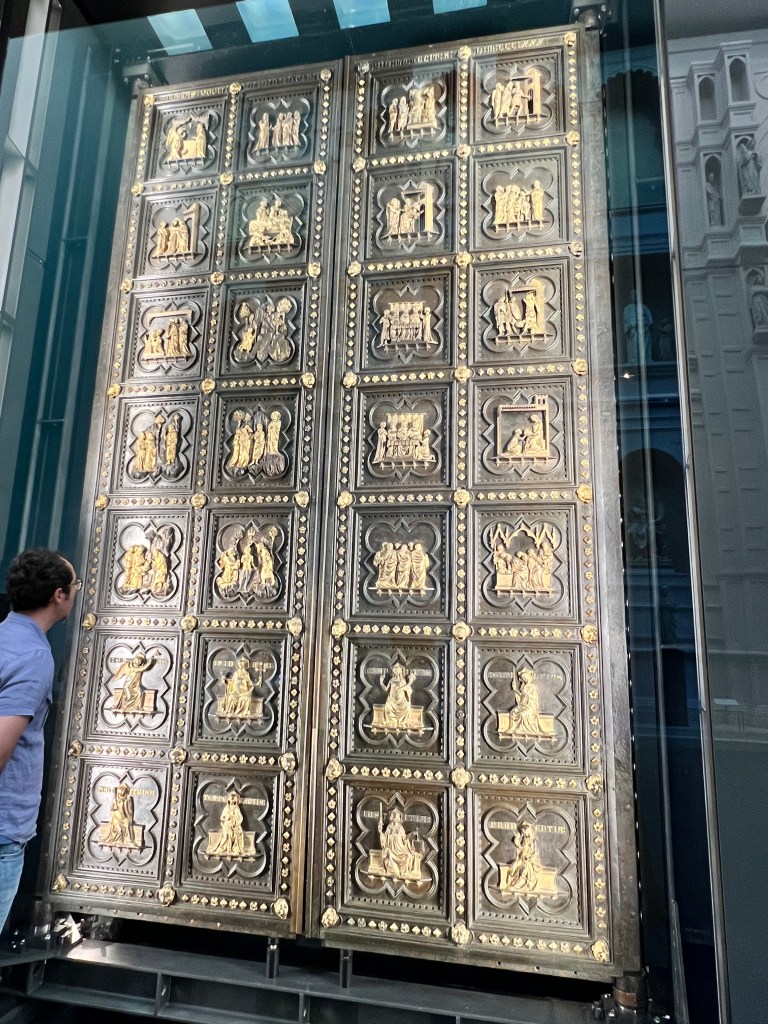
If you are wondering about the other Baptistry door, the South door was made 70 years before Ghiberti and depicts the life of Saint John the Baptist, patron saint of Florence. Created by Andrea Pisano in the 1330’s they are static and devoid of perspective. One can easily see how Ghiberti’s efforts are far superior.

Pisano’s Door

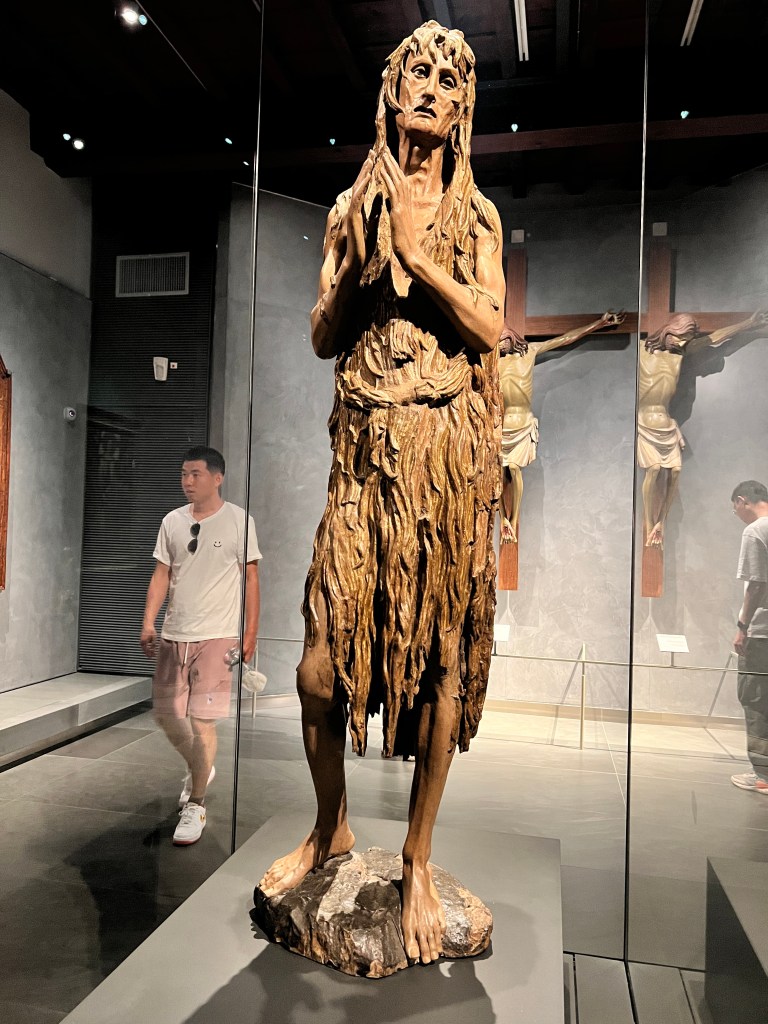
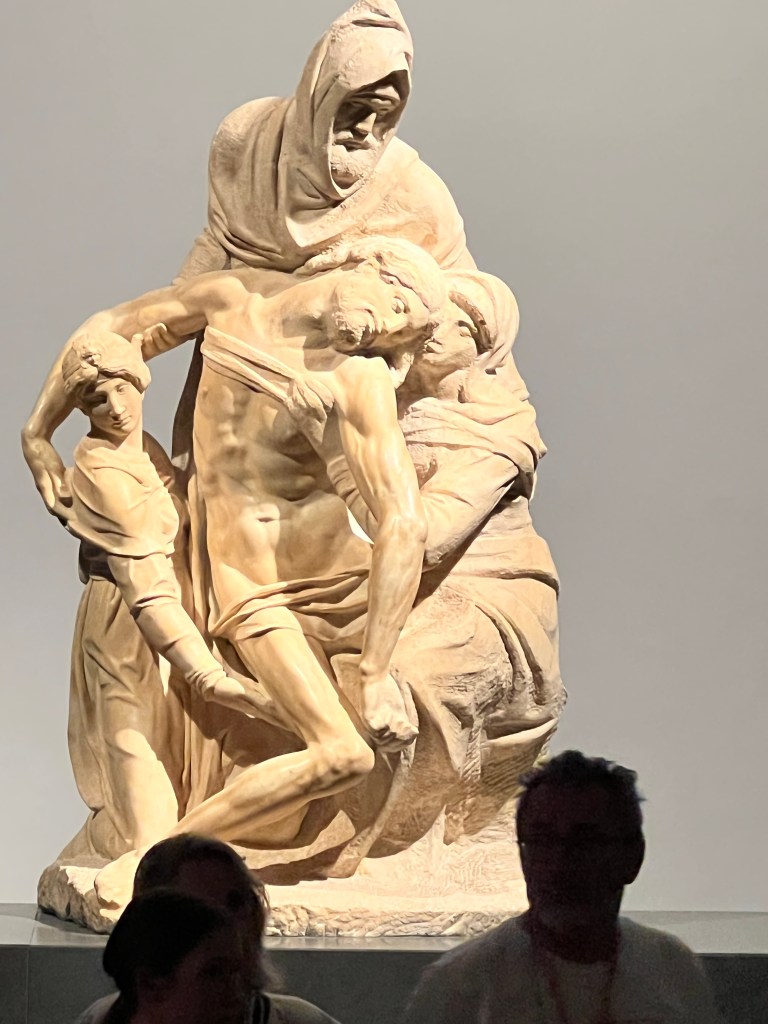
Along with relics and lots of other incredible pieces of art in the Duomo Museum, Donatello’s Mary Magdalene stood out. Made of wood, the sculpture depicts an emaciated woman praying to be forgiven. It is striking in its detail. Frankly it was difficult to look at since the subject appeared to be in so much pain. In addition, there is another version of the Pieta sculpted by an 80 year old Michelangelo. It was meant to be part of his own tomb. The body of Christ is supported by Mary, Magdalene and Nicodemus. It shows an intimacy between mother and son. The face of Nicodemus, the converted Pharisee, is Michelangelo himself.

Donatello’s Mary Magdalene
Michelangelo’s Pieta

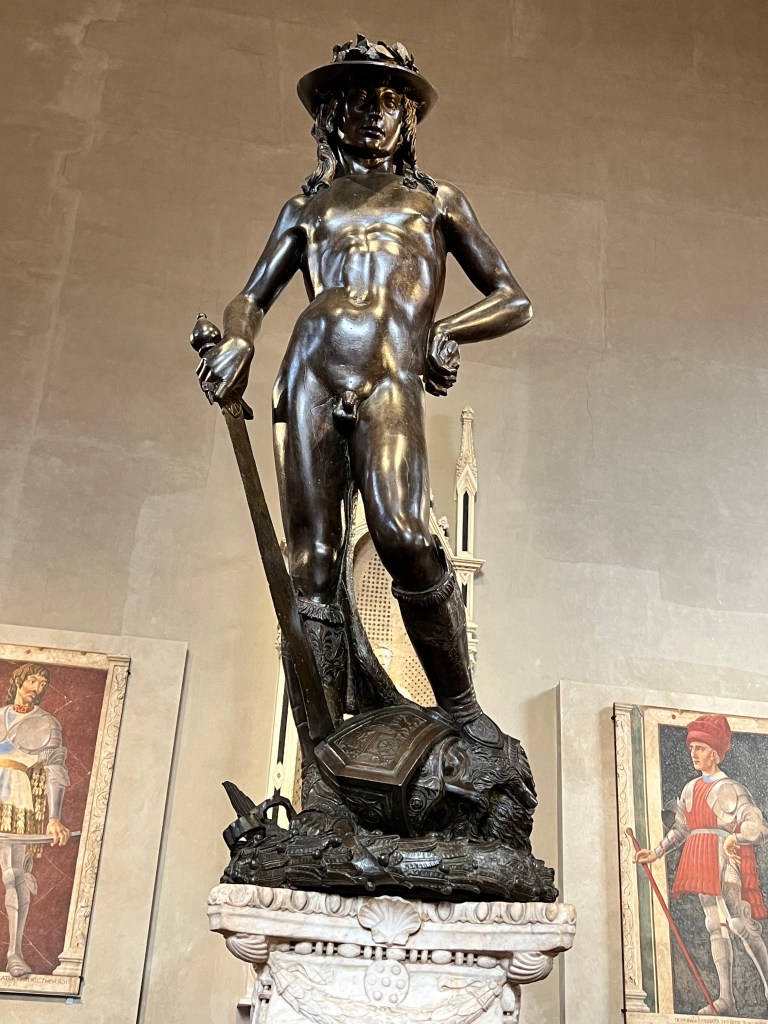
Before leaving for Italy we read the Wall Street Journal reported that there was a special exhibit of Donatello’s work at the Museum del Bargello. Since we were walking right past that museum, we decided to take a look. Donatello was born in Florence in 1388 and was an apprentice at Lorenzo Ghiberti’s workshop. The special exhibit allowed us to see several of his works that had been brought together for the first time. Most interesting to us was his somewhat effeminate bronze statue of David. What was with the odd hat? Quite a different take than Michelangelo’s version.

Donatello’s David
Donatello’s Virgin and Child

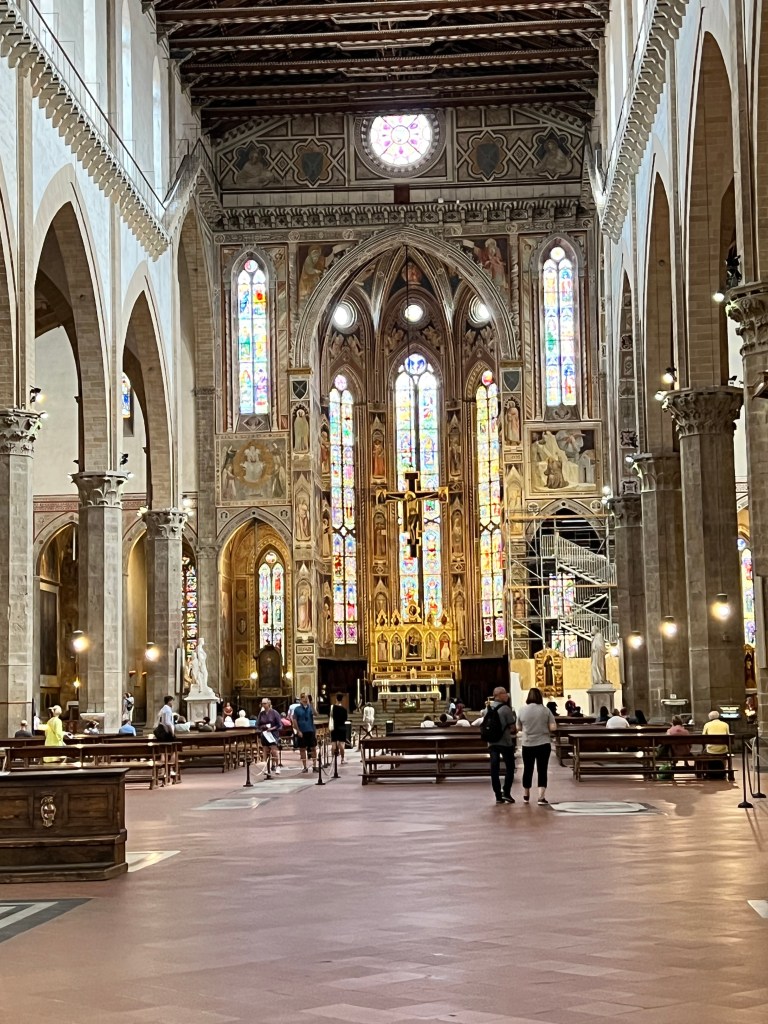
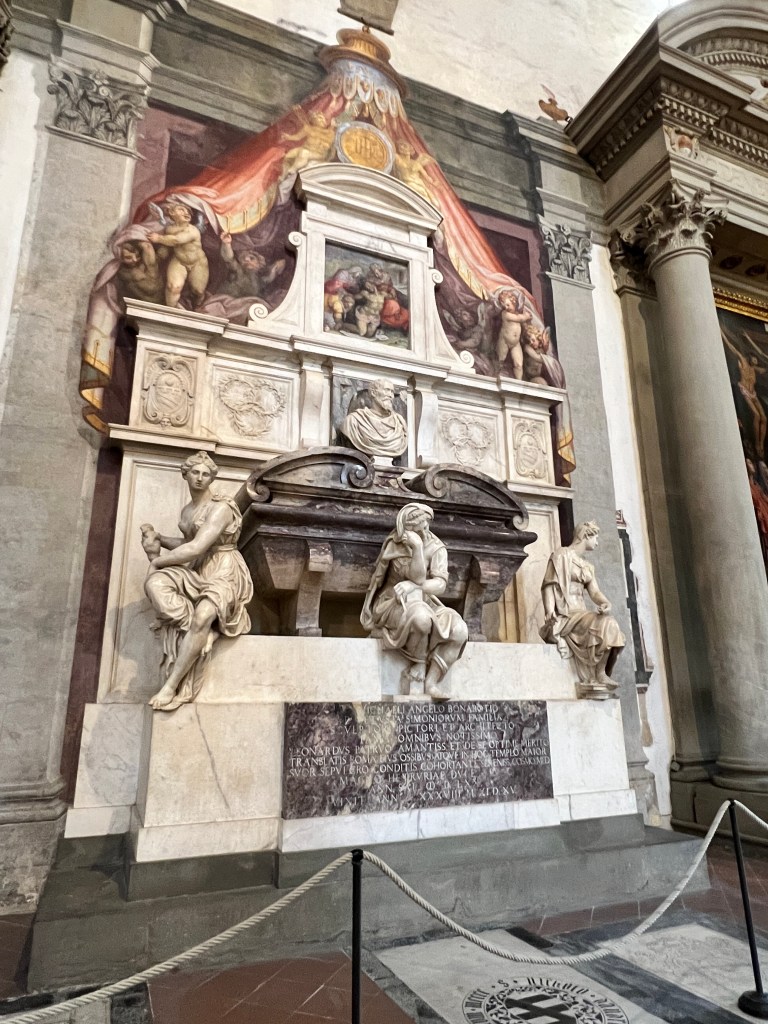
Then it was back to Santa Croce, and this time we went inside. It is a beautiful edifice, and is one of Florence’s largest and oldest churches. It was designed by Arnoldo di Cambio in 1290 A.D. He also designed the Duomo in Florence. It is the final resting spot for many famous Florentines including Michelangelo, Galileo, Dante, and Rossini. Galileo’s remains were not interred in Santa Croce until years after his death. As most people know he was considered a heretic simply because he believed the earth revolved around the sun. His last years had been lived under house arrest.

Inside Santa Croce
Michelangelo’s Tomb

Located behind Santa Croce is the Scuola del Cuoio, also known as the Florence Leather School. The school was established after WWII to train a new generation of leather crafts people. Today it is still a school, but also provides a place for artisans to create unique leather goods of the highest quality.

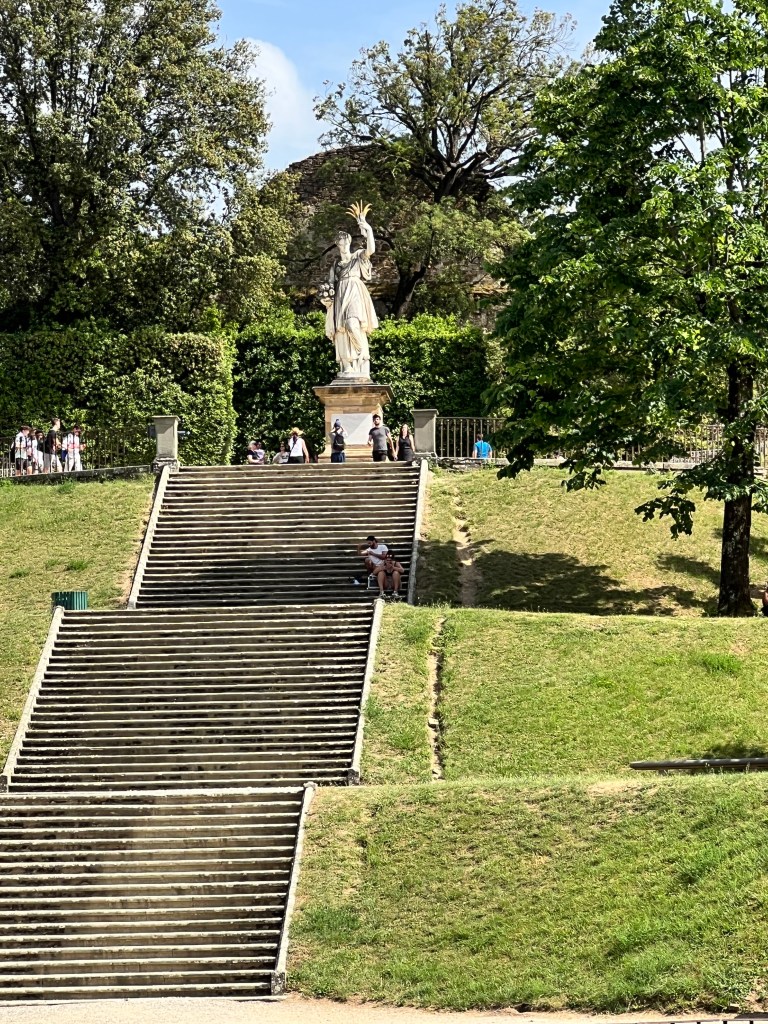
After hours of walking in the sun we should have called it quits and headed back to our hotel. But no, not us. We had heard of the beautiful Boboli and Bardini gardens at Pitti Palace. Besides they were located on our side of the Arno River. It wasn’t until after we paid to enter that we discovered that the gardens required a major uphill climb and energy we simply did not have. We made it up part of the way, found a shady spot and sat for a while. Finally using some common sense we decided to leave.

Part way up hill in Boboli Garden

Our friends Terry and Paul had raved about a restaurant just around the corner from us. So after washing up and relaxing we headed out to find Del Bricco Hosteria. Arriving at 7:00 PM, when many restaurants first open for dinner, was a lucky move. We were one of two couples they let in without reservations. The veal stew was absolutely delicious, the house wine quite wonderful and the tiramisu divine. It was a fulfilling way to complete our Florence marathon day. Tomorrow we head to Milan for the start of our Tauck tour, Italia Bellissima.