
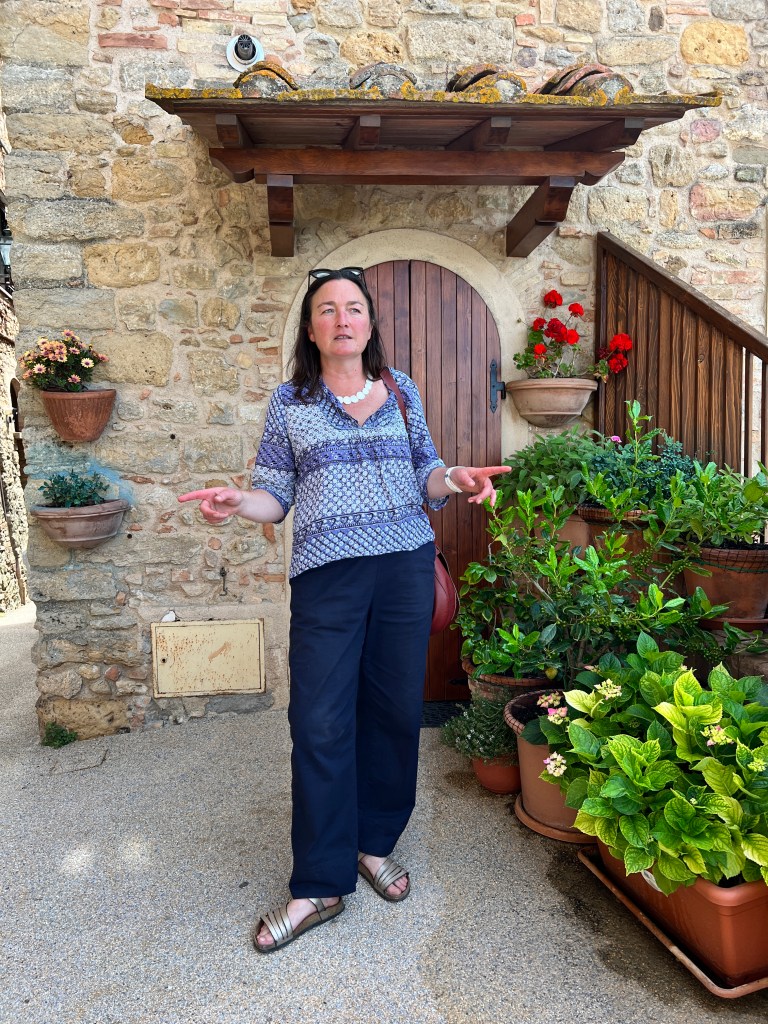
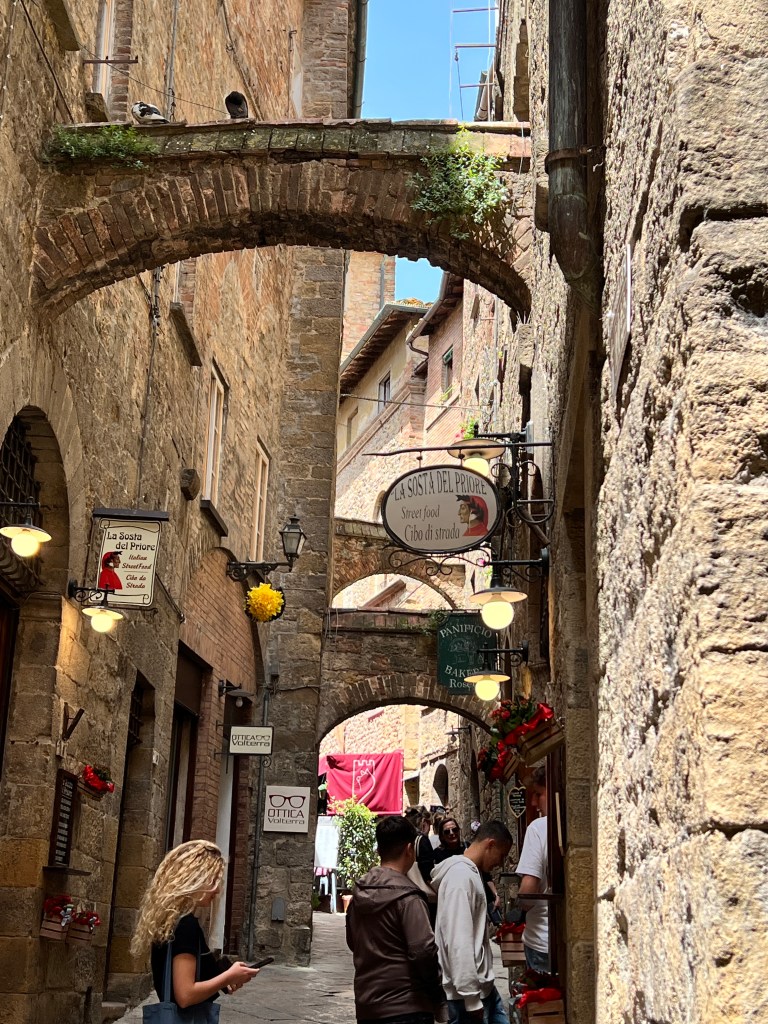
Today Eileen, Jim, Dan and I were off to an early start. We met our driver, Francesco outside our hotel and headed to the Tuscan hill town, Volterra. Etruscan, Roman, and medieval remans can all be found in Volterra. We were going to explore this charming medieval town with Annie Adair. She is a U.S. citizen who fell in love with Italy (and an Italian) and now makes Italy her home.
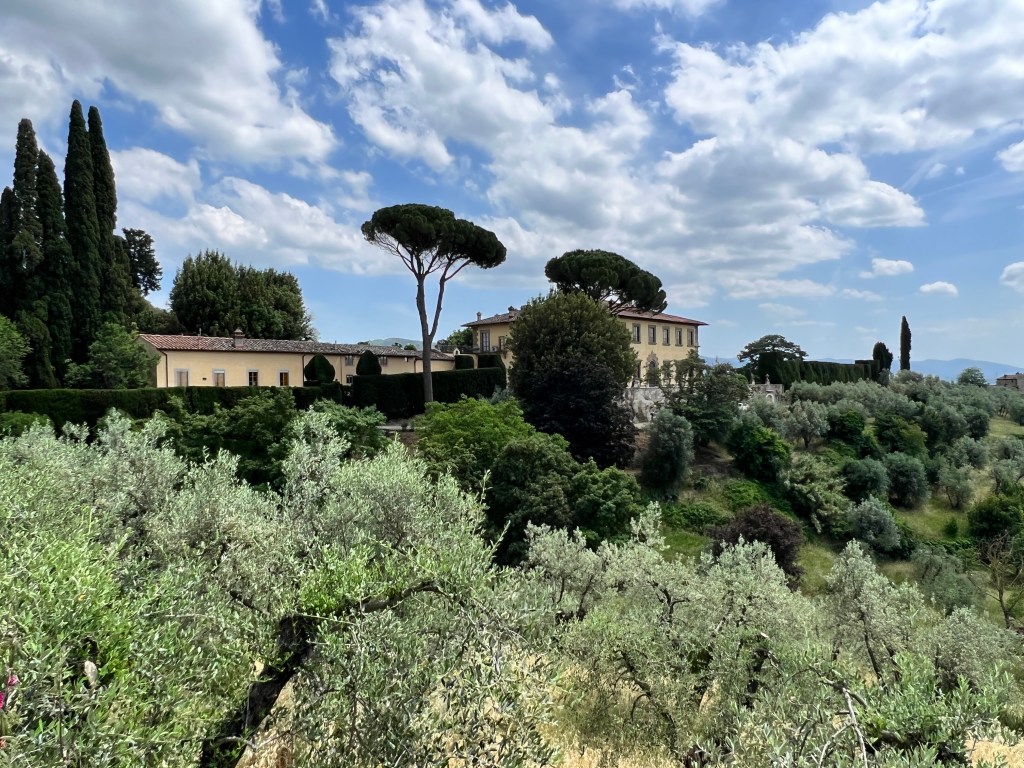
Once out of Florence, the countryside quickly turned into green hills filled with fields, olive, fruit and cypress trees, and vineyards. After about 1-1/2 hours we arrived in Volterra and connected with our guide Annie.
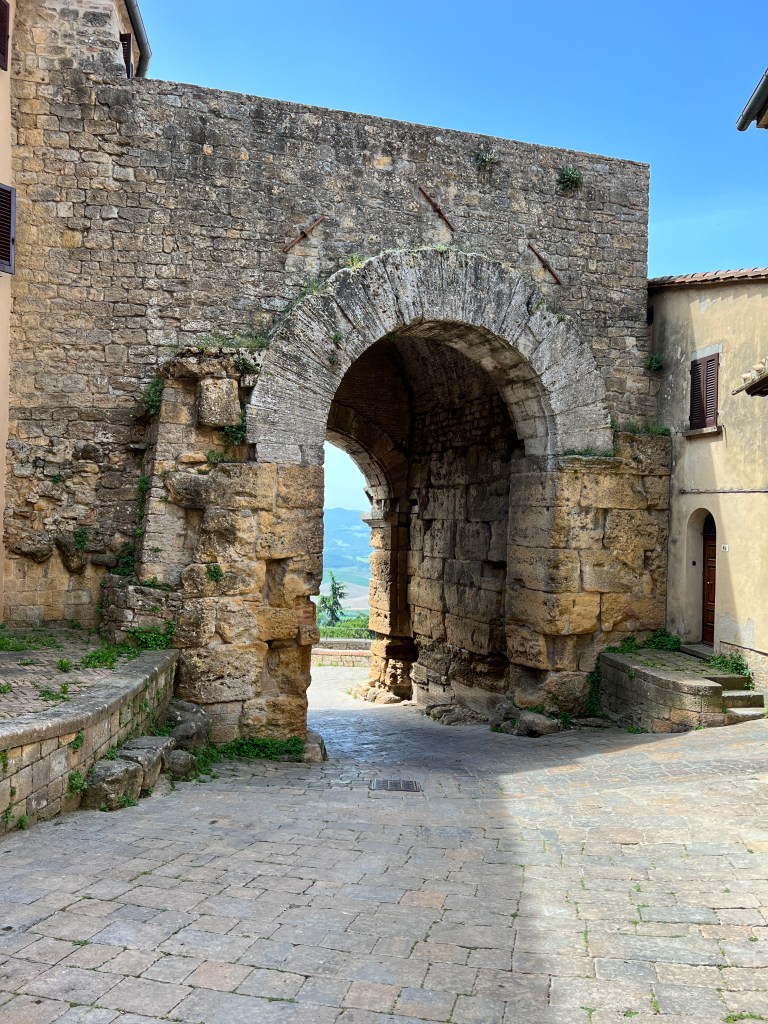
The Etruscans started building the town back in the 4th century BC, where it was originally called Velathri. They chose this spot because it sat high on a hill that could be easily defended, was near a fresh water source, and was a reasonable short journey to the ocean where salt could be gathered. Salt was critical for survival. Some of their original arches and walls still exist. Annie mentioned that it was the Etruscan’s not the Romans that first built arches, and aqueducts.
When Volterra became incorporated into the Roman Empire, a Roman amphitheater and substantial baths were built. Much of it was just recently uncovered. Excavations are still taking place.

The Piazza San Giovanni, was the town’s religious center with its Basilica Cathedral of Santa Maria Assunta, Baptistery and administrative buildings. The Basilica was started around 1120. I learned that originally only individuals old enough to understand religious doctrine could make the decision to be baptized. They would walk into the Baptistry a heathen, and walk out the other side into the light of God. When Catholic doctrine changed so that infants were being baptized, Baptistry’s were no longer needed.

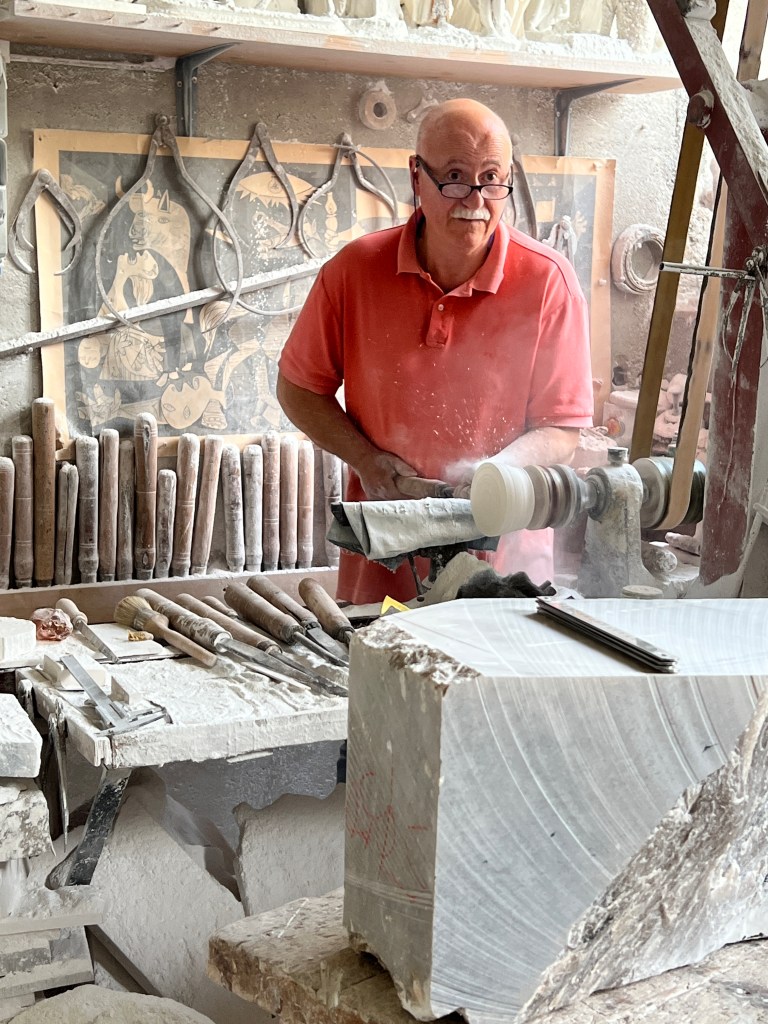
Volterra was known for its high quality alabaster products. To this day it still produces alabaster items for sale. We were taken to the workshop of Alab Arte, where we saw a master craftsman make an alabaster bowl. Eileen and Jim purchased that bowl, but we found one as well. The artist was kind enough to sign both pieces for us.
The town had been a growing city since its inception, however that was to end. After the fall of the Roman Empire, Volterra was not controlled by the church, but was a self-ruling city. Elections were held every 4 months, so no one could become overly powerful, unlike what takes place in our own country. Of course, only men who owned property were allowed to vote or hold office.
The town’s downfall came when the Medici family became a powerhouse in Florence. Alum, used in the production of leather, had been found near Volterra. Using unfair tactics, the Medici found a way to take over the supply of Alum, taking away a major revenue source for Volterra. Enraged by the Medici deception, the town government tossed three Medici representatives out the window to their deaths. The Medici’s in turn sent in three divisions of mercenaries to sack the town,. It never recovered from that attack.
Another enemy that had to be overcome were the Nazis during WWII. They had taken over the town. When the war was winding down instructions were given to destroy the Etruscan gate. In order to save the arch, the townspeople took paving stones and filled in the arch completely. Since the objective was to make the wall impassable, and it was, the Nazi soldiers decided not to waste explosives and left it intact.
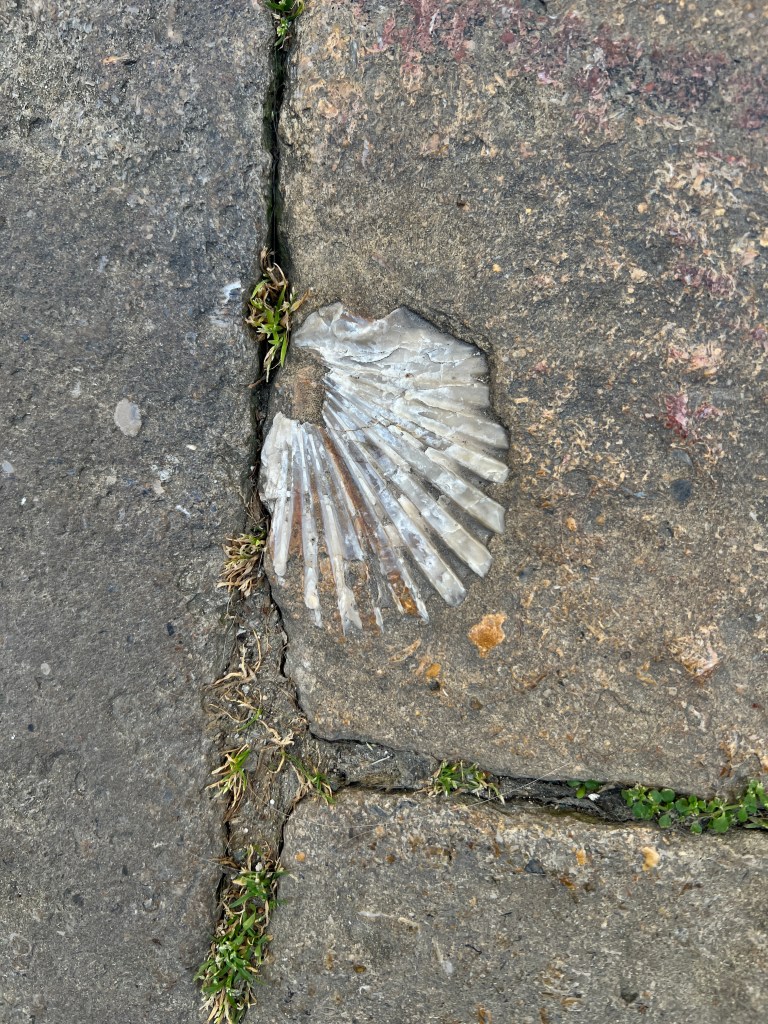
Walking the winding streets of Volterra was very enjoyable. You could find seashell fossils in the paving stones since they had once sat at the bottom of an ocean. There were plenty of tourists, but not nearly as many as found in the other places we had visited. Annie had pointed out her favorite pastry shop where we stopped and enjoyed some Danish style pastry and meringue cookies with chocolate chips.
Annie had also told me of her favorite leather store, which was located in Volterra. Florence is packed with people selling leather goods making it impossible to know who had authentic Italian made products at a fair price. I ended up buying a few things at a store named ‘100% Tocana’. They manufactured many of the items themselves.

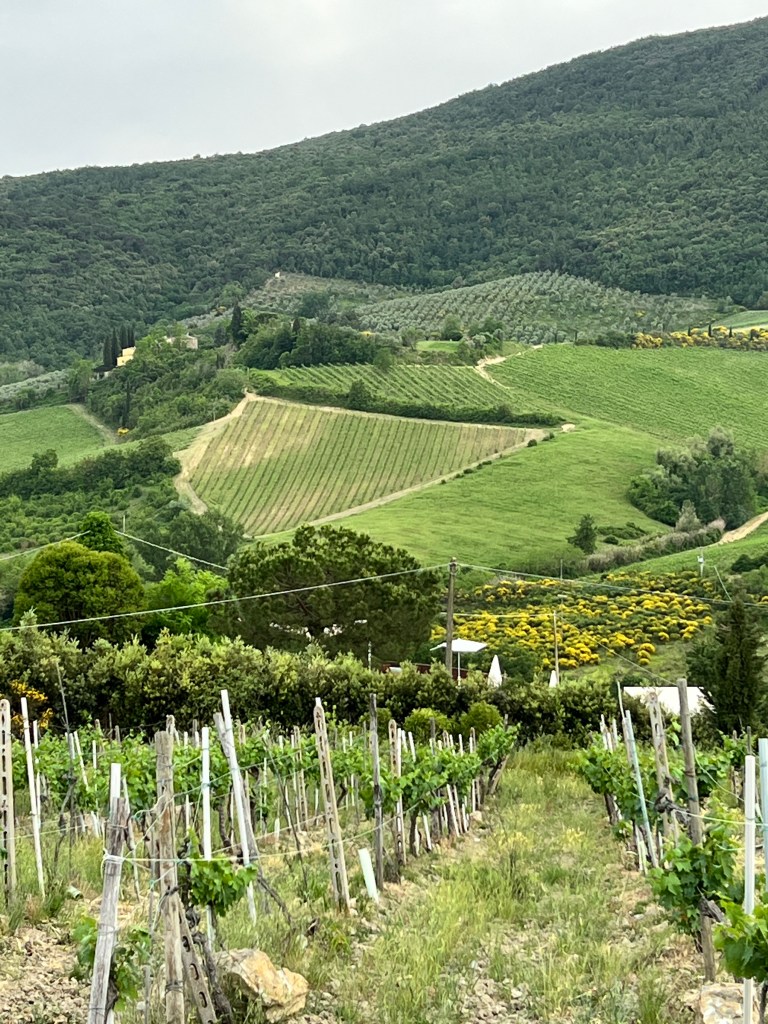
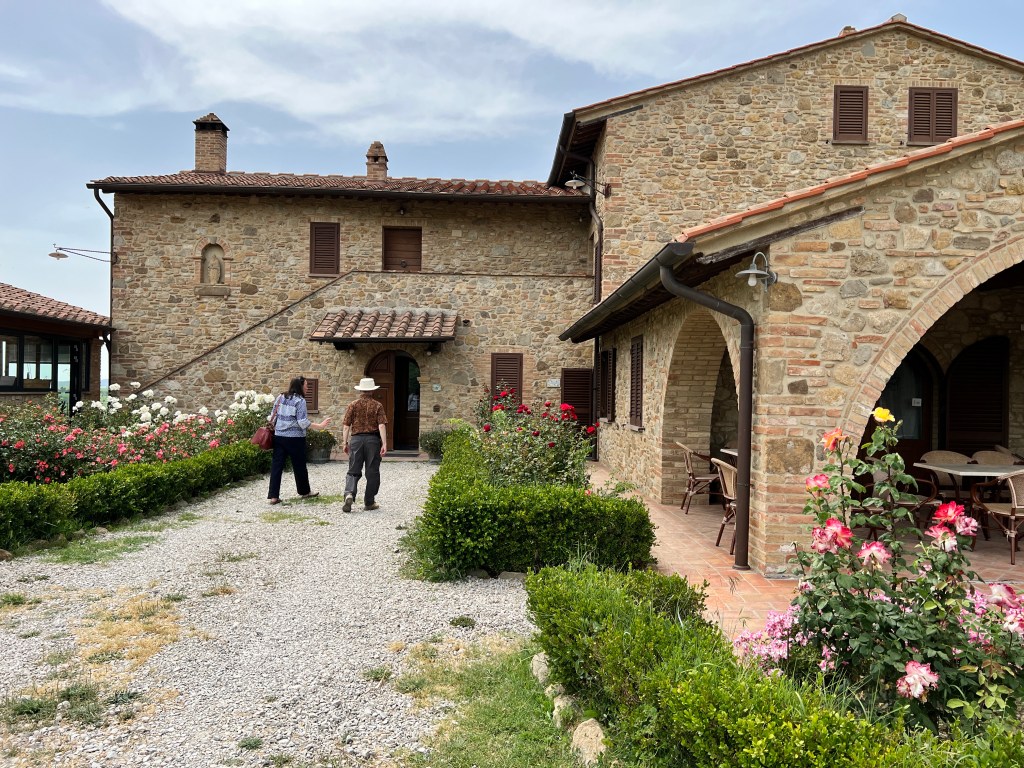
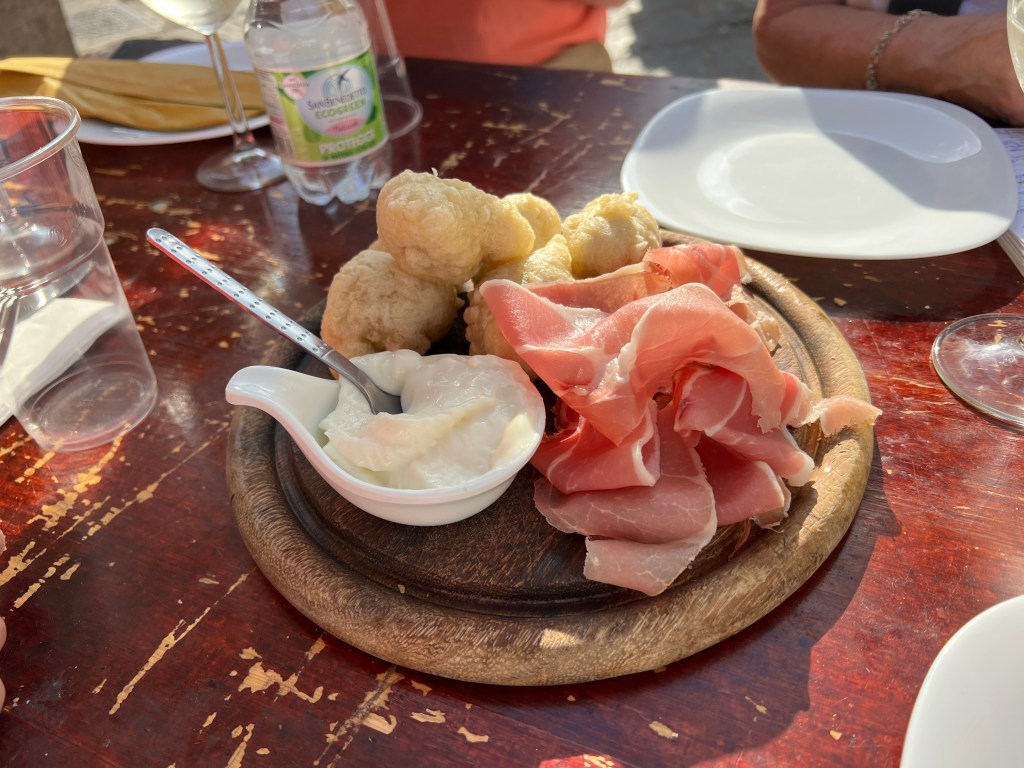
Francesco then picked us up, with Annie leading the way in her car to a argriturismo Podere Marcampo. Marcampo has their own vineyards and produces a wine that is sold all over the world. The daughter now helps her father run the business. She let me know that the sweetness we’ve been smelling all over Italy is from honeysuckle and the fragrant Yellow Broom plant. She took us for a tour of their vineyard, and production and storage facility. We ended up in a lovely windowed room that looked out over the hills and had the chance to taste several of their wines along with cold cuts and cheeses, some of which they also produce. Dan liked their Merlot, so we bought a bottle to take home.


Our last stop of the day was at a family run place known for its truffle products, Boutique del Tartufo. It too produced wine, but truffles is their main focus. I had not known that I loved truffles until this trip. The cheese fondue with black truffles was beyond good. How about honey infused with truffles on fresh bread, or truffle potato chips? They were all beyond super delicious. Soooo good!!!!
The owner had been a lawyer, but gave up his practice to go into business. He uses a special bred of dog to sniff out truffles on his property. Pigs are no longer used because they tend to destroy the truffles they find. There are several types of truffles. We are now in the midst of black truffle season.

They also produce saffron. One of the treats they served was a very tasty saffron pudding. Between the truffles and saffron they have a very lucrative business, but we were told truffle hunting is extremely competitive..
Side Bar: Farmers throughout Italy have a wild pig problem. All over the countryside can be found very aggressive and large pigs. They are very destructive to crops and property, and can be hunted. Their meat is used in many local dishes.
It was late afternoon and time to head back to Florence. We said our goodbyes to Annie. Francesco took a different route back so we could stop and take some photos of San Gimignano and its towers. The countryside is stunning. I wish we had scheduled more time away from the cities.































 BY THE WAY WITH WENDY & DAN