Day 11 Volterra and the Tuscan Countryside

Today Eileen, Jim, Dan and I were off to an early start. We met our driver, Francesco outside our hotel and headed to the Tuscan hill town, Volterra. Etruscan, Roman, and medieval remans can all be found in Volterra. We were going to explore this charming medieval town with Annie Adair. She is a U.S. citizen who fell in love with Italy (and an Italian) and now makes Italy her home.

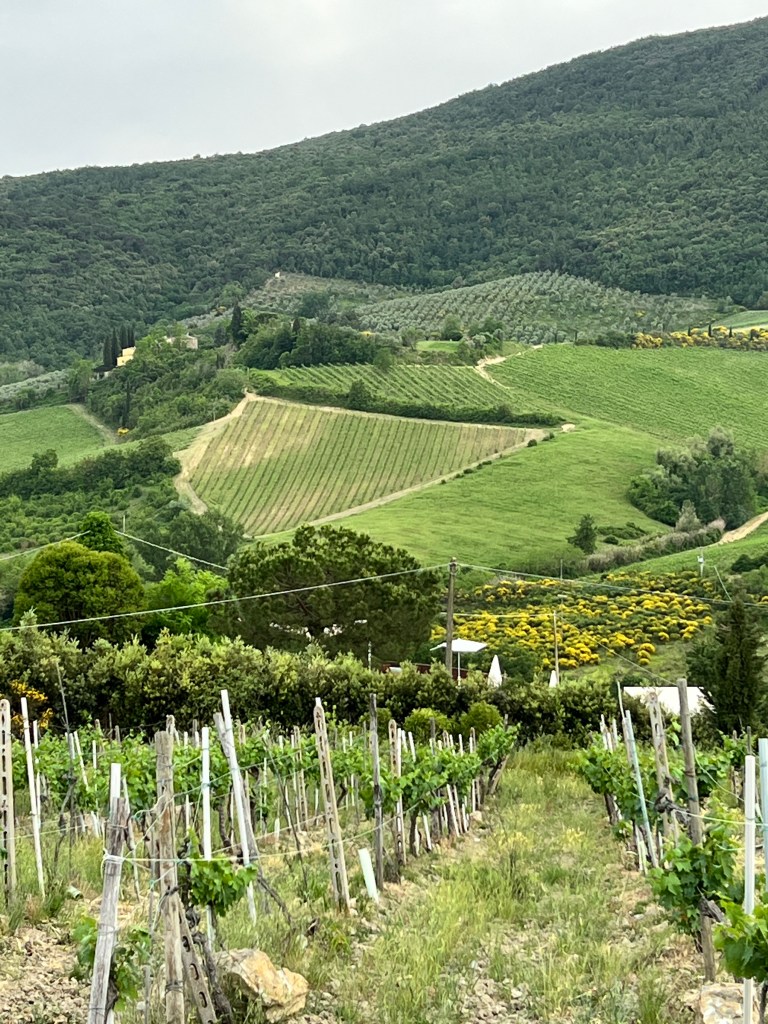
Once out of Florence, the countryside quickly turned into green hills filled with fields, olive, fruit and cypress trees, and vineyards. After about 1-1/2 hours we arrived in Volterra and connected with our guide Annie.
The Etruscans started building the town back in the 4th century BC, where it was originally called Velathri. They chose this spot because it sat high on a hill that could be easily defended, was near a fresh water source, and was a reasonable short journey to the ocean where salt could be gathered. Salt was critical for survival. Some of their original arches and walls still exist. Annie mentioned that it was the Etruscan’s not the Romans that first built arches, and aqueducts.
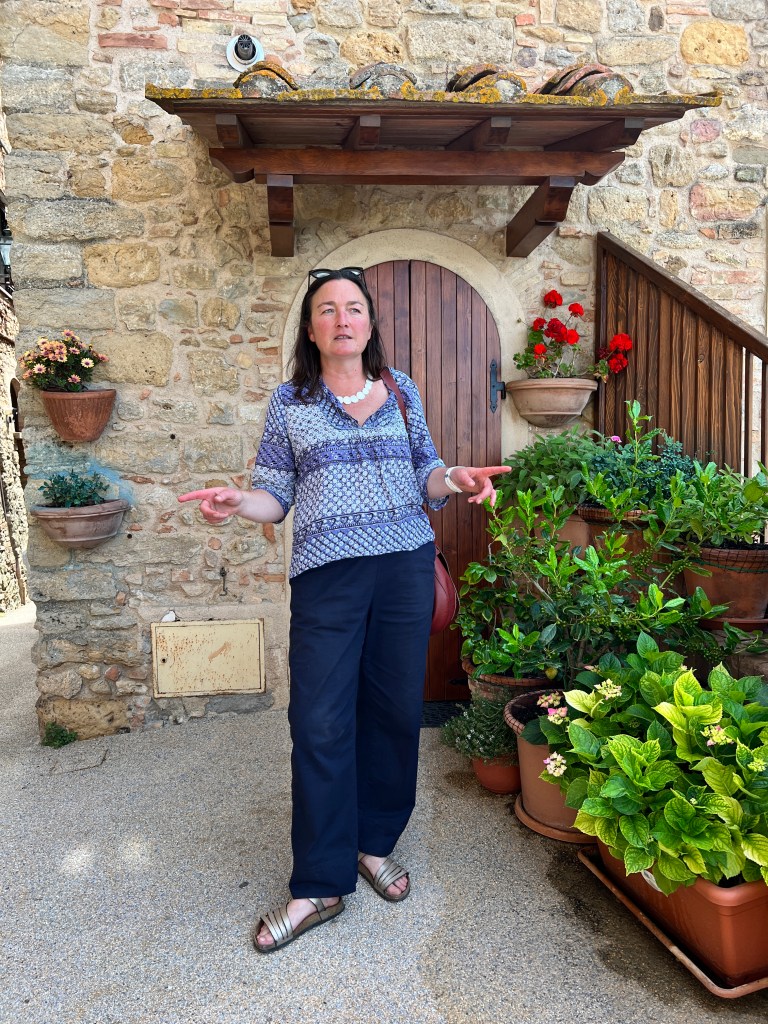
Our guide Annie Adair

When Volterra became incorporated into the Roman Empire, a Roman amphitheater and substantial baths were built. Much of it was just recently uncovered. Excavations are still taking place.

The Piazza San Giovanni, was the town’s religious center with its Basilica Cathedral of Santa Maria Assunta, Baptistery and administrative buildings. The Basilica was started around 1120. I learned that originally only individuals old enough to understand religious doctrine could make the decision to be baptized. They would walk into the Baptistry a heathen, and walk out the other side into the light of God. When Catholic doctrine changed so that infants were being baptized, Baptistry’s were no longer needed.

Cathedral of Santa Maria Assunta

Volterra was known for its high quality alabaster products. To this day it still produces alabaster items for sale. We were taken to the workshop of Alab Arte, where we saw a master craftsman make an alabaster bowl. Eileen and Jim purchased that bowl, but we found one as well. The artist was kind enough to sign both pieces for us.
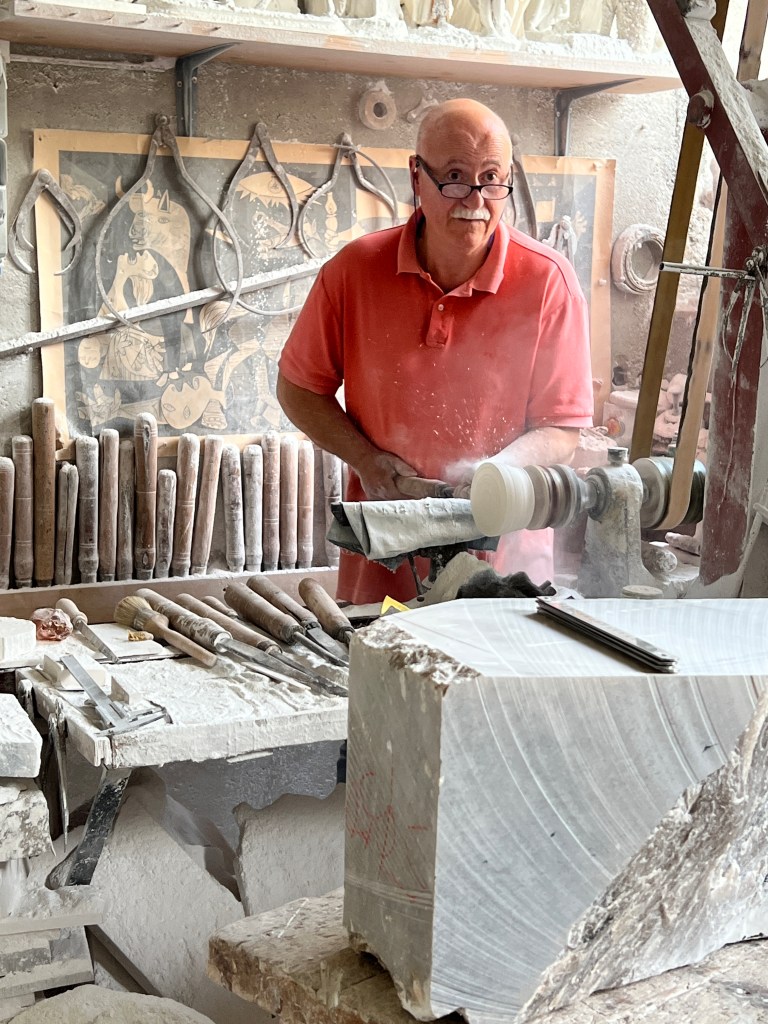
Master of Alabaster

The town had been a growing city since its inception, however that was to end. After the fall of the Roman Empire, Volterra was not controlled by the church, but was a self-ruling city. Elections were held every 4 months, so no one could become overly powerful, unlike what takes place in our own country. Of course, only men who owned property were allowed to vote or hold office.

The town’s downfall came when the Medici family became a powerhouse in Florence. Alum, used in the production of leather, had been found near Volterra. Using unfair tactics, the Medici found a way to take over the supply of Alum, taking away a major revenue source for Volterra. Enraged by the Medici deception, the town government tossed three Medici representatives out the window to their deaths. The Medici’s in turn sent in three divisions of mercenaries to sack the town,. It never recovered from that attack.

Another enemy that had to be overcome were the Nazis during WWII. They had taken over the town. When the war was winding down instructions were given to destroy the Etruscan gate. In order to save the arch, the townspeople took paving stones and filled in the arch completely. Since the objective was to make the wall impassable, and it was, the Nazi soldiers decided not to waste explosives and left it intact.
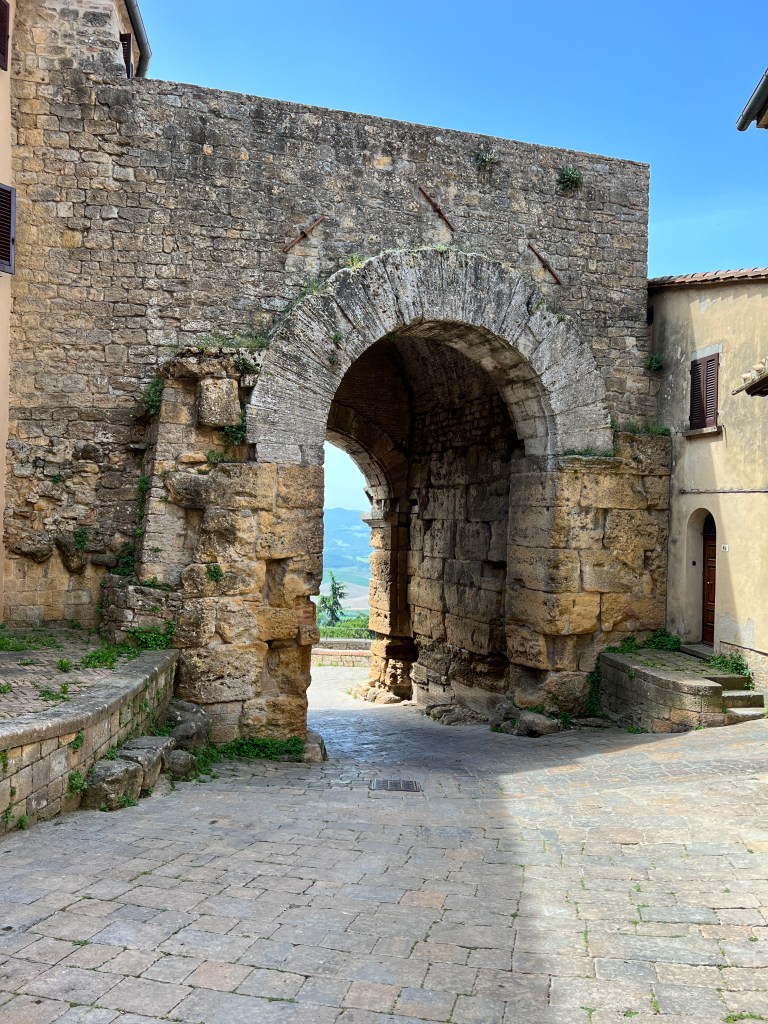
Etruscan Arch/Gate

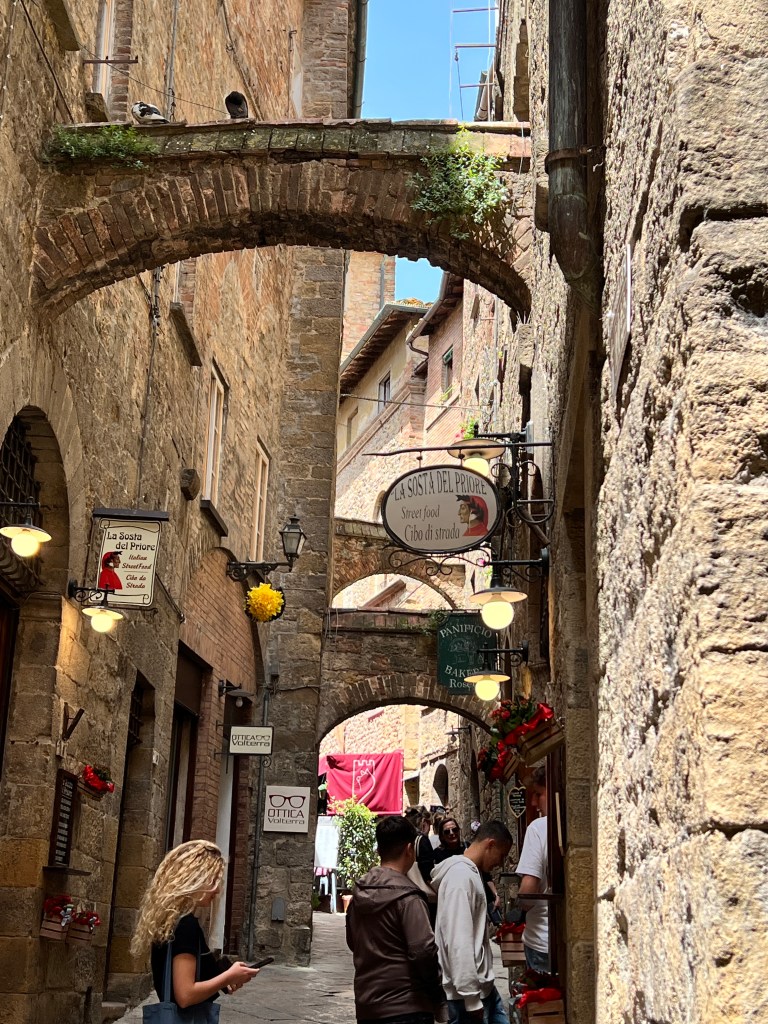
Walking the winding streets of Volterra was very enjoyable. You could find seashell fossils in the paving stones since they had once sat at the bottom of an ocean. There were plenty of tourists, but not nearly as many as found in the other places we had visited. Annie had pointed out her favorite pastry shop where we stopped and enjoyed some Danish style pastry and meringue cookies with chocolate chips.
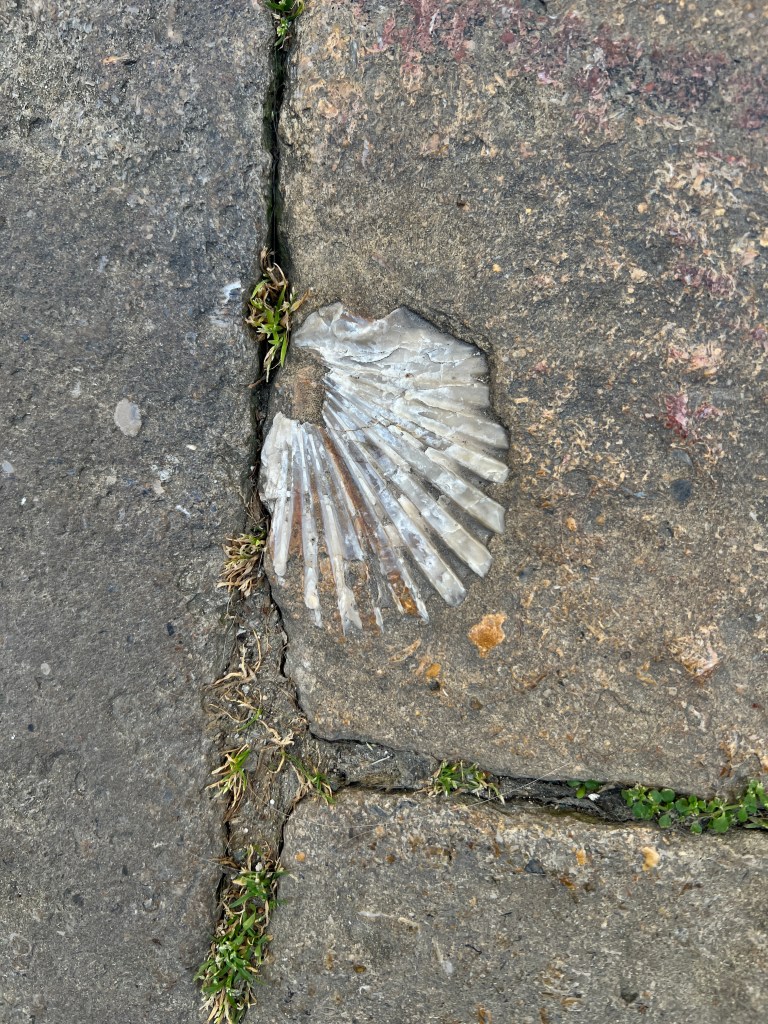
Sea shell in paving stone

Annie had also told me of her favorite leather store, which was located in Volterra. Florence is packed with people selling leather goods making it impossible to know who had authentic Italian made products at a fair price. I ended up buying a few things at a store named ‘100% Tocana’. They manufactured many of the items themselves.

100% Tocana leather store

Francesco then picked us up, with Annie leading the way in her car to a argriturismo Podere Marcampo. Marcampo has their own vineyards and produces a wine that is sold all over the world. The daughter now helps her father run the business. She let me know that the sweetness we’ve been smelling all over Italy is from honeysuckle and the fragrant Yellow Broom plant. She took us for a tour of their vineyard, and production and storage facility. We ended up in a lovely windowed room that looked out over the hills and had the chance to taste several of their wines along with cold cuts and cheeses, some of which they also produce. Dan liked their Merlot, so we bought a bottle to take home.
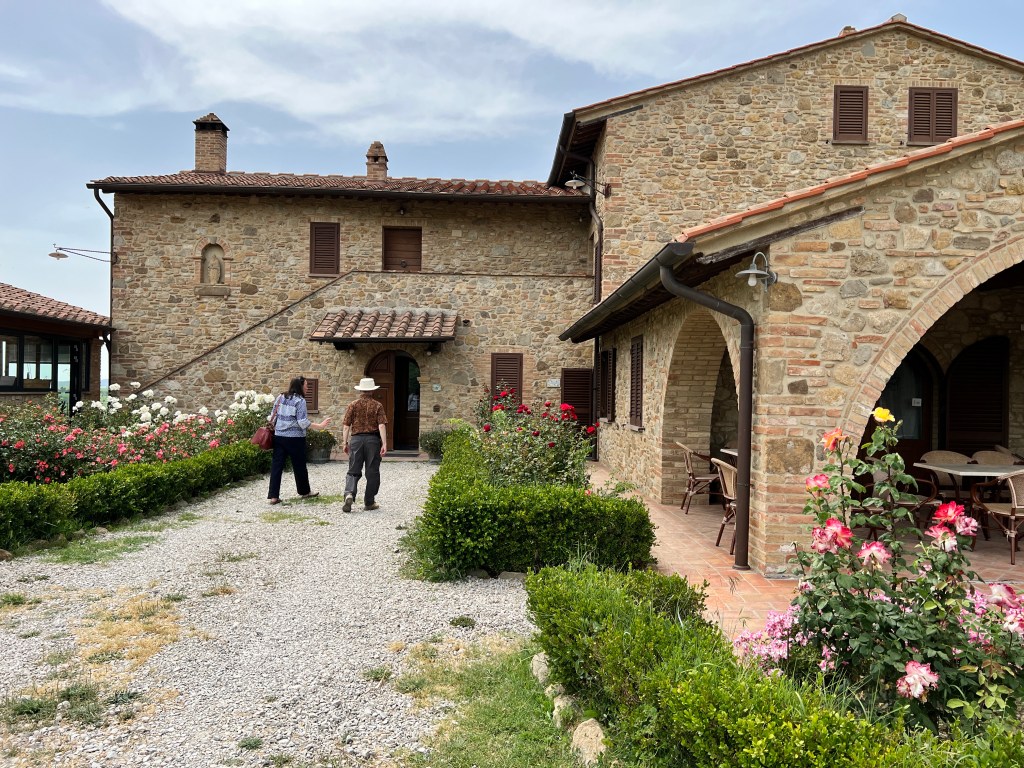
Marcampo
Baby Grapes

Our last stop of the day was at a family run place known for its truffle products, Boutique del Tartufo. It too produced wine, but truffles is their main focus. I had not known that I loved truffles until this trip. The cheese fondue with black truffles was beyond good. How about honey infused with truffles on fresh bread, or truffle potato chips? They were all beyond super delicious. Soooo good!!!!

The owner had been a lawyer, but gave up his practice to go into business. He uses a special bred of dog to sniff out truffles on his property. Pigs are no longer used because they tend to destroy the truffles they find. There are several types of truffles. We are now in the midst of black truffle season.

Cheese Fondue with black truffles — YUM!

They also produce saffron. One of the treats they served was a very tasty saffron pudding. Between the truffles and saffron they have a very lucrative business, but we were told truffle hunting is extremely competitive..

Side Bar: Farmers throughout Italy have a wild pig problem. All over the countryside can be found very aggressive and large pigs. They are very destructive to crops and property, and can be hunted. Their meat is used in many local dishes.

It was late afternoon and time to head back to Florence. We said our goodbyes to Annie. Francesco took a different route back so we could stop and take some photos of San Gimignano and its towers. The countryside is stunning. I wish we had scheduled more time away from the cities.

San Gimignano

Day 10 Florence and Settignano

We met our friends for breakfast in the lovely outdoor dining area at the hotel. Today we are spending. most of the day with Jim, since the other three are going biking up to Fiesole. But first, Dan and I are going to the Accademia to visit Michelangelo’s David. Directly after breakfast the three of us headed out. It took about 30 minutes to walk to the museum. The line wasn’t too bad once we found out where we had to go with our prepaid no-line tickets.

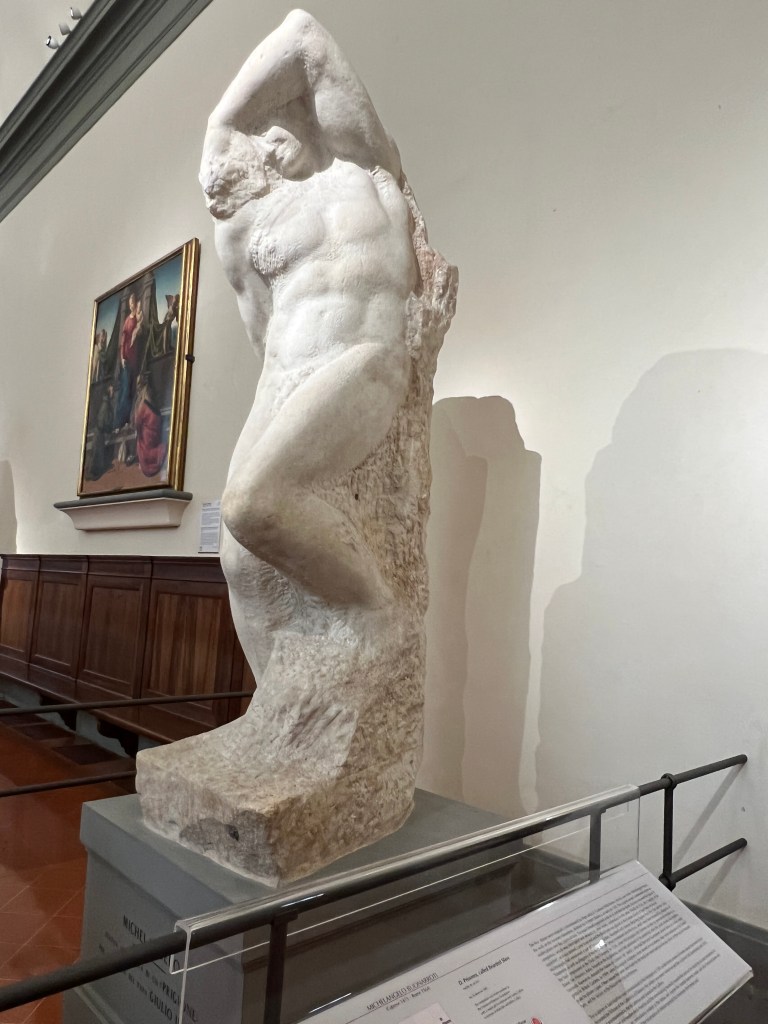
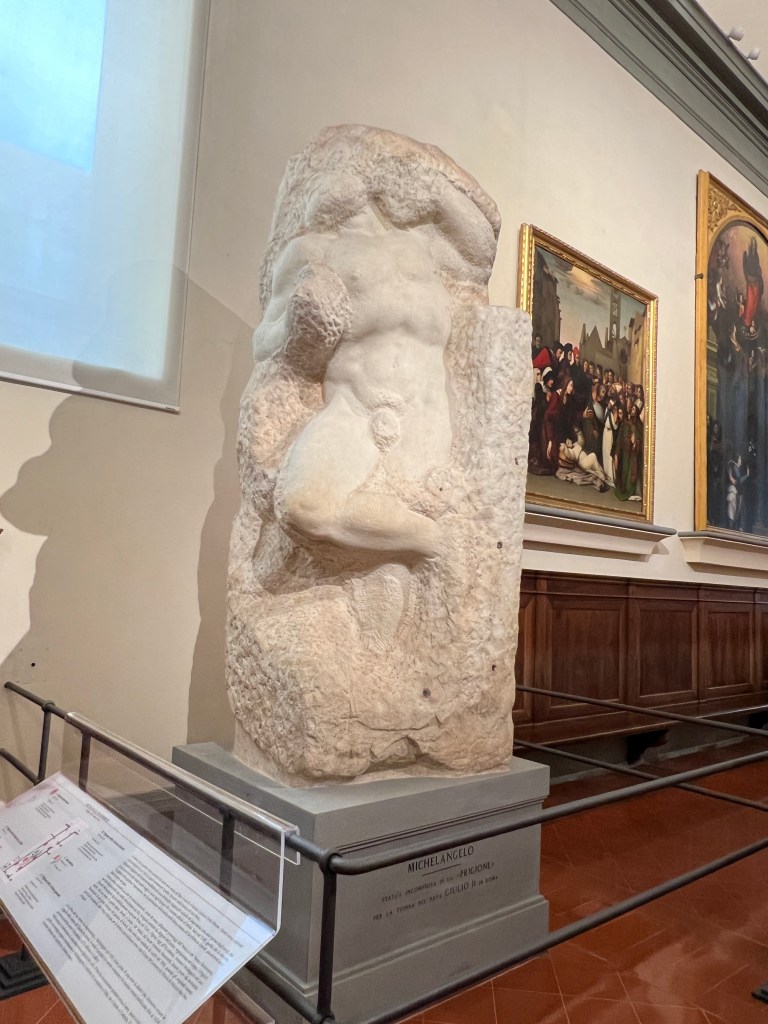
Upon walking into the Accademia Gallery you can see David immediately at the end of the gallery. Before reaching him, however, you see several unfinished sculptures by Michelangelo. It was strange seeing these works with some body parts almost perfectly carved and the rest of the stone roughly chipped away. It was as if Michelangelo was about to walk back in and take up his tools again.

The unfinished works were never named by Michelangelo, but by scholars. I’ve included photos of some of them below. Why they were never completed is not known. He may have left them incomplete because the project lost funding, or he just moved on with projects that interested him or paid him more.

The Atlas Prisoner
Saint Matthew
Young Prisoner
The Awakening Prisoner

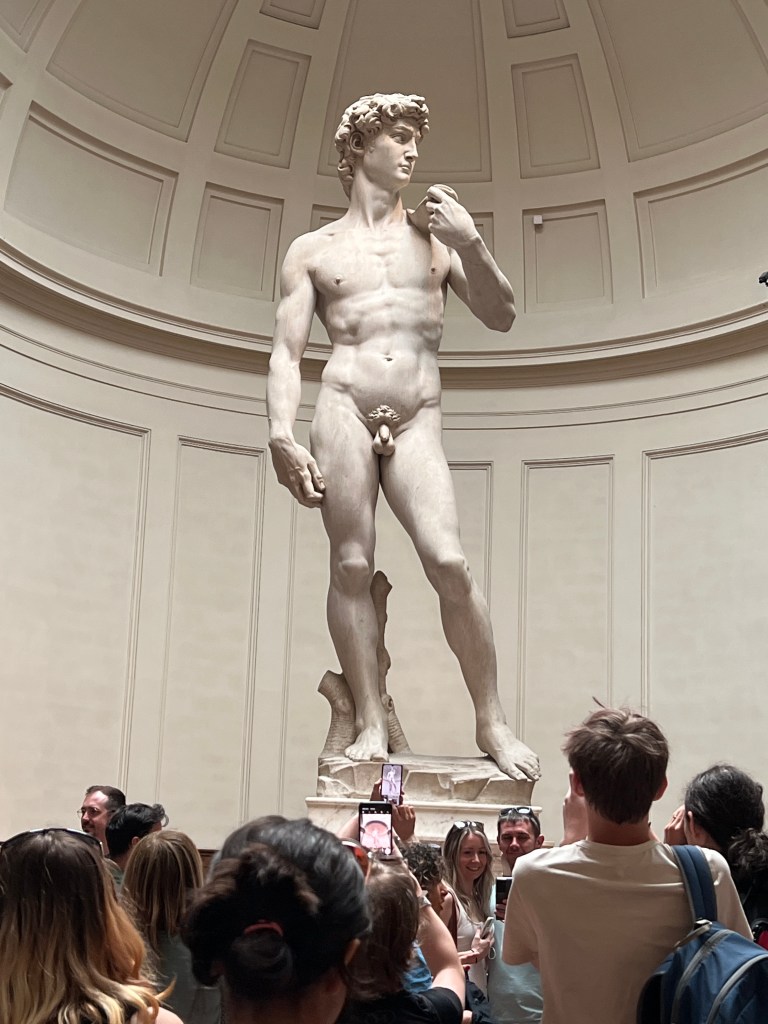
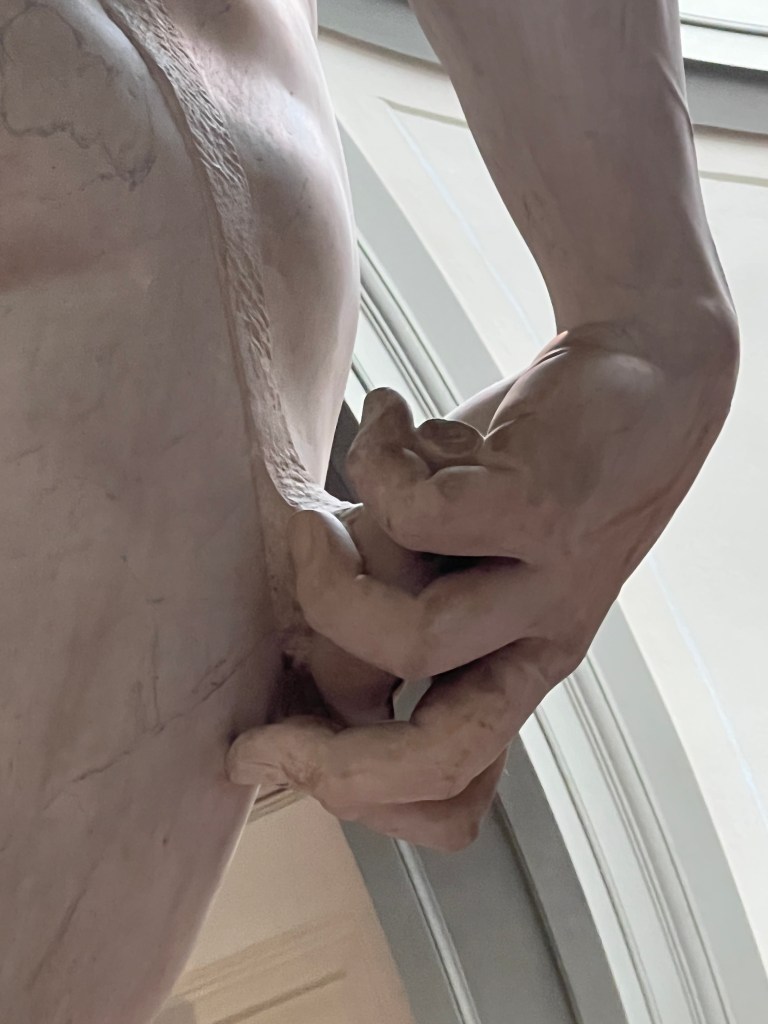
I don’t believe any one can look at David and not be amazed by his beauty. He is a 6 ton, 17 foot-tall symbol “of divine victory over evil,” according to Rick Steves. Michelangelo was only 26 years old when commissioned to create a work for Florence’s Duomo. David hasn’t changed since I last saw him 50 years ago. If you look closely enough you can see signs of wear from the 350 years he stood outside the Palazzo Vecchio before he was moved inside in 1873. The pictures speak for themselves.

There were other sculptures in the Accademia including a plaster model of the Rape of the Sabine Women by Giambologna and a bust of Michelangelo in bronze. However, David is the number one reason for visiting this museum.

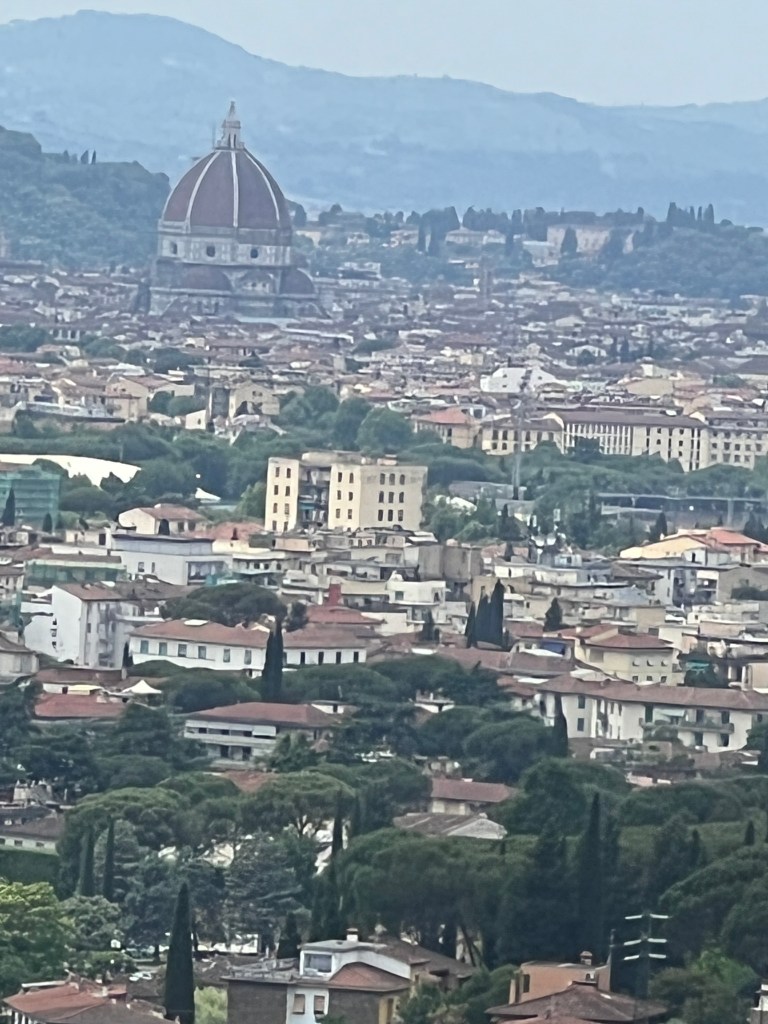
We reconnected with Jim who had been wandering about taking pictures having already seen David. We attempted visiting the Medici Chapels, but it wasn’t open yet. Instead, we decided to go into the hills surrounding Florence and visit a small town named Settignano. Bus #10 took us up into the hills and 30 minutes later we were in the town’s Piazza Niccolò Tommaseo. A short walk away offered us a beautiful view of Florence far below us.

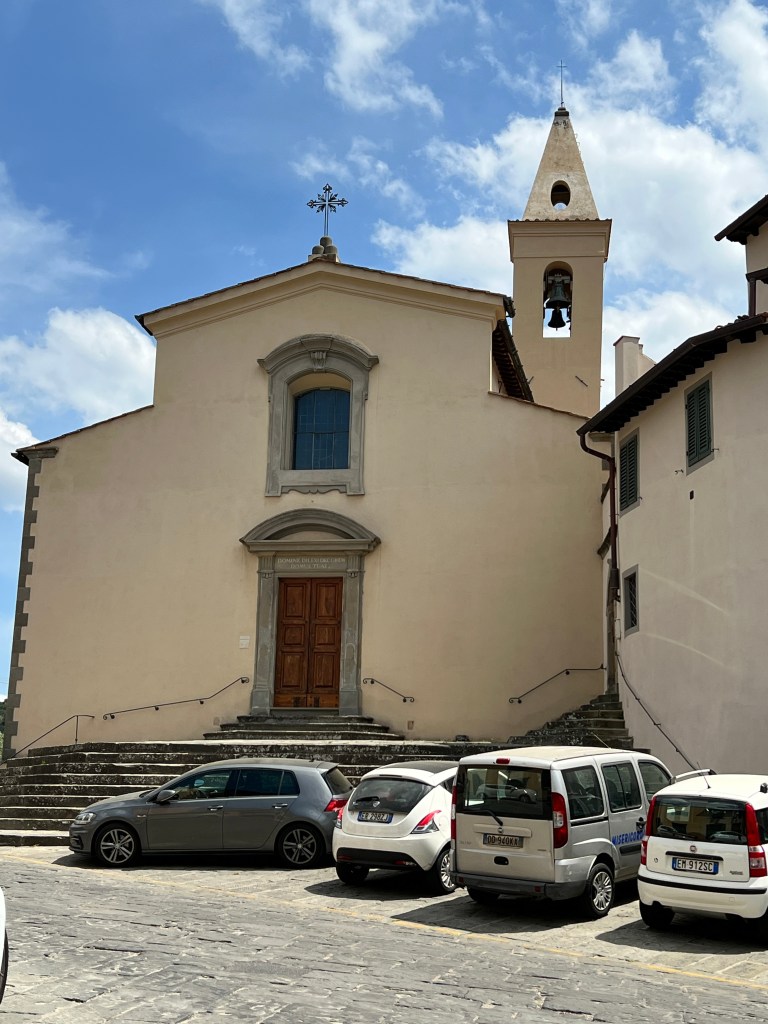
As to be expected, there was a church in the center of town, Chiesa di Santa Maria Assunta constructed in 1518. A heavy wooden door lead to a simple church with some interesting artwork. Not knowing where to go, we followed signs leading us to the Villa Morghen. The Villa turned out to house a program for students from various U.S. colleges and universities.

Church of Santa Marie Assunta

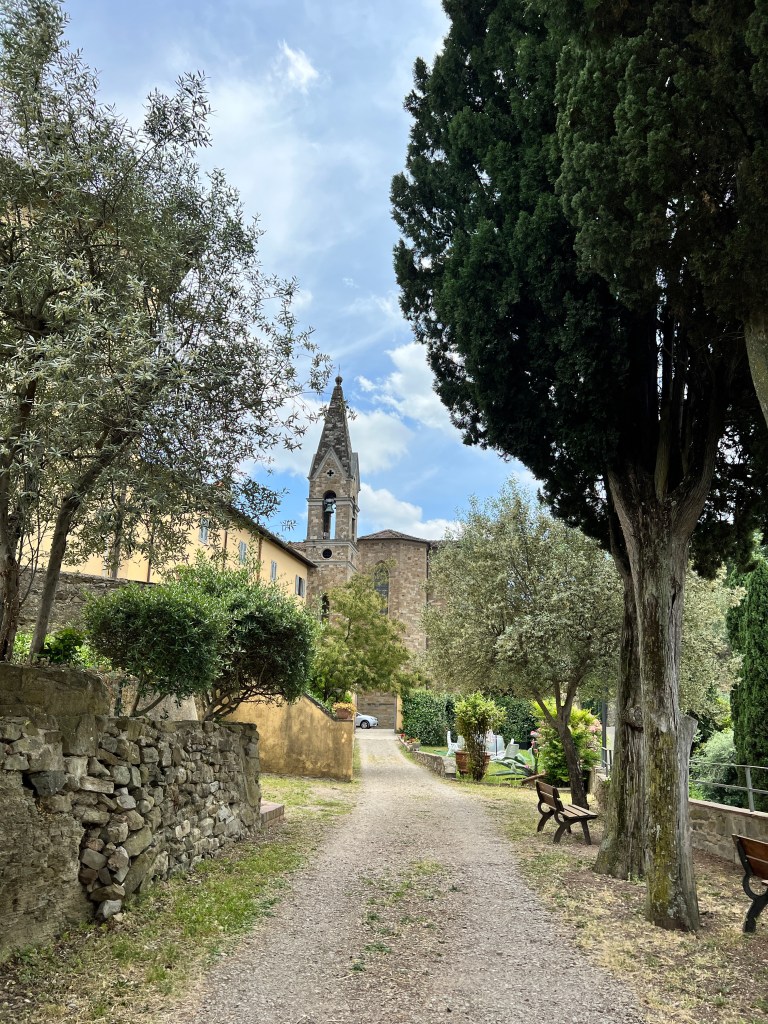
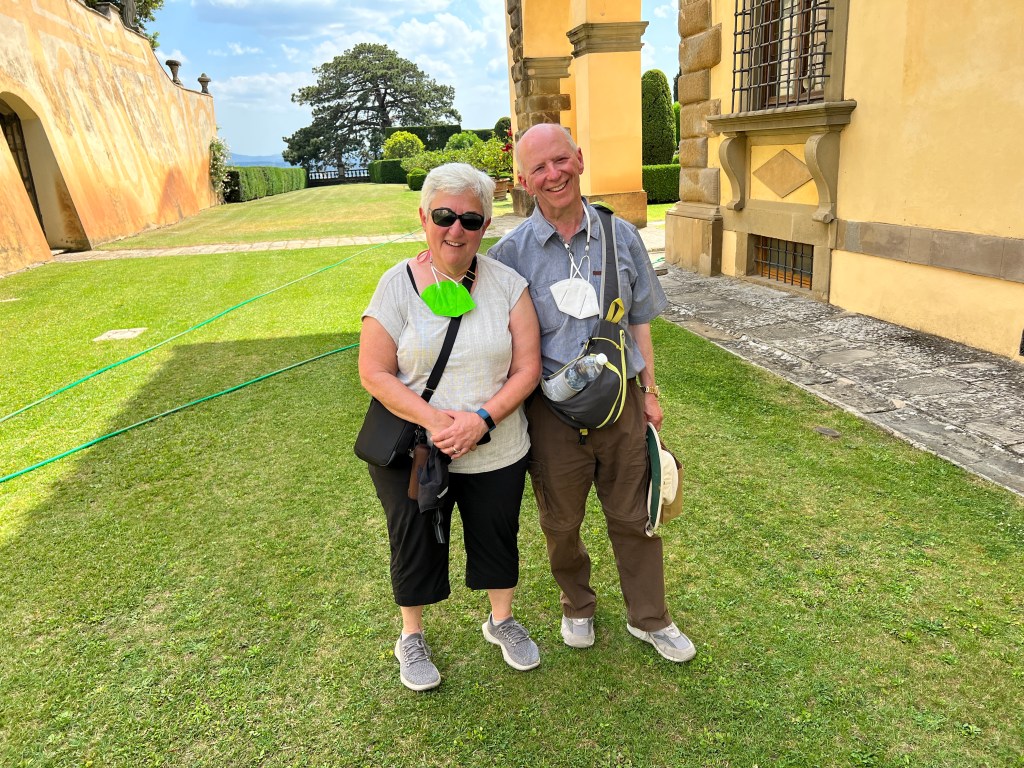
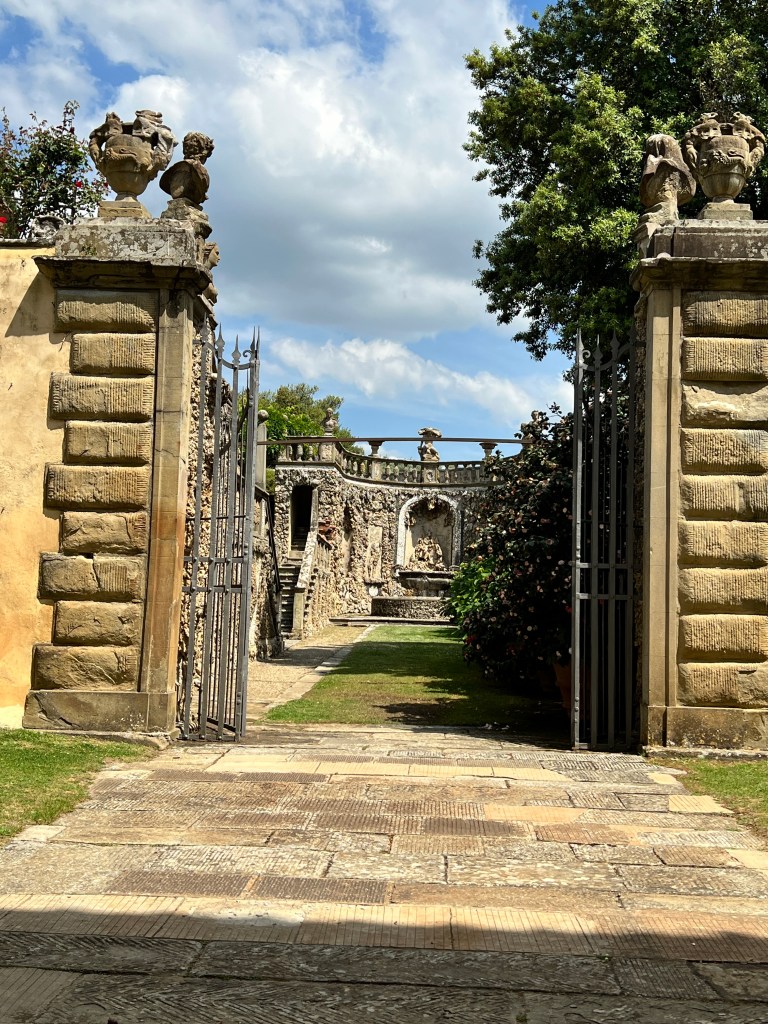
We then headed back to the square looking for signage that would lead us to the Villa Gamberaia Gardens. With Jim’s help, we did find our way to the Villa after taking an uphill twisting road up into the hills. Back in 1904, Edith Wharton wrote that the Villa combines “almost every typical excellence of the old Italian gardens.” She was right. After ringing a bell we entered the property through a small gated doorway, paid our fee, and walked into the past.

A farmhouse had been located on this spot back in the 1300’s. In the 1400’s it became the property of Matteo di Domenico who adopted the surname Gamberelli. His two sons were important architects and sculptures at the time and they built the original villa. The gardens and system of fountains, however, were designed by the next owner of the property in the 1600’s. It was owned by Zanobi Lapi, a wealthy Florentine merchant, and his two nephews. Since then the Villa has passed into many different hands, including the Nazis. They used the property as a headquarters during WWII . In 1954 the Marcelo Marchi family purchased and restored the property. It now belongs to his daughter Franca and her husband Luigi Zalum of Herzegovina.

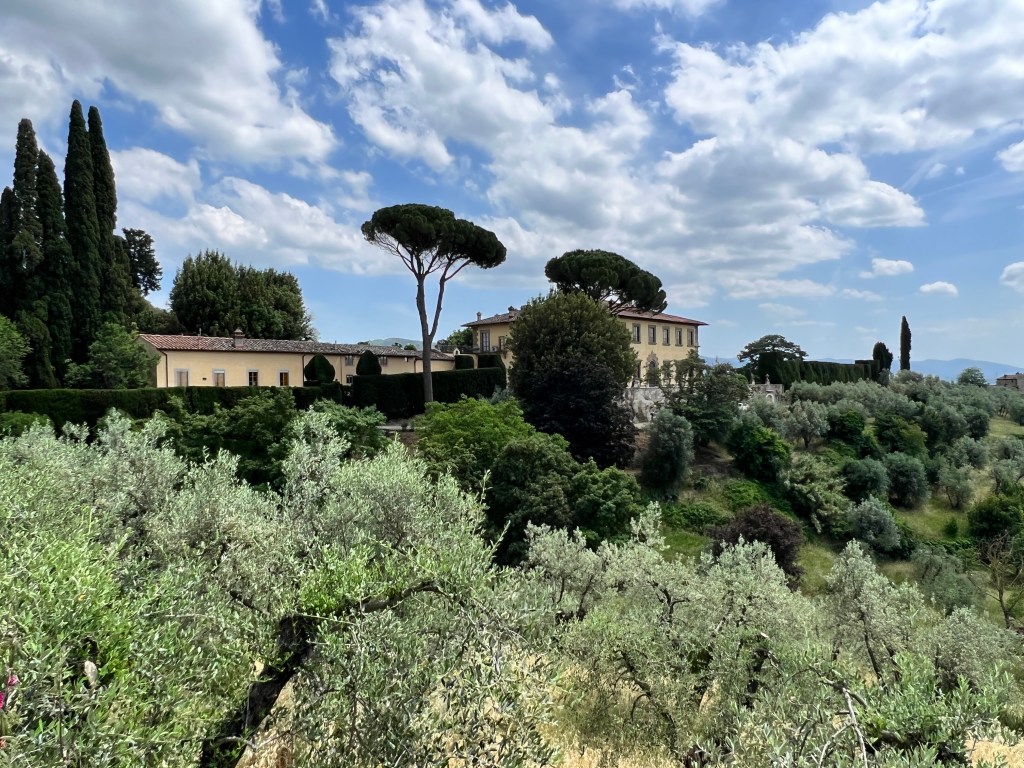
The views of the Florence and Arno valley below were beautiful. The gardens were filled with citrus trees, sculptures, a long bowling green, wild woods, ornate rock work, ponds and an unusual shaped multi level grotto. Greenery and flowers were planted everywhere. It was a wonderful place to wander. New features were discovered down every path. Unfortunately the Villa itself is not open to the public.

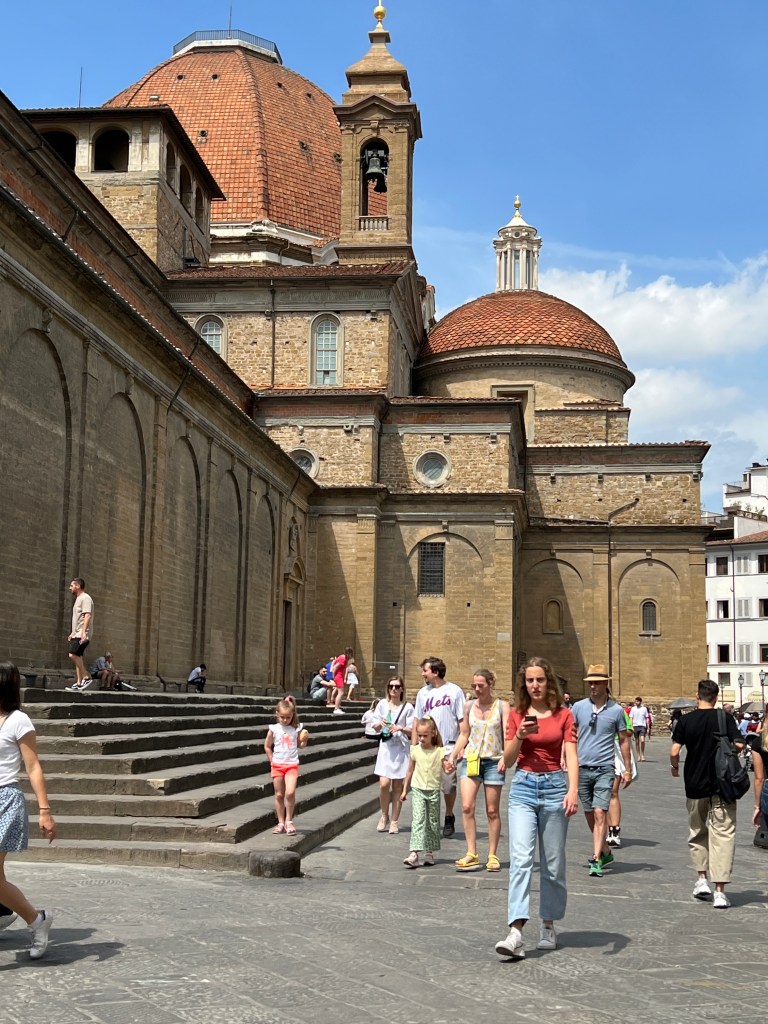
It was time to head back into town. We quickly caught a bus back to Florence that unexpectedly dropped us off in the middle of nowhere. Fortunately, we picked up a second bus that got us more or less close to where we needed to be. The three of us then returned to the Medici Chapels and Church of San Lorenzo.

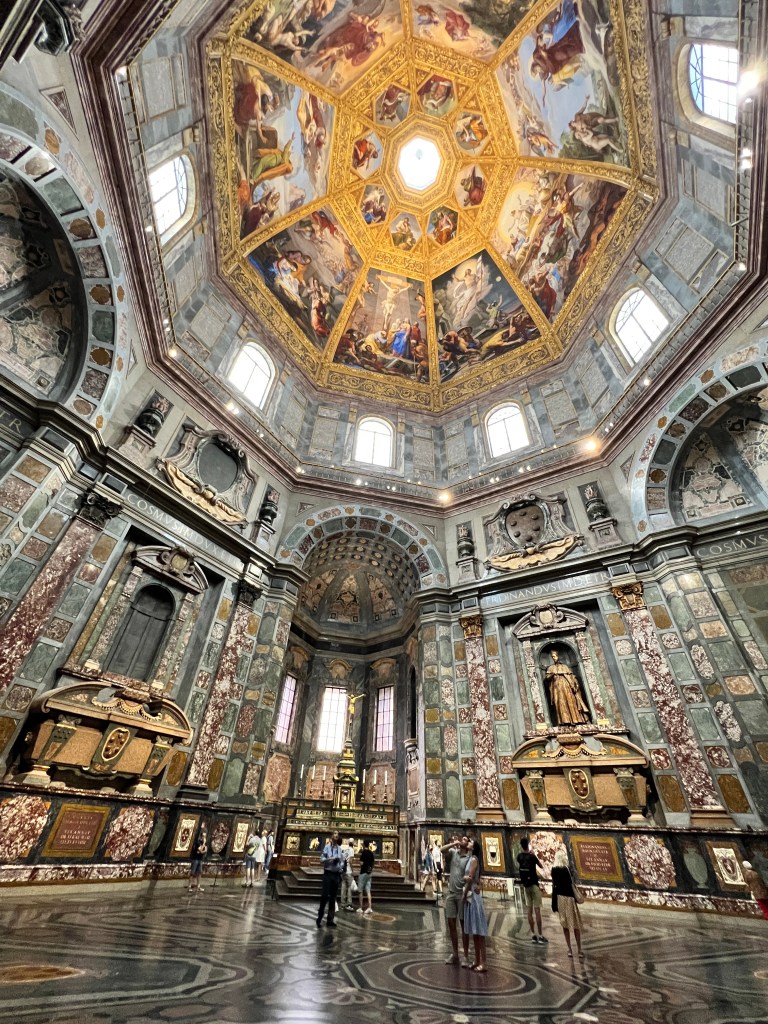
The Chapel of the Princes is part of a huge complex developed almost two centuries ago. It was based on the Grand Duke Cosmo I’s idea to create a family tomb for the Medici family. It is a very impressive building filled with cut marbles, semi precious stones, and statuary of the Medici “rulers.” It gave off an essence of raw power, however, others think its extravagance is an exercise in bad taste.

The Chapel of Princes 1602-1743
Medici Coat of Arms

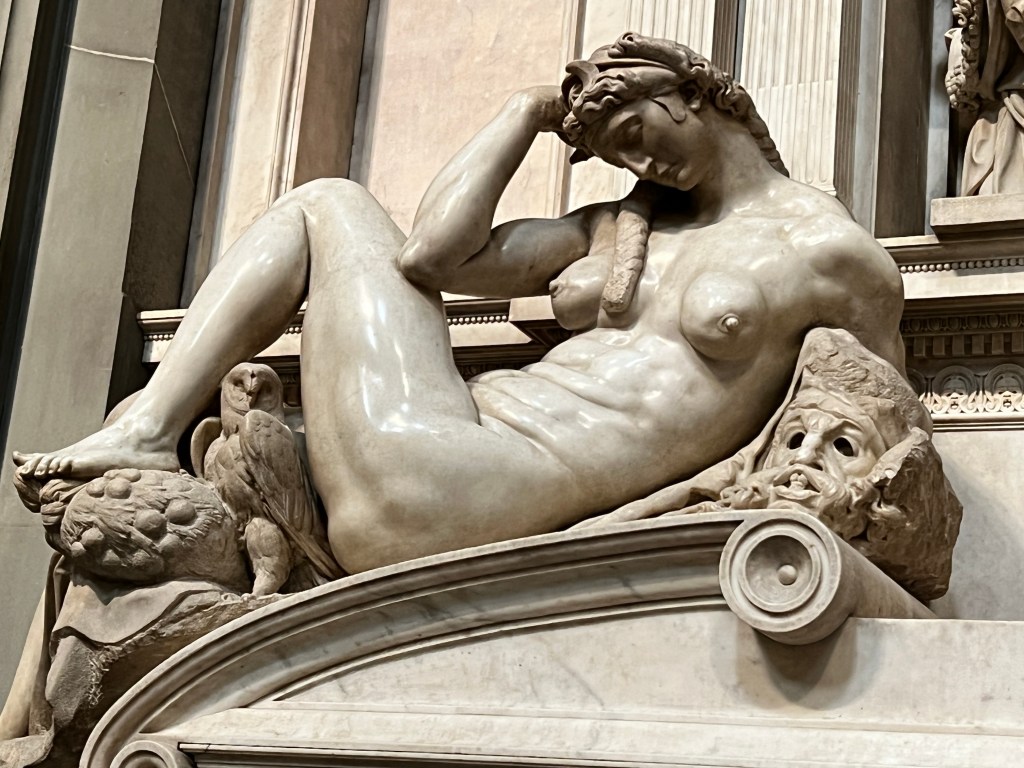
The entire New Sacristy was designed by Michelangelo during his last years in Florence, 1531-1532. While I know Michelangelo wasn’t particularly interested in women, the sculpture, The Tomb of Lorenzo, kind of proved to me that he had no interest in women artistically either. As beautiful as the sculpture may be, it looked as if he simply slapped breasts onto a male figure in order to turn it into a woman. See for yourself in one of the photos below.

Woman as created by Michelangelo

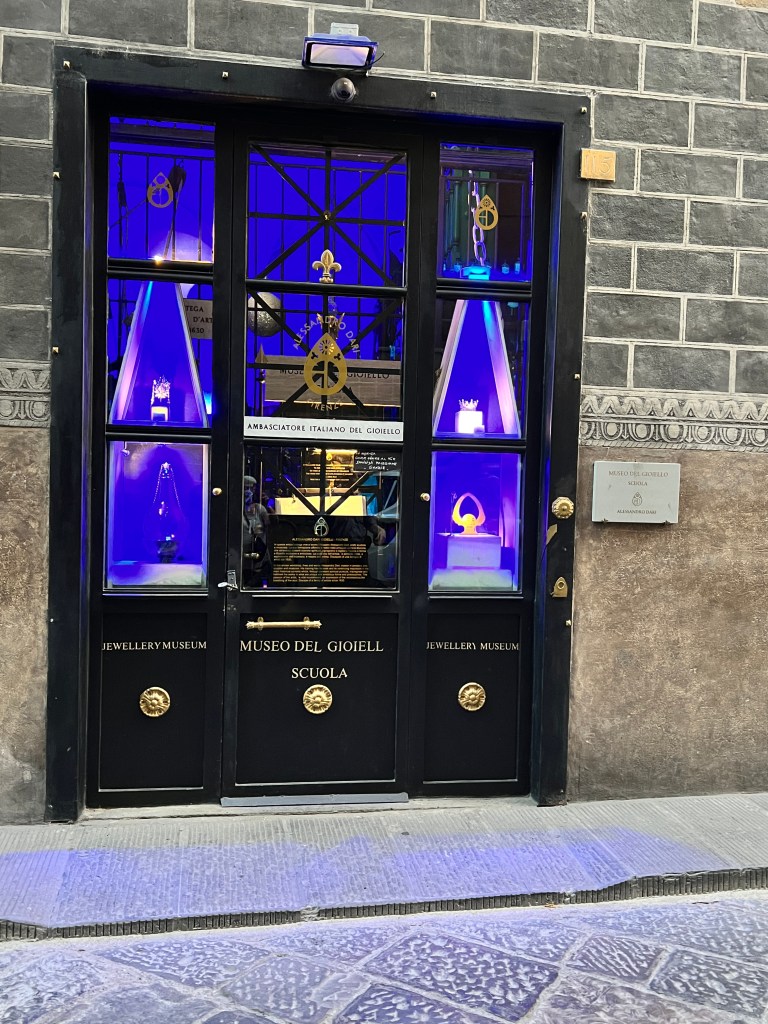
All of us were starting to run out of energy so we walked back to our neighborhood. The rest of our group was resting back at the hotel and didn’t feel like dinner, so we found a nice restaurant around the corner. After dinner we took a short walk around the block and discovered some interesting stores including a perfumery where they developed personal fragrances, and a master of jewelry arts in a space that could easily be found in Harry Potter’s Dragon Alley.

A shop on Dragon Alley?

Eileen then joined us for a gelato at the highly recommended La Strega Nocciola. It was now far past my bedtime. Tomorrow offers another opportunity to see the Tuscan countryside as we head to Volterra.

Day 9 First Day in Florence

By 10:00 AM we had our breakfast and were ready to meet out tour guide, Ilaria Signorini. Ilaria had several advanced degrees, including one in archeology, and was an expert on the history of Florence. She was to give us crash course on Florence and take us through the Uffizi Gallery. Dan has not been feeling well, with what we think is a sinus infection. He had the option to stay back at the hotel and relax, but he said he felt well enough to come along.

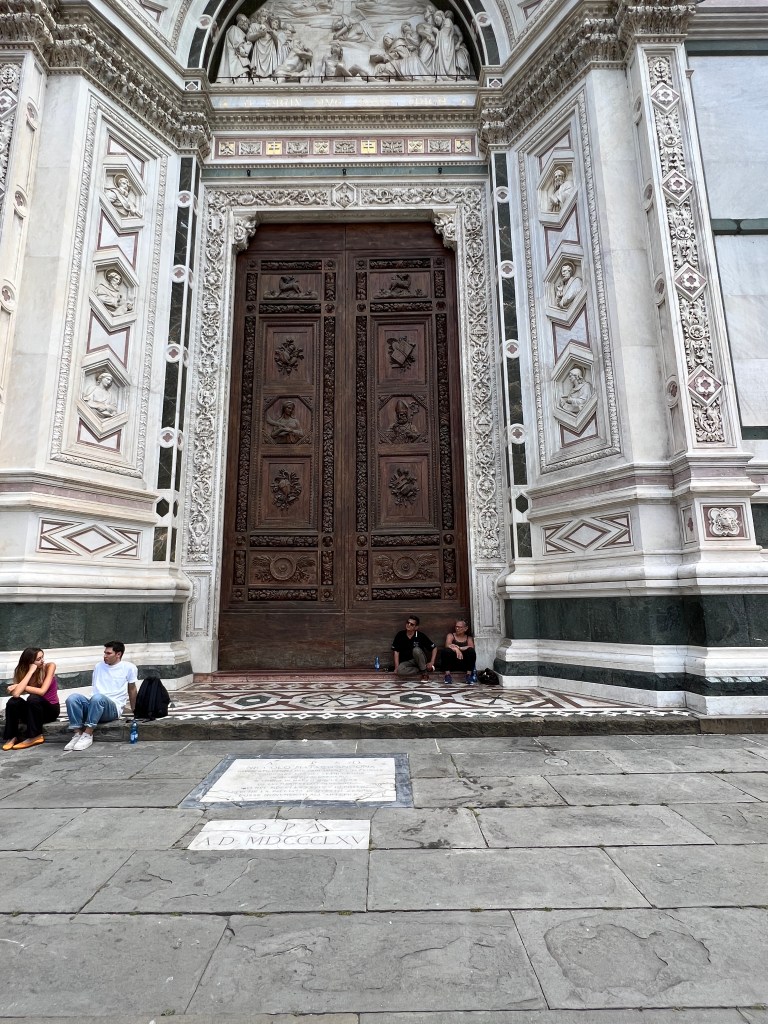
Our first stop was the Santa Croce district. The 14th Century church holds the tombs of Michelangelo, Rossini, Machiavelli, and Galileo. Ilaria told us a facinating story of Niccolo Matas di Ancona. The Church’s facade was unfinished due to lack of funds. Matas offered to complete the work at no charge, but what makes the story more interesting was that Matas was Jewish. At first the Franciscans didn’t know whether or not they should accept his generosity, but they eventually agreed. He did as he had promised, and the facade was completed. In return Matas requested a small favor that upon his death he would be buried in the church along with the other famous Florentines. This, however, the Franciscans could not do. As a compromise, he was eventually buried right outside the front door.

Nicolas Matas’ Burial Site at Front Door of Santa Croce

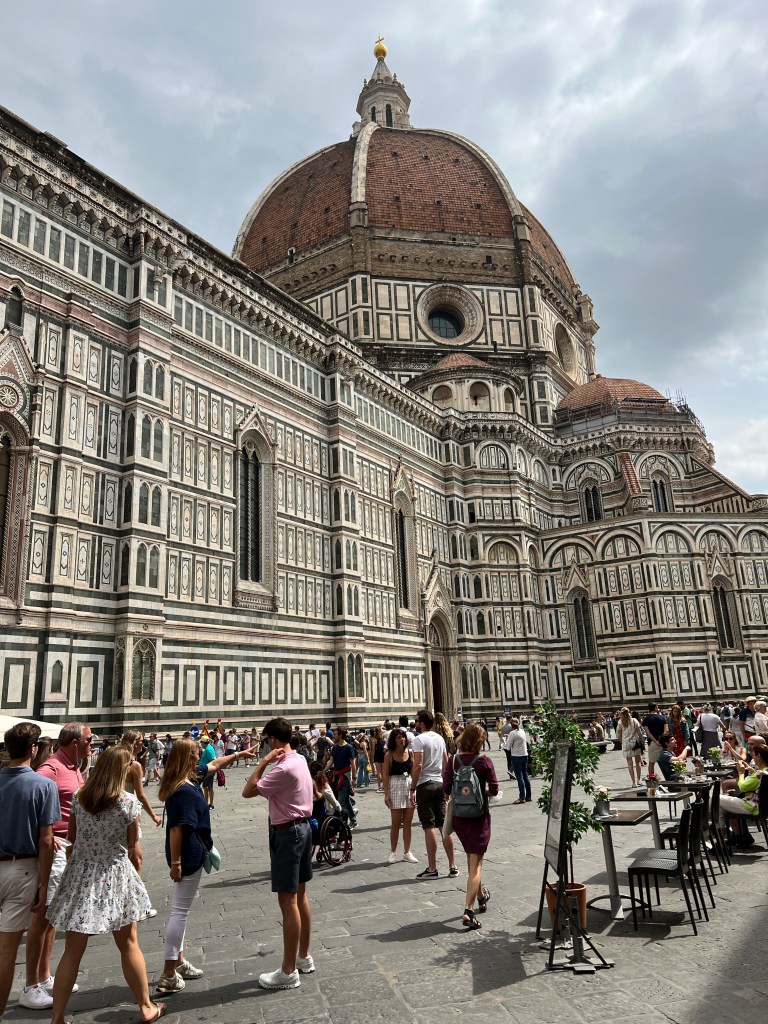
Ilaria then led us to the Duomo, Baptistery and Campanile. One cannot help but be impressed with the the buildings covered in pink, green and white Tuscan marble. The facade on the Duomo, is an imitation of the decorative Florentine style found on the bell tower, only dates from the 1870’s. It’s formal name is Santa Maria del Fiore, and it is the third largest church in the world. The nave was completed in 1420 with the exception of the 140 foot hole in the roof. A competition was held by the city for someone to design a solution for covering the hole. Brunelleschi won the competition and constructed his magnificent dome —the first built since the Romans.

The Baptistery is known for its bronze doors created by Lorenzo Ghiberti. The originals are in the Duomo Museum ,which we hope to see later. Ghiberti used mathematics to create the illusion of receding distances on a flat surface. There was also the 270 foot Campanile (Giotto’s Tower).

Ilaria next showed us the Mercato Nuovo, also known as the Straw Market. It is still a marketplace, but now its merchants sell leather goods. Due to the proliferation of cheap products imported from China, the government now only allow purveyors of authentic Italian leather goods to set up shop. There were measurements stamped into the walls so that the merchants in the days of yore could not cheat their customers. Il Porcellino (the Piglet) is also found there. It is thought that if you place coins in his mouth and pet his snout you will return to Florence. (Basically a take off on the Trevi Fountain in Rome.) His shiny snout has been replaced many times because of this custom.

Porcellino at Mercado Nuevo

The Piazza della Republican came next. This was the site of the original Roman Forum. In the 1500’s it served as the center of the Jewish quarter. In 1571 Cosimo I had the area walled up into an official ghetto. It wasn’t until 1870 that ghetto was razed to make room for a more modern city.

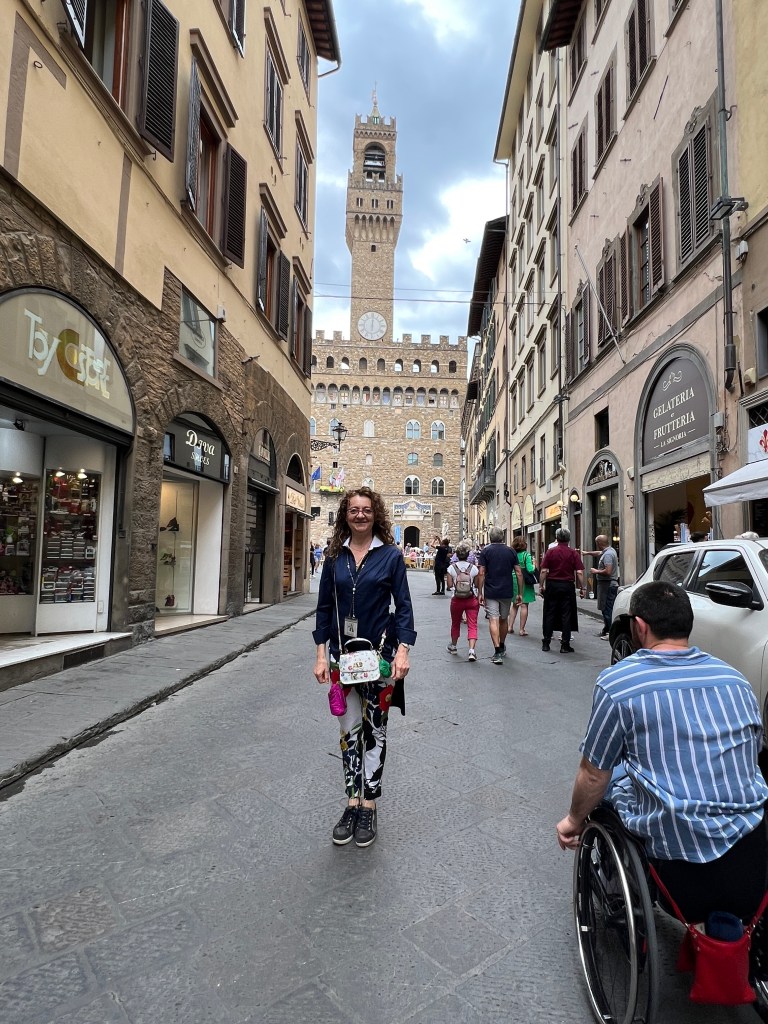
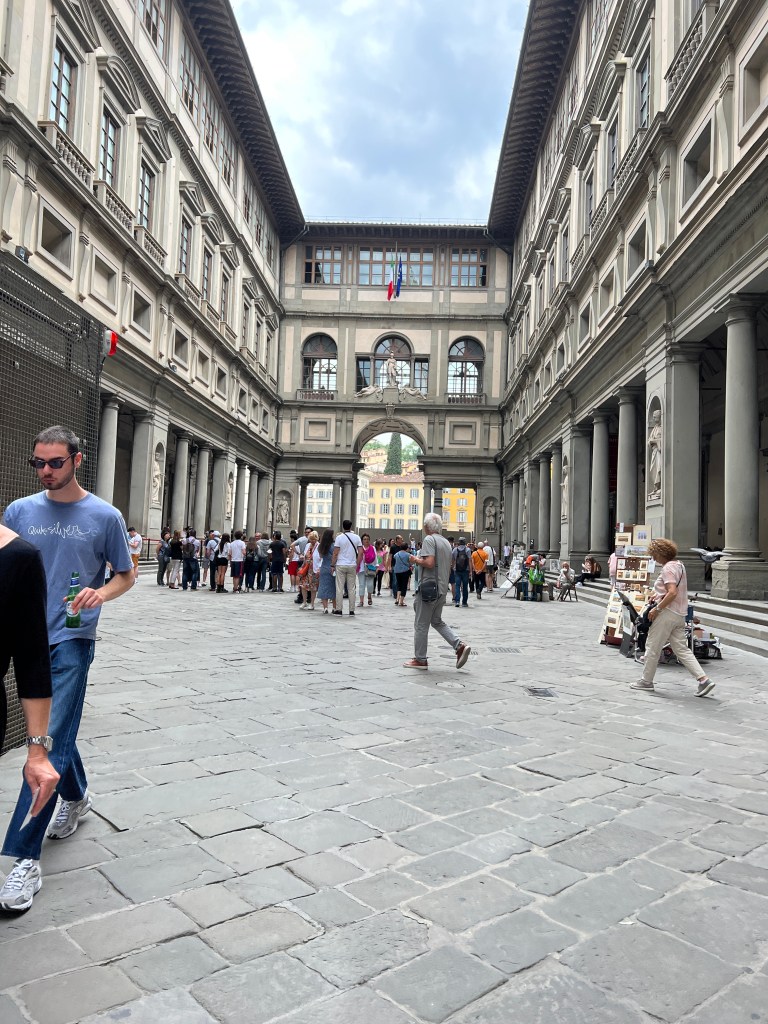
It was now getting close to our entry time to the Uffizi Gallery and we headed to the beautiful Piazza della Signoria. It is dominated by the Palazzo Vecchio tower which served as a town hall in Renaissance times. In 1540 Cosimo I made the building his palace. The Piazza has been the center of the city’s celebrations and executions. Now it offers a large number of restaurants and cafes. Luckily we had place to sit because Dan had reached his limit and had become dehydrated, and on the verge of fainting. While we ordered some drinks and food, Ilaria went to get our entry tickets.

Icarian Headed to Uffizi Gallery

When Ilaria returned I headed to the Uffizi Gallery with her and left Dan behind to recuperate. With her help, I was able to see the most important artwork housed in the museum. The first painting we viewed was the Madonna and Child painted by Filipino Lippi. Lippi added something to his paintings not often seen at the time, and that was real flesh and blood human beings. He was a monk, but left the order after having a relationship with a nun who bore him two children. Some suspect that the woman portrayed in this painting was his lover. They were lucky in that the Medici in power at the time told the order to leave the lovers alone.

Uffizi Gallery

Madonna and Child by Filipino Lippi

Next was Palo Uccello’s The Battle of San Romano. It was one of the first attempts at painting three dimentionally. I didn’t think it was a particularly good painting, but the artist was credited for his originality.

The Battle of San Romano by Palo Uccello

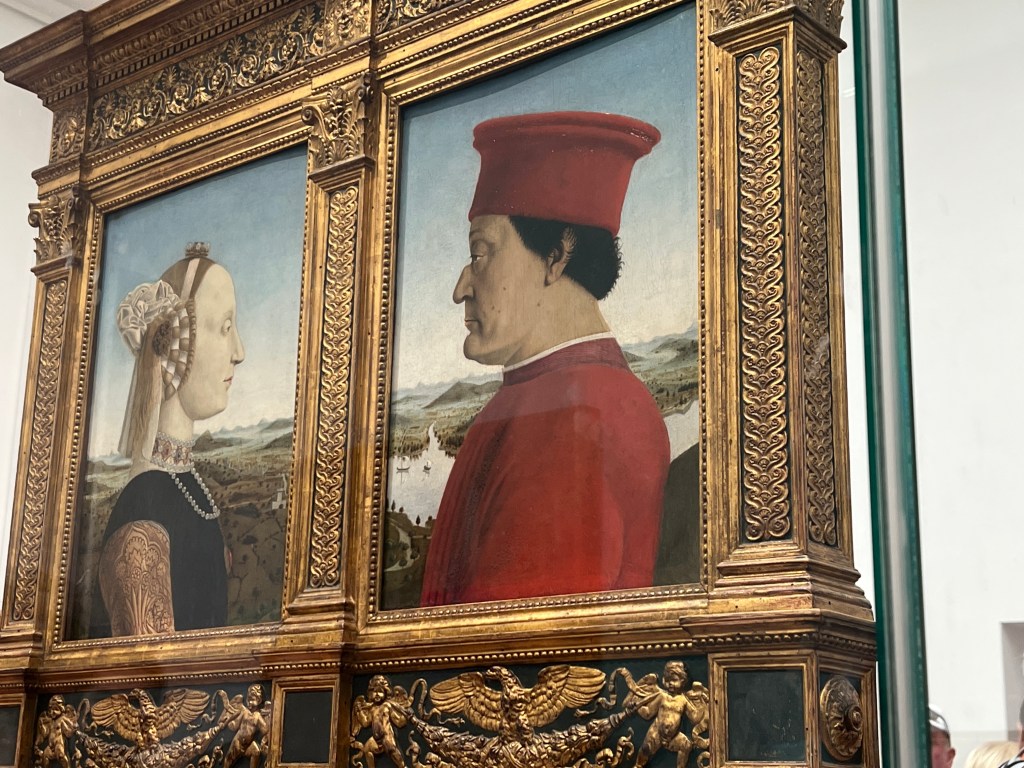
During the Renaissance, paintings no longer had to include saints or religious subjects, but people. Federico da Montefeltro had lost his right eye. In addition, it is said that he had part of his nose cut away so he could see better out of his left eye. Thus the side view of the couple. To make this painting even creepier, some think that the portrait is of his wife after her death, thus her white coloring. The double portrait was done by Pietro della Francesca.

Federico da Montefeitro and Batista Storza by Piero Della Francisca

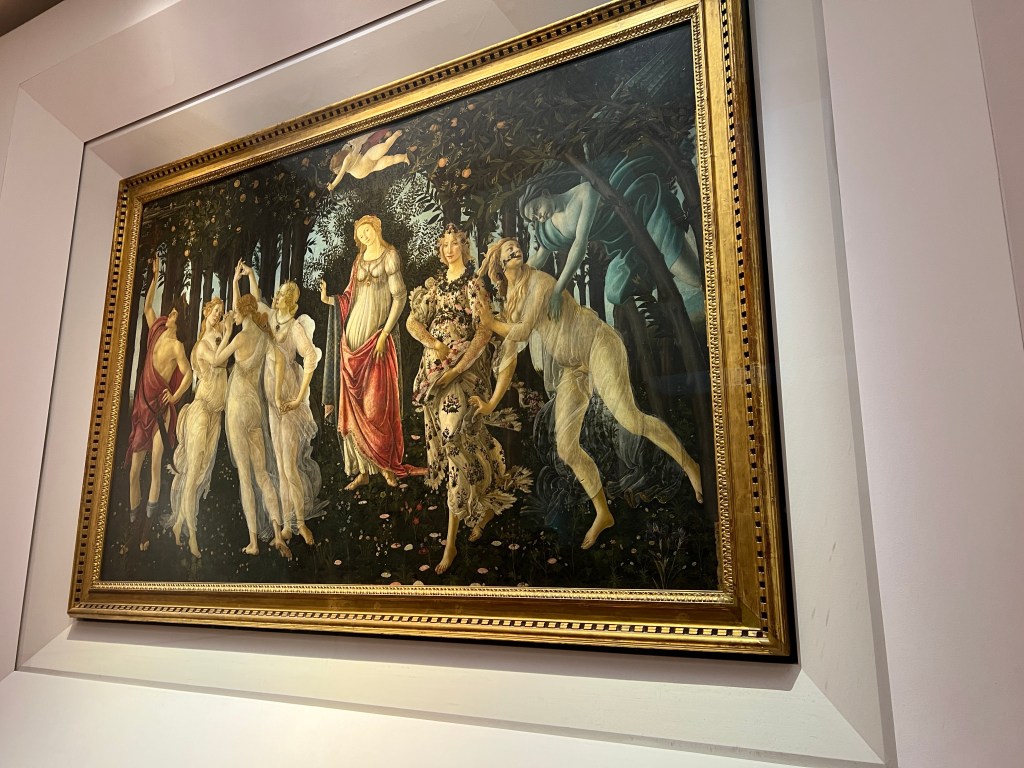
Sandro Botticelli’s paintings were next on the to see list. Primavera or Spring is a large painting depicting a group of figures from classical mythology. Apparently Botticelli liked to depict pregnant women, and all the female figures in the painting are pregnant with the exception of one. She is gazing at a young man at the far left. Ilaria mentioned it is thought that the painting was created in celebration of the engagement of a nobelman’s daughter— the girl gazing at the young man. The inference being that before long she too would be pregnant. Over a 100 species of plants are accurately depicted in this painting including some that are now extinct.

Botticelli’s Spring

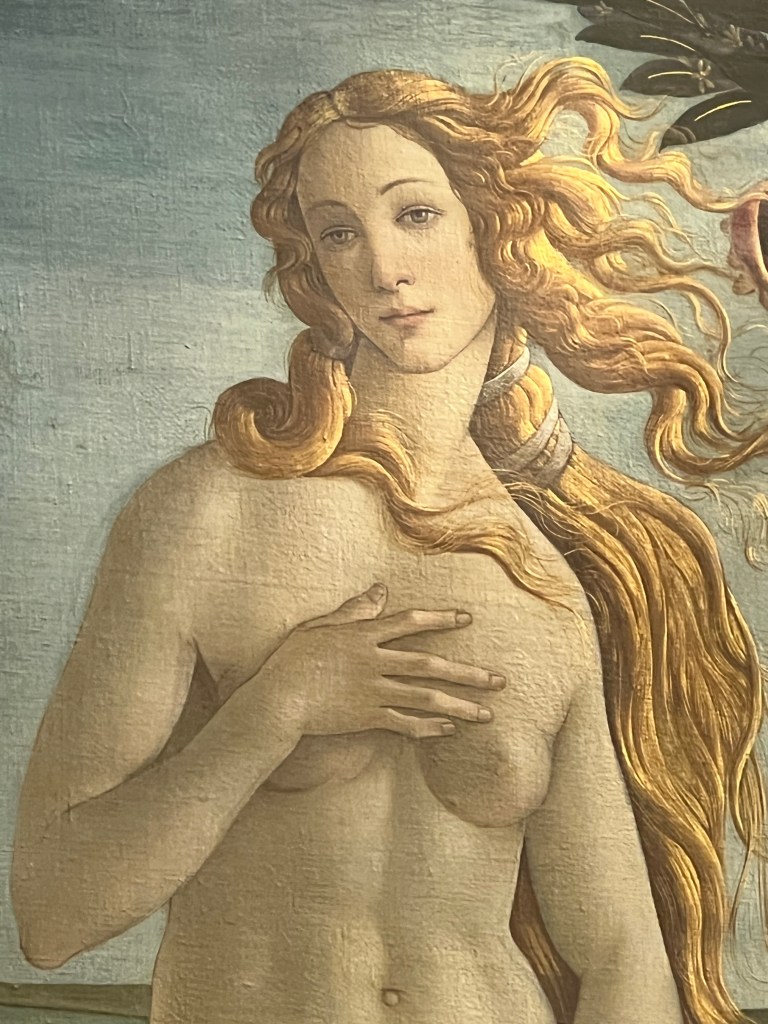
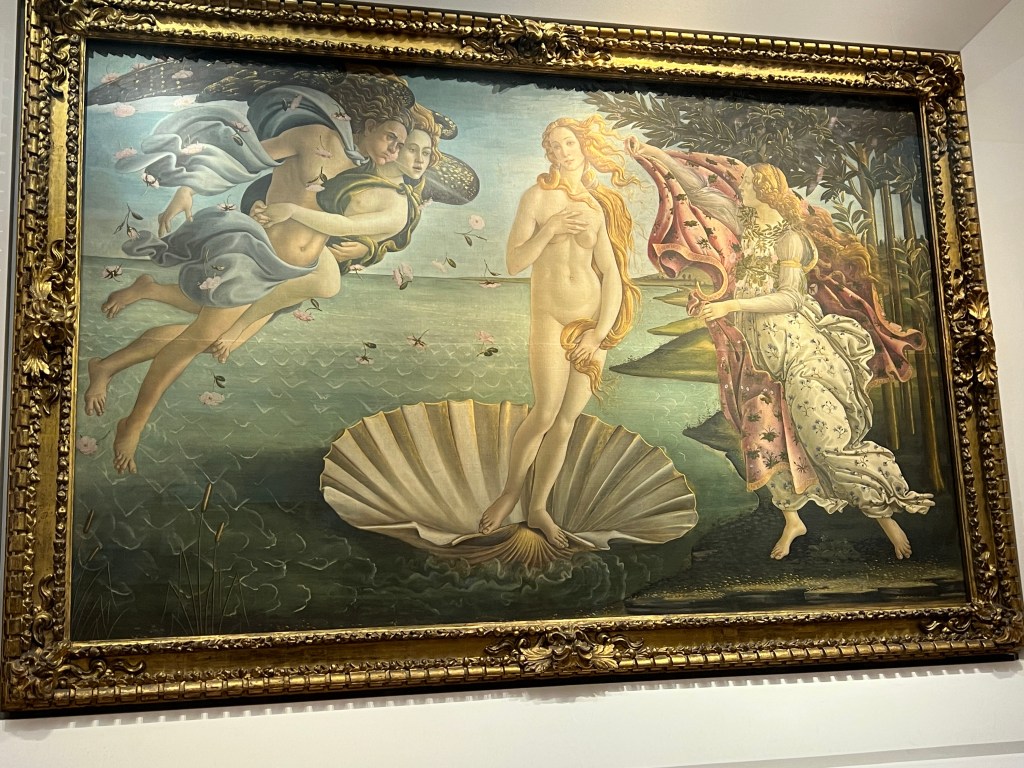
Botticelli’s Birth of Venus was in the same room. That was a lot of beauty to take in. The artist thought that physical beauty was part of appreciating God. Here the goddess Venus is arriving at the shore after her birth, when she emerged from the sea fully-grown. His painting Calumny of Apelles was a political statement. According to Ilaria the artist had become disillusioned with those in power after Lorenzo Medici died and the economy fell apart. It is much darker than his earlier works.

Botticelli’s Birth of Venus

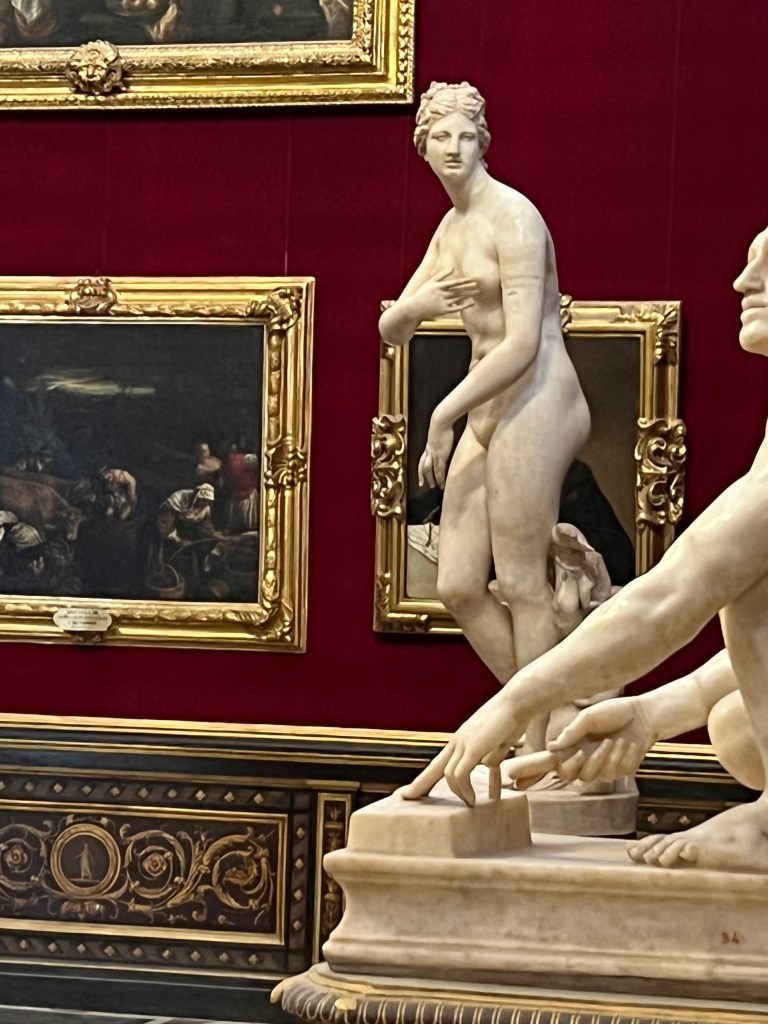
Now for a statue, Venus de’Medici from 1st century BC. Her pose is similar to Botticelli’s Venus. It is a Roman copy of a statue carved by Praxiteles. It was held to be the epitome of ideal beauty and sexuality in the 18th and 19th centuries.

Venus

I couldn’t leave the museum without seeing The Annunciation by Leonardo da Vinci, dated to 1472-1476. He was still an apprentice when he completed this work. Ilaria mentioned that almost all depictions of Mary showed her inside, but this one depicts her outdoors. She also mentioned something about the juxtiposition of the table and the angel which Leonardo used to make it clear that he was no longer merely a student of painting, but a master.

Adoration of the Magi by Leonardo da Vinci was left unfinished. He left for Milan which is one reason that is given for it being incomplete. Ilaria mentioned that it may also have been that he became so overcome with the depressing scene that he had painted that he simply couldn’t complete it.

Adoration of the Magi

Ilaria was wrapping up my tour when all of sudden Dan appeared. How he found us, I don’t know given that there are hundreds of galleries. Fortunately he was feeling much better, so as Ilaria said her goodbyes, Dan and I continued to view a few more galleries before we too left the Uffizi and headed back to the hotel. We were to meet Eileen Strauss and Jim Murdoch, and Terry and Paul Benfer for a food tour of the Oltrarno neighborhood this evening. They had all just arrived in Italy.

Who do we meet in the lobby of the hotel when we arrive, but Paul Benfer. We had only met via Zoom. He told us Eileen and Jim had also arrived. At 5:00 PM we met in the lobby and headed to the meeting point for our food tour guide.

At L’Radii di santo Spirito we had the chance to taste several regional specialties of Florence. Coccola consisted off fried pizza dough in which you put a piece of Tuscan ham along with a creamy cow cheese called stracchino; some grilled pork sausage, and lampredotto. I gave it all a try, but the lampredotto, which is made from the 4th stomach of a cow was not my favorite. It is a popular street food in Florence and vendors sell sandwiches filled with it. Basically all you taste is the sauce in which the stomach is cooked, but I found the texture “yucky.” Fortunately the Prosecco they served with it helped wash away the taste.

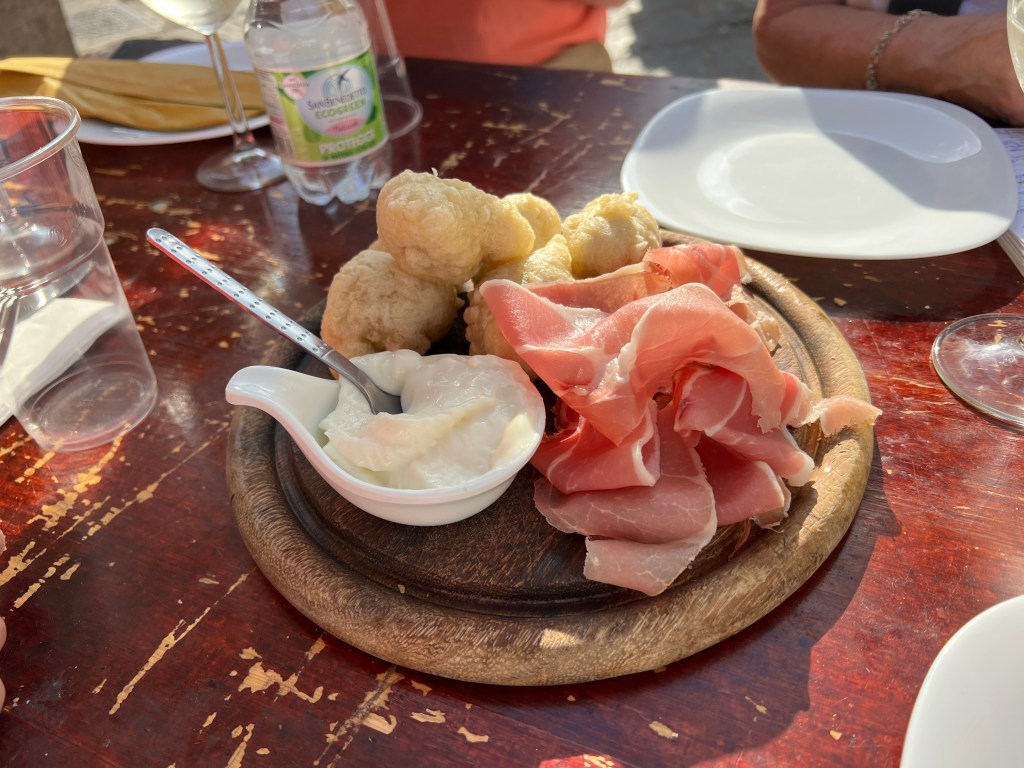
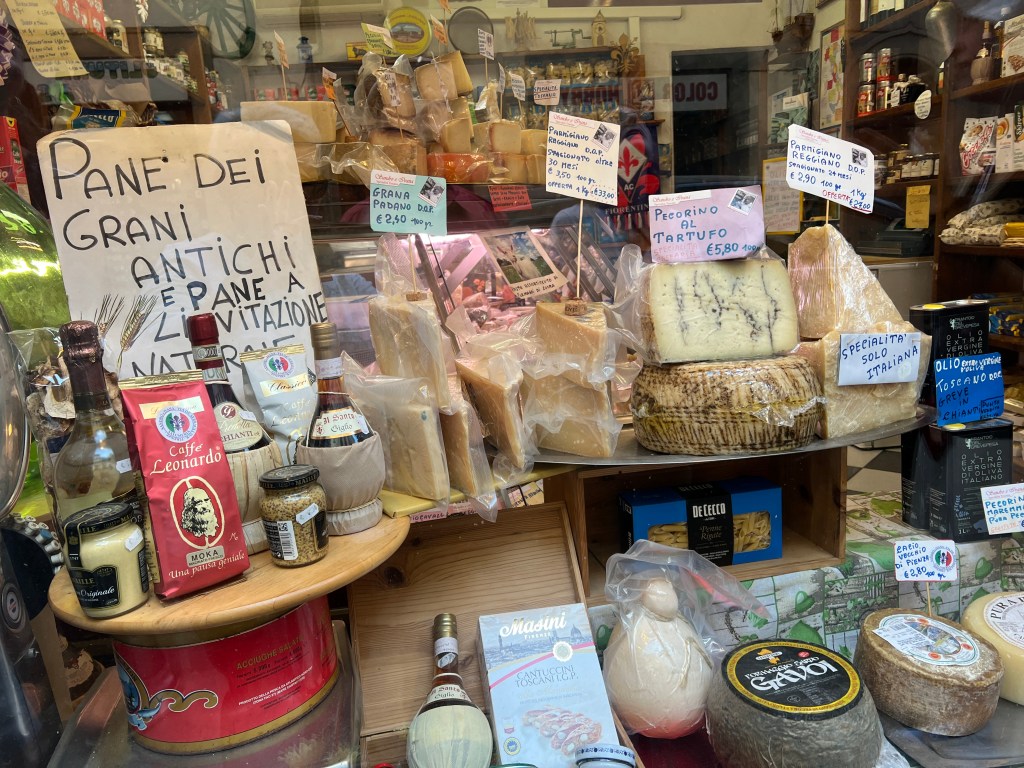
Our next stop was at Sandro & Ivana (Cheese and Salami). The owner of the shop has been involved in the cheese business since he was a child. Here we had the chance to taste Tuscan cheese and cured meat. There were two pecorino (sheep) cheeses, one plain and one with truffle. Along with the cheese came some of Florence’s tasteless bread. The bread is tasteless because of wars between Sienna and Florence. Because Sienna controlled the salt trade, Florence decided to stop using salt as much as possible. In addition, they now claim that their tasteless bread allows the flavors of meats and cheeses to be more fully appreciated. I loved the pecorino with truffle. I would buy it to take home if I could. We also tried a salami aged with fennel seed (finocchiona), which was quite tasty.

One of our favorite stops was at the Florence Food Studio. The owner was making cartucci when we arrived. Biscotti is used to describe biscuits or most types of cookies, but a Mandel bread type of sliced cookie often with almonds, goes by cartucci. Just like when I make Mandel bread after it is baked and sliced it is put back in the oven to become more dry. If fresh cartucci wasn’t enough, the practice is to dip it in a sweet Tuscan dessert wine. The one we had was called Santo Spirito made by the Frescobaldi family. Delicious.

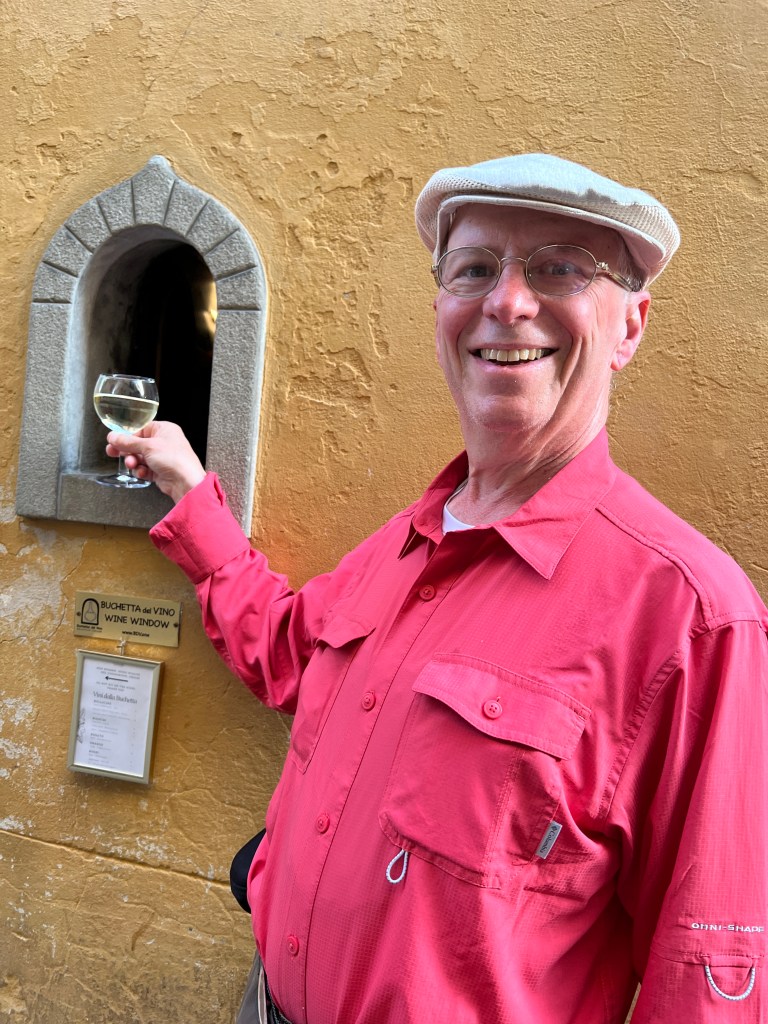
A fun experience was getting wine from a wine door. These were little door like openings in the street where during the Renaissance you could ring a bell and have your wine container filled with the owner’s homemade wine. For us, we rang a bell and ordered glasses of red or white wine, which were then handed to us through the wine door. We then went inside the restaurant, Barbae, where we continued to enjoy our wine along with a Crostini, a wonderful bruschetta topped with a soft mozzarella cheese and tomatoes. The owner of the restaurant was the first in the area to make use of the historic wine doors.

Wine Door

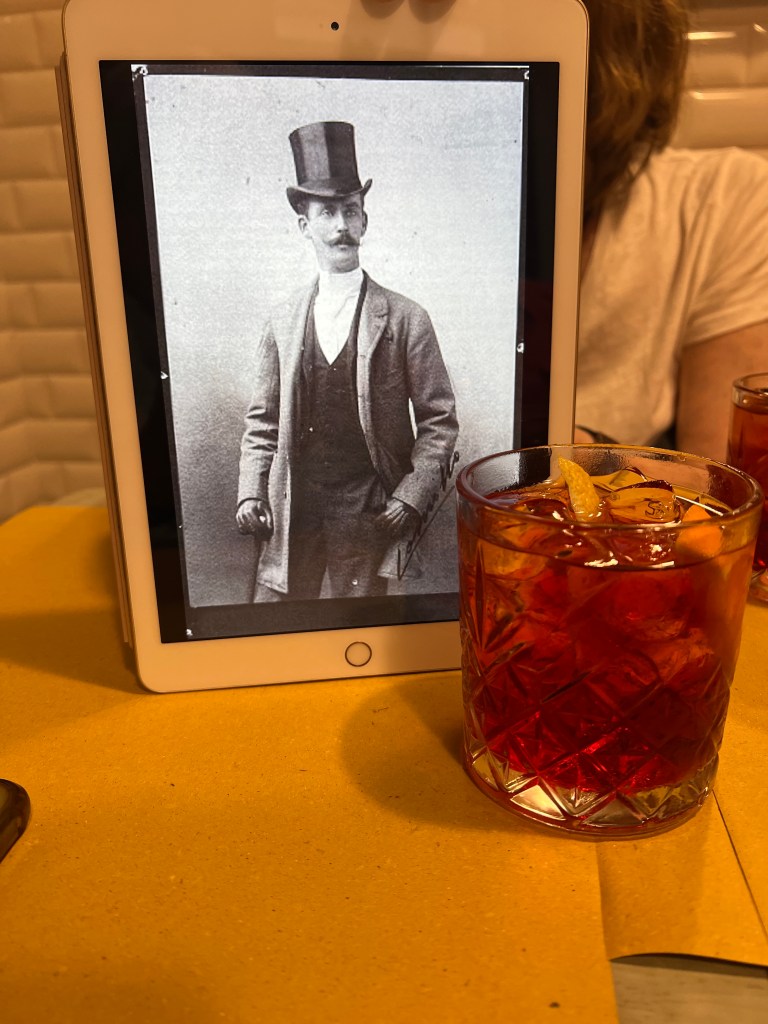
We weren’t done drinking, even though we had enough wine by now. At Fantappie, a wine shop, we had a demonstration of the making of the a Negroni cocktail, one made with gin and the less authentic one referred to as the “Negroni mistake”, that is made with Prosecco. The original was developed by Pascal Olivier Count de Negroni. It is made with lots of ice, one part gin (preferably English), one part vermouth Russo, and one part Compari with an orange slice. Each of us received a large glass of either the traditional or mistake Negroni. Along with the drink we enjoyed a wild boar stew, and papa al pomodoro. The papa was made with stale bread cooked with a tomato-based sauce. Essentially it is a kind of bread soup. As for the Negroni, it was bitter and strong, none of us drank much of it. However, as the ice melted it seemed to improve as did I.

Negroni with Negroni

The last stop was at an artisan gelato shop. There were many interesting flavors and it was yummy as usual. It was a nice way to finish up our tour. We all then strolled slowly back to our hotel.

Day Eight Naples and then on to Florence

Our travel company, JayWay, had helped us with the first 7 days of our trip. Now we are on our own until we connect up with our Tauck tour in Milan. A visit to the Archeological Museum is the main item on our agenda today.

We grabbed a quick breakfast at the hotel, and checked out of the Hotel Bellini. They were kind enough to let us store our luggage for the day. It was an easy walk to the museum. Once again we were confronted with a massive building filled to the brim with art and artifacts.

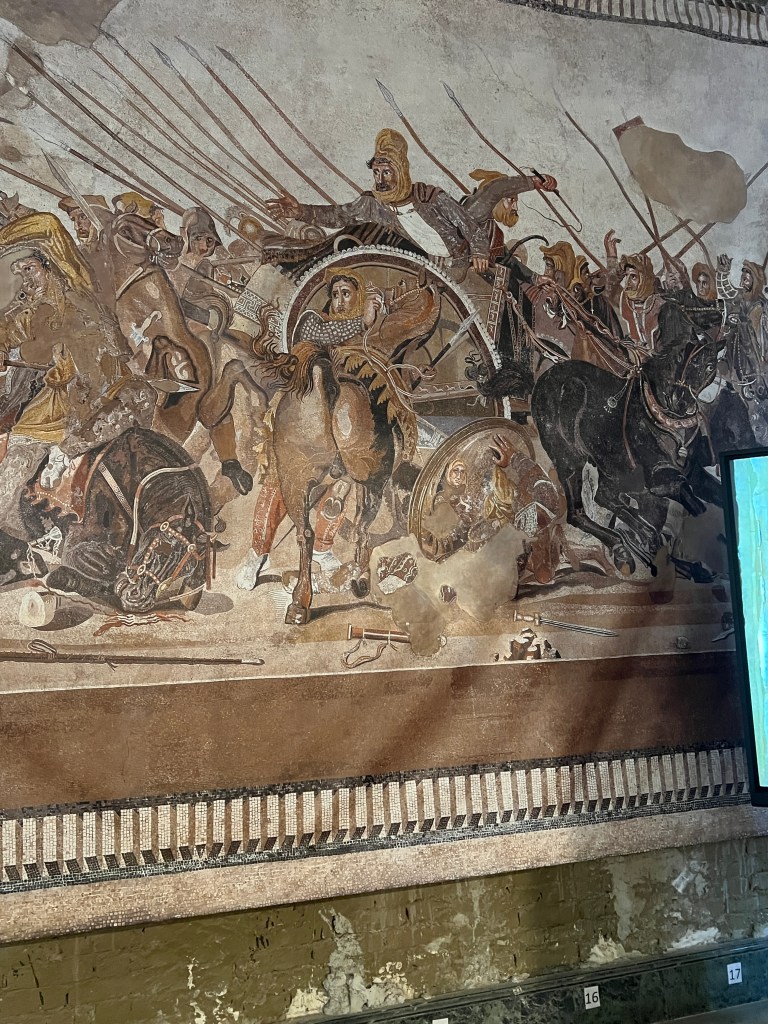
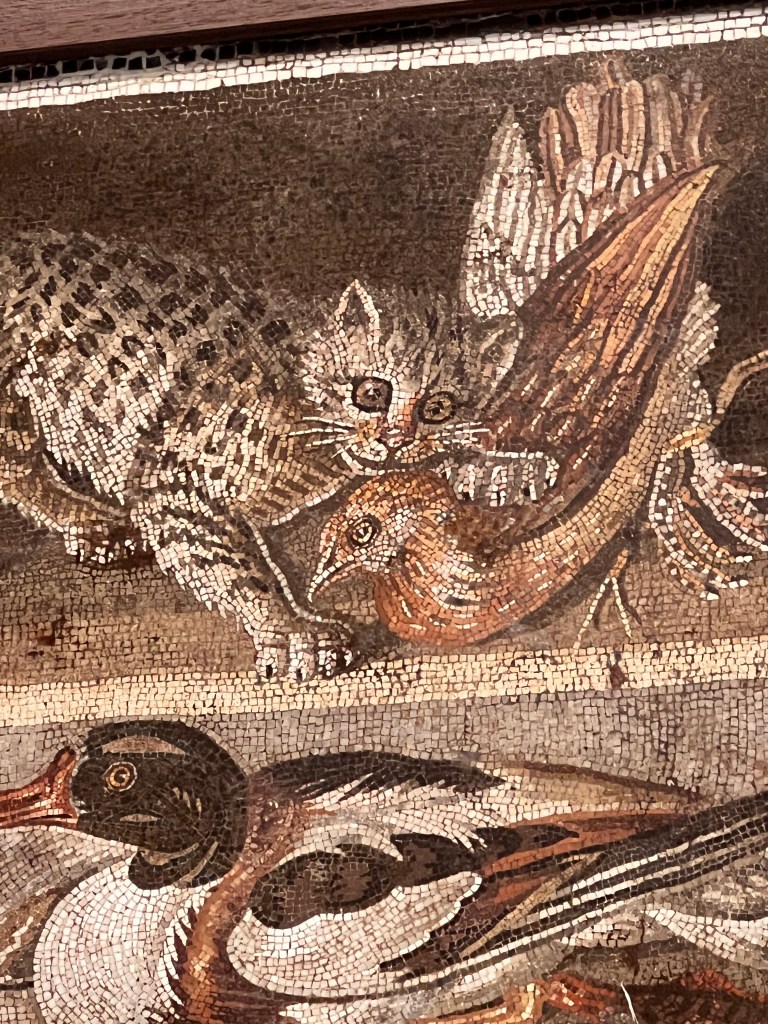
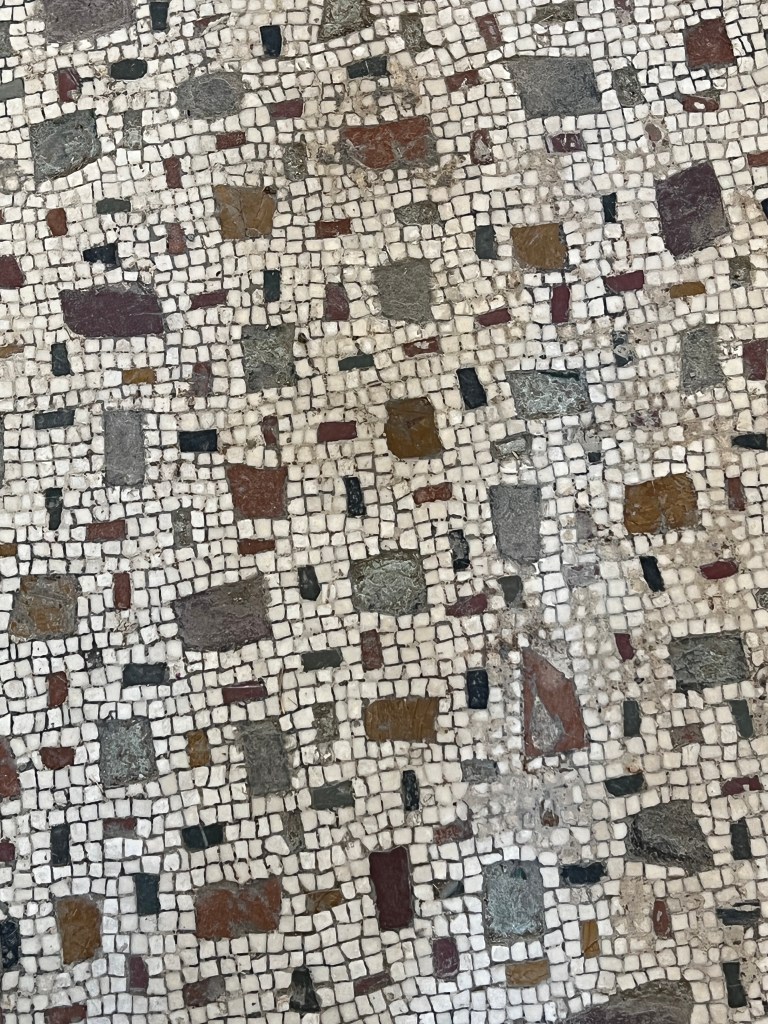
In addition, to the incredible mosaics that were part of the museum’s regular offering, we were treated to a special exhibit of additional mosaics. The majority had been removed from Pompeii and other Vesuvian cities. The workmanship was truly incredible. One of the most impressive was a battle scene where Alexander the Great defeats Darius III of Persia in 331 B.C. Interestingly enough it is a 2nd century copy of the original and had once decorated the floor in the House of the Faun located in Pompeii.
Alexander the Great vs Darius
Cat and Birds Mosaic
Assorted Fish Life Mosaic
Beautiful Marble Stone Floor

The museum also housed a “Secret Room” or “Baginetto Segreto. You must be of a certain age in order to enter, as it contains a collection of erotic statues, paintings, and frescos. They were found in the homes of wealthy Romans, along with brothels and shops. Considered to be entertaining by the Romans, they are quite risqué. There were plenty of phalli to be found, but a phallus wasn’t necessarily a sexual symbol during Roman times. It could also symbolize fertility, happiness, etc.

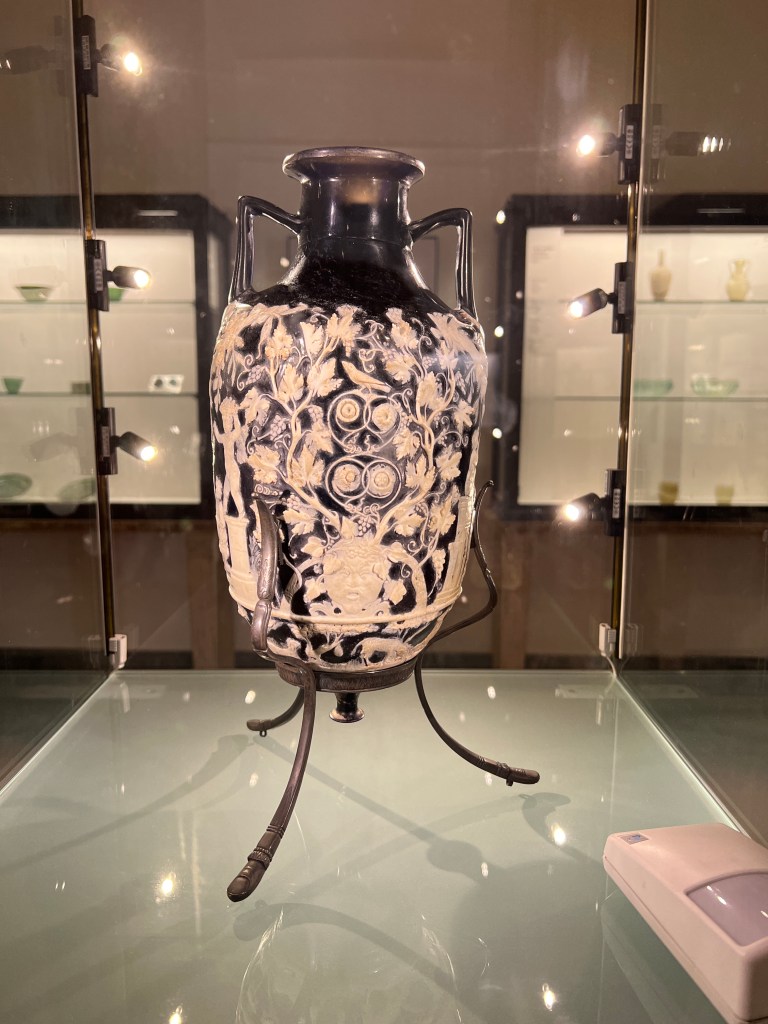
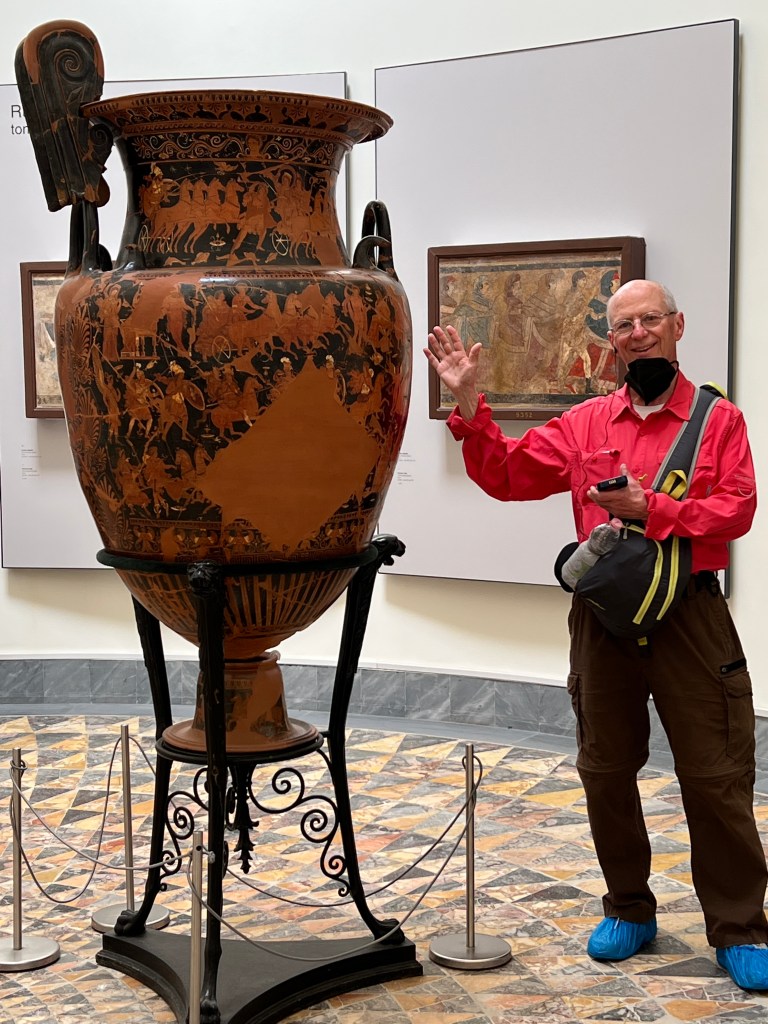
The museum had an amazing collection of daily life objects. Pieces of furniture, huge pieces of pottery, glassware, cookware and gorgeous jewelry all gave insights into the Roman household. One item stood out to us, the Blue Vase. It was made around mid-century 100 A.D using a cameo affect. Shaped like a wine amphora, it was most likely a cremation urn. In addition, some of the clay urns were extremely large.

Cobalt Blue Vase
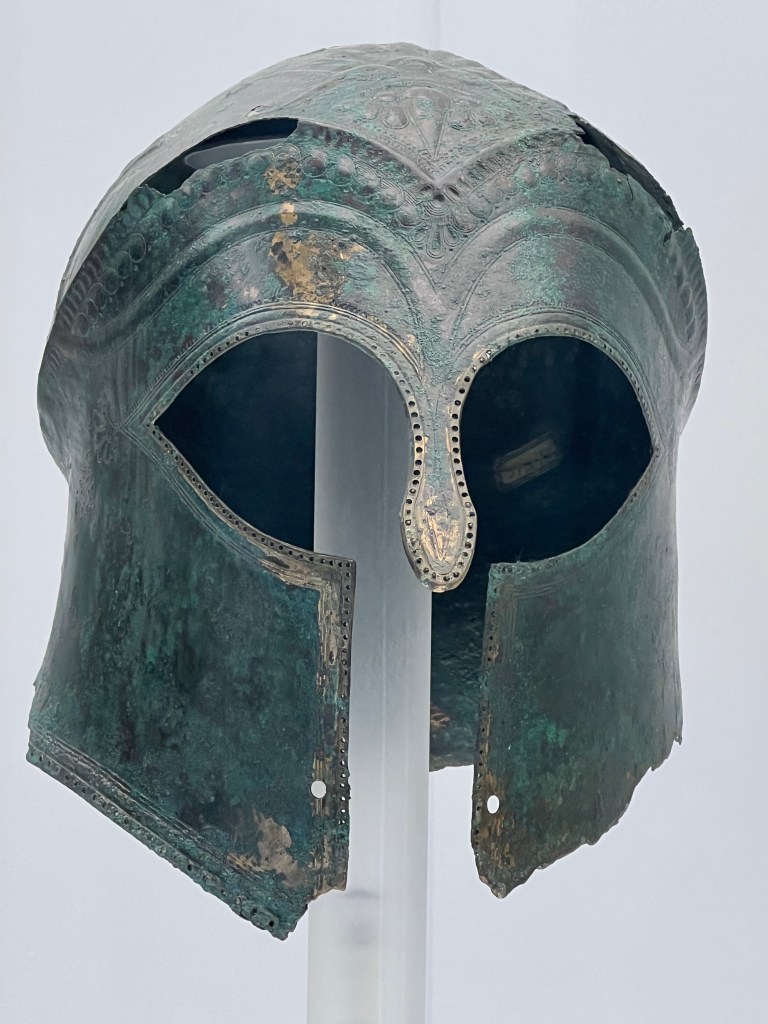
Roman Helmut
Elegant Gold Necklace

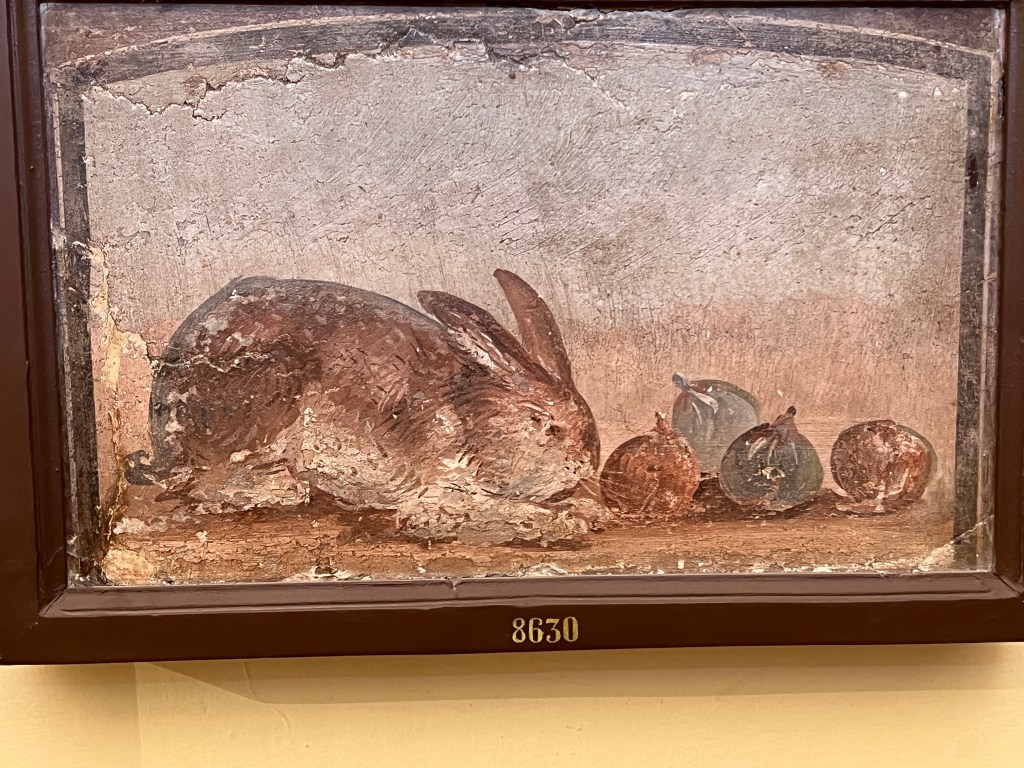
Rooms were filled with frescoes, which are paintings done rapidly on wet plaster on a wall or ceiling, so that the colors penetrate the plaster and become fixed as it dries. It was the same method used by Italian Renaissance painters such as Raphael and Michelangelo. Many of the paintings depicted scenes from mythology, but they also included everyday life or landscapes.

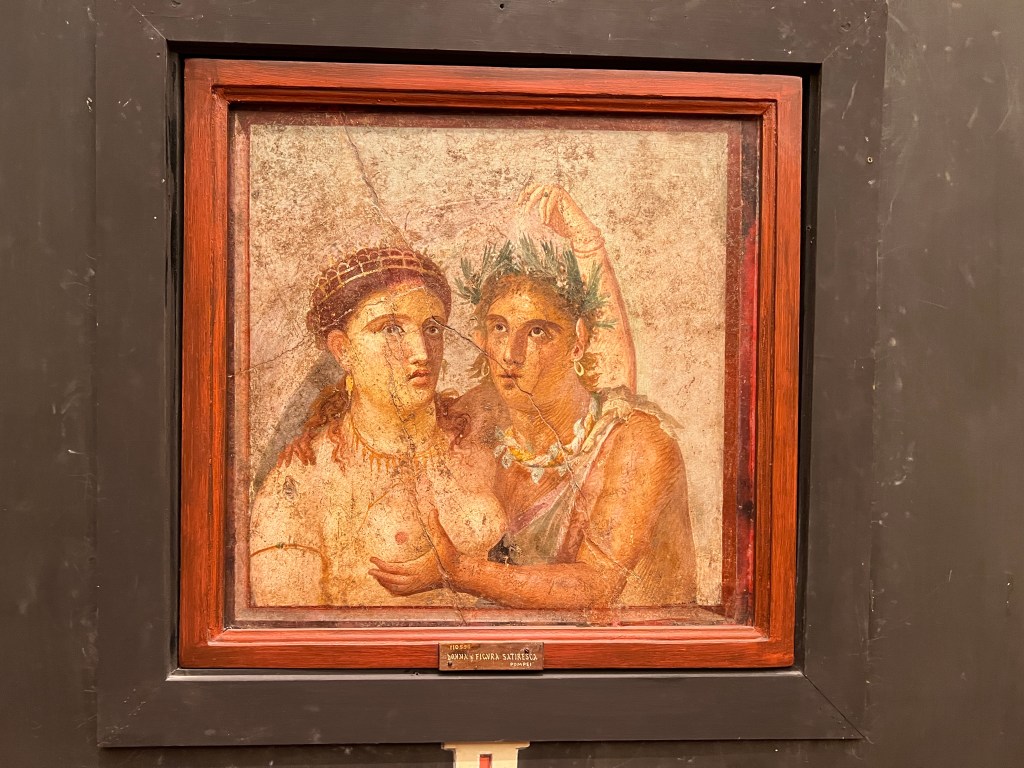
Fresco
on Marble

As to be expected, the museum was full of statues, many of which were Roman copies of those originally made by the Greeks. The most famous was Doriforo. It’s a Roman copy of a 5th century B.C. Greek bronze by Polyclitus. He once stood in Pompeii’s gym, and helped inspire the Renaissance by inspiring people like Michelangelo and Donatello.

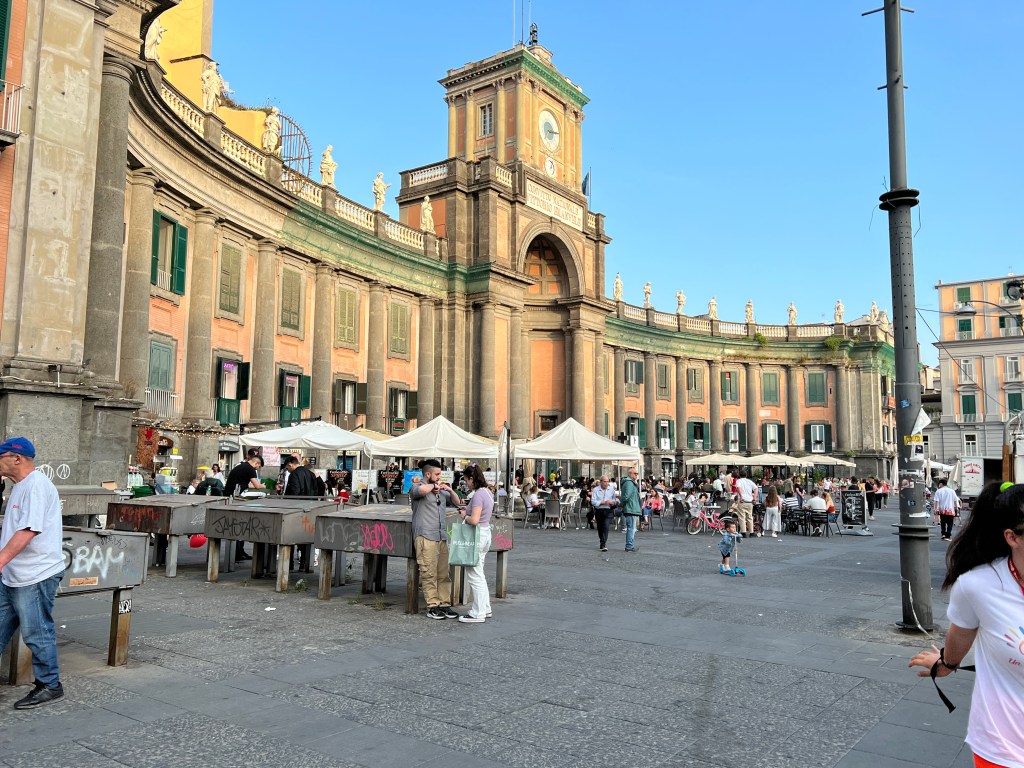
There is no question that the Archaeological Museum is worth coming to Naples to see, but it isn’t possible to see it all in one visit. After several hours it was time to change direction and find another pizza. We headed to what we were told was the first pizzeria in Naples, Antica Pizzeria Port’Alba. On our way we stopped at Naple’s Galleria to look at the shops. Sadly, it was almost totally empty and quite depressing to walk through. We also paid a little more attention to Piazza Bellini, which had its own Roman ruins.

City Gate near Piazza Bellini

Our Margarita pizza was delicious. We thought the pizza was a little bit better than the first pizza we had eaten, because the sauce was less watery. After lunch we picked up our luggage from our hotel, hopped into a taxi and headed to the train station for our 4:00 PM train. Our train ride to Florence was a pleasant experience. This time we traveled business class, which gave us a little more room and more snacks and drinks were served.

Upon arriving in Florence at 7:00 PM it was a bit of a challenge finding a taxi stand, and once we did, there was a long line. Luckily the line moved quickly and we arrived at The Hotel Silla where we were to meet our friends Eileen Strauss and Jim Murdoch, tomorrow.

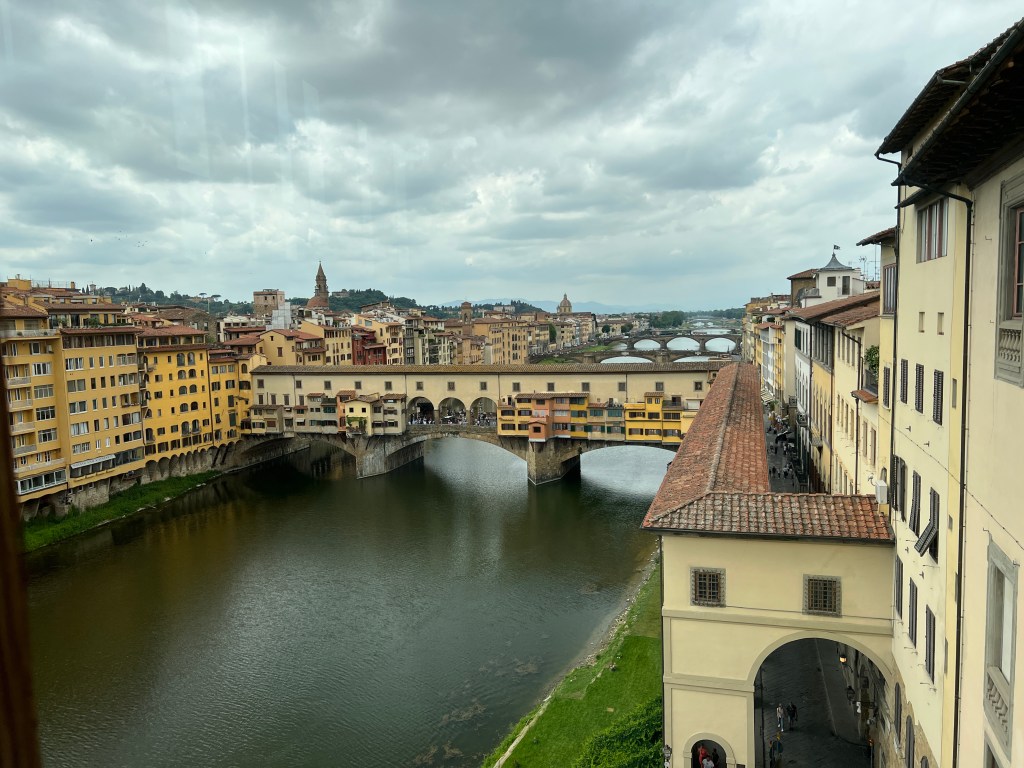
We seem to go through cash so we inquired where we could find the nearest ATM. Our hotel is located in the Oltrarno neighborhood and in order to reach the ATM we had to cross the Arno River via the Ponte Vecchio bridge. How cool is that? Here we are on our first evening in Florence and we have already visited the oldest bridge in the city. The bridge is lined with high end stores, but it used to house blacksmiths, tanners and butchers. The Ponte Vecchio was rebuilt after a flood in 1345 by a student of Giotto, Taddeo Gaddi. During WWII it was the only bridge across the Arno River that the fleeing Germans did not destroy.

The Ponte Vecchio Bridge

As soon as we replenished our funds we headed back to our hotel on the other side of the Arno River. Our tour of Florence begins at 10:00 AM.

Day Six The Isle of Capri

It turns out we didn’t need to look for the starting point of our Small Group Boat Excursion to Capri because we were picked up by a van in the morning. The location of our marina was not any where near the point we discovered last night, but on the outskirts of Sorrento. After taking an elevator down from the top of the cliffs overlooking the sea, we ended up at a small marina where we were placed on a powerful boat along with 10 other people plus two crew members. Our fellow passengers were friendly and it was fun spending time with them. They included a young couple finally able to take their honeymoon, a family with 3 teenagers from Seattle, and a husband and wife traveling with their 6 year old son from Vancouver.

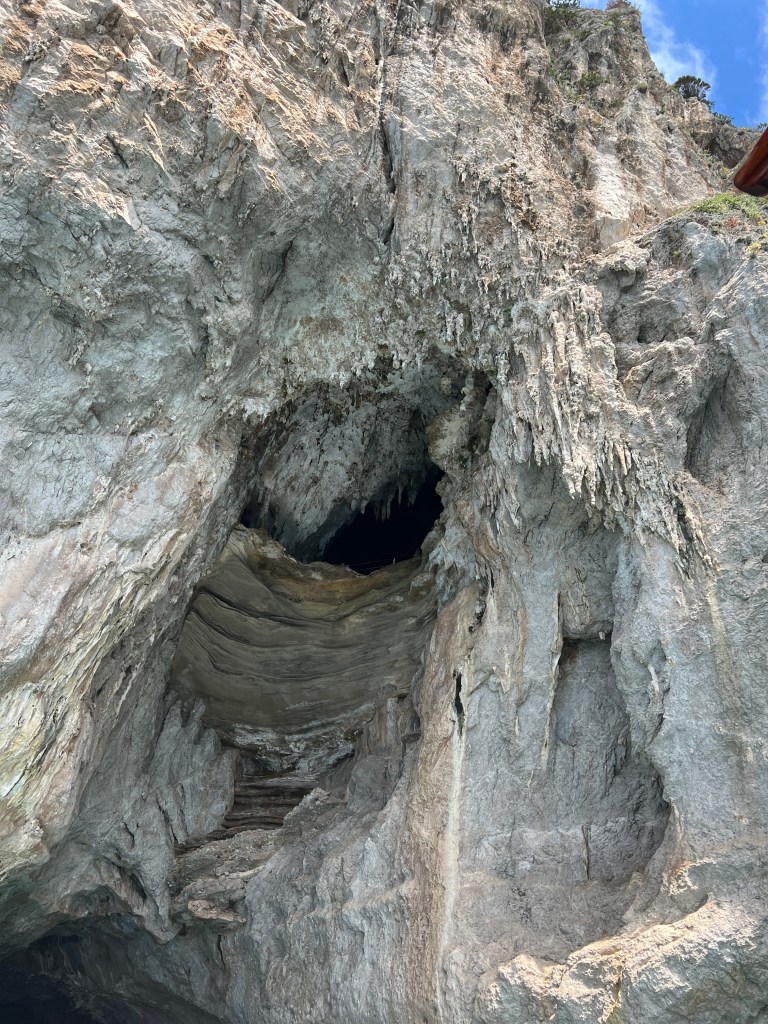
I can’t imagine a more beautiful day for a trip to Capri. It looked like hundreds of boats full of tourists were all heading to the island, and in the distance sailboats were competing in a race. Capri is rugged and mountainous with a variety of caves or grottoes set into its coastline. The boat took us close to several of them, many of which had stalagtites visible.

Green Cave with Stalactites

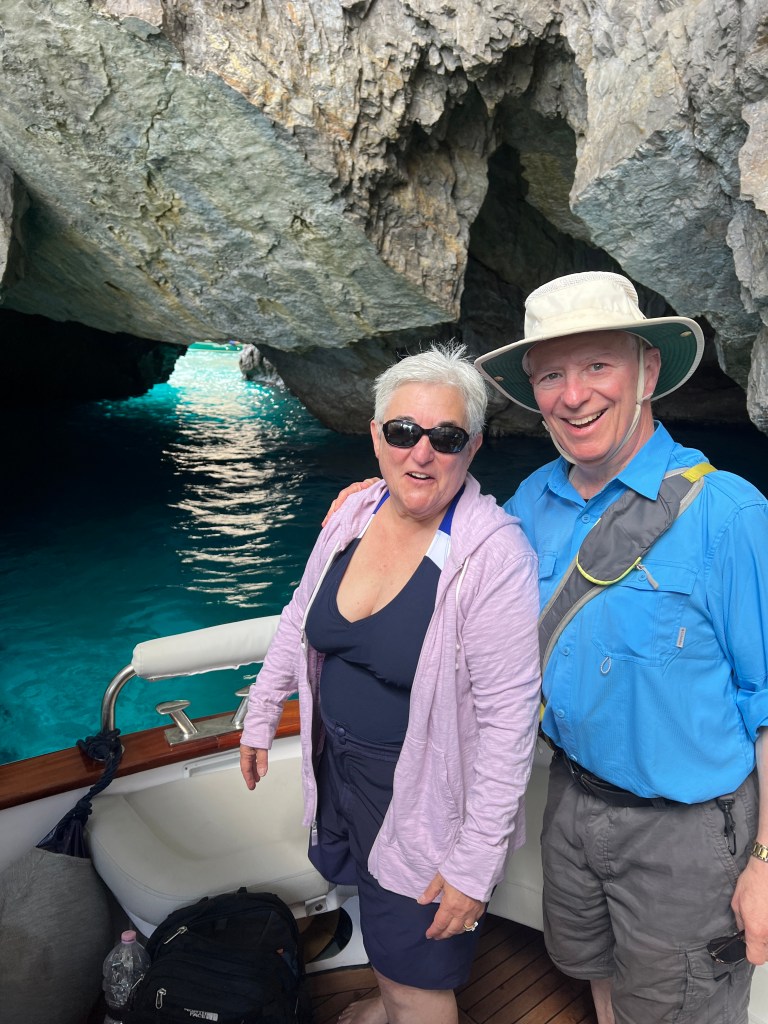
One popular tourist site is the Blue Grotto. We were given the option to join the line of boats gathered there, or go with an alternative. Our guide said he had his own private cave we could visit, but we would have to swim to get there. We all happily accepted his option. A short time later the boat stopped about 150 feet from a small cave entrance. I decided to take the plunge. The crystal clear water was so cold it literally took my breath away. It was a tough swim, despite the fact I’ve been swimming weekly for the past several months. I made it to the opening, ducked under a ridge and entered a beautiful world of the clearest greenest water I’ve ever seen. After a few minutes we headed back to the boat. When we returned snacks were served along with beverages.

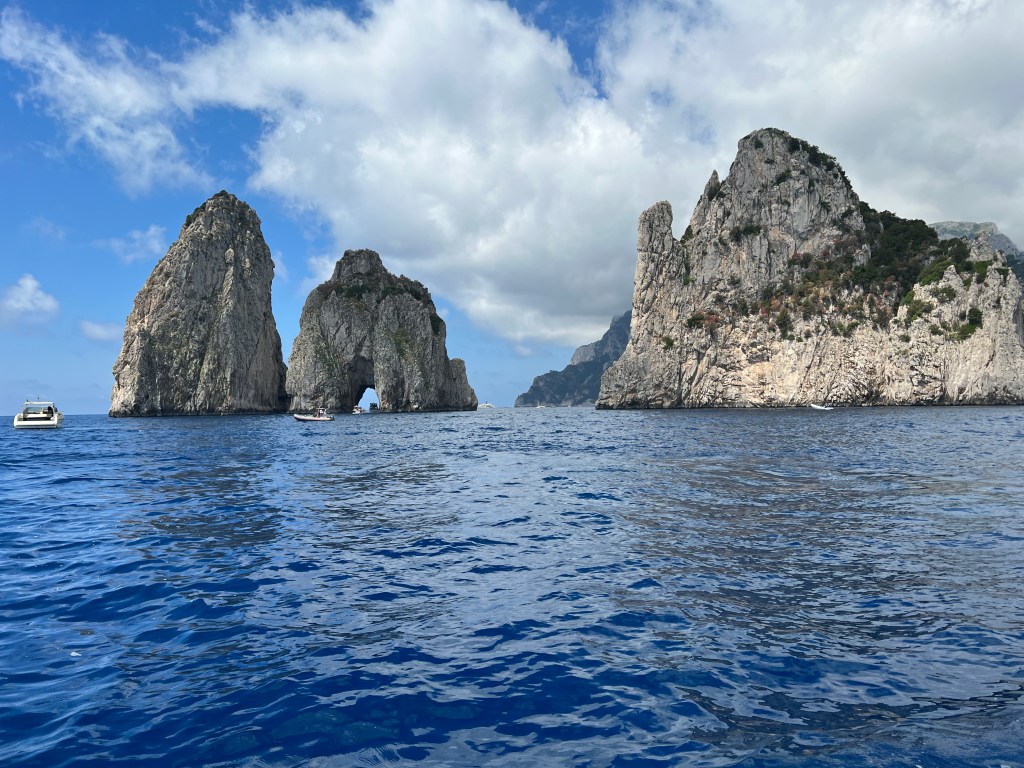
One of Italy’s most famous natural sights are the Faraglioni. They consist of three towering rock formations that jut out from the Mediterranean. One of them has an arch large enough for boats to go through. The legend is that if you kiss when going through the arch your relationship will last forever. As our boat passed through the arch, the captain played Amore and Prosecco was served. A very nice touch.

Faralioni

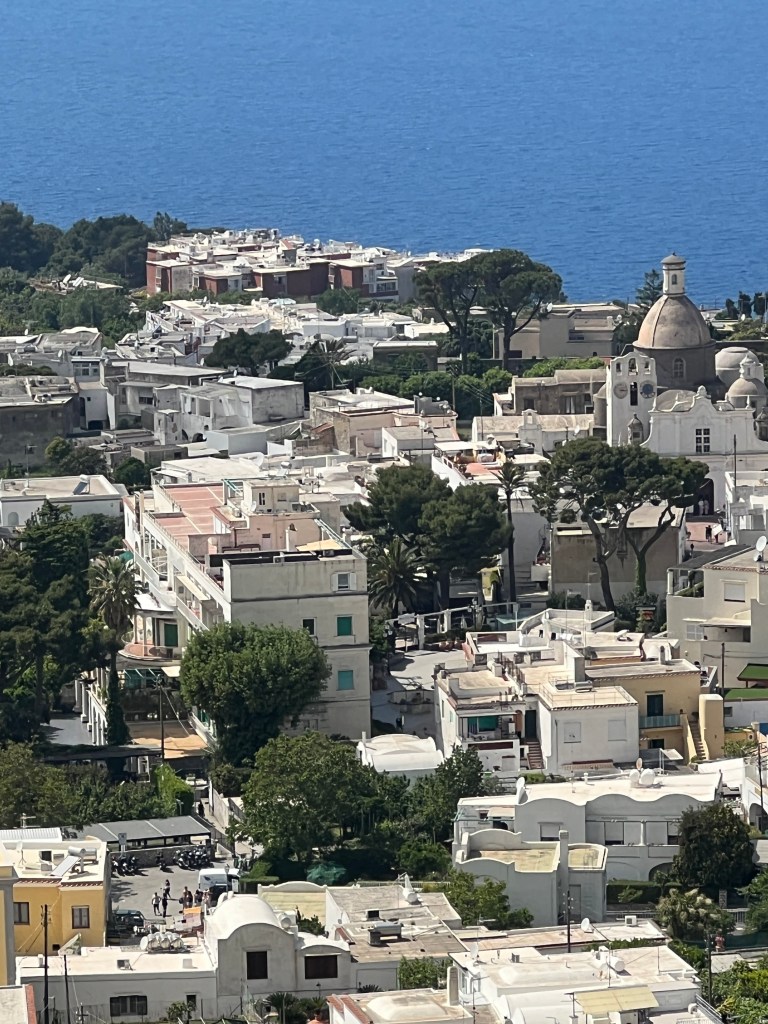
We then were dropped off at the town of Capri, and choose to immediately board a bus taking us to Anacapri. We had 5 hours to explore the island on our own. We had heard that the town was less commercial and less crowded than Capri. This time we traveled in a large vehicle driving twisting, turning, narrow roads. At Anacapri we found a quiet place to sit and eat the bread, cheese and tomato sandwiches we have been given when leaving our boat.

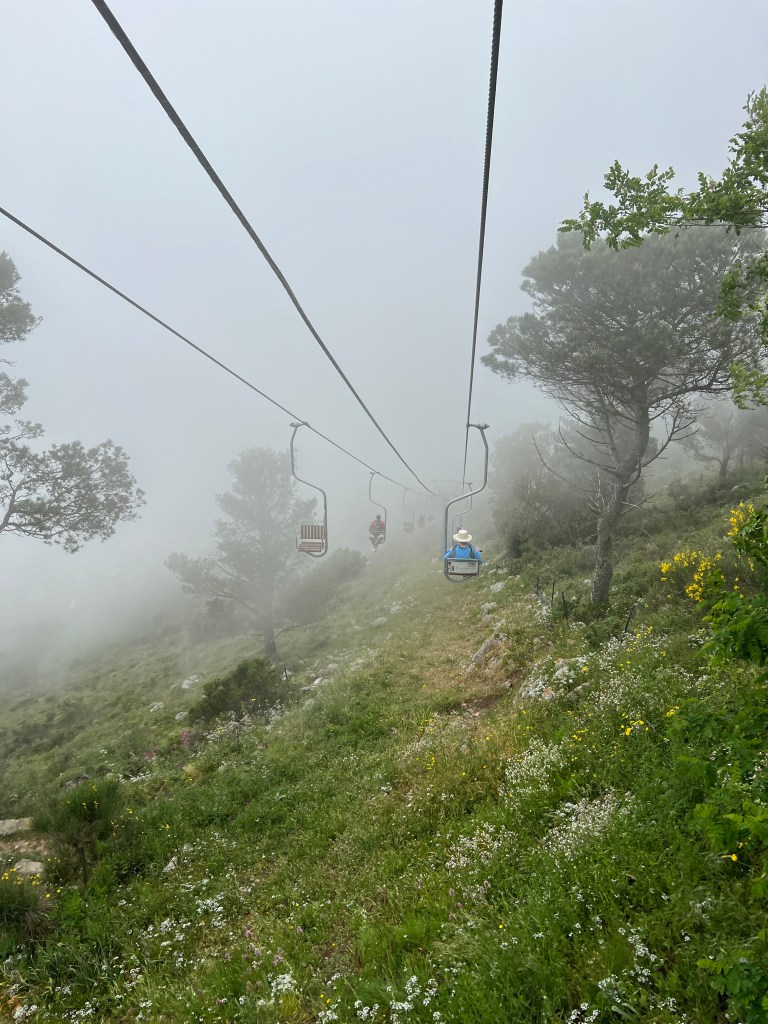
Once again it felt like we were seeing the same shops, and the same crowds. However, we did enjoy a trip up to the top of Monte Solara, the highest point on the island. The only way to reach it would be walking or taking the chairlift Seggiovia Monte Solaro. It is about a 13 minute ride up. While the views were beautiful on the way up and down, the top of the mountain was covered in clouds.

Dan on chairlift in the clouds
Anacapri
Selfie at Anacapri looking down

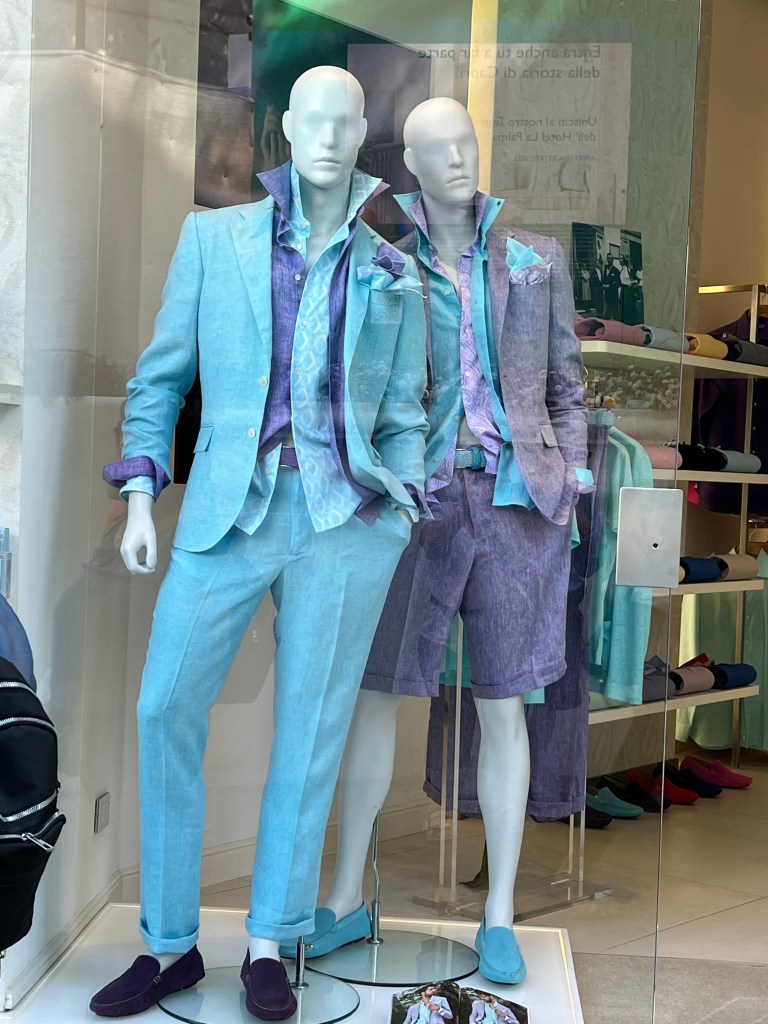
There are a few other sights to see in Anacapri, but we opted to take the bus back down and spend some time in Capri. There we found even larger crowds of visitors, along with high end shops and luxury hotels. Window shopping was fun. Some of the merchandise was what you would see in some of the top fashion magazines and way over the top.

High Fashion?

We did find some beautiful terraced gardens in Capri, the Giardini di Augusta. The gardens offered panoramic views of the coast, but some of the best vantage points were closed off to us due to a wedding.

Dan and I could see why emperors, poets, actors, and artists were drawn to the beauty of Capri. However, apart from the island’s physical beauty, we were ready to head back to Sorrento. The boat ride back was much quicker, and before we knew it we were back in our hotel.

Day Seven Pompeii and Herculaneum

Goodbye Sorrento. Our driver, Pasquale picked us up at 8 AM and we headed to Pompeii. Pasquale was like a character from The Godfather. He was middle aged, casually dressed, and had a wonderful gruff but friendly personality. He tried to engage us in conversation, but it was difficult since his English was as limited as my Duolingo Italian. We arrived in Pompeii before the park opened in plenty of time to connect with our guide for the day, Franco.

Dan and I felt like celebrities as Franco cut through all of the lines and took us directly into Pompeii. He was a slightly built energetic man who was an expert on antiquities. Our first impression was the vastness of Pompeii. It would take a full day, not the 2 hours we had, to see the entire place. Approximately 1/3 of the city of 20,000 people remains covered in debris that is 30 feet deep. Pompeii had been an important producer of a specialty fish oil product and woolen goods sitting directly on the Mediterranean. After the Mt. Vesuvius eruption it was 3 miles from the coast.
The majority of the population left Pompeii when Mt. Vesuvius first erupted on August 24, A.D. 79. On the second day, ash and pumus filled the sky, but the 3rd day was the worst. Poison gas killed anyone that remained in the city. Preserved by the layers of ooze and ash, Pompeii gives an overview of what how people lived in a middle class Roman town, with its grid like streets and the remains of buildings.

Written records had spoken about the existence of Pompeii, but no one knew where it had been buried. Its location was accidentally discovered in 1599 by a farmer, but excavations didn’t begin until 1748 under the patronage of Don Carlos, King of Naples. The King had an interest in art and antiquities. Anything of value was removed and brought to Naples. Digging proved to be extremely expensive and was stopped, not resuming again until the 20th century. Most of the original artifacts are in the Archaeological Museum in Naples.

Small part of Pompeii structures`1

Franco provided us with an overwhelming amount of information. If I had managed to remember everything he told us, which I do not, and repeated it all in this blog you would be reading a 500 page text book. Instead, I’m concentrating on a few things that Dan and I found the most interesting.

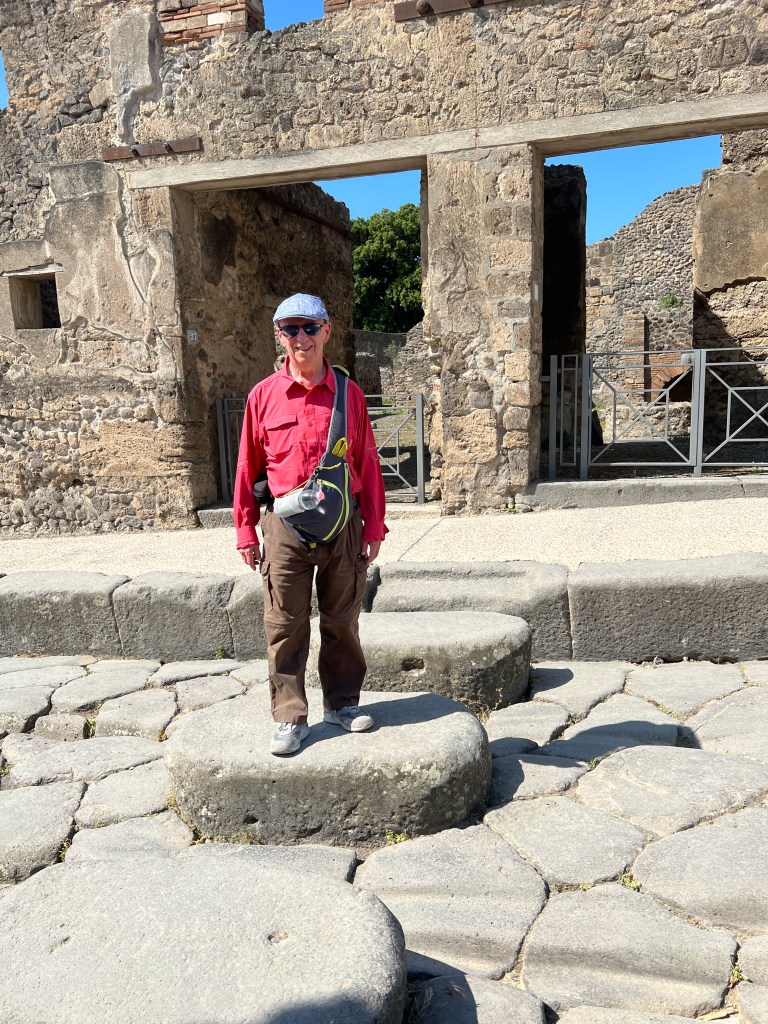
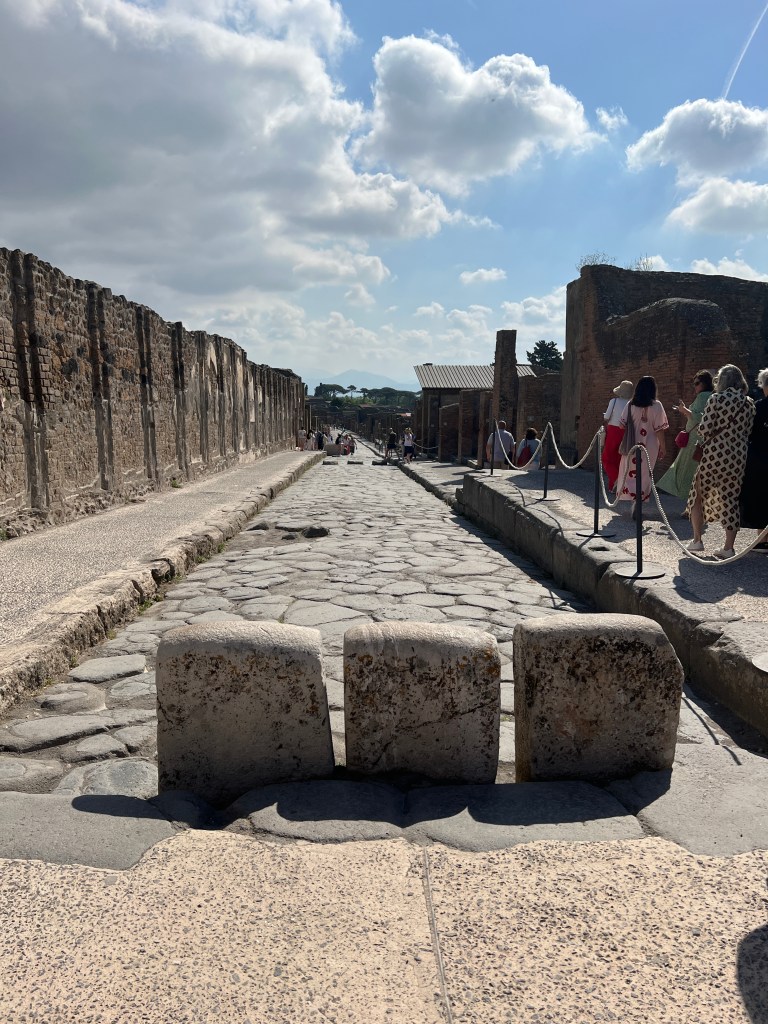
Pompeii had streets with elevated sidewalks. People tended to throw garbage into the streets, but the Romans liked things clean so the streets would be flooded daily. The ground was hard from past volcanic activity and they could not install a drainage system. As a result, the streets would remain very wet. In order to keep the feet of pedestrians dry large stepping stones were placed in the roads allowing them to cross. Chariots and wagons could straddle these stepping stones because all vehicles had standard sized axels. The standard is still used today on vehicles throughout the world.

Dan on walking stones.
Stones stopped traffic for pedestrian only streets.

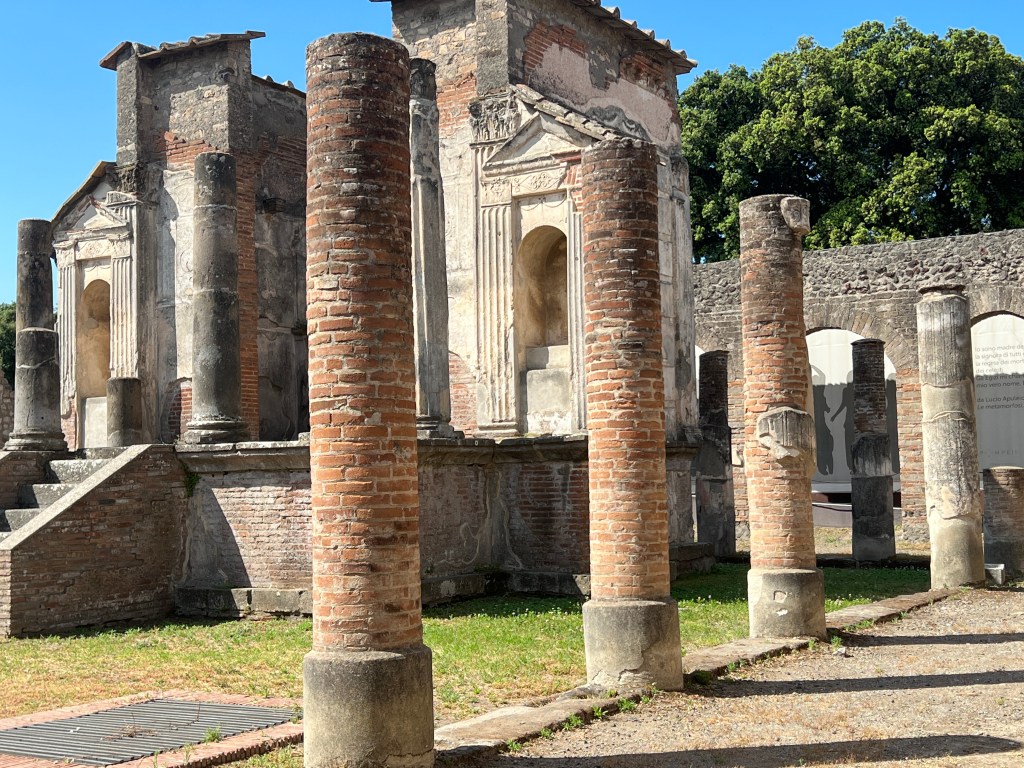
Romans were fairly open minded when it came to religious worship. As long as you bowed down to the Emperor, it didn’t matter what God(s) you worshipped. Within Pompeii is a rare Egyptian temple dedicated to Isis. It is thought to be the only one to be found outside of Egypt.

Remains of Isis Temple
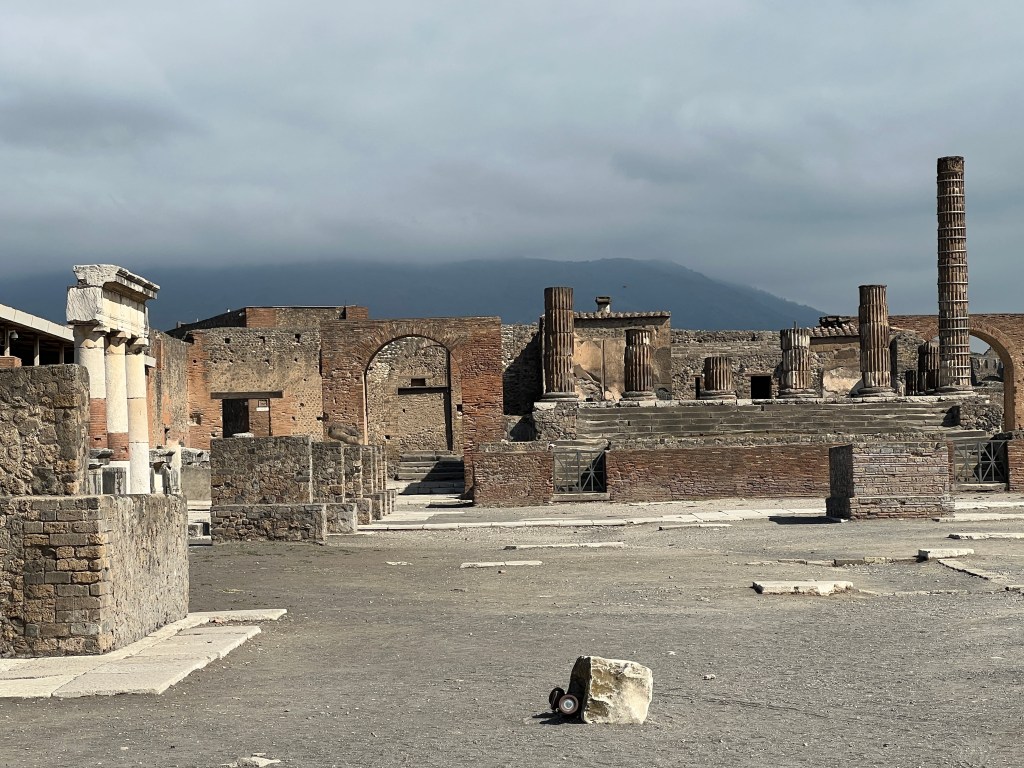
Remains of temples

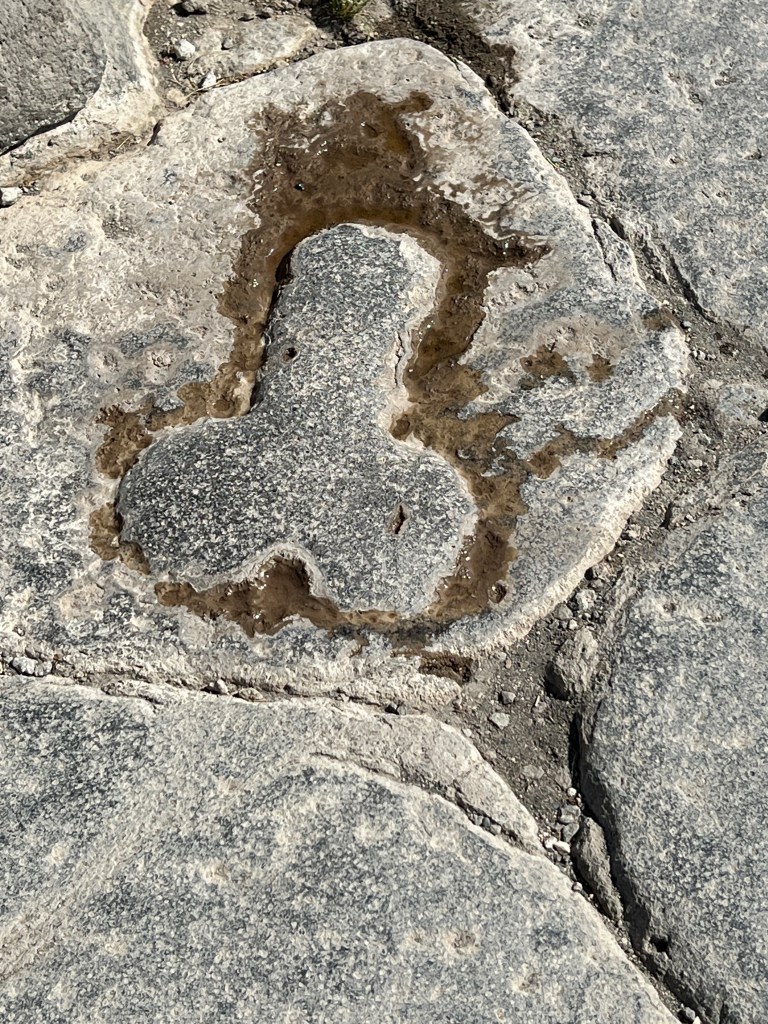
Carved directly into the pavement on the sidewalk was a penis pointing the way toward one of several brothels located in the city. Inside the brothel itself rooms had paintings of what appeared to be a menu of services a customer could pick from. Customers came from all over the Mediterranean and spoke many different languages. These signs would have made it easier for them to communicate their wishes. The pictures were quite graphic.

Penis sign to brothel

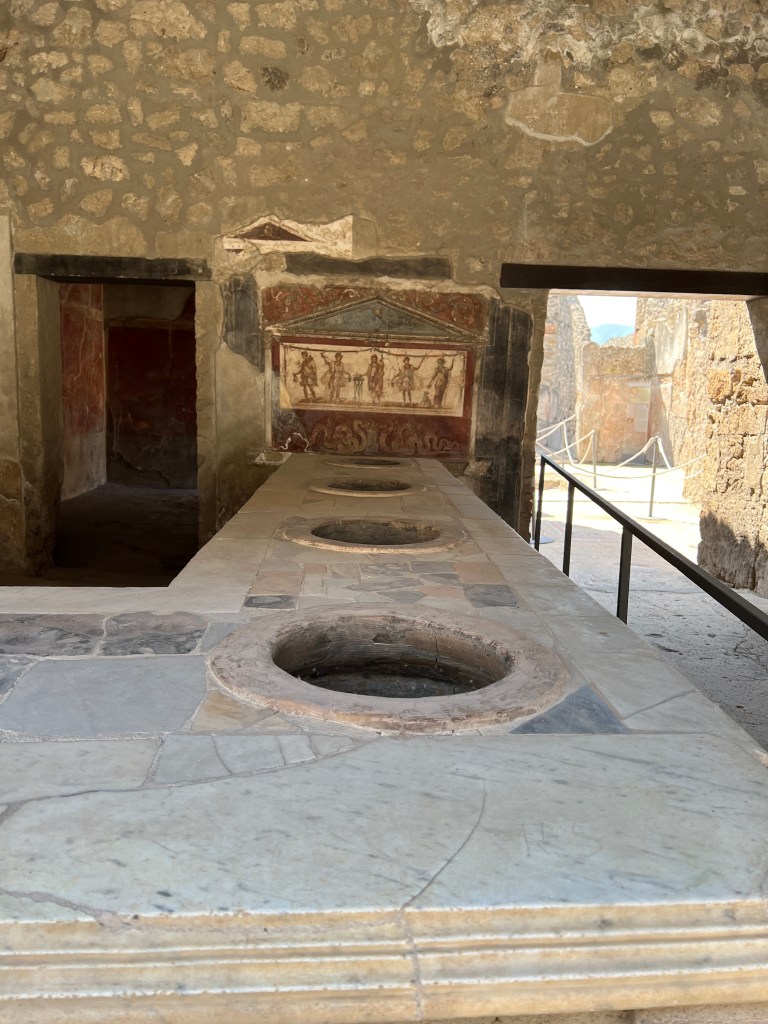
Most Romans didn’t cook for themselves, and certainly visitors required food along with the other amenities the city offered them. Pompeii had over 120 fast food places. Thermopylae were public dining establishments. One can still see the brick counters decorated with marble or terracotta slabs, into which were sunk the jars (folio) containing wine, soup, etc. The pots kept the food and drink hot or cool. Awnings protected diners from the sun. At night accordion style doors would allow these small business to close up for the night. You can see the grooves in the pavement where these doors would slide. Spaces without grooves were probably living quarters.

Roman Fast Food Restaurant

A one hundred mile long aqueduct carried fresh water down from the hills to a reservoir. If you paid extra, lead pipes could be connected to your home or business so that fresh water would be supplied. For the rest of the population, water was available at public fountains located throughout the city. The water would also be used for washing the streets, as mentioned earlier, and for public baths.

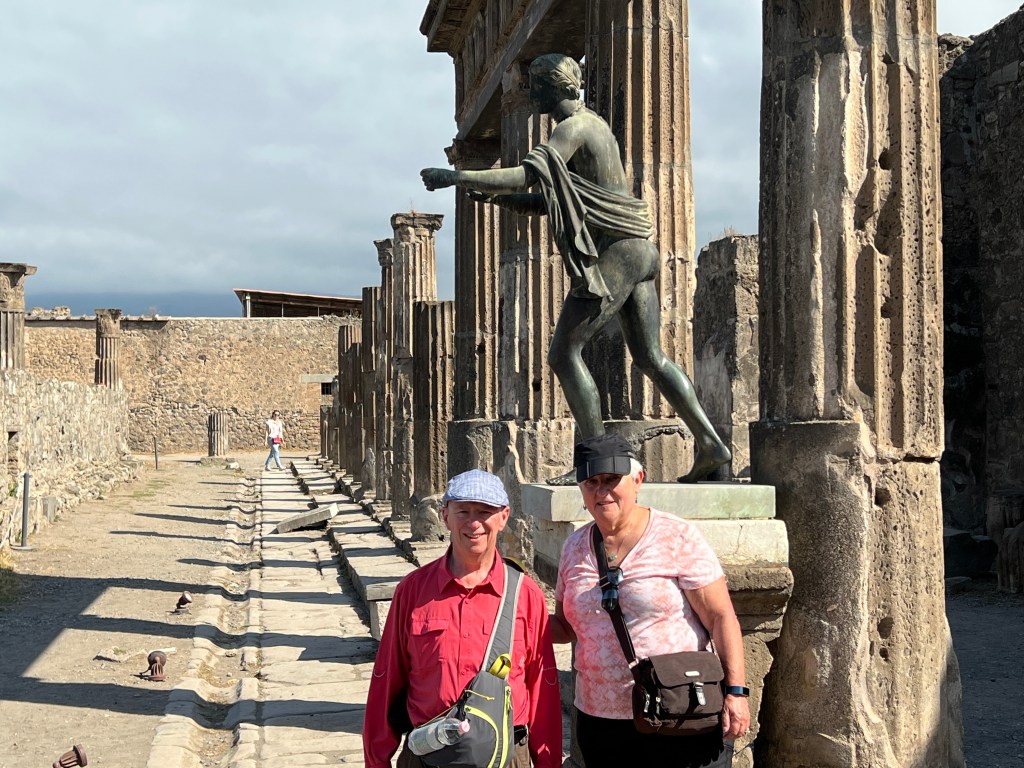
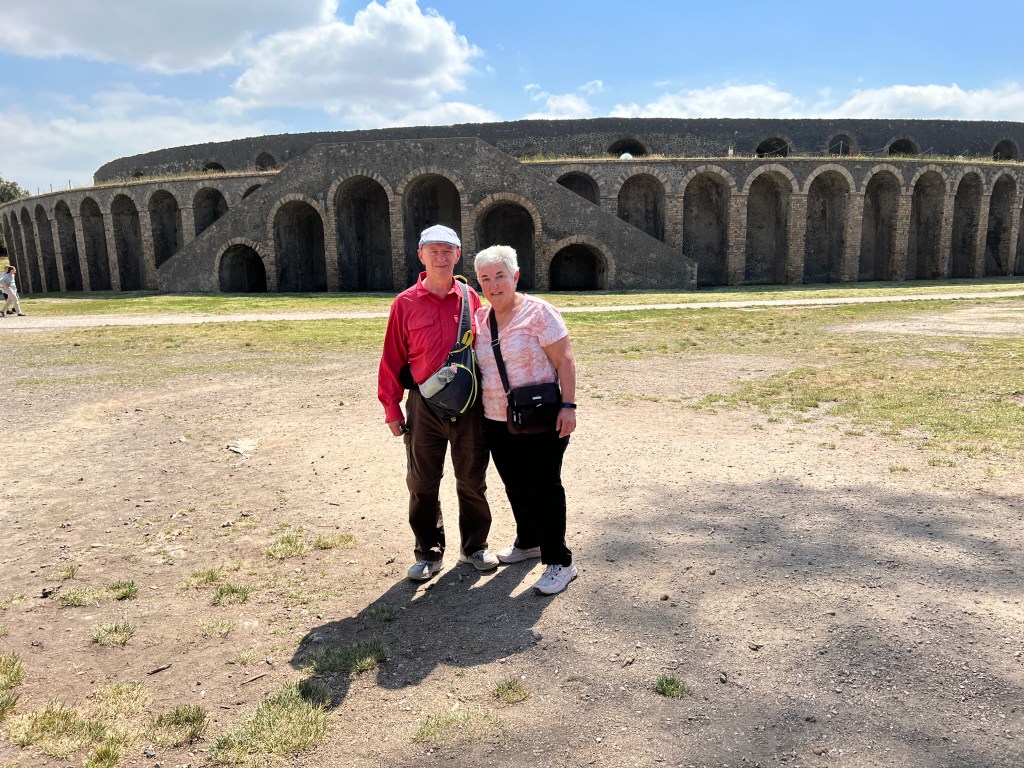
Us in Pompeii

Several homes in Pompeii were those of the wealthy. The most impressive home we saw was the House of the Faun. You were greeted with a mosaic greeting of “HAVE” (hail to you). Inside was a small bronze statue of the Dancing Faun. The most impressive thing, however, was a floor mosaic portraying the Battle of Alexander the Great victory over Darius and the Persians. Both pieces are found in the Archeological Museum in Naples. Another cute touch at some of the homes would be a mosaic of a dog right at the front door. The thought is that it warned a thief that a dog was present.

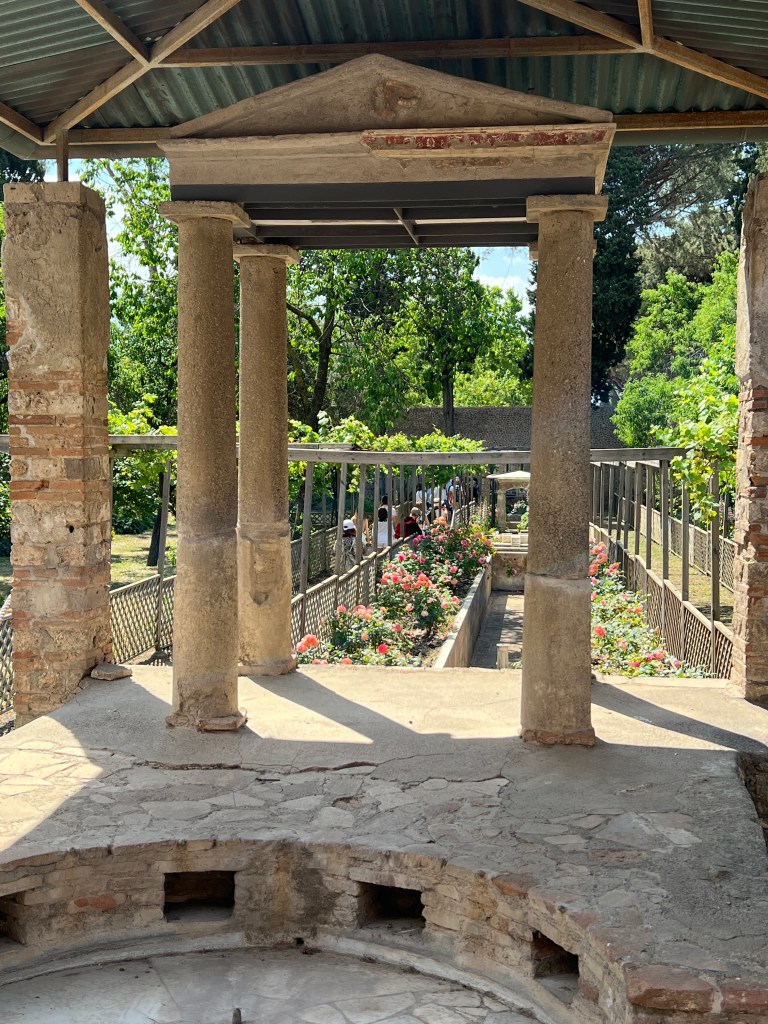
Some wealthy homeowners had beautiful gardens.
Guard Dog

No Roman city would be complete without a theater, amphitheater, and baths. Politicians at the time wanted to please the populace and offered these services for free. They would promote themselves with advertisements sponsored by local businesses. Some of those ads were still visible. Merchants also would advertise their wares with signage. One example we saw was for the sale of wine.

Amphitheater in Pompeii
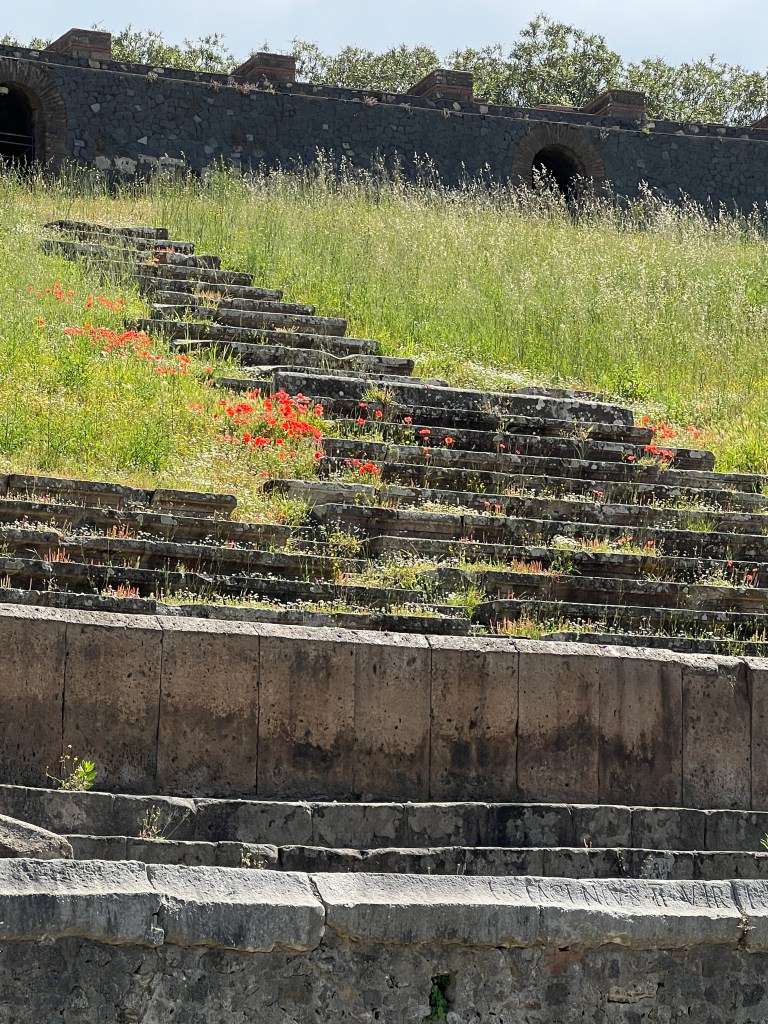
Amphitheater steps among the poppies
Wine merchant advertisement and pricing found in Herculaneum.

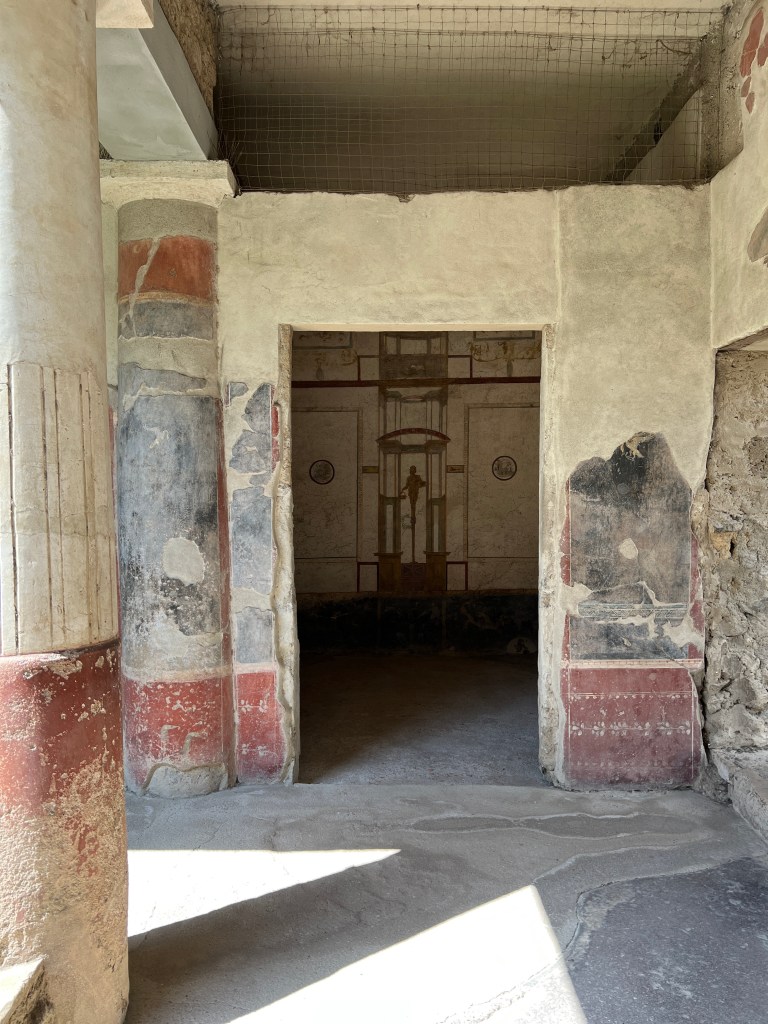
No Roman villas had windows that faced the outside of the home. This was primarily due for security reasons. As a result, much of the artwork found on the walls were done in a style that attempted to give the sensation of openness, since the insides would often be rather dark.

I could go on and on, but I’m already saying too much. After our two hours was almost up, Franco took us to see “the bodies.” You can’t come away from seeing that without an even greater sense of the tragedy that happened here.

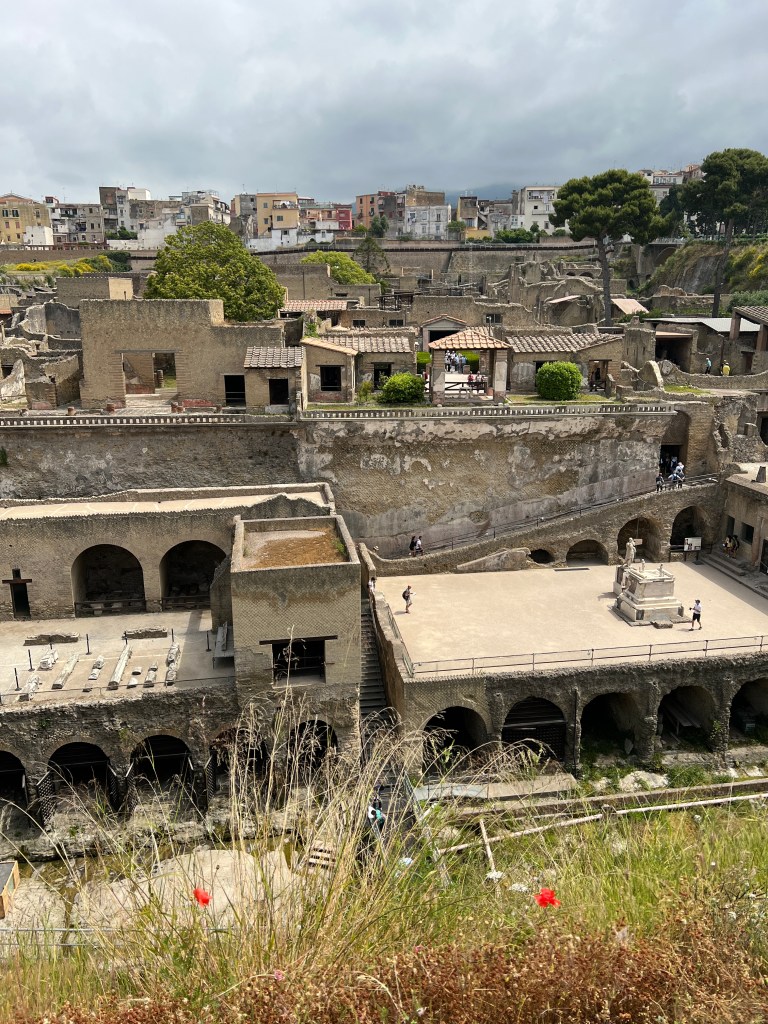
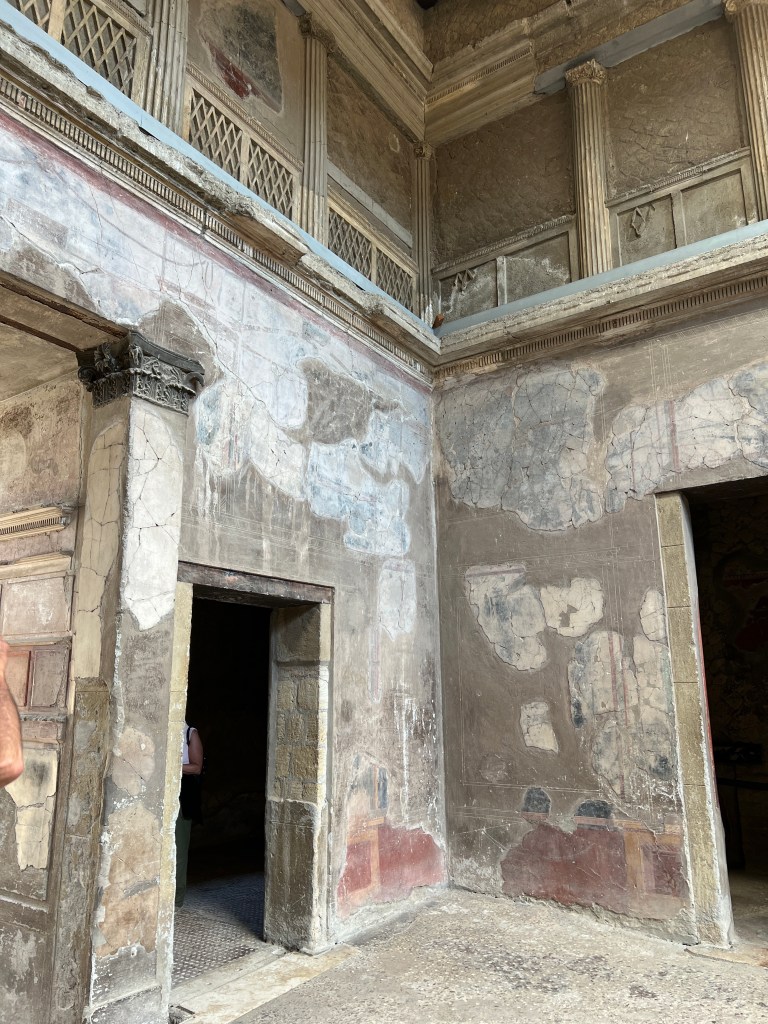
Right on cue we met up with Pasquale and were whisked away to Herculaneum. The signage spelled it. Ercolano. It had been a small fishing town of 4,000 people before being destroyed by Mt. Vesuvius. Several wealthy Roman families built their summer homes in the town taking advantage of being directly on the coast. Although much smaller than Pompeii, the building here are better preserved.

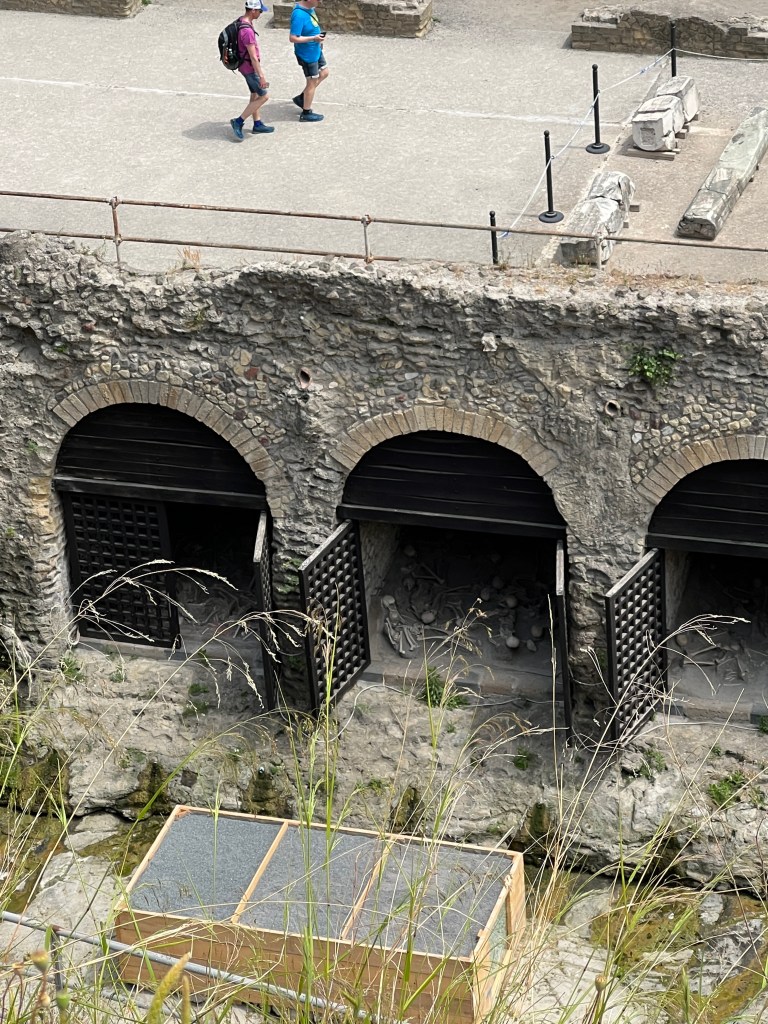
The city was hit with a superheated avalanche of hot gases and ash that would have immediately burned people to death. The town was buried under close to 70 feet of of superheated material. It was originally thought few people died because only 3 skeletons had been found, but that changed a few years ago. Three hundred skeletons were found concentrated in an area where fisherman had kept their boats. People had rushed there hoping to be rescued by sea, but that rescue never came.

Overview of Herculaneum
Area where 300 skeletons were found

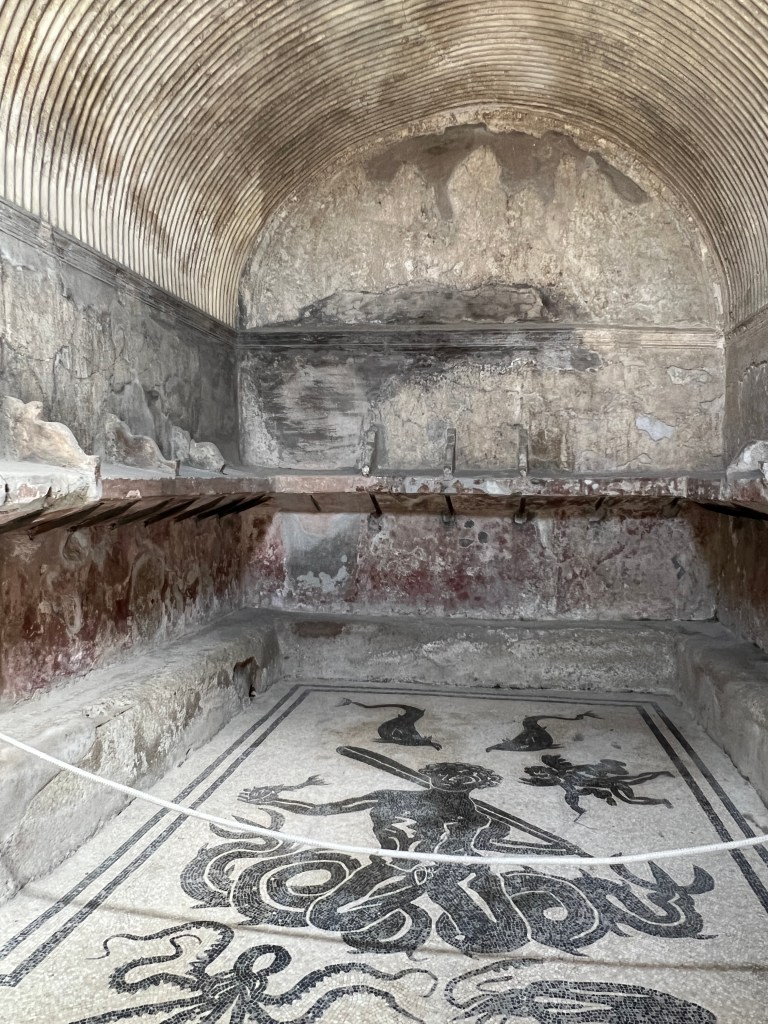
The steam-bath rooms (caldarium) for men and women were interesting to see. There were niches where people would store their clothing. The floor was heated from below. There was the tepidanium where one could take a steam bath, and a Frigidarium where one would take a cold bath. You can also see original wood charred in the disaster.

Beautiful steam room

Franco took us through a number of villas pointing out many of the same features we had seen earlier in Pompeii. While we enjoyed visiting Herculaneum, in all honesty, Pompeii was the more interesting of the two. It was a little repetitive, but worth the visit.

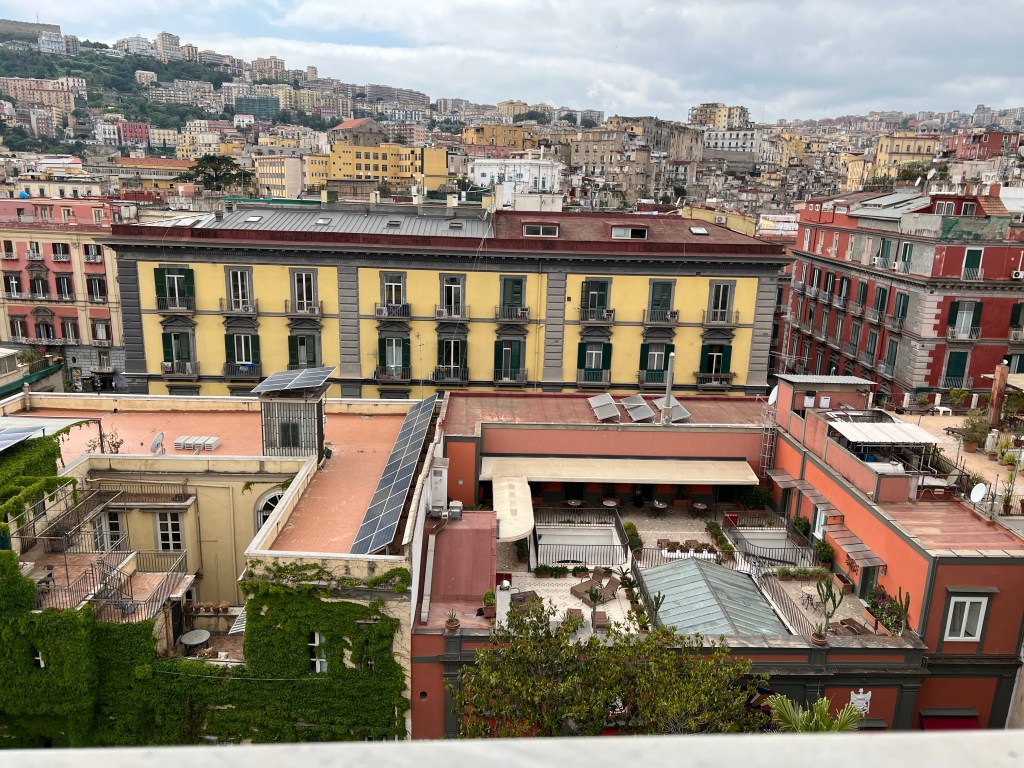
Once again we connected with Pasquale and said our goodbyes to Franco. In about an hour we were in the middle of Naples and dropped off in the middle of a very busy Piazza Bellini, pointing right and left as to where our hotel was located. He had no idea, and neither did we. Fortunately Dan spotted some Cabaneri who pointed us in the right direction. The Hotel Piazza Bellini was just down the street. A freshly remodeled hotel was basic in its decor, but very practical in its built-in cabinets and comfortable. A tiny little window opened up and overlooked the town.

Naples from hotel window

We came to Naples for two things. One was the Archeological Museum, which we plan to visit tomorrow. Secondly, we wanted to eat pizza in the city where it had first been served. So, after checking in we headed out in search of the number one rated pizza place according to a number of different sources, L’Antica Pizzeria Da Michele.

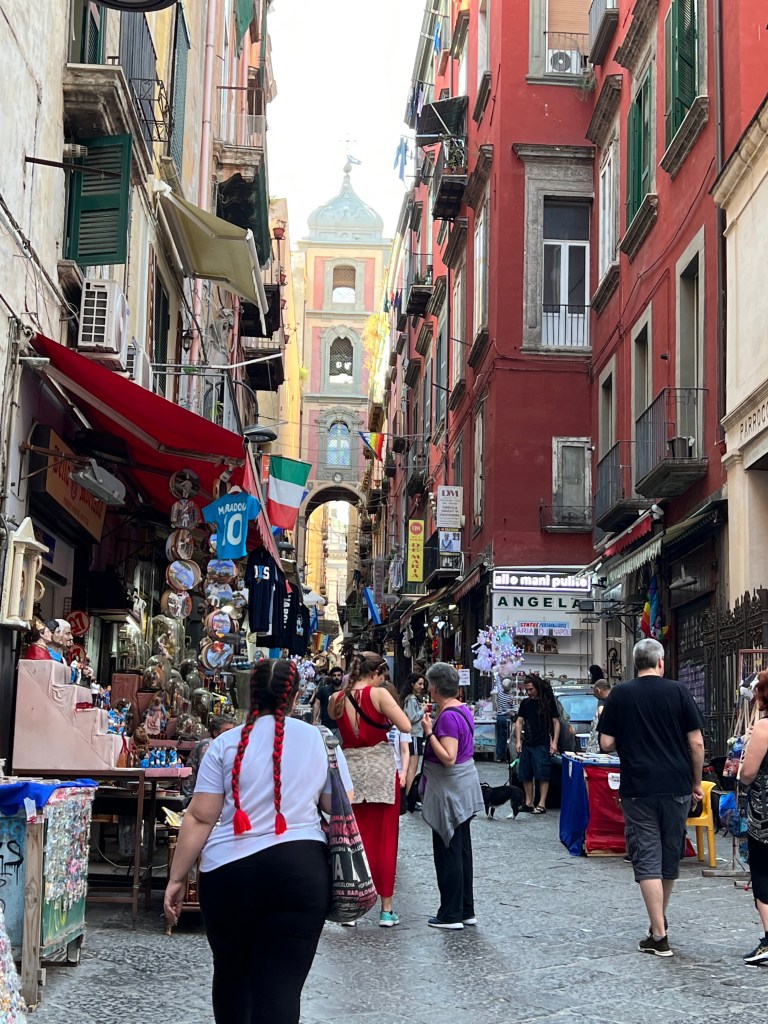
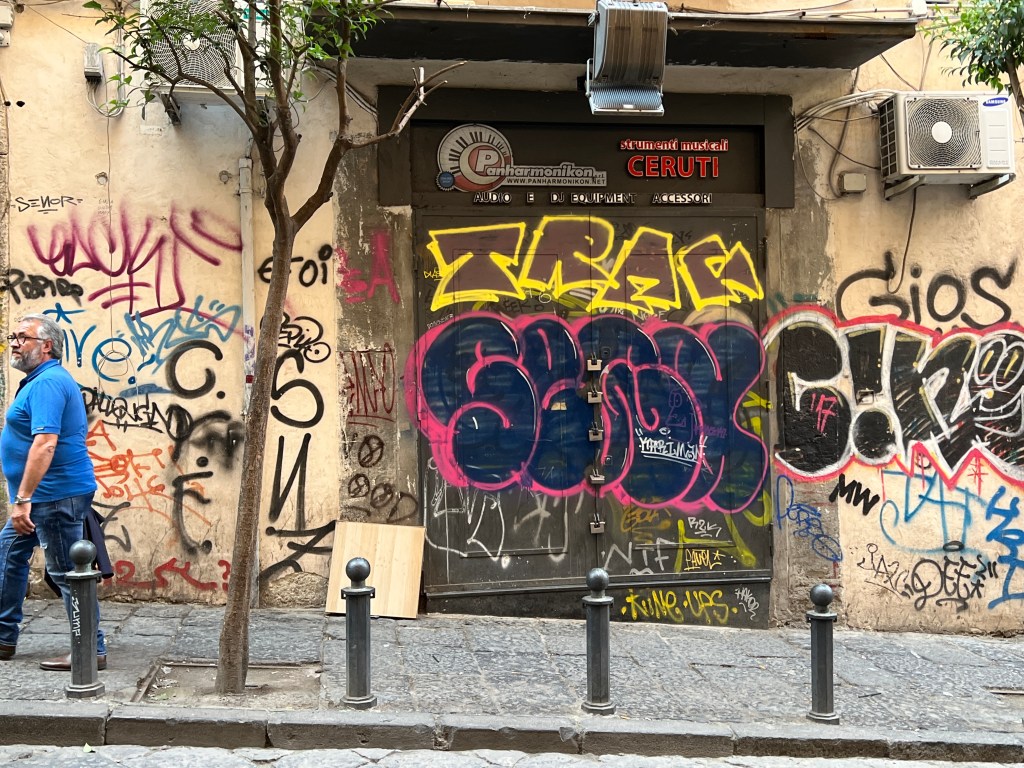
Naples is a gritty city. There is colorful graffiti everywhere, even on churches, and lots of garbage waiting to be picked up. The streets are jammed with people, cars, bikes, and shops, but with very few street signs are visible. Our map was almost useless, but while we were trying to make some sense as to where we were, a young woman took pity on us and offered to take us to the restaurant. She warned us to make certain we left the area before dark because it was known for drug trafficking.

Naples Street Scene
Graffiti

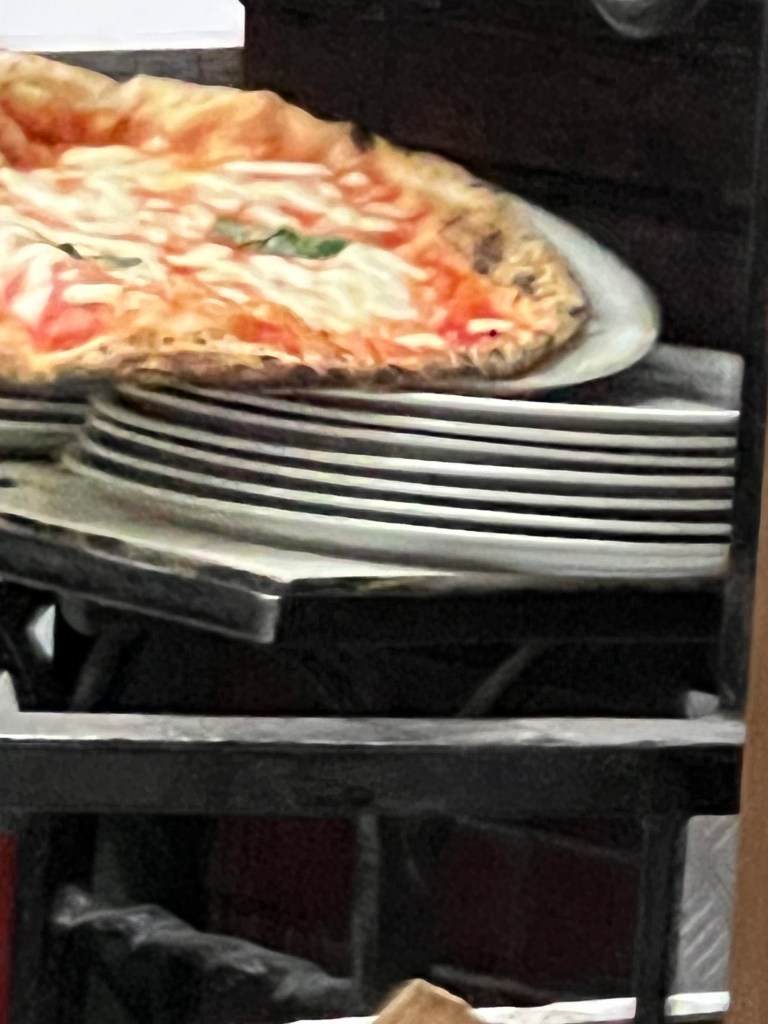
There was a small crowd waiting at the pizzeria for takeout, but we were able to get a table inside after a short wait. The menu was limited consisting only of 4 types of pizzas. We ordered one Marita pizza, which was enough for the two of us. The pizza was fresh out of the oven and very delicious. It is a very simple pizza, but the crust was al dente, and all the ingredients fresh. We liked the Margherita side of our pizza better with its wonderful fresh and creamy mozzarella cheese. To top it off, the pizza only cost 5 Euros.

Menu at L’Antica Pizzeria Da Michele
Marita Pizza coming out of the oven

After our dinner we didn’t waste any time getting back to our hotel. It had been an extremely busy day. Tomorrow we’ll get to see all of the incredible antiquities found at Pompeii and Herculaneum.

1

Day 5 Amalfi Coast

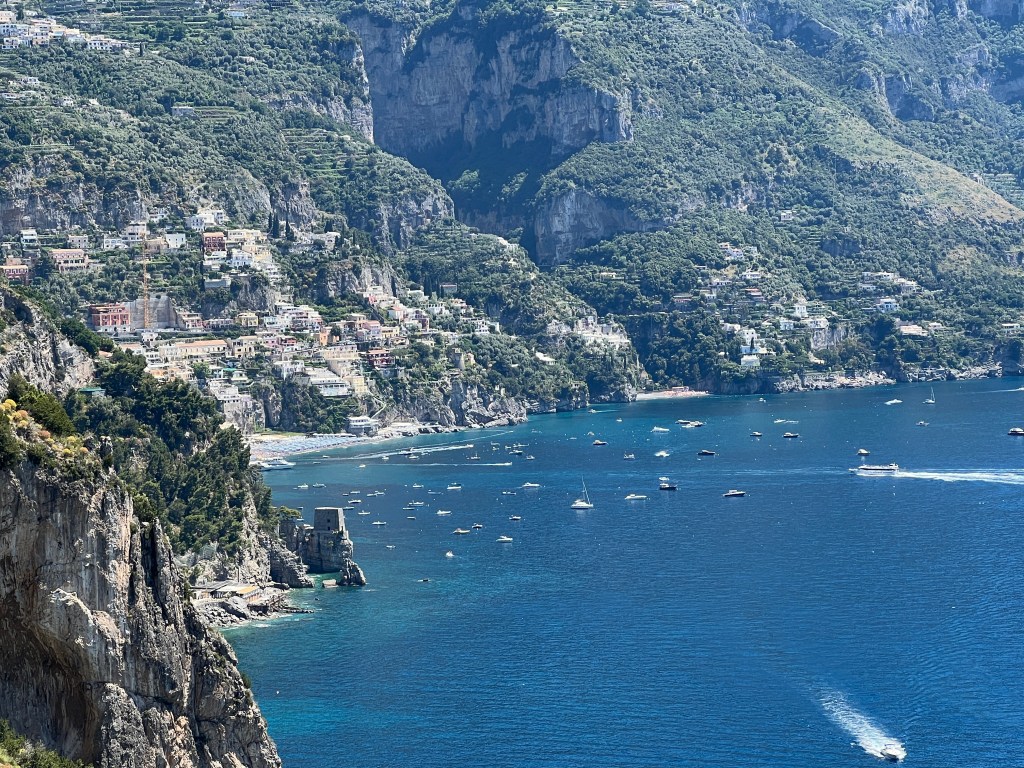
The Amalfi Coast has always epitomized Italy to me.. Whether that stemmed from watching movies like James Bond, I don’t know, but I’ve always wanted to go there. Today Dan and I will be spending the day exploring Positano, Amalfi and Ravello. We were warned to tighten our seat belts for the ride,

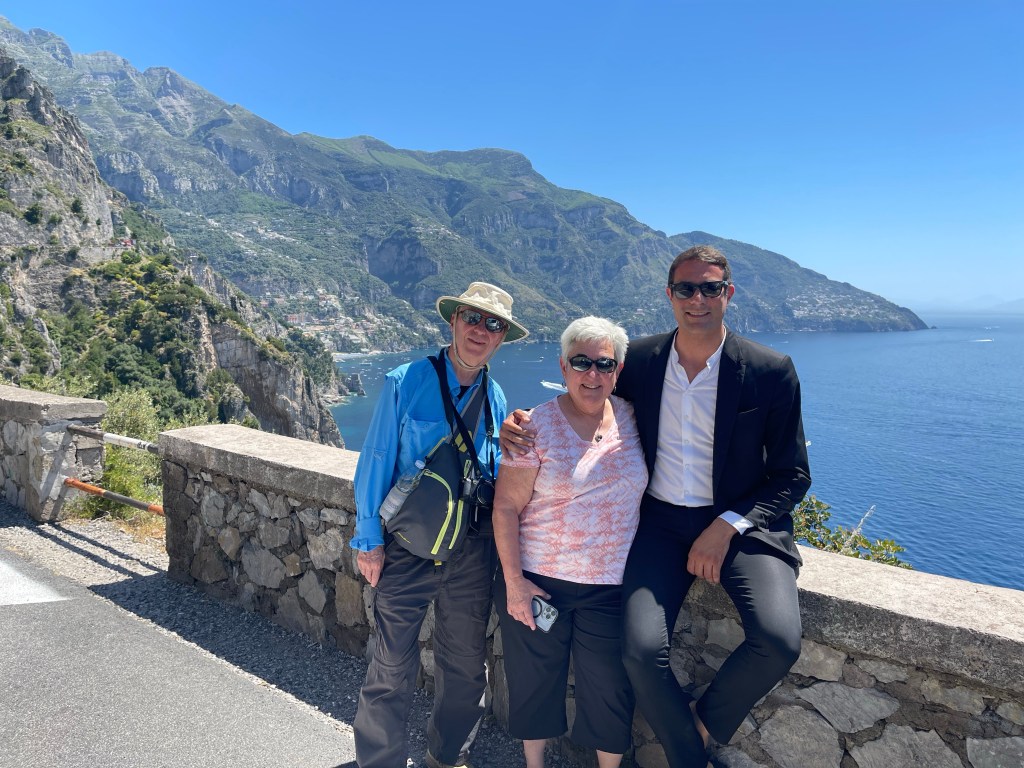
We enjoyed a wonderful buffet at our hotel and met our driver, Alessandro at 10:00 AM. Another charming young man, who also happened to be Italian movie star handsome. Off we went heading toward Positano.

Us and Alessandro

On the way we stopped at a local olive oil processor, Gargiulo. The family processed olive oil for themselves, as well for other olive growers in the region. Gino gave us a personal tour that included the family history, a walk through part of their property, and a tour of their production facility. It was actually a lot more than we expected (or wanted) but it was interesting to learn how olive oil was produced in the past, and why it is even a better product today due to modern technology. Of course we ended up at their store, and purchased several bottles. We ended up shipping them home. It cost almost as much for shipping as it did for the olive oil, but there was no way for us to carry it back with us.

From this point on, the drive was filled with hairpin turns, extremely narrow roads, and spectacular scenery. The sky was crystal clear and the Mediterranean was a sparkling deep blue. Every turn was harrowing, but every turn brought with it another amazing view. Alessandro made several stops for us take pictures, and pointed out sights along the way such as Gladiator Rock, a private island used by celebrities such as LeBron James and Sophia Loren’s home. He once was the personal driver for LeBron James.

Positano was a pretty town perched up on the hillside. It was almost as if it was just hanging onto the cliffs that surrounded it. Alessandro dropped us off and gave us an hour or so to wander on our own. While picturesque, it essentially consists of steep pedestrian streets filled with the same types of stores we had seen in Sorrento, only much more crowded. However, the town in known for its linens and colorful ceramics, and some of those shops offered some amazing products.

After walking down steps and steep inclines we managed to make our way to the shore, where I did my usual ritual of sticking a hand into the water. I got my hand wet as planned, but my shoes made it into the water as well. We then grabbed a quick bite at a caffe located on the Piazza dei Mulini located close the the town’s black sand beach. We also paid a quick visit to the town’s main church, The Church of Santa Maria Assunta with its dome of beautiful majolica tile.

Alessandro then headed up to the town of Ravello that sits 1,000 feet above the sea. This is the town where celebrities such as Richard Wagner, D. H. Lawrence, and Henry Wadsworth Longfellow fell in love with the town and called it home.

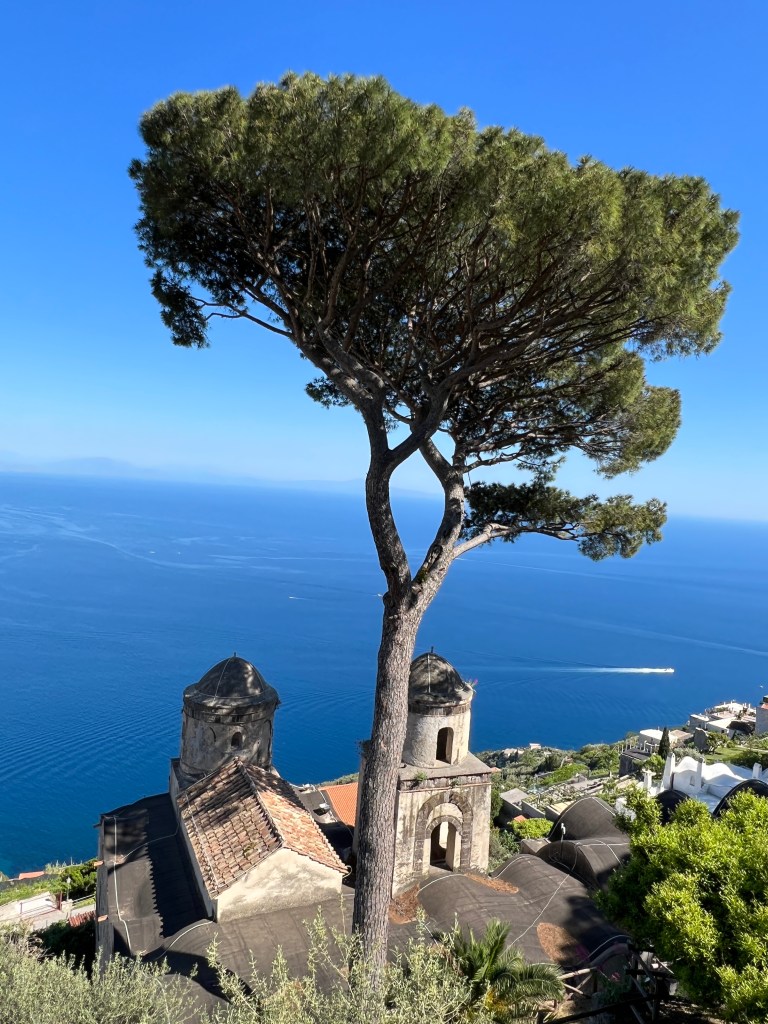
Ravello does resemble paradise in that the views of the Mediterranean are gorgeous. It is a lush green and filled with flowers. However, while it must have been peaceful at one time, it is no longer. It too was jammed with tourists and shops

Ravello’s cathedral overlooks the main square, but we didn’t take the time to go in. We had limited time and decided to head toward the Villa Rufolo known for its gardens. The villa was built upon 13th century ruins. The gardens were lovely and the views worth the price of admission. The annual Ravello arts festival and music society performances take place at the villa during the summer.

Villa Rufolo

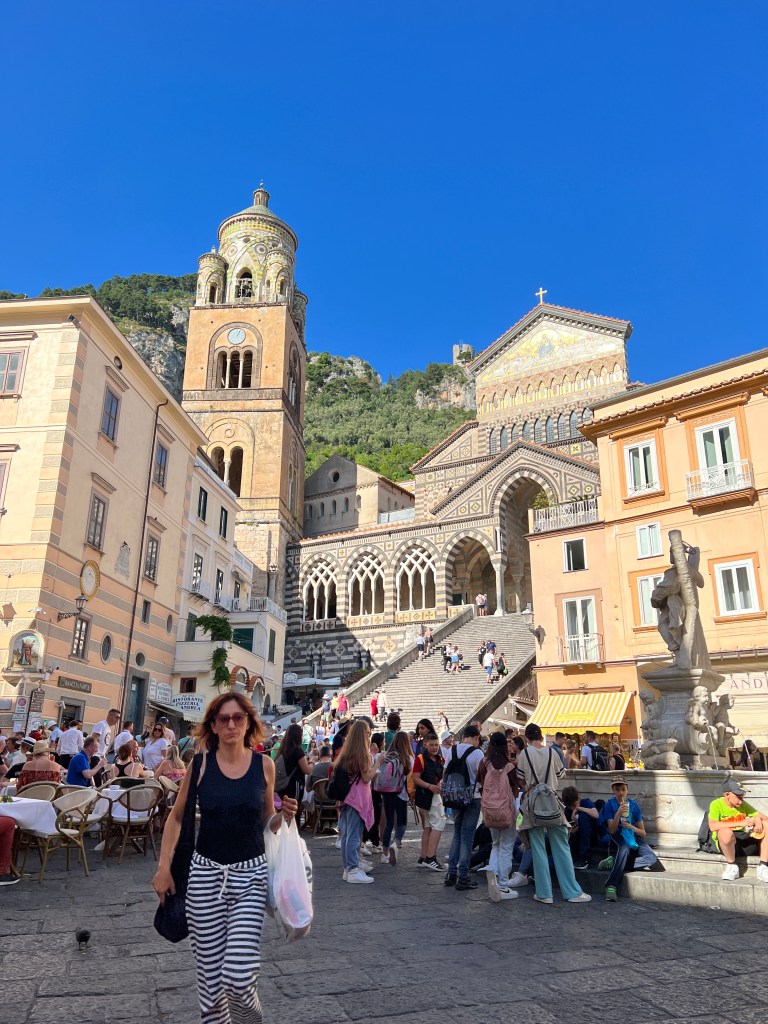
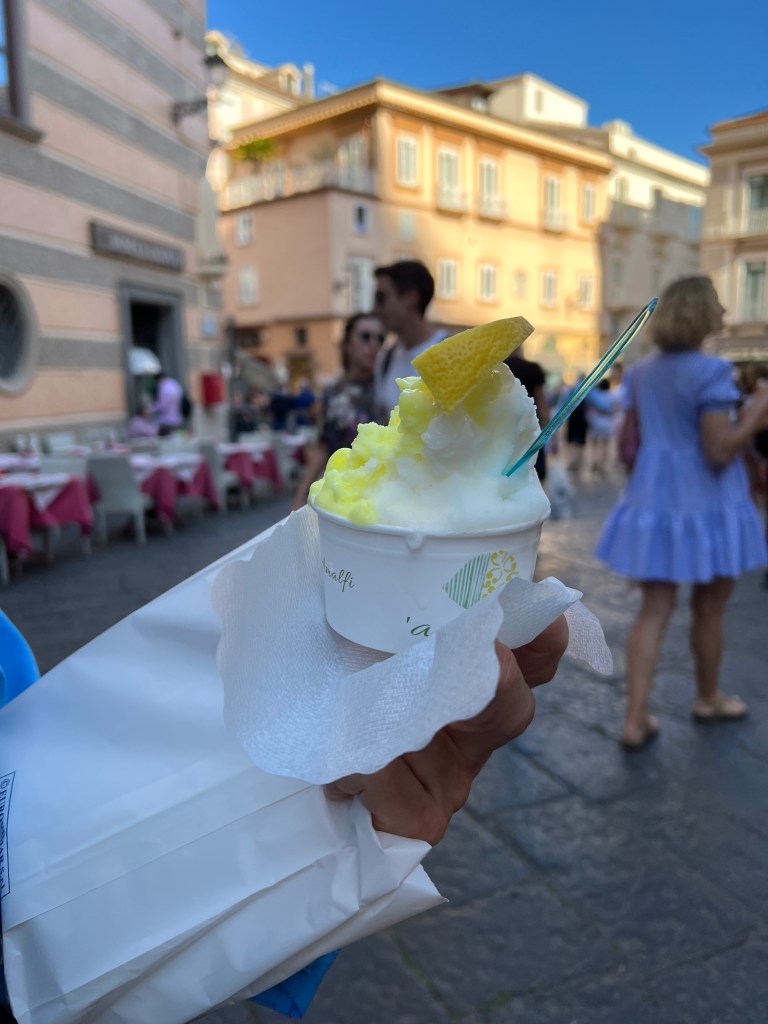
By the time we reached the town of Amalfi, we already knew what to expect. In the 10th and 11th centuries it had been a powerful maritime power. To me it was the least interesting of the three towns and was also packed with tourists. The best thing we did was purchase delicious lemon ice.

It was time to head back to Sorrento. The scenery was the best part of our day trip. Alessandro was fun to be with, and we had met some interesting people along the way, i.e. a group of Israelis. The ride itself is a worthwhile experience, however, Dan and I both agreed that as far as towns go, we liked Sorrento the best.

When we returned to town, Dan insisted we try to find where our boat to Capri was situated, so we would know where to go in the morning. So, despite being tired, we took a very long walk. As it turns out, we discovered an entirely different part of Sorrento filled with Medieval like alleyways, and ended up at the waterfront area called Marina Grande. That is where we had to be in the morning, and it is also where we had a delicious dinner of ravioli stuffed with crab covered in a rich shrimp sauce. The restaurant, Taverna Azzurra, just had happened to have been recommended to us by Alessandro,

It had been a very long day, and we were really happy to get back to our hotel and collapse. Tomorrow was to be spent on and around Capri.

Day 4 Sorrento

One last breakfast fighting off Rome’s aggressive birds and then on to the train station by taxi. It was a bit confusing entering Rome’s Central Station without a clue as to where to go, but we managed to get ourselves on the train to Naples.

We had standard seats, which turned out to be just fine. There was plenty of room to store our luggage without having to lift them onto shelves — Thank Goodness!!! It was a very pleasant trip of about 1 hour. It felt as if we were on an airplane when drinks and snacks were served.

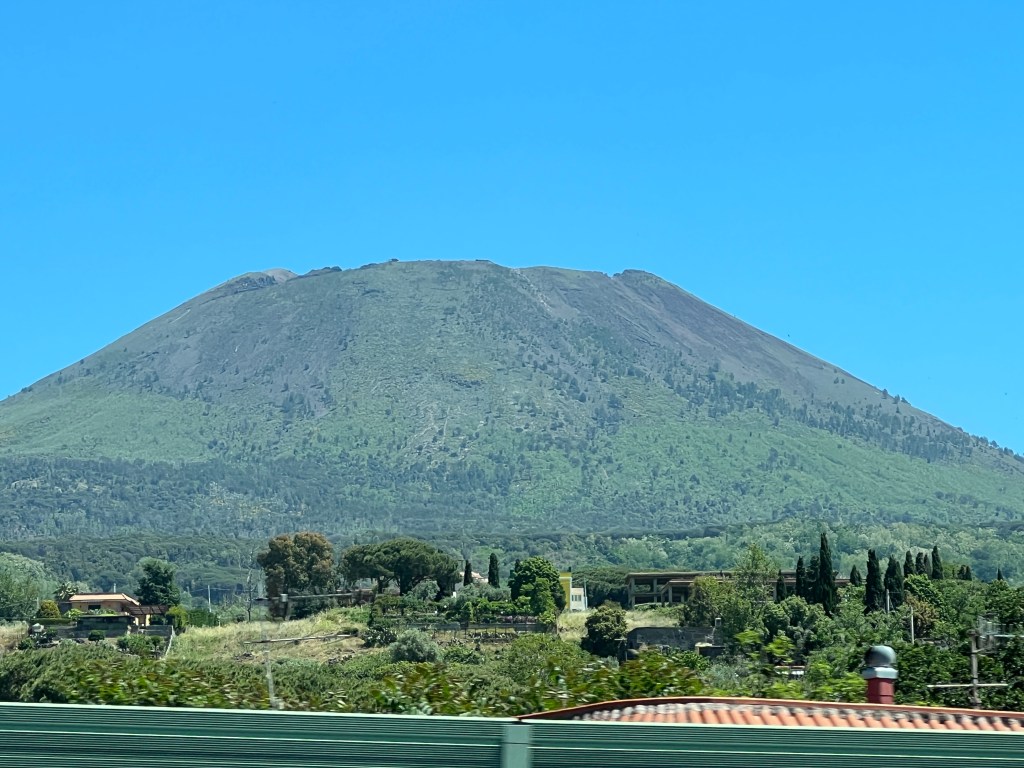
Once in Naples it was easy to spot our driver, especially since he was holding a sign with our ames on it. Just like all of the drivers we’ve had so far, Davide was young and dressed nicely with a sports jacket. As he drove we got our first view of the infamous Mt. Vesuvius looming in the distance.

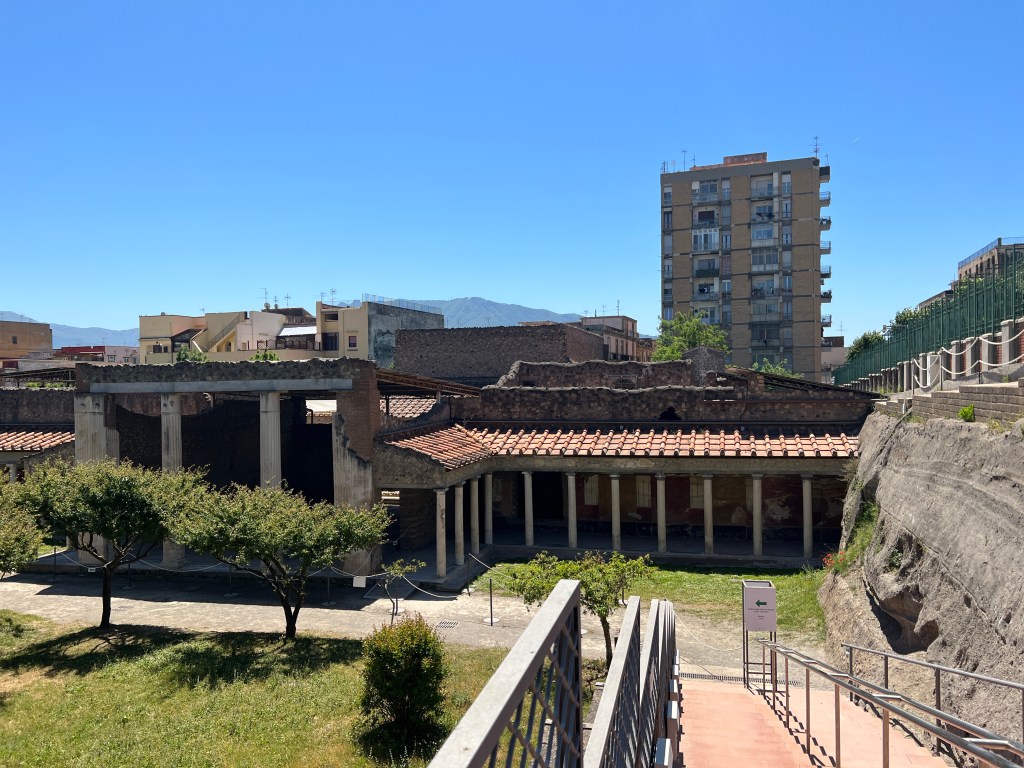
Our driver had been surprised when he learned that we had wanted to go to the Villa Oplontis. It isn’t a popular tourist spot — yet. I had learned about it on the internet when doing research for our trip. It is one of the best preserved villas from the Roman period with much of its colorful painted walls still intact.

Mt. Vesuvius

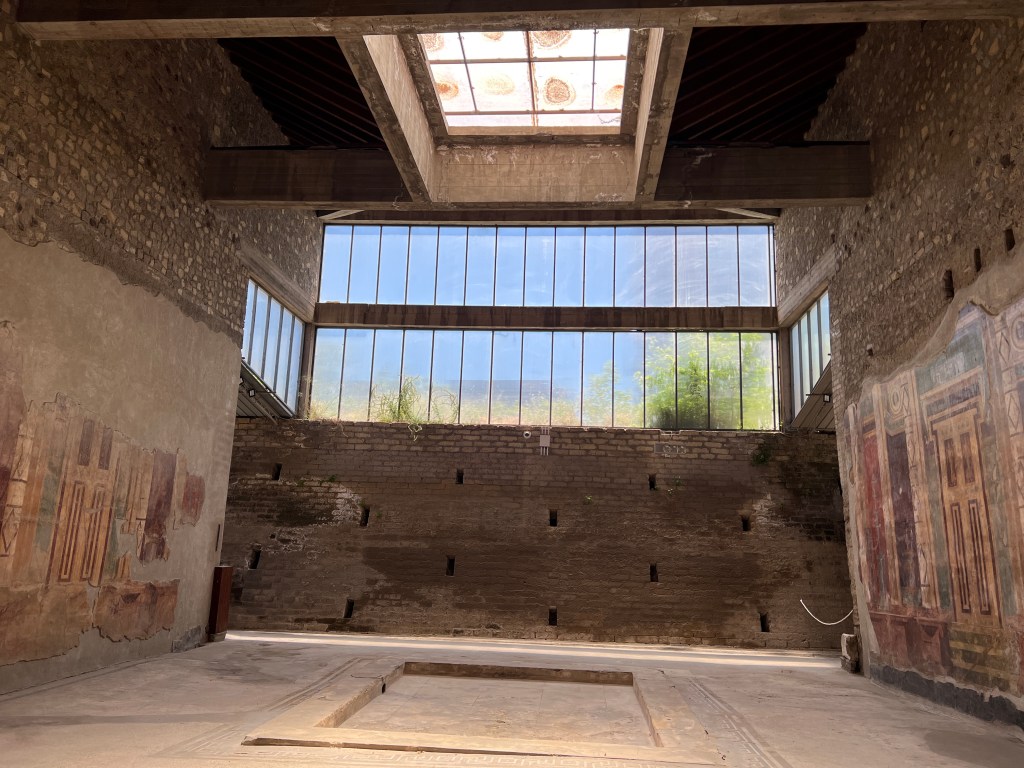
The Villa belonged to the family of Nero’s second wife, Poppaea Sabina. It’s construction dated back to the first century B.C. It now sits in the middle of what now is a rather sad small town, but it was the height of elegance in its time. Just like Pompeii, the Villa had been buried by the Vesuvius eruption in 79 A.D., but most likely no one was home at the time. TheVilla had been undergoing renovations due to a violent earthquake in 62 A.D.

Villa. Oplontis

We were the only visitors and had free reign of the place. It was incredible that so much of it survived, with the exception of the roof. The place was sprawled out like a massive ranch home with too many rooms to count. All of the floors were covered in mosaics or stone, and all of the walls and columns at one time had been colorfully painted. Much of it could be seen today. Some of the rooms were enormous in size, including several courtyards. The home had indoor plumbing for its numerous fountains, drinking water, bathing, bathrooms and large outdoor pool. At one time it must have also had beautiful gardens.

The only downside on our visit was that there were no tour guides and it was difficult for us to know how many of the rooms had been used. Some rooms were labeled, but we didn’t know what was meant by the word Triclinium or Calidarian. We will have to do some research when we return home.

After about an hour we hopped back into the car and headed to Sorrento. Our hotel, Antiche Mura, sits on the edge of a crevice splitting Sorrento into two, and very near the main square. It was a perfect location in that it was close to the center of town, but quietly tucked away on a side street. The grounds were lovely, and were filled with lemon trees and other beautiful plantings.

Once settled, we ventured out into charming Sorrento and saw it’s beautiful coast line. As to be expected the town was filled with shops and restaurants, including the usual limoncello stores. We selected a restaurant that appeared to be popular, Taverna dell’ 800, and enjoyed pasta dishes made with local seafood. The pasta has been very good everywhere we have eaten, and is always cooked al dente. It was another wonderful day in Italy. Tomorrow we head for the Amalfi coast.

Day 3 The Colosseum, Roman Forum, and Palatine Hill

We began the morning with a lovely breakfast at our hotel. It was a beautiful buffet that included some wonderful pastries, which we enjoyed on a small outdoor patio. One lesson we learned is that Roman birds are as aggressive as Roman drivers. If you left your plate unattended they would swoop down and carry some of your breakfast away. Fortunately there was enough for everyone.

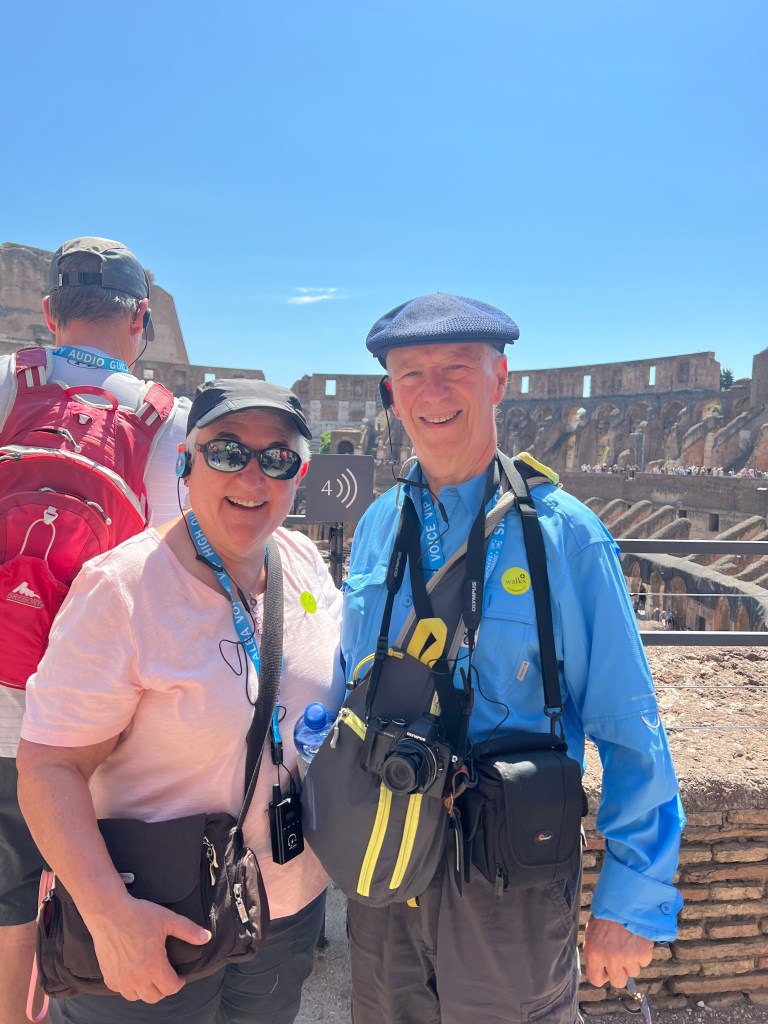
Today we didn’t waste time trying to walk to our tour on our own. It was so much easier to simply have the hotel call us a taxi. Our tour guide was a very knowledgeable and animated Italian woman. The Colosseum was built at the peak of the Roman Empire’s power, in 80 A.D., and could hold 50,000 people. One major event it was used for were wild animal fights. It gave the audience a chance to see lions, tigers, giraffes, elephants and other exotic animals from all over the Roman Empire. This spectacular performance was a demonstration of Rome’s power.

As for the gladiators, many fought and died, but many fought and survived. People would root for their favorites, and it wasn’t good business to kill off one of the celebrities. The Emperor was too small for him to simply give a thumbs up or down as shown in the movies. Instead it was the crowd that determined who won or lost by how loudly they yelled.
Colosseum

Our guide explained how the colosseum was built, materials used, where people were allowed to be seated based on status and sex, and so much other information I’m afraid I’m too tired to report on details. Only about a third of the building still exists due to earthquakes and people simply carting off parts of it to build other buildings. What is left, however, is truly amazing.
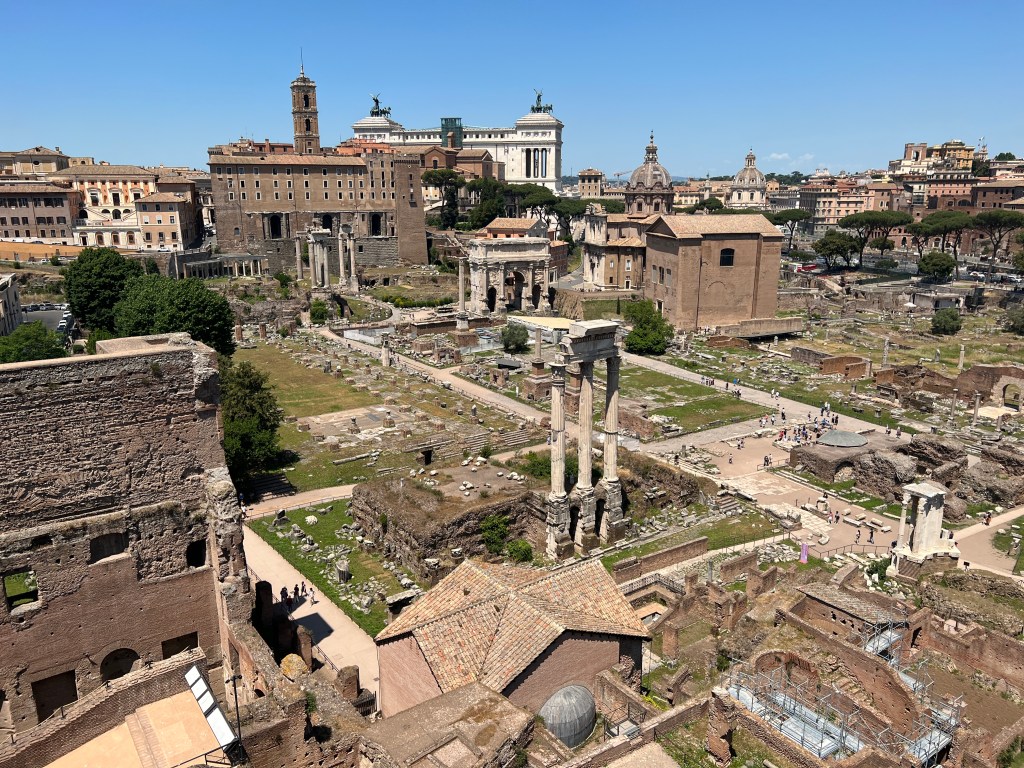
Our next top was the Roman Forum and Palatine Hill. To be honest I was surprised by how large the area covered given that Rome is such a large growing city. However, I do know tourism dollars spent to see these incredible sites must be huge. Back in 1970 when I visited as a college student, I paid nothing to enter. That is no longer the case.

Forum

There are so many arches, temples and other buildings that it is too much information for me to process in this blog. A few things did stand out to us. The Arch of Titus commemorated the Roman victory over the province Judaic (Israel) in 70 A.D. Once defeated the Israelites were supposed to worship the emperor as their g-d, but the Israelites believed in one G-d and refused. The Romans then destroyed and plundered the Temple.

Menorah on Arch of Titus

The Temple of Vesta was the only place in the forum where people lived. Those people were the seven Vestal Virgins. They tended a flame that was never to go out. The burning flame insured that Rome would never fall. They were selected for their beauty between ages of 6 and 13, and served for 30 years. If one were found not to be a virgin, they would be buried alive.

Lastly, was the Temple of Julius Caesar, where Caesar’s body was cremated, The area was not much to look at, but interesting in itself. Just 13 years after he was stabbed to death for attempting to become Rome’s 1st emperor, his son was named Emperor Augustus. In dedicating this temple in the name of Julius Caesar, Augustus helped make his father the first Roman to become a god.

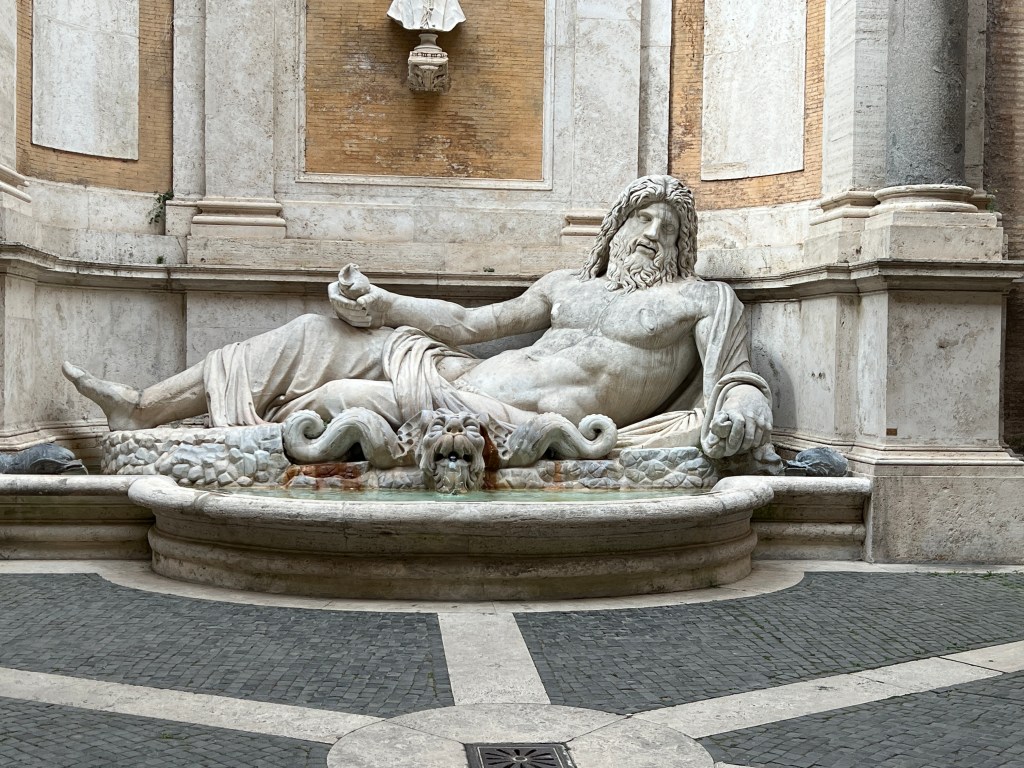
In order to kill some time before our next activity, Small Group Food Tour, we headed over to the enormous Capitoline Museum, that houses an incredible array of ancient statues, mosaics, etc. Some statues were amazing in their details and in their size. Once again we were museumed out, but bided our time until 6:00 when we were to meet our foodie group.

Anastasia collected us a the Piazza Farnese along with another 10 people. Our first stop was at Rucceri’s, a shop that specialized in meats and cheeses. We sampled olives, salami, and some other delicious tidbits. Anastasia then took us through a beautifully painted “secret” shortcut between the streets that led to Rossioli’s, where we tasted two kinds of Roman pizza. The next restaurant was located in the former Jewish ghetto, The Taverna del Ghetto. Here we tasted fried artichokes, rice balls, and white wine. Already full, the tour kept on going. Our next stop Sette Oche in Altadena was across the Tiber River in the Trastevere neighborhood. We were served two types of local pasta dishes: one with pepper and parmesan cheese, and the other with a light red sauce, parmesan and bacon. Of course, we also enjoyed some more wine, this time red. Now almost too full to walk we had gelato at Fior di Luna. Did you know that the best gelato should not be overflowing. If it is there is too much air in it. Also, if the store advertises with the word “genuine” gelato, you should keep on walking. It is unnecessary to state that fact.
Fried Artichoke and Rice Ball
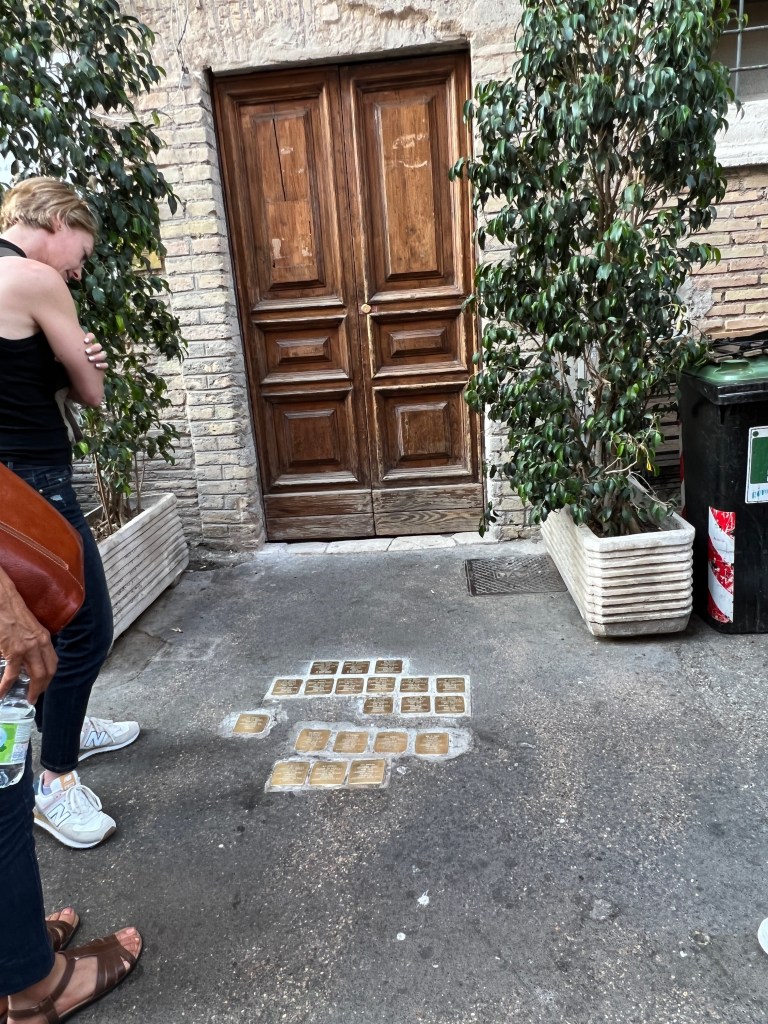
Markers showing names of Jews that had lived in the building and had been deported to concentration camps.

Side Note: From the 16th through 19th centuries Jews or Rome lived in a cramped ghetto area near the Tiber River. Few Jews live there now, but the Synagogue is there along with a Holocaust Museum. There are small metal markers in front of buildings commemorating the names of people that had lived in those buildings and had been deported by the Nazis.

Our gastronomical experience now over, (it was quite wonderful), we grabbed a taxi and headed back to collapse at our hotel. Tomorrow we head to Sorrento.

Day 2 in Rome

Our room is very comfortable, but neither of us slept well last night. Part of jet lag I presume. Our “Pristine Sistine Early Entrance Small Group Vatican Tour” started at 7:00 AM and we took a cab to reach the starting point. Dan and I are not early birds, so this was particularly challenging for us. It was too early for the hotel breakfast which started at 7:00 am, but they packed us enough food for 4 people. In fact, we shared some of it with our taxi driver.

We arrived on time and enjoyed chatting with everyone in our group. Our tour guide, Davide, gave us an overview of our tour and he then explained that the tour no longer included St. Peter’s Basilica. Instead he would take to other areas of the Vatican Museum. WHAT! Sure we wanted to see the Sistine Chapel, but St. Peter’s was also on our bucket list. Davide explained that they no longer allowed early entry to the Basilica and there was no way they could run the tour not knowing if it would take 40 minutes or 2 hours to get in. What could we do at that point other than go along with him.

Our guide was very knowledgeable about the artwork we saw, and gave a very thorough lecture about how Michelangelo was chosen to paint the Sistine Chapel. Originally Raphael thought he was going to be given the position, as he was known as being the best painter of his time. Michelangelo was known as an archiitect and sculptor, but he was not a painter. Everyone thought that when Michelangelo was offered the position he would turn it down and that it could then be given to Raphael. However, Miehelangelo surprised everyone and accepted the offer. It is said that when Raphael saw Michelangelo’s work he was overwhelmed by its power and beauty, and that he copied some of Michelangelo’s techniques and styles into his own works.

The collection of Greek and Roman sculptures was quite amazing, but many did not seem to fit the Roman Catholic point of view. Granted I’m no expert on Catholic theology, but I don’t think room after room of naked people easily fits into religious thinking. Many of the male figures had their penises chopped off or were covered by fig leaves. That included a beautiful piece of Apoxyomentos. The original was created by Lysippus around 330 BC. This one, however was a Roman copy made in 1st century AD.

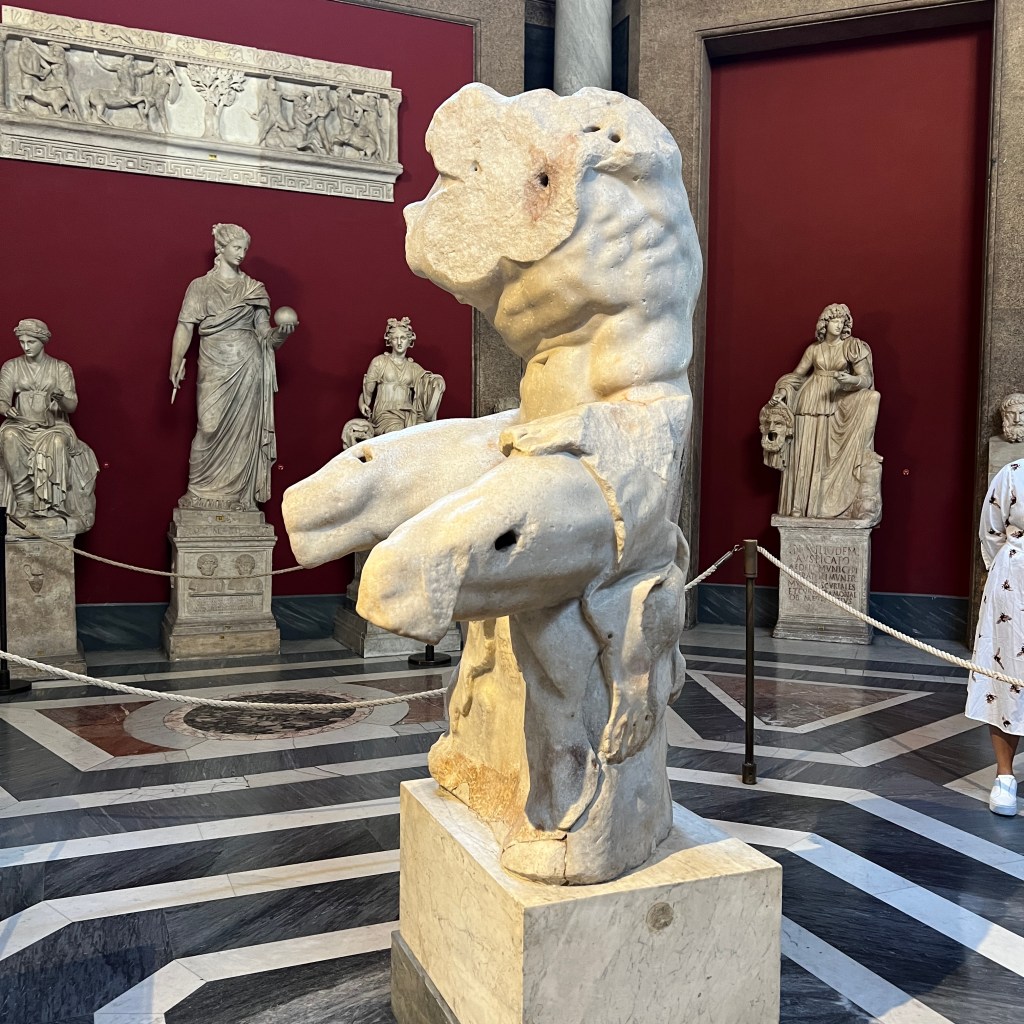
The Belvedere Torso was also quite remarkable. It has been documented since the 15th century. As ancient as it is, it too is considered to be a replica. The original was said to have been created in the 1st century BC by the Athenian sculpture Apollonius. It’s thought to be of the Greek hero Ajax Telamonius contemplating suicide. I immediately thought of Rodin’s The Thinker. As it turns out he was greatly influenced by this piece.

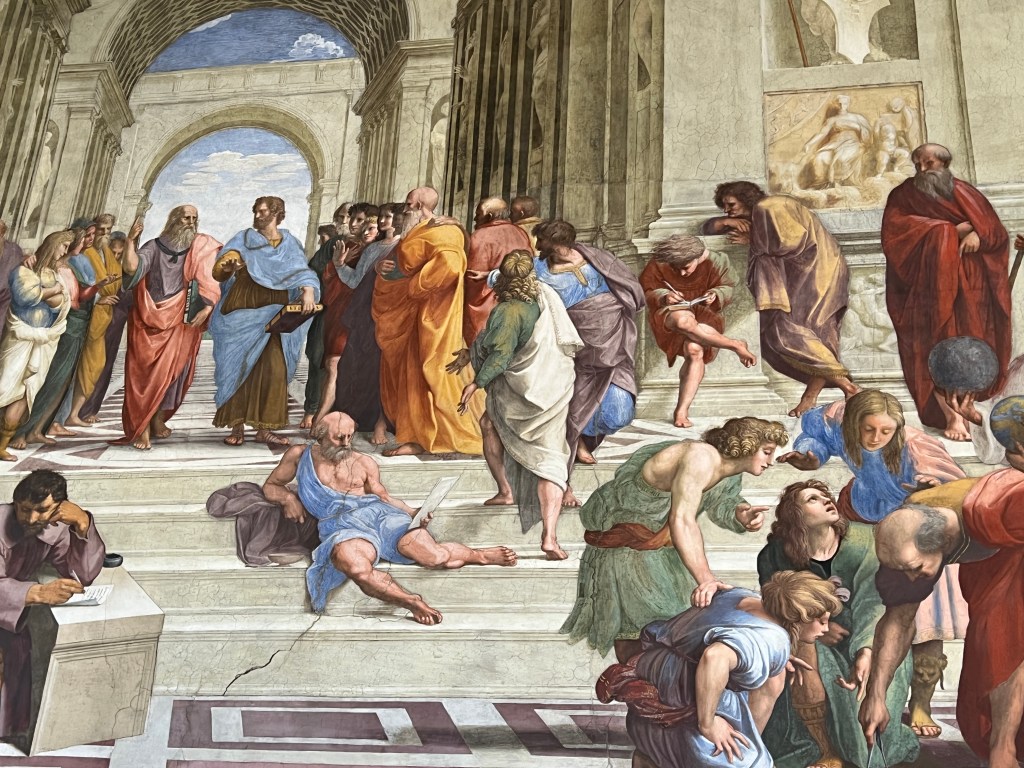
The most impressive paintings I thought were those in the Raphael Rooms. Four connected rooms were covered with Raphael’s work. They were commissioned in 1509 by Pope Julius II. It was being painted at the same time Michelangelo was painting the Sistine Chapel. The most famous of them is “The School of Athens.” Raphael actually painted Michelangelo into this work, along with his own self portrait.

Room after room, after room, hallway after hallway, and then more rooms, we finally got 20 minutes to view the Sistine Chapel. It is amazing seeing it in person. It truly is a sacred place, No photos were allowed. Before we knew it, our 20 minutes were over. Afterwards, Dan and I decided to leave the tour. We had reservations to visit the Borghese Gallery and were getting overwhelmed with the volume of artwork at the Vatican Museum.

Before leaving Vatican City, Dan and I went to see the massive St. Peter’s Square. It is very impressive. It is there that people were lined up to visit the Basilica. The line was very long, so we had decided we would just have to accept the fact that we would not be visiting St. Peter’s.

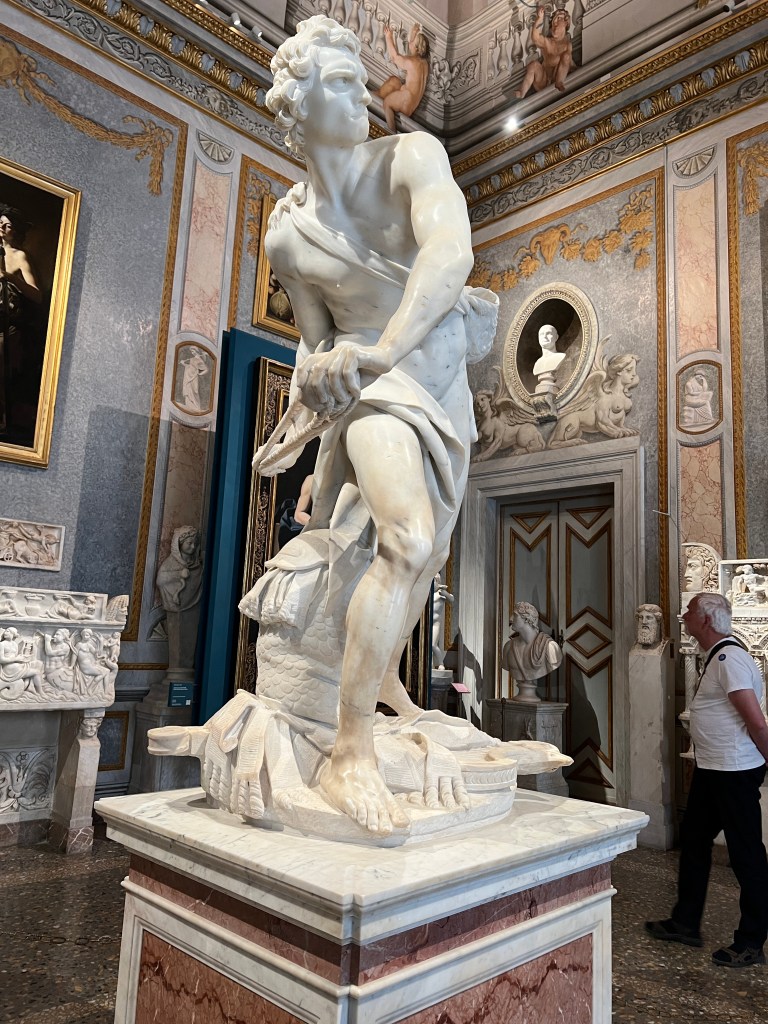
We took a cab to the Borghese and arrived about 45 minutes early. That gave us a few minutes to relax in the Borghese Gardens. We also had time to get a snack in the Gallery’s cafeteria. Once again we were gazing at statues, but these were incredible: Gian Lorenzo Bernini’s David; Apollo and Daphne; and Enea, Anchises and Asanius. Of course there was more to see and we tried, but after a while we simply were museumed (our own made up word) out.

Despite being tired we managed to walk back to our hotel. It was a lovely walk through the Borghese Gardens and back through Rome’s twisting streets back to our hotel. Once again we relaxed for a few hours. We then headed to the lively neighborhood of Trastevere for dinner at Evo where we finally tasted some of Rome’s specialties including Parmigiano di melanzane con creosote di buffalo (eggplant parmigian) and Casio e Peppe. Quite delicious. Well sated, we headed back to our hotel.

APOXYOMENOS
BELVEDERE TORSO
RAPHAEL’S SCHOOL OF ATHENS
MICHELANGELO IN
RAPHAEL’S SCHOOL OF ATHENS
BERNINI’S DAVID