
July 4, 2025
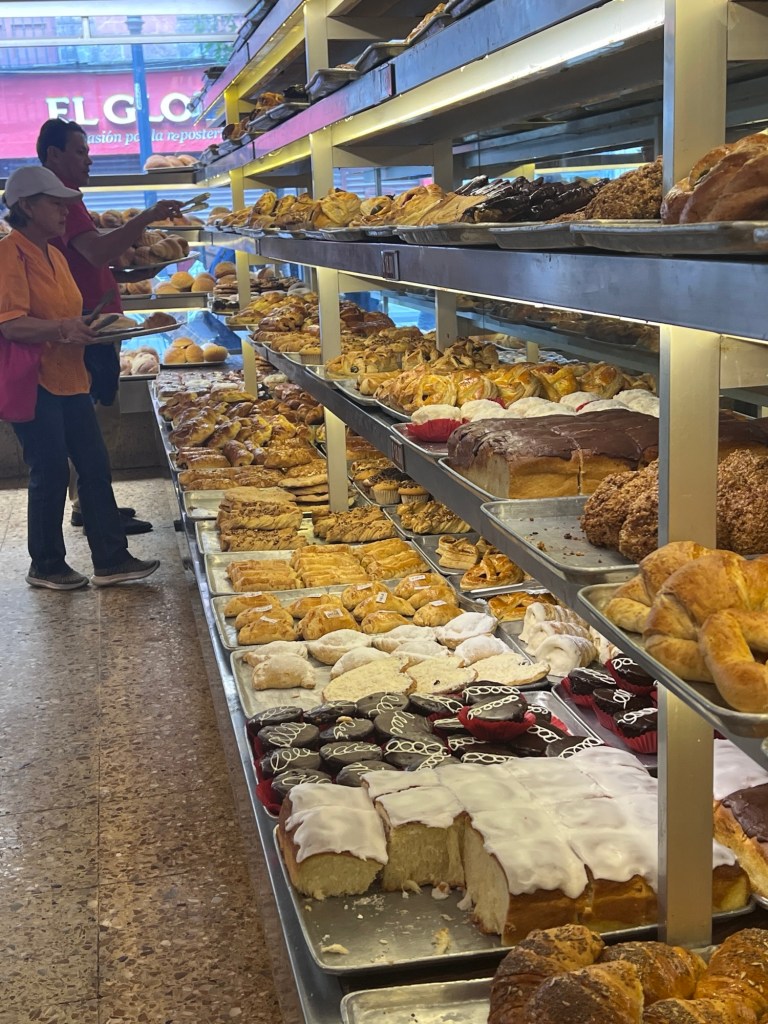
No fourth of July celebration for us today. We have something much more interesting planned. We are going on a private tour of the pyramids of Teotihuacan. Once again we enjoyed a quick breakfast at our favorite bakery. At exactly 9:00 AM we were picked up by our guide Ulysses, from TonaTours.
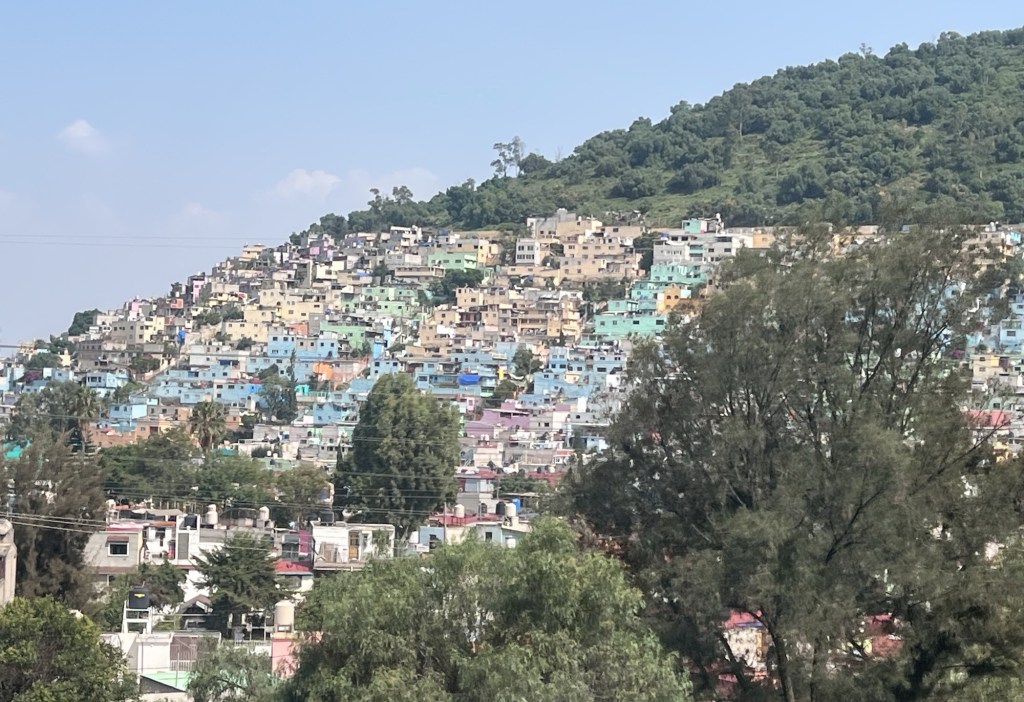
Teotihuacan is an amazing archeological site located 31 miles outside of Mexico City, which translates to over an hour drive each way. The ride gave us the opportunity to see the countryside outside CDMX. For the most part it was a continuation of the non-stop development we’ve been seeing, albeit a lot more hilly. What we found unique was that a system of gondolas or cable cars (Cablebus) connected people between these hillside communities providing a safe and efficient means of transportation. As we closed in on the pyramids, the crowded hillsides gave way and we began to catch a glimpse of rural Mexico.

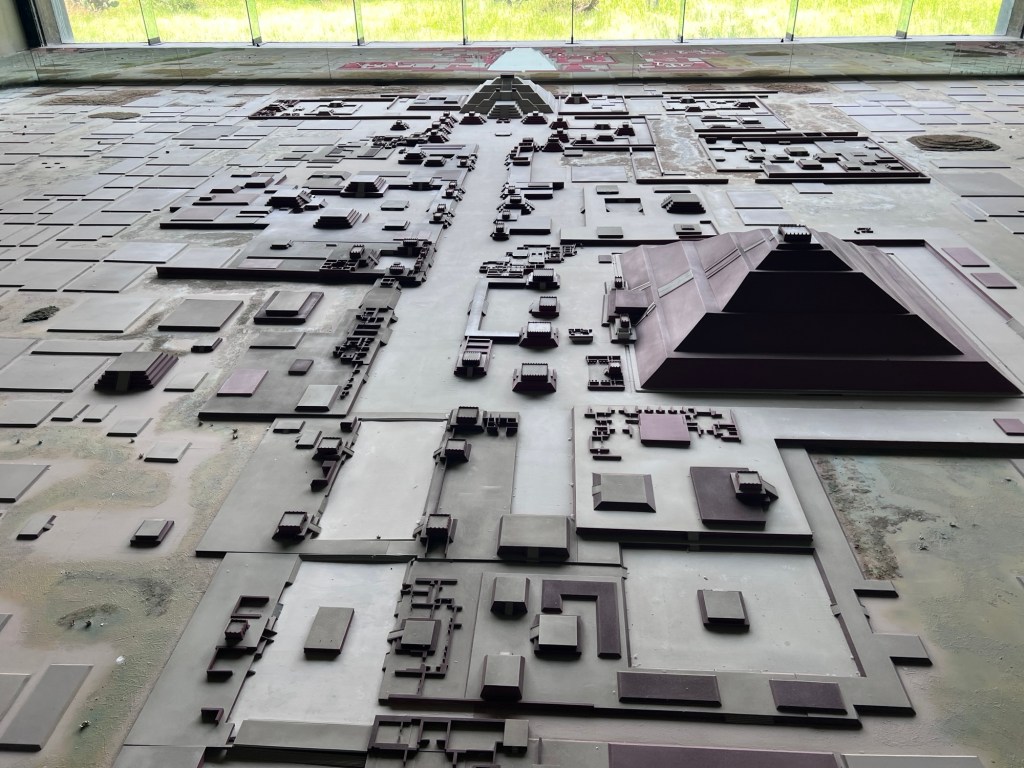
Prior to the arrival of the Aztecs, a powerful Mesoamerican city flourished at Teotihuacan from about 100 BCE to 800 CE. The city was massive, covering 8 square miles. At its height it has been estimated that a population of between 100,000 to 200,000 occupants lived there. The ceremonial center had two avenues dividing the city into quadrants. The Avenue of the Dead was the main thoroughfare with key structures built along it including the Pyramid of the Sun, the Pyramid of the Moon, and the Temple of the Feathered Serpent.
Very little is known about Teotihuacan other than it was a complex society that included residential compounds that housed up to 2,000 people. The arts flourished as could be seen by mural paintings, ceramics and stonework. Through the mural paintings archeologists learned that the inhabitants grew corn, squash, nopal (prickly pear cactus) and Maguey (agave). There was also evidence that the city had a sophisticated drainage system.

Teotihuacan collapsed between 700-800 CE. It is thought that class tensions between multiethnic groups who were living in segregated neighborhoods were partly responsible. Other factors included droughts, external threats, overpopulation, and fires that destroyed many of the city’s core monuments. Does any of this have a familiar ring to you? It sure does to me.
Abandoned for centuries, the Aztecs re-discovered the city and gave it the name Teotihuacan, “the place where the gods were created”. The Aztecs revered the ruins and incorporated them into their religious beliefs.
Pyramid of the Moon
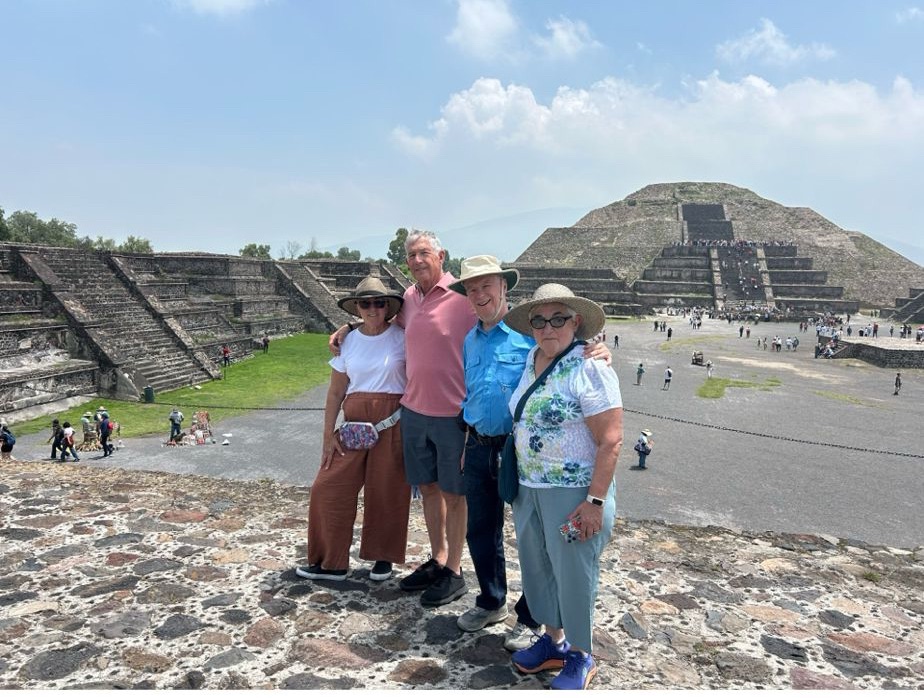
The Pyramid of the Moon was built between 100 and 450 CE. Its main purpose was as a stage for performing ritual sacrifices of humans and animals. It also served as a burial ground for sacrificial victims. Ceremonies were conducted on a platform atop the pyramid in honor of the Great Goddess of Teotihuacan — the goddess of water, fertility, earth and creation itself.
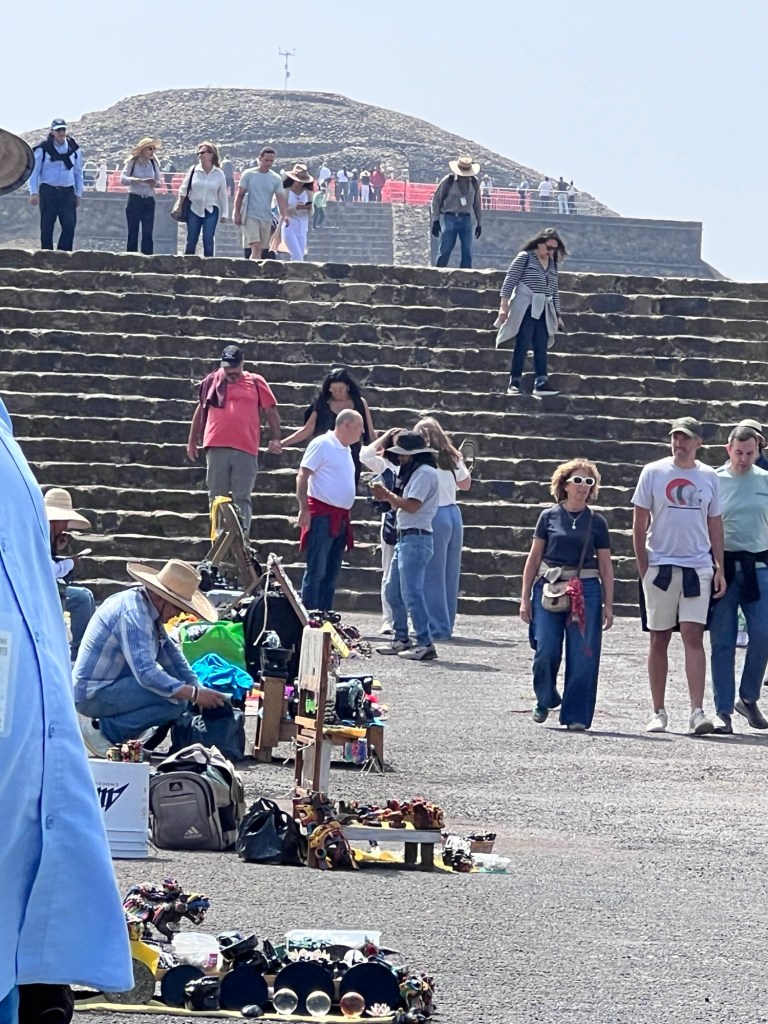
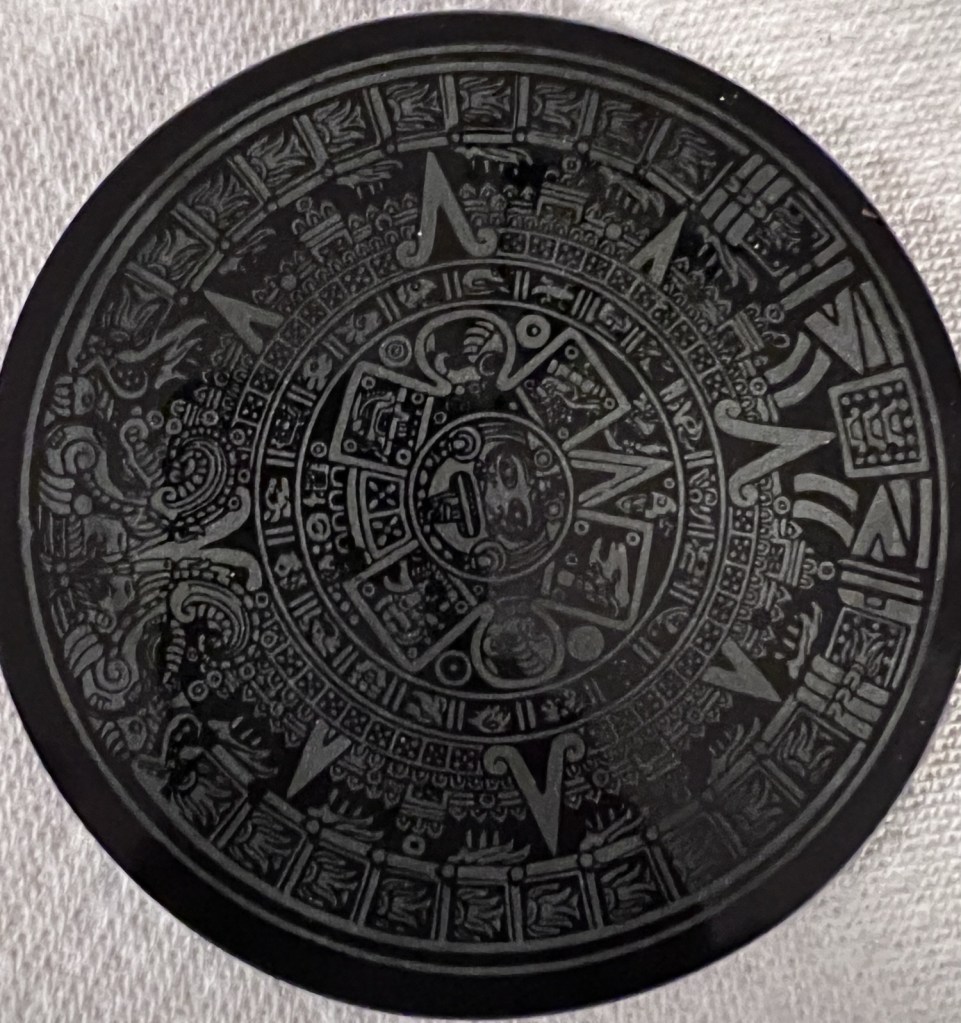
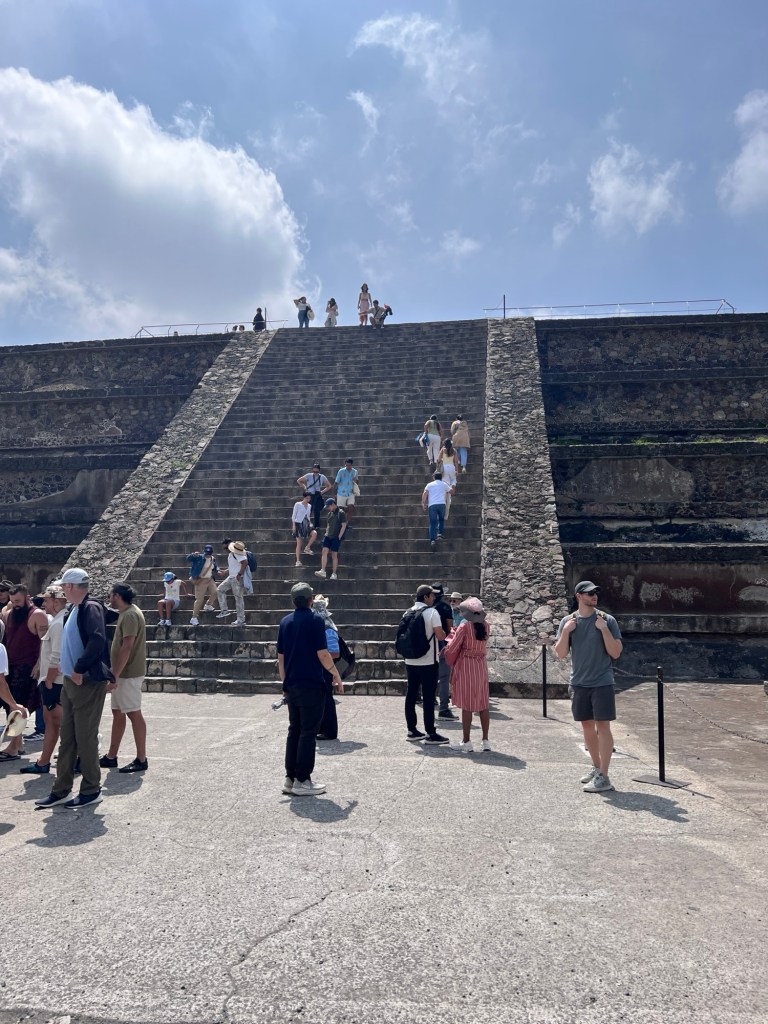
As of May 2025, tourists have been allowed to climb the 47 steps to the top of the first section of the Pyramid of the Moon, as well as to the top of five additional platforms. While there were vendors located throughout Teotihuacan, knowing that tourists would spend the most time in this particular area made it a popular spot for vendors selling a wide variety of local handicrafts. Far too many of them were selling a whistle-like toy that made very irritating high pitched screeching sounds meant to imitate an eagle or a puma. We definitely would have gotten into serious trouble if we had brought any of those whistles home for the grandchildren. Others sold lovely woven rugs, typical Mexican styled clothing, silver jewelry, pieces of shiny onyx through which you could view the sun, and countless other goods.



Pyramid of the Sun
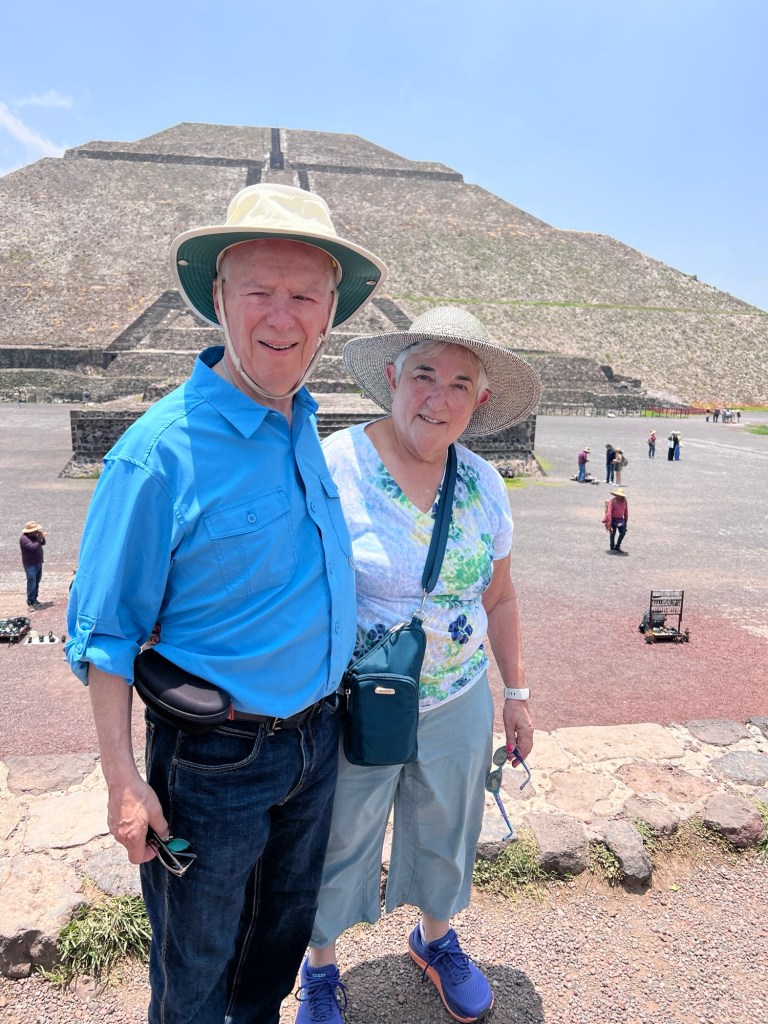
The Pyramid of the Sun was constructed about 100 – 200 CE and is one of the largest structures of its type in the Western Hemisphere. You can see how huge it is by looking at the tiny people standing in the lower right hand corner of the photo below. Its purpose is unknown, but it is thought to have been built to honor a deity or celestial body. Archeologists believe there was once a temple built on top. A large natural cave was found beneath its base with evidence of ritual offerings having taken place there. Its astronomical alignments also suggests it was used for important religious and ceremonial functions.


Temple of the Feathered Serpent
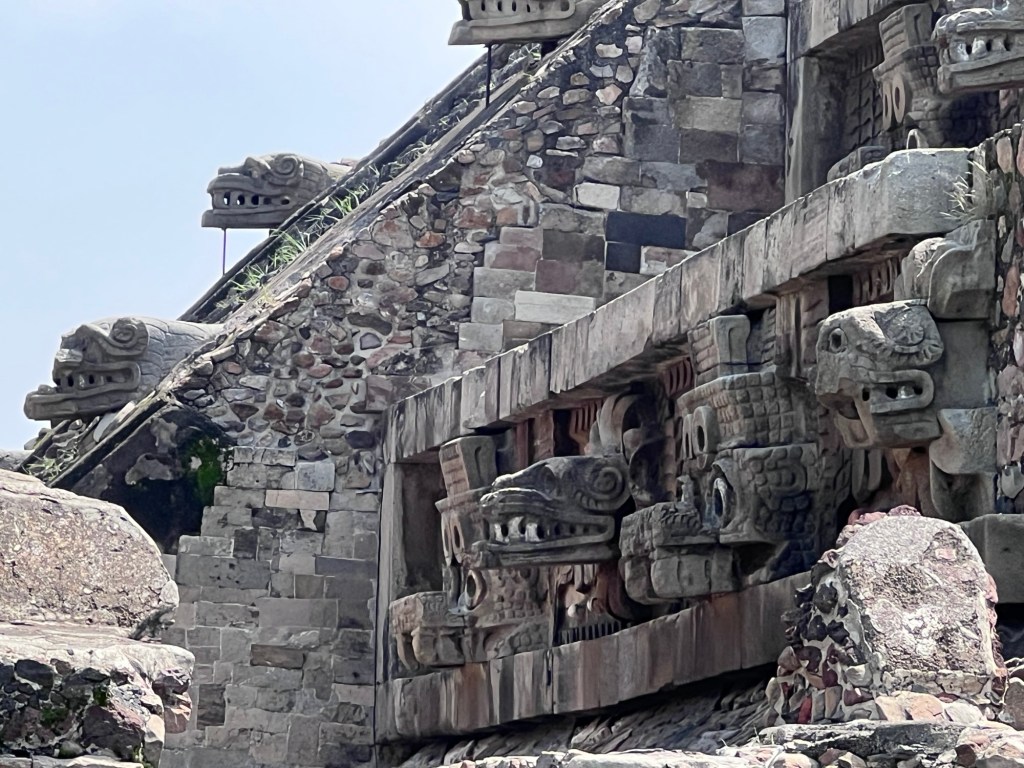
The third largest pyramid in Teotihuacan was the Temple of the Feathered Serpent. It is also the most ornate. Built between 150 and 200 CE, the facade is adorned with amazing carvings. Imagine them being painted in bright blue, red, green, and yellow, with the eyes of these mythical creatures filled with obsidian glass. Archeologists think it may have been built to venerate the “sacred” calendar cycle.

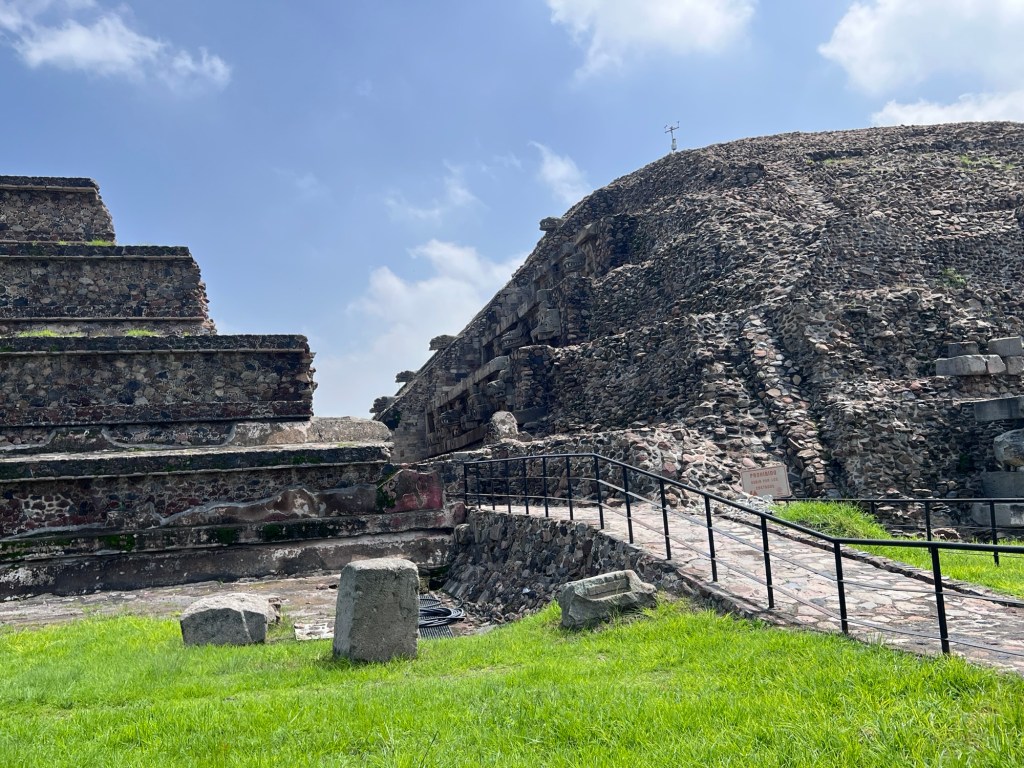

Puma Complex
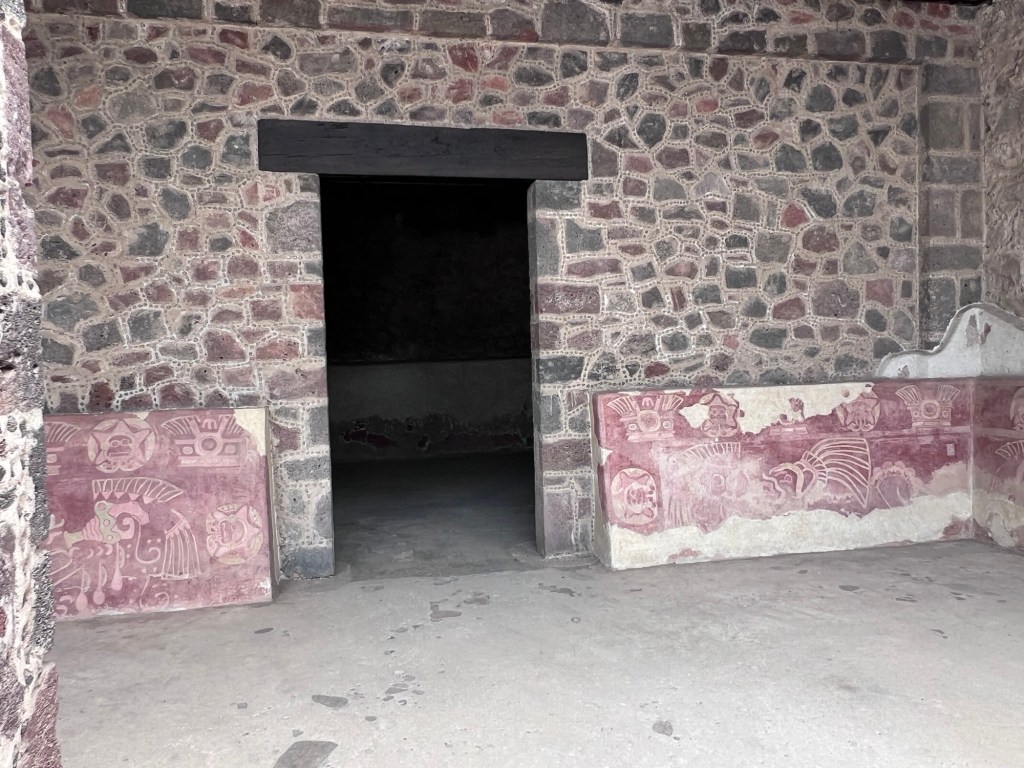
Complete rooms and many wall murals could be found in some of the smaller temples and residential apartment compounds along the Avenue of the Dead. One example was the Puma Complex where we saw wall carvings and murals still intact.


Palace of the Jaguars
Located near the Plaza of the Moon is the Palace of the Jaguars. Within its rooms are more well-preserved murals, most of which are of jaguars. One example shows a jaguar blowing into a conch shell from which water or blood drips. The palace was a complex for elite warriors and priests with the murals representing themes of war, the cosmos, and the water deity, Tlaloc. The mural shown below is presumed to be a symbol of war because conch shells were blown before a battle. The bleeding shell could also symbolize an extracted heart, or symbol of conquest.

Museo del Sitio (Site Museum)
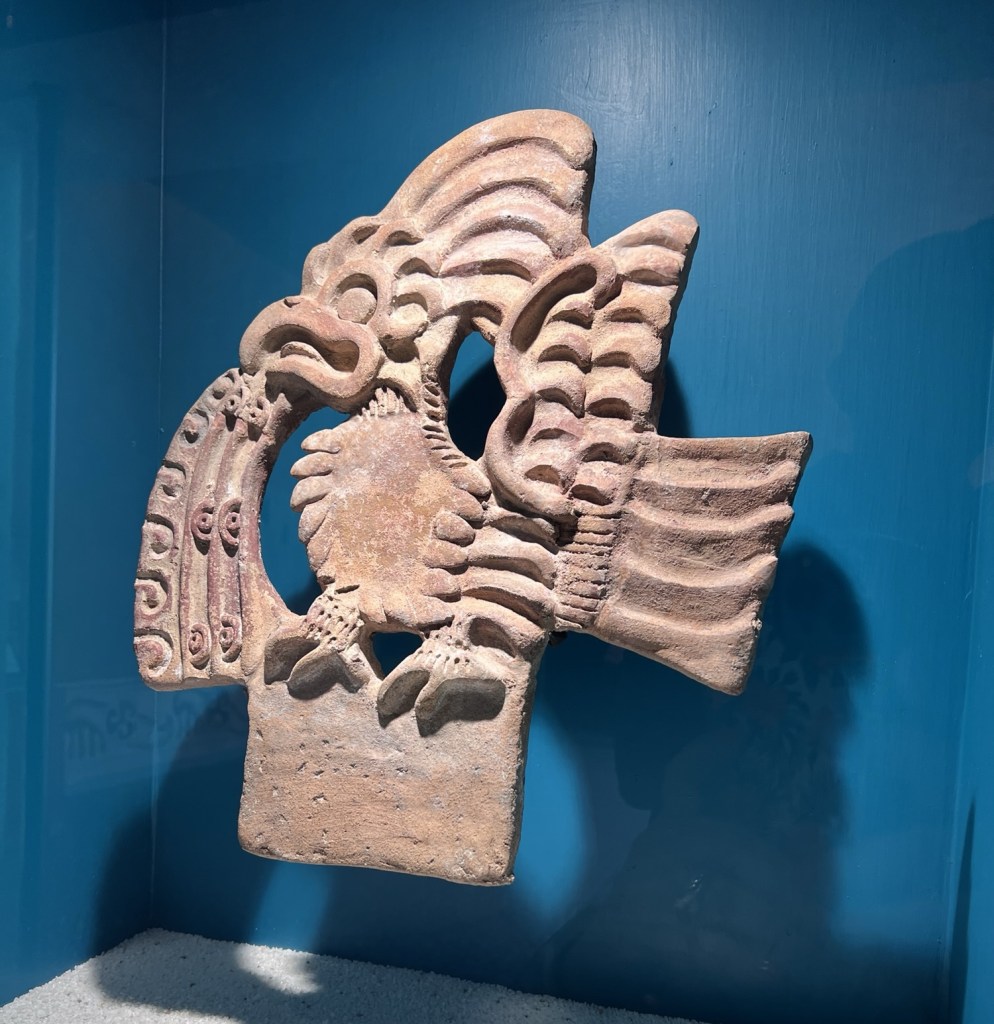
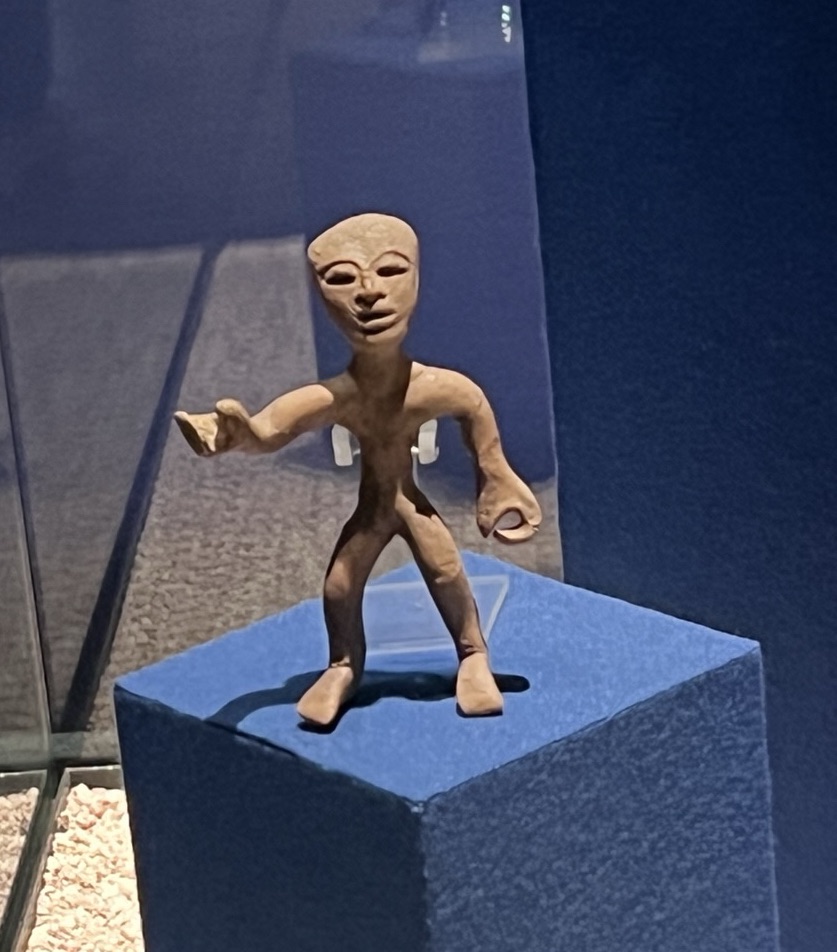
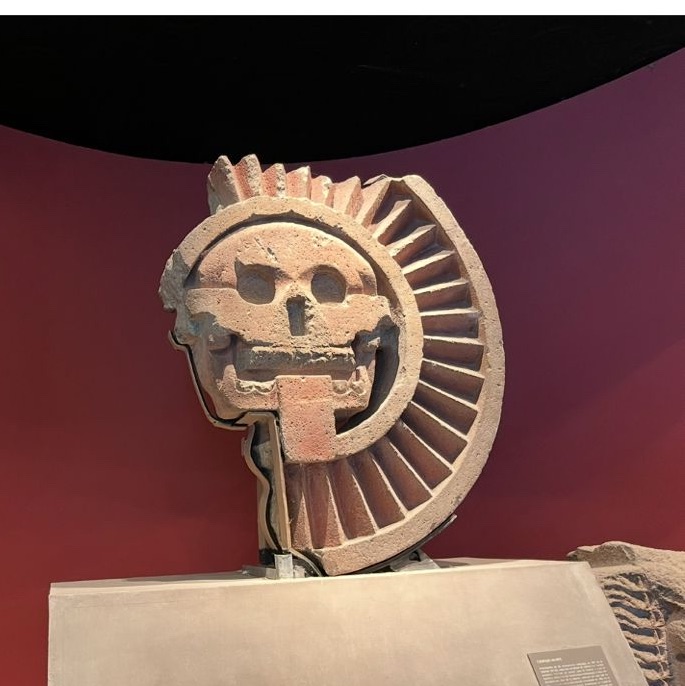
The main museum within Teotihuacan is the Museo del Sitio. It offered marvelous displays of artifacts found within the ruins and helped give us a comprehensive look at the ancient city’s history and culture.

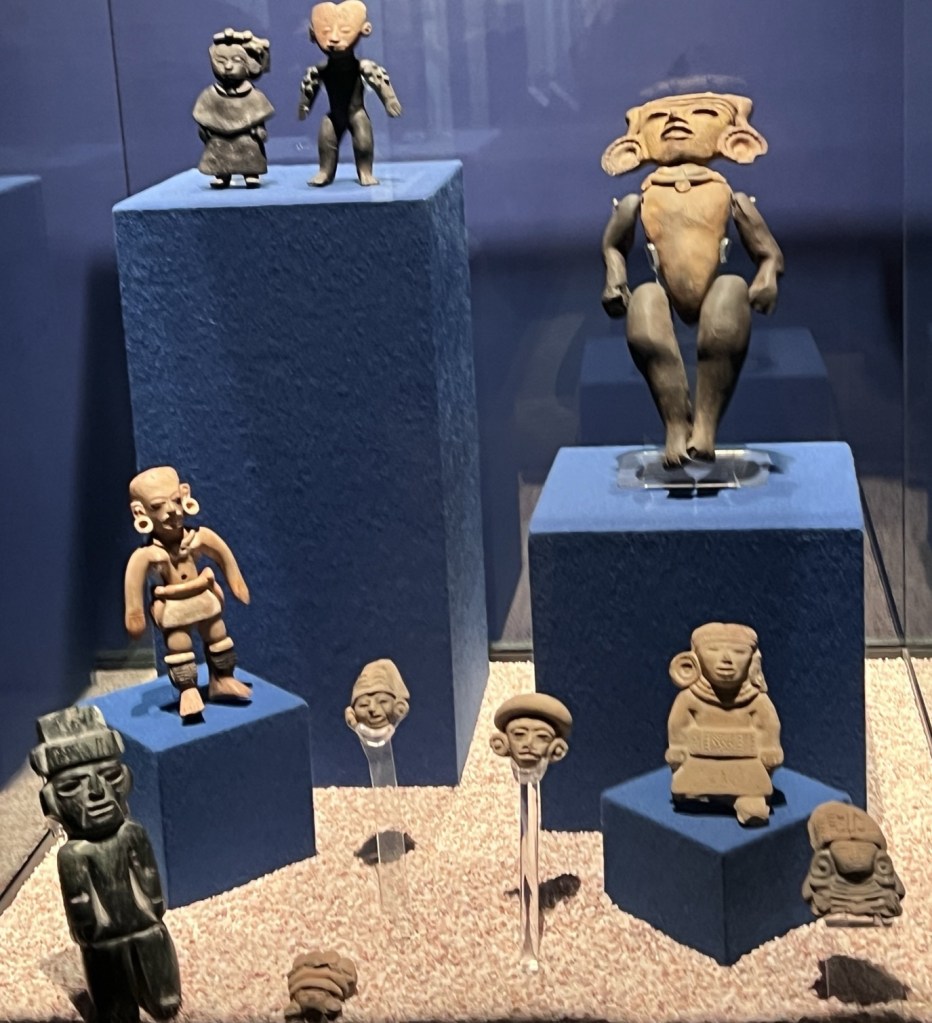
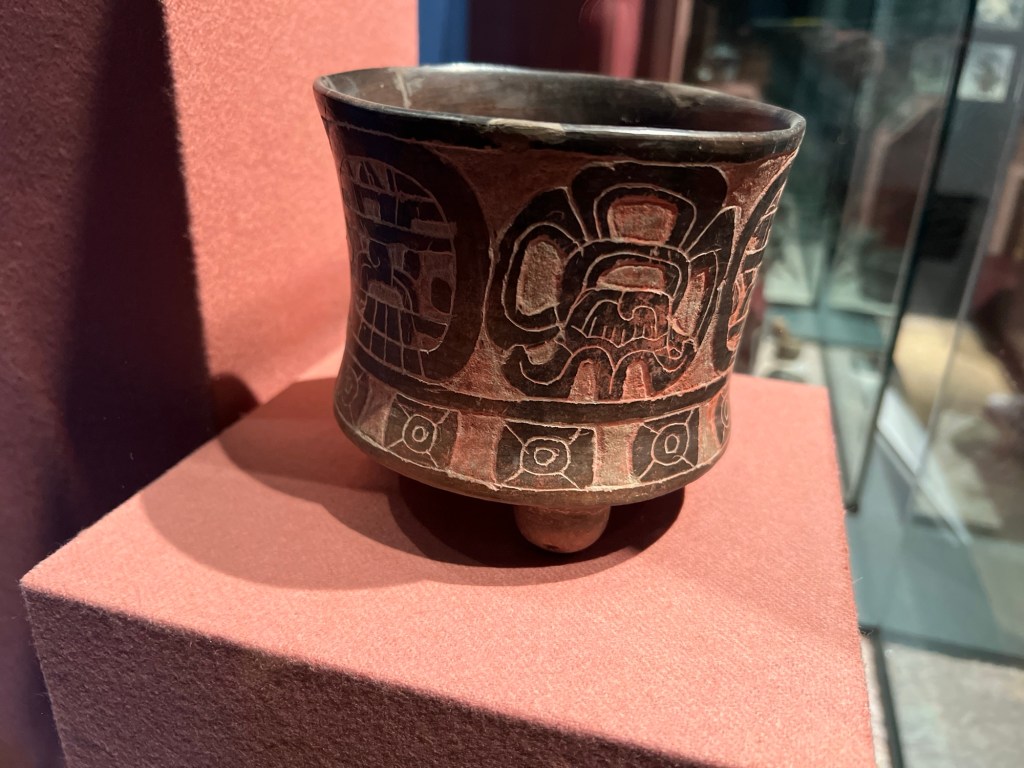

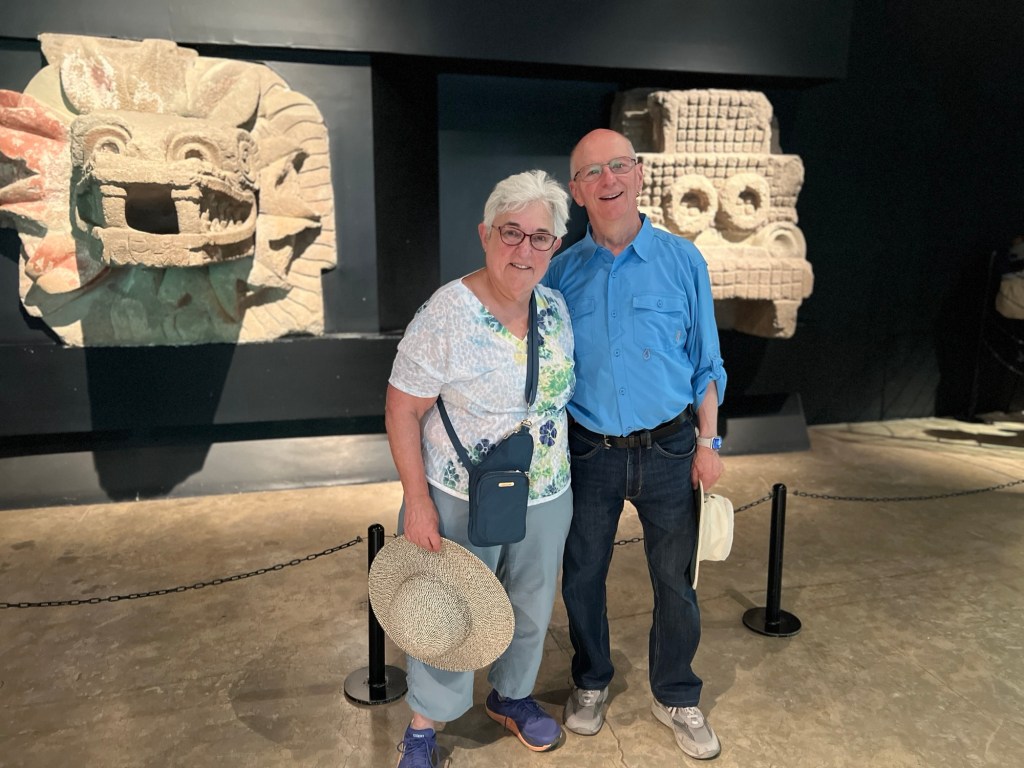

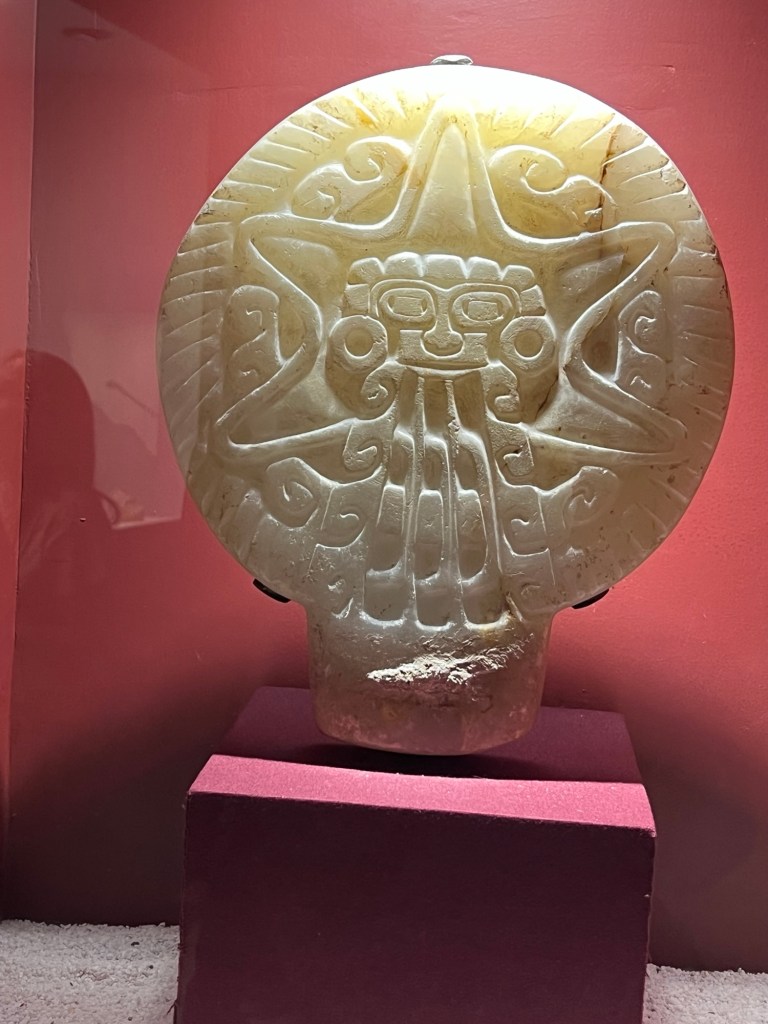
The last stop on our tour was the Restaurante La Greta set inside a volcanic cave. It was “unapologetically gimmicky”, but so much fun to visit. The cave was huge, and after a day in the sun, comfortably cool. The food was typical Mexican fare, and quite good. There was even a Mariachi band to entertain us over lunch.
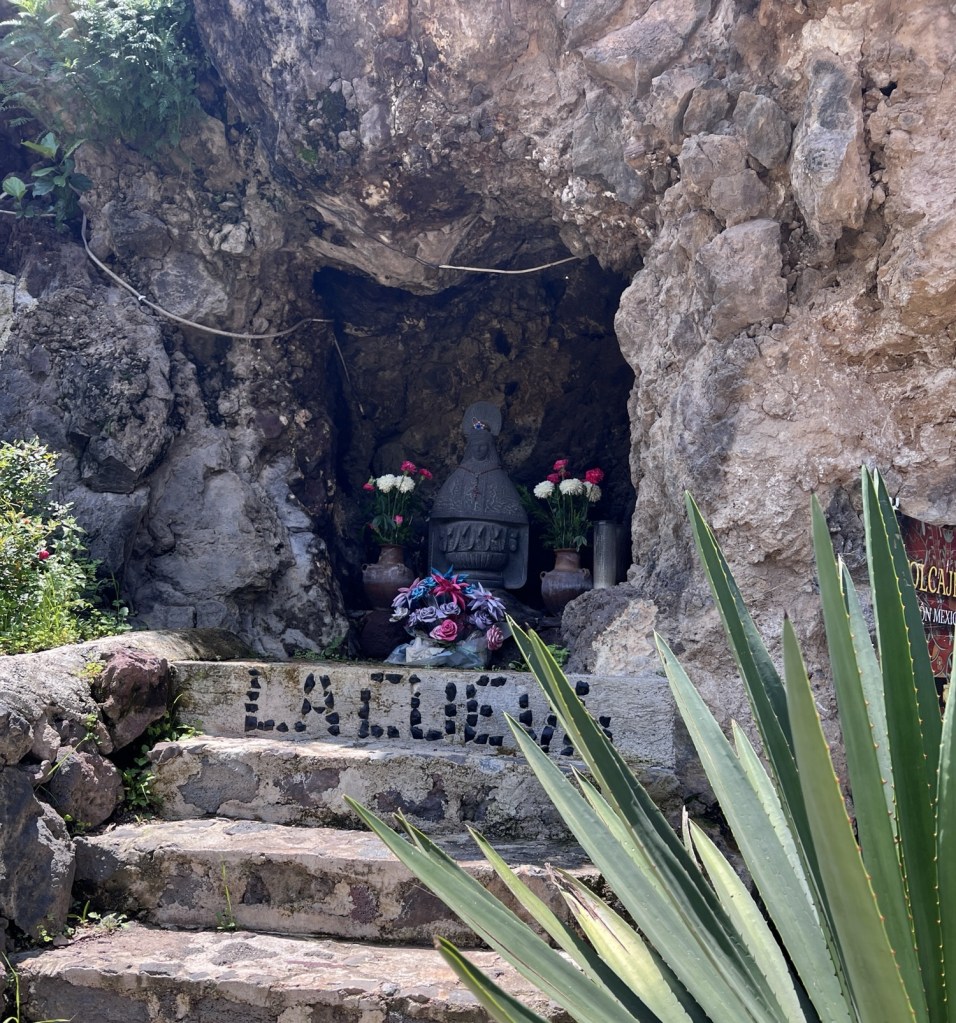
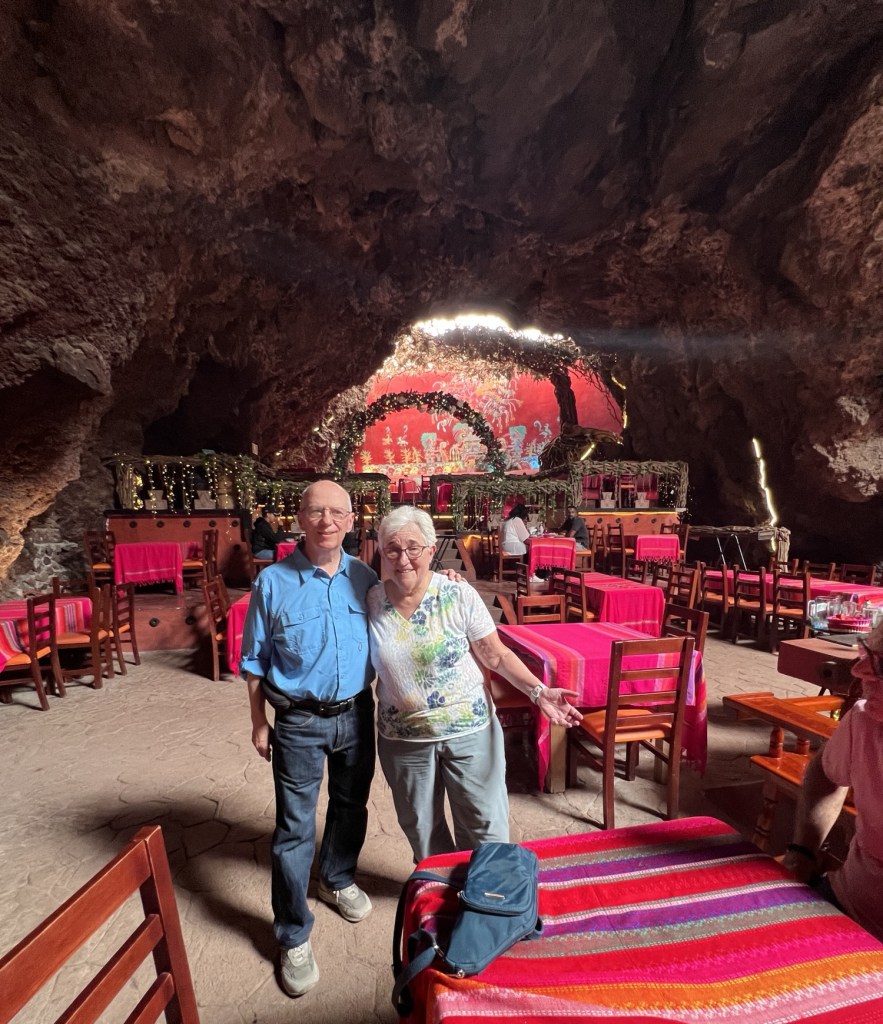
Ulysses was a wonderful tour guide and took excellent care of us. Teotihuacan is an amazing place. We could have spent hours more there, but to be honest it was a lot to take in and I think we all had seen enough for one day. It sure was nice to sit back and relax on our ride back to Mexico City.
The day was still young and Amy said that she really liked castles and would like to see the Castillo de Chapultepec. So instead of taking us back to our hotel, Ulysses dropped us off at Bosque de Chapultepec, which translates to Chapultepec Park. It is one of the largest parks in the Western Hemisphere and contains a multitude of attractions including museums, lakes, Castillo de Chapultepec and a zoo. Unfortunately, many of these attractions, including the castle, were closing in 30 minutes.
The Castillo’s construction began in 1785, but it wasn’t completed until Mexico’s independence in 1821. For a few years Mexico reverted to an independent monarchy, and that is when Emperor Maximillian and Empress Carlotta arrived from Austria in 1864. They refurbished the Castillo de Chapultepec as their residence. To say all did not go well for them is an understatement. Maximillian was the younger brother of Emperor Franz Joseph I of Austria, but his reign in Mexico lasted only 3 years. It ended when forces of the restored Republic executed him by firing squad. Empress Carlotta was not executed, but she suffered a mental breakdown. She spent the rest of her life in seclusion, dying in Belgium in 1927.
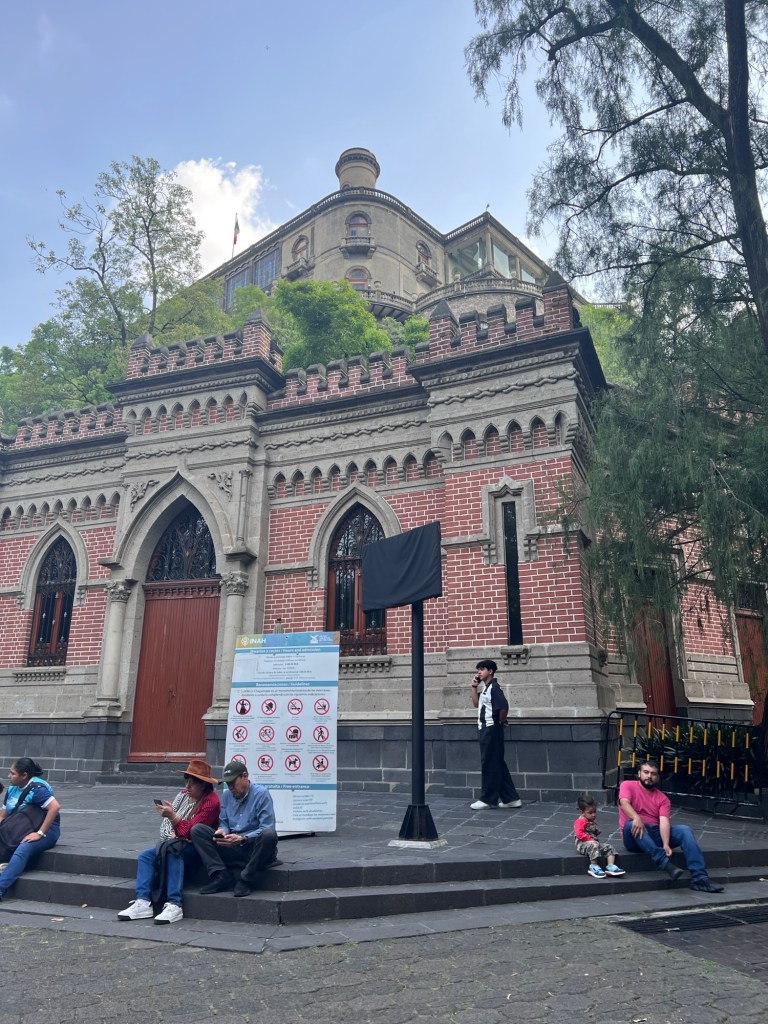
It was late afternoon, so it wasn’t surprising that things were closing for the day. However, we managed to purchase a few monkey like creatures (Dan and I called them Squirting Monkeys) that we had seen adults wearing on their heads. A small container could be filled with water, and by squeezing a bulb, you could squirt people out of the the monkey’s head. Odd looking, but cute in its own way. I just had to buy a few for our grandkids.

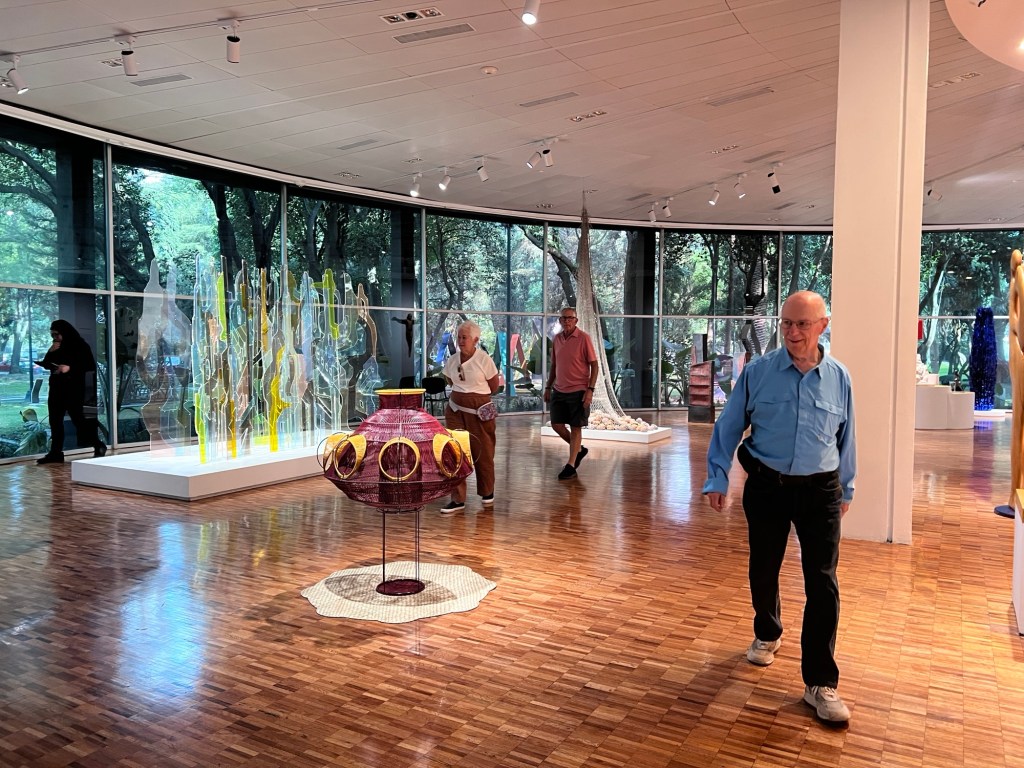
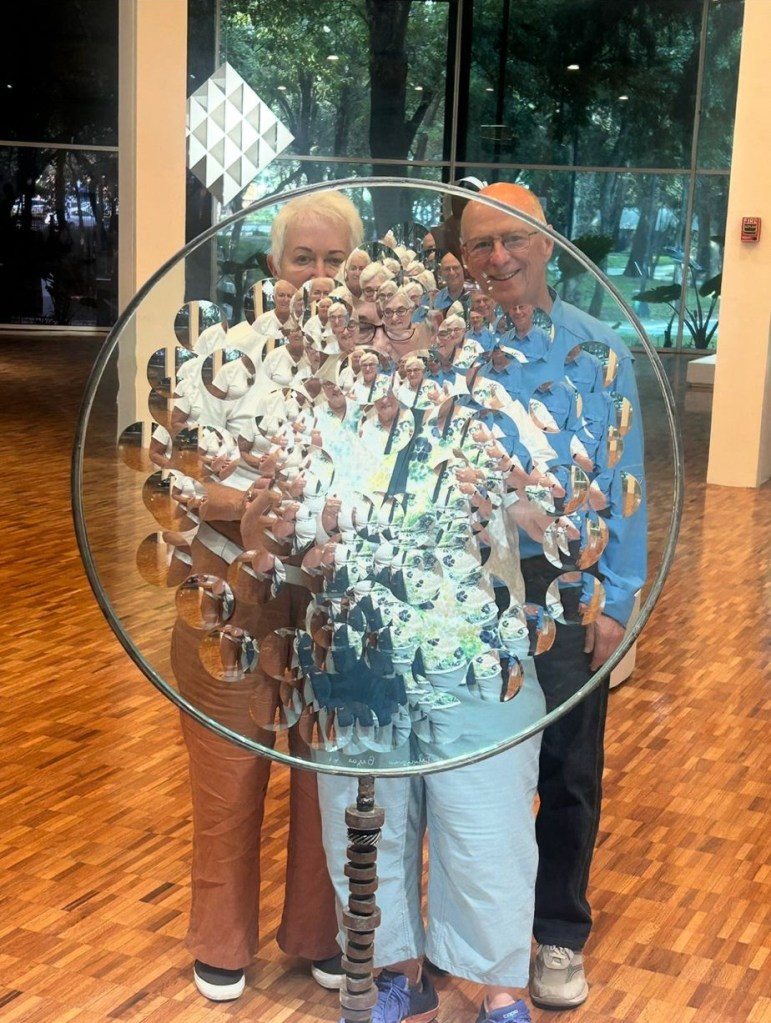
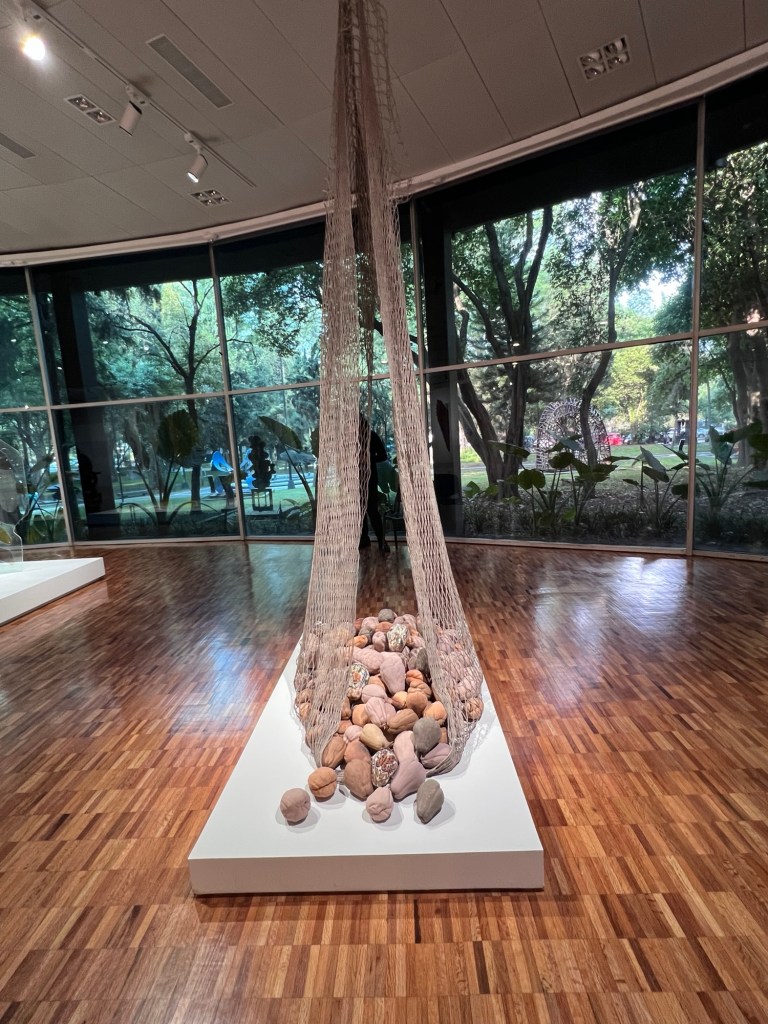
Although the Museo de Arte Moderno was closing soon, the security guards were kind enough to let us roam the museum at no cost. It was a magnificent space and exhibited some extraordinary pieces of art.
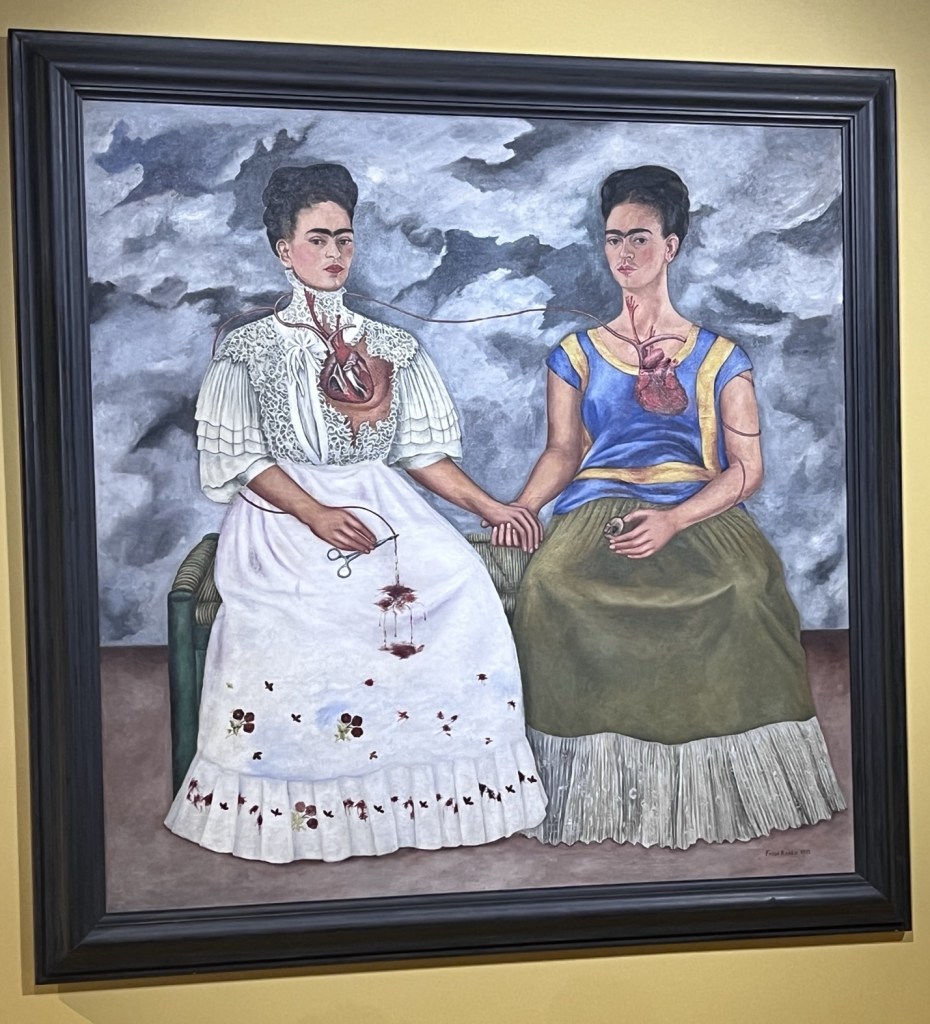
The remarkable painting, The Two Fridas, was painted by Frida Khalo in 1939, the year she and Diego Rivera divorced. The painting featured two seated figures holding hands and sharing a bench in front of a stormy sky. The two Fridas are identical except in their dress. The healthy heart of the Mexican-dressed Frida, on the right, represents the Frida that was loved by Diego Rivera. The broken, bleeding heart of the European-dressed Frida, on the left, symbolizes Rivera’s rejection of her. The vein connecting the two hearts shows their link, while the surgical forceps in the European Frida’s hand, as well as the blood stains on her dress, illustrate her efforts to stop the bleeding from their broken relationship.
Our visit to the Museo de Arte Moderno was short but sweet, and at exactly 5:30 the museum closed and we went on another search for an Uber. Fortunately, it has been incredibly easy to use Uber throughout our trip even at the busiest times of the day, and they have always been reasonably priced.
Selecting a place for dinner was a challenge since every block had several intriguing places to choose from. We ended up at El Zorzol Condesa, a “classic Argentine” restaurant. It had a quiet and lovely dining area and a great selection of steaks and seafood. I shared a gigantic, delicious steak with Amy and Steven, and Dan had seafood.
One last stop before heading back to pack, was a visit to the large bookstore we had passed numerous times during our visit. I had seen a display of children’s books in the window and thought it would be fun to purchase a few for our granddaughter, Maya. It turns out that Liberia Rosario Castellanos was a famous bookstore and cultural center named after the renowned Mexican poet and author, Rosario Castellanos.
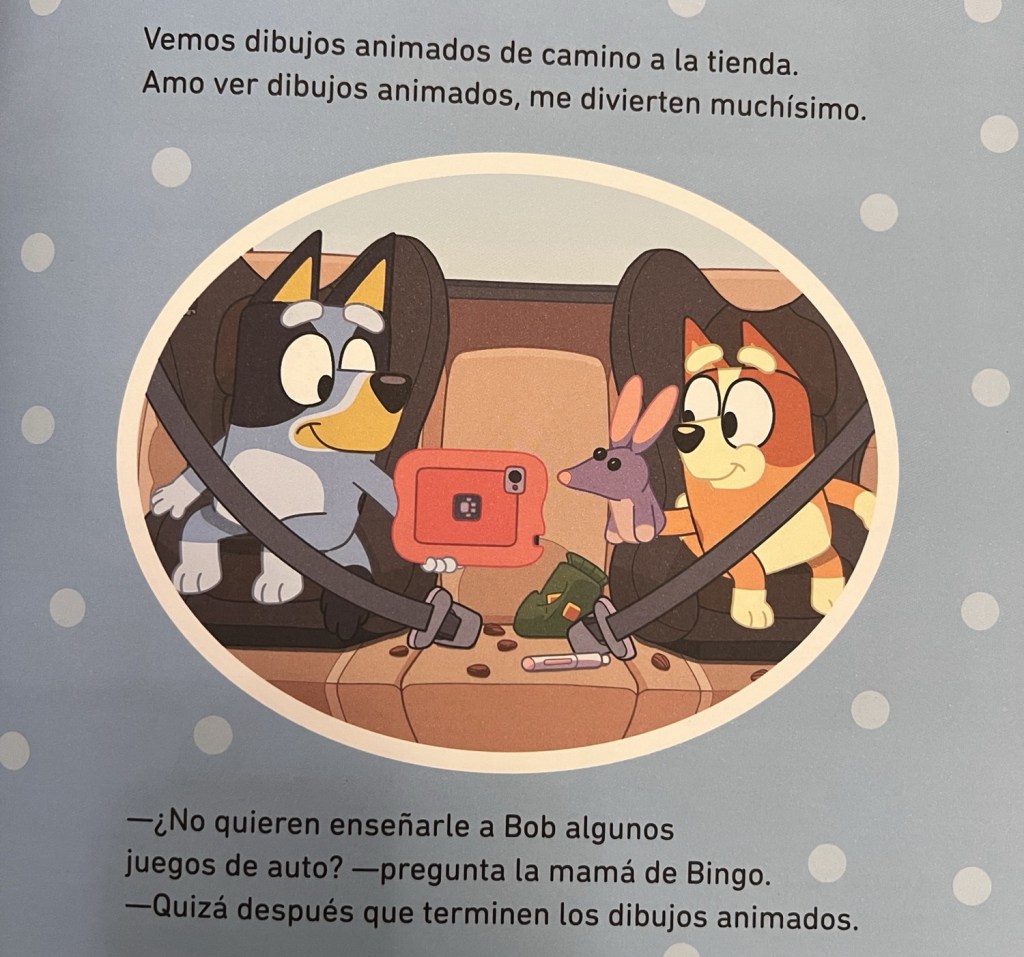
The number of children’s books was enormous. I ended up asking a 4 year old boy, and his father, what they would recommend for an almost 3 year old. The boy was adorable and had no problem recommending some of his favorite reads. Since one of them was a Bluey book, I’m almost certain Maya will be happy with our selection. Of course all of the books were in Spanish, but I thought Maya might enjoy taking them to preschool where many of her teachers are Hispanic. I planned on translating them into English once I got home.
It was time now to finish packing and get ready for tomorrow’s departure.
July 5, 2025
On the morning of our departure we made one last visit to “our” bakery and then ordered an Uber to take us to the airport. Having left plenty of time getting to the airport, it wasn’t stressful for us to figure out where to check-in and how to locate our gate. We were flying American Airlines with a stop in Charlotte, NC. For some unknown reason (I was not going to ask why), we had first class tickets. This allowed us to relax in the American lounge and left me with plenty of time to check out the duty free shops. We made it to Charlotte on schedule, caught our flight home to Cleveland on time, and were picked up by our limo driver as expected.
CONCLUSION
What a wonderful trip. It was a perfect balance of family, beach and city. However, we barely scratched the surface of Mexico City. It is an amazing city, and one of the more interesting places we’ve been. Below is a short list of some of the things that we would definitely want to see should we be fortunate enough to return:
- Diego Rivera murals and those of other artists such as Japanese-American muralist, Eitaro Ishigaki.
- Palacio de Bellas Artes, Mexico City’s cultural center. I would like to see a performance there, perhaps the Ballet Folklorica.
- Castillo de Chapultepec and more of the Bosque de Chapultepec.
- Xochimilco, ancient Aztec canals that are explored on flat bottomed boats.
- Food — There are so many foods and restaurants we didn’t try.
- There are a large number of museums we never had a chance to visit.
- It would be fun to explore more Mexico City neighborhoods
VIVA MEXICO!


































 BY THE WAY WITH WENDY & DAN