
JULY 1, 2025
After enjoying a pastry and coffee in our hotel lobby, the four of us headed out to our “Free Tour of Mexico City” offered by Estacion Mexico Free Tours. We were meeting our cousins Danny and Lauren from Chicago, and Debby and Marty from Columbus. Their daughter Amanda and her boyfriend Yuri, who live in Minneapolis, also joined us. All we had to do was make our way to the Metropolitan Cathedral’s main entrance and hunt for people wearing pink t-shirts and umbrellas.
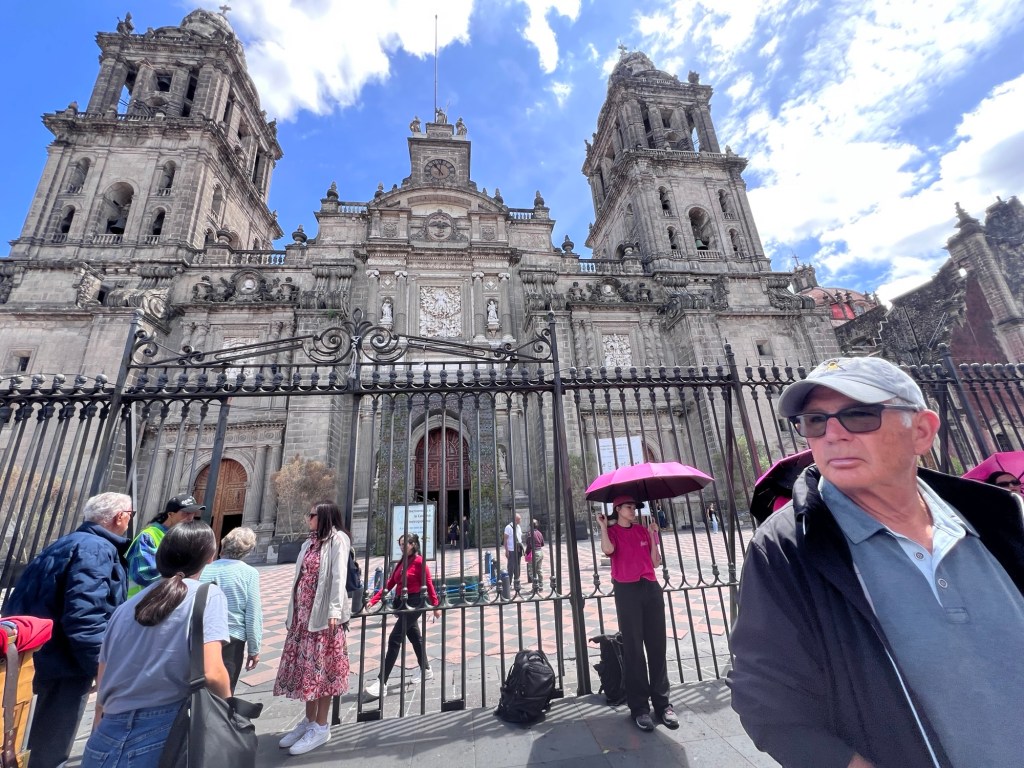
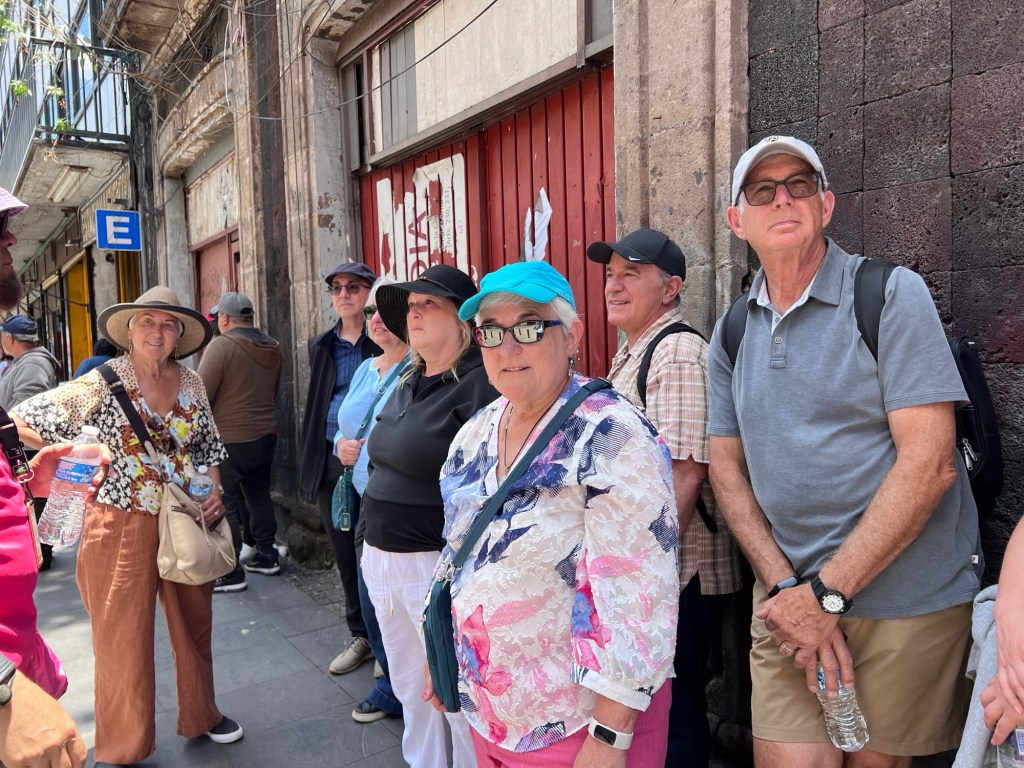
This 2-1/2 hour Free Walking Tour concentrated on the Historical City Centre of Mexico City (CDMX). Our guide was very informative and was a rock musician in his “real life.” He took us on a comprehensive tour of the major landmarks beginning with the heart of Centro Historico, the massive Zocalo, or main square (also known as the Plaza de la Constitucion). This is the place where people gather for cultural events, political protests and celebrations. In fact, shortly after we left Mexico there was a demonstration against increased housing costs due to the large influx of Americans moving into the city.
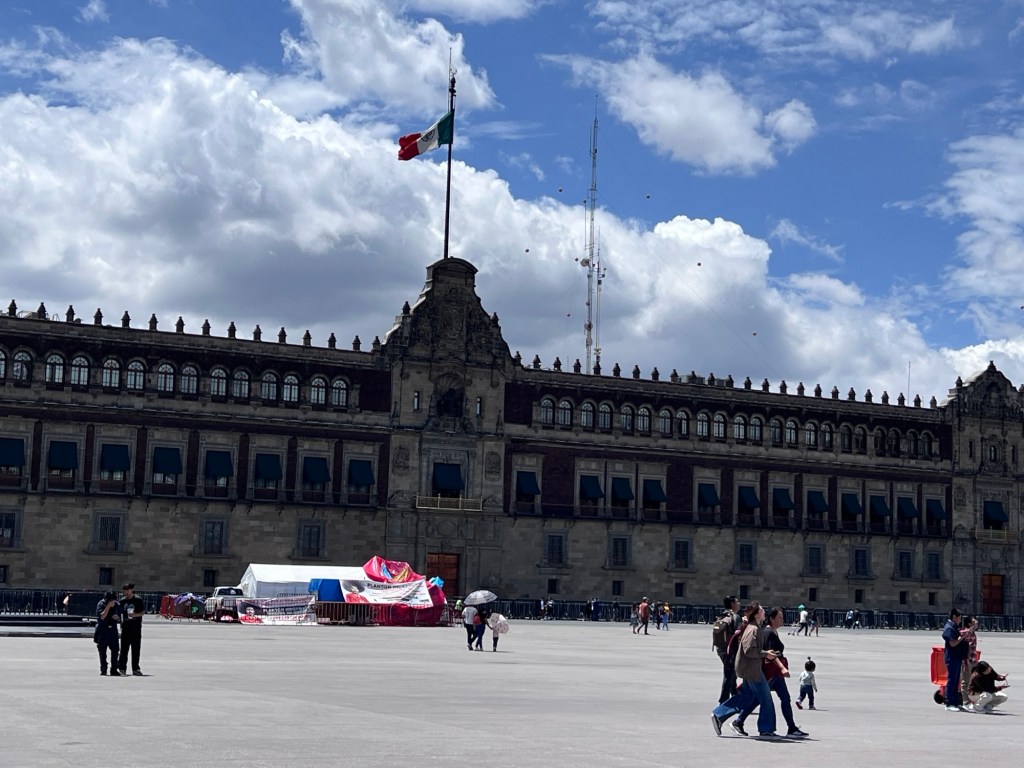

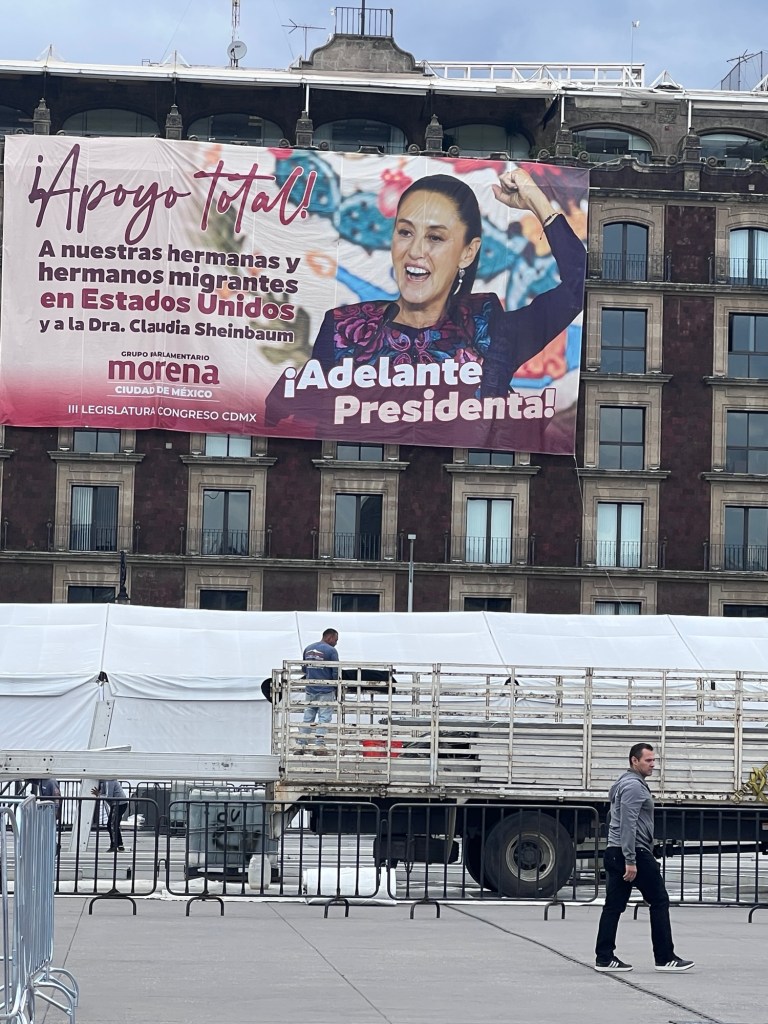
Every Mexican city or town has a Zocalo, which usually features a church and government buildings. The Zocalo in CDMX is surrounded by impressive colonial era buildings including the National Palace on the east side and the Metropolitan Cathedral on the north side. The Palacio Nacional has been the seat of power and sovereignty for the Mexican people since the 16th century. Great figures in Mexican history have lived and worked within its walls, and it serves as the official residence and workplace for Mexican presidents. The current president, Claudia Sheinbaum Pardo was elected Mexico’s first woman president in 2024. In addition to being a politician, she is an energy and climate change scientist, and an academic.
The palace also houses one of the most famous Diego Rivera murals depicting Mexico’s history and cultural heritage. Unfortunately every time we tried to see a Diego Rivera mural there was some obstacle in our way i.e. the building was closing early, renovations were being made, or we simply ran out of time. (The closest we got to seeing one was in the Palacio de Bellas Arts where we caught a glimpse of a mural, but were prevented from seeing it in full.) It was very frustrating being unable to see Rivera’s work, especially since so much is written about him and other muralists in Mexican history books.
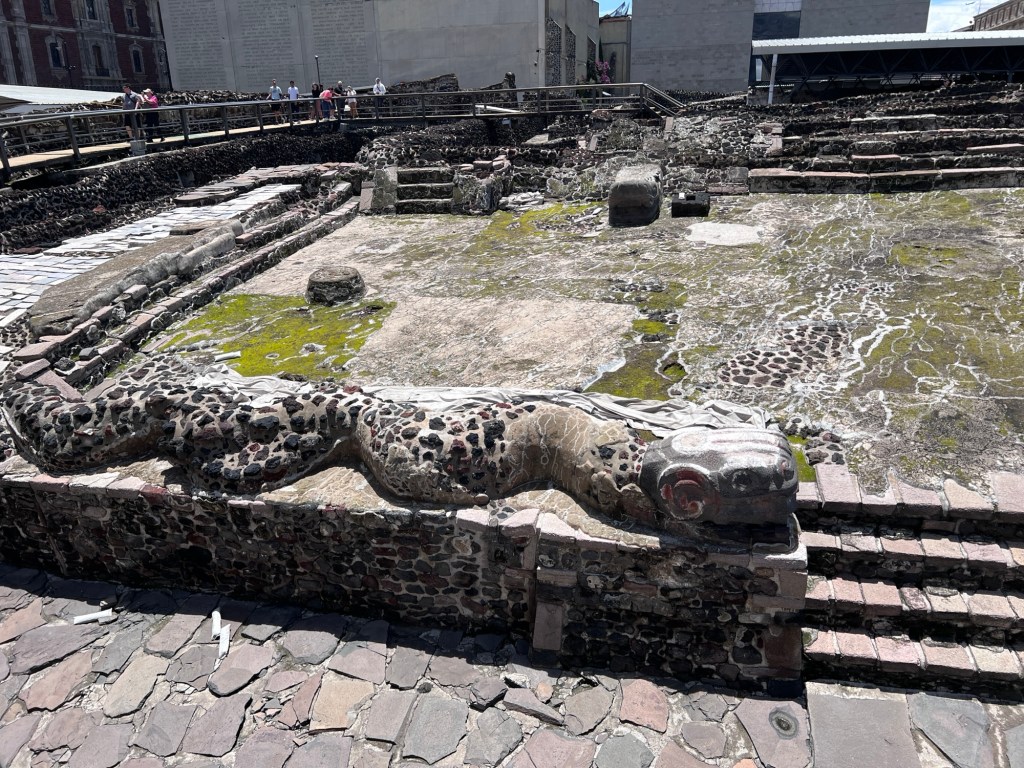
Our next stop was the Templo Mayor (Great Aztec Temple). It was the religious hub in the Aztec capital city of Tenochtitlan. The city was destroyed in 1521 by the Spanish, and the stones of its buildings used to build other structures including the Metropolitan Cathedral. The remains of this double pyramid complex were uncovered when in 1978 electrical workers happened upon an 8-ton stone-disc carving of the Aztec goddess Coyolxauhqui. Several colonial buildings were torn down in order to excavate the site.
Aztec scouts had been sent out to find the perfect location for a new city. Tenochtitlan was built on the very spot where these scouts saw an eagle perched on a cactus holding a snake in its beak. This was an important symbol for the Aztecs, and they literally believed that this spot was the center of the universe. The symbol still resonates with the Mexican people and appears on their flag. The temple was dedicated to the gods of sun and rain and at its center was a platform dating from about 1400.


After walking through a local market, which sold utilitarian items, our guide pointed out an area we should avoid because it was considered unsafe, the La Merced Market. (Our tour the next day was scheduled to take us to this “dangerous” market.) CDMX is second only to London in the number of museums it hosts, and our guide pointed out an incredible number of them along with government offices and interesting shops.
Some stores were selling princess-like dresses for girls celebrating their 16th birthdays in a traditional ceremony called Quinceañera. The ceremony, includes a religious service and celebrates a girl’s transition into womanhood. A large party follows mass, and is often held at a banquet hall, featuring food, music, and dancing. Families spend years saving for this special event, and often fundraise asking friends and family for contributions to help finance the party.

Dan and I were exhausted by the time our tour came to an end. There was so much more to see around the Zocalo, but we had a private tour of the National Museum of Anthropology in less than an hour. We were to meet our guide, Pepe in front of a mural near the museum entrance, but he was nowhere to be found. I tried texting him and then sought help from one of the museum’s security guards. My poor Spanish, and his poor English, made it difficult to explain our problem, but he managed to leave our guide a message. I gave up on Pepe when I saw our cousins arriving for their tour. We were fortunate in that we both had booked through Viator, and their guide allowed us to join their group.
The museum is architecturally a beautiful place in and of itself. It is considered one of the most important museums in the Americas, especially regarding pre-Hispanic civilizations such as the Aztecs, Mayas, and Olmecss. Even if we had an entire day it would have been impossible to see everything in its vast collection. Our guide concentrated on some of the most important objects.


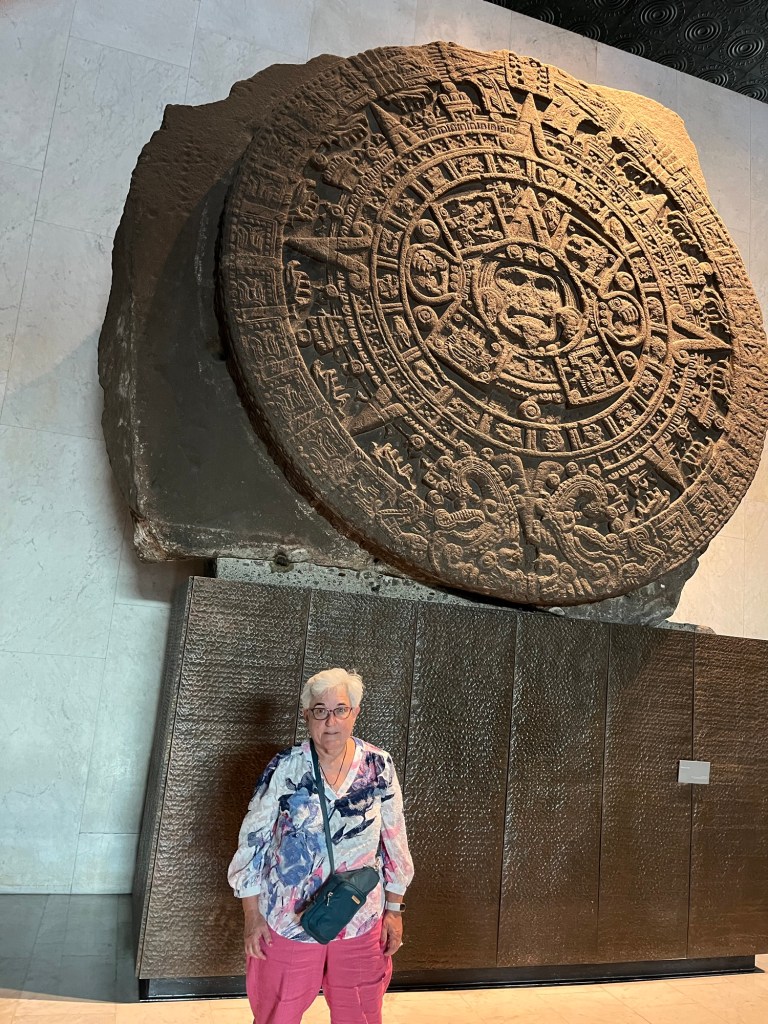

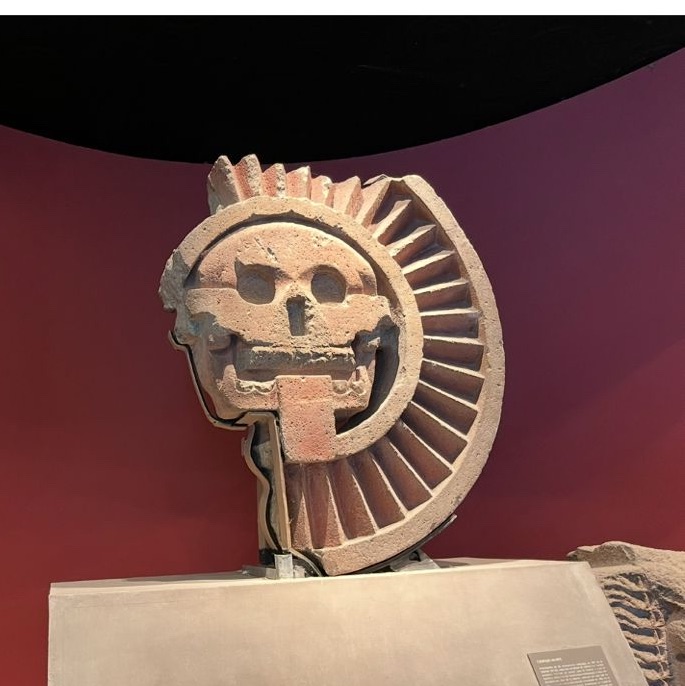
Our guide was an academic and researcher and tended to talk about the fine details of every exhibit. At some point, Dan and I wandered away from the group and looked at the exhibits at our own pace. Most of the descriptions were in Spanish, so we made the best of it. We were surprised to find that many of the exhibits featured replicas rather than original pieces. Before we left, we reconnected with everyone and relaxed a bit in the museum restaurant, but not for too long. It was at least a 60 minute ride back to our hotel and the four of us had dinner reservations at one of the premier restaurants in CDMX, Entramar.
Entramar serves only the freshest of seafood and is located in the upscale Polanco neighborhood. It is the sister restaurant to the famous Contramar, offering the same dishes—but in a more relaxed atmosphere. While listed in the Michelin Guide, it does not have a star. We tried their tuna tostados as an appetizer—delicious. I wish I had kept track of what we all ordered. I think I had halibut and Dan a shrimp dish, but the bottom line is that all of us enjoyed our dinners and would highly recommend dining there.
After dinner we headed straight back to our hotel. I had been feeling a bit off. Perhaps that is why I found the day so exhausting. (Motezuma’s revenge stayed with me throughout the rest of the trip. Luckily for me it wasn’t a severe case). We were all tired and went straight to bed. We had another busy day planned for tomorrow.
 BY THE WAY WITH WENDY & DAN