
We are looking forward to today’s guided tour of Verona. Verona is an interesting town because you can stand in one spot and see Roman ruins, along with medieval, renaissance and baroque buildings all at the same time. No bus ride for us today. After breakfast we met our guide in the lobby of our hotel and headed out.
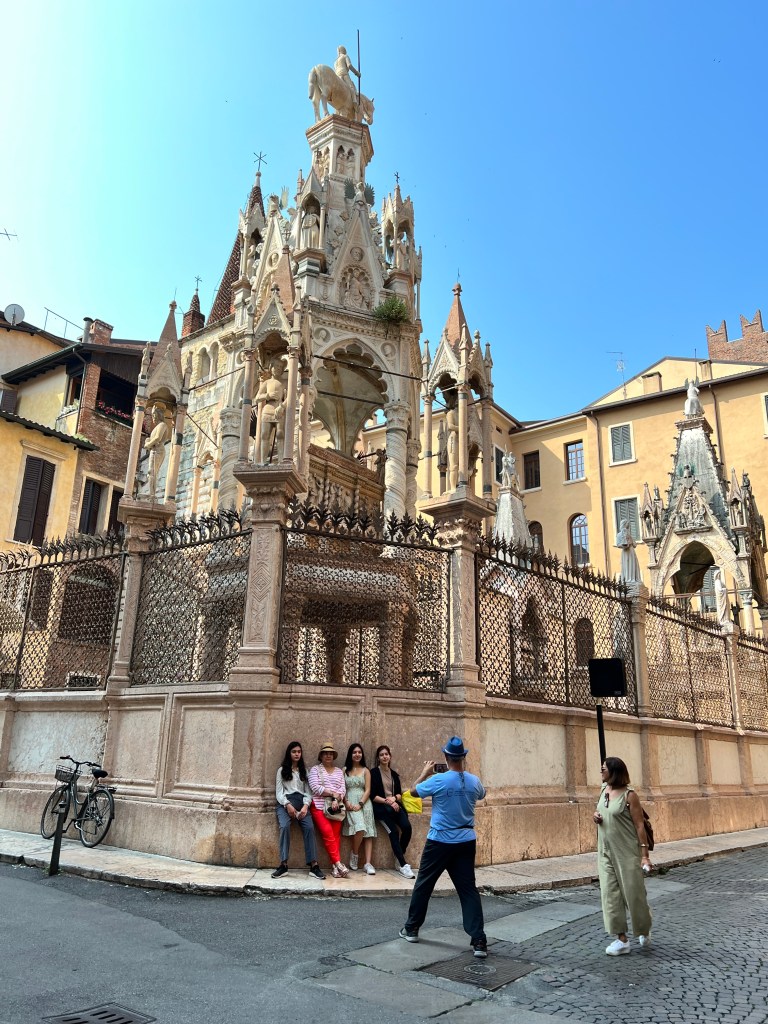
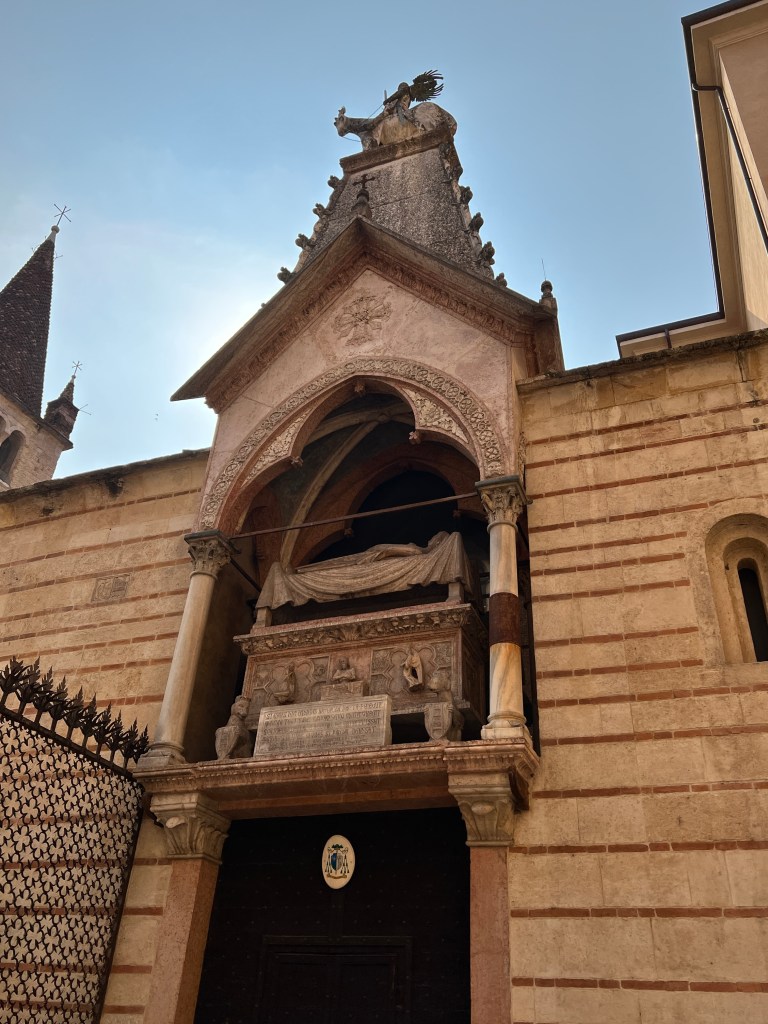
Verona had its own true intrigue. Feuds between the Montecchi and Cappellos families were real and served as models for Shakespeare’s Montagues and Capulets. Just like the Medici in Florence, Verona’s Scaligteri family was responsible for the city’s 13th and 14th century cultural and political power. Our first stop today was at the tombs of the Scaligeri family. By building their 14th century gothic funerary complex upon pillars they guaranteed that they would always be looked up to. The tombs are protected by wrought iron fences that incorporate a ladder emblem into the design. The emblem represents the family’s original name of della Scala “of the steps.”
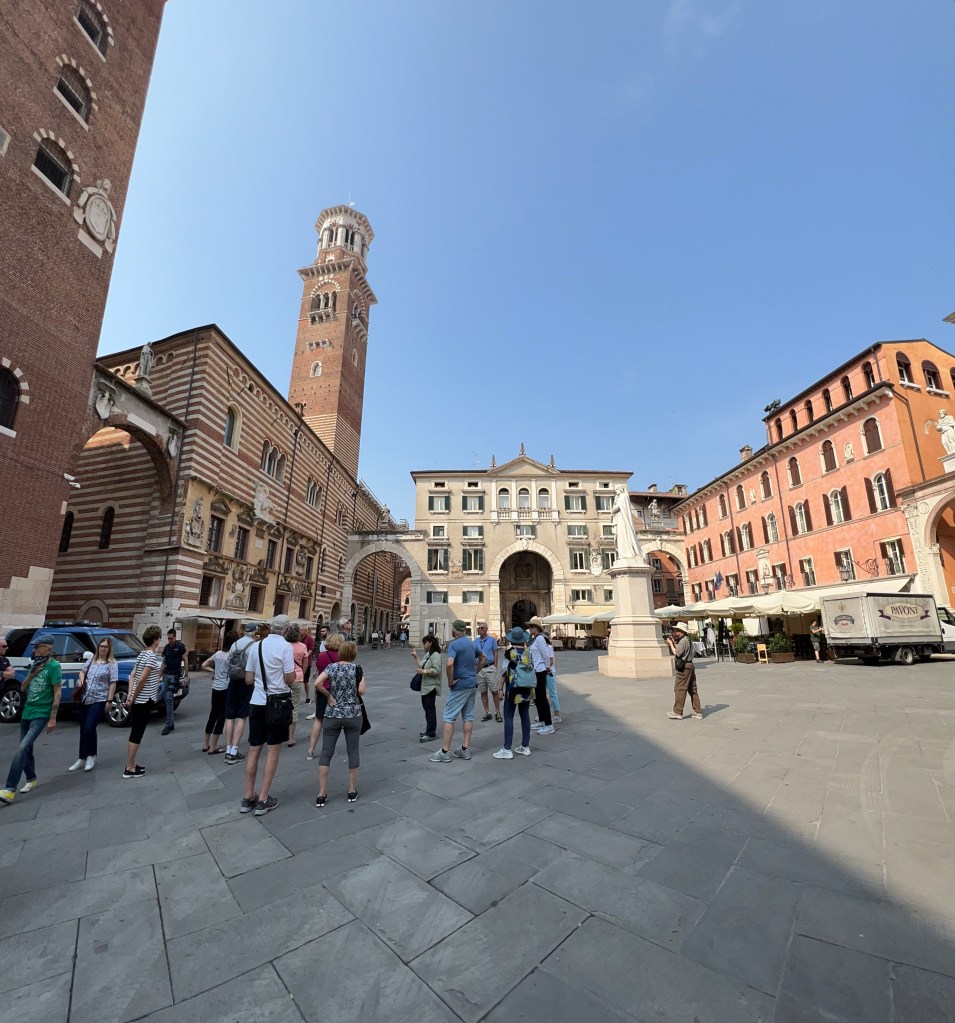
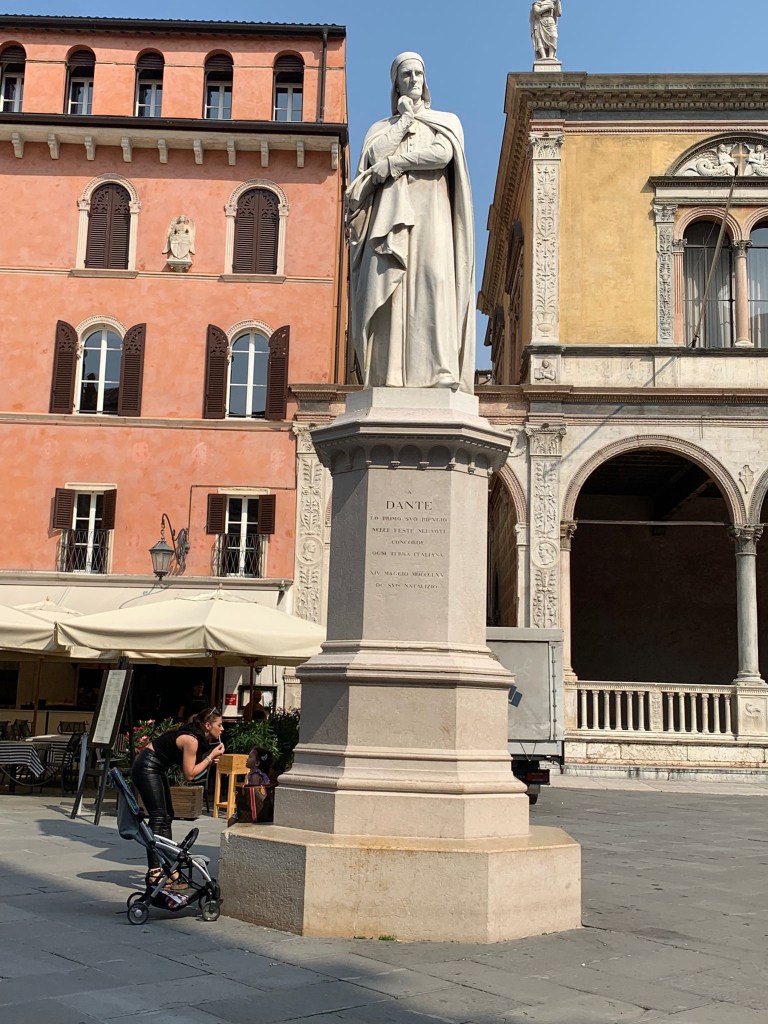
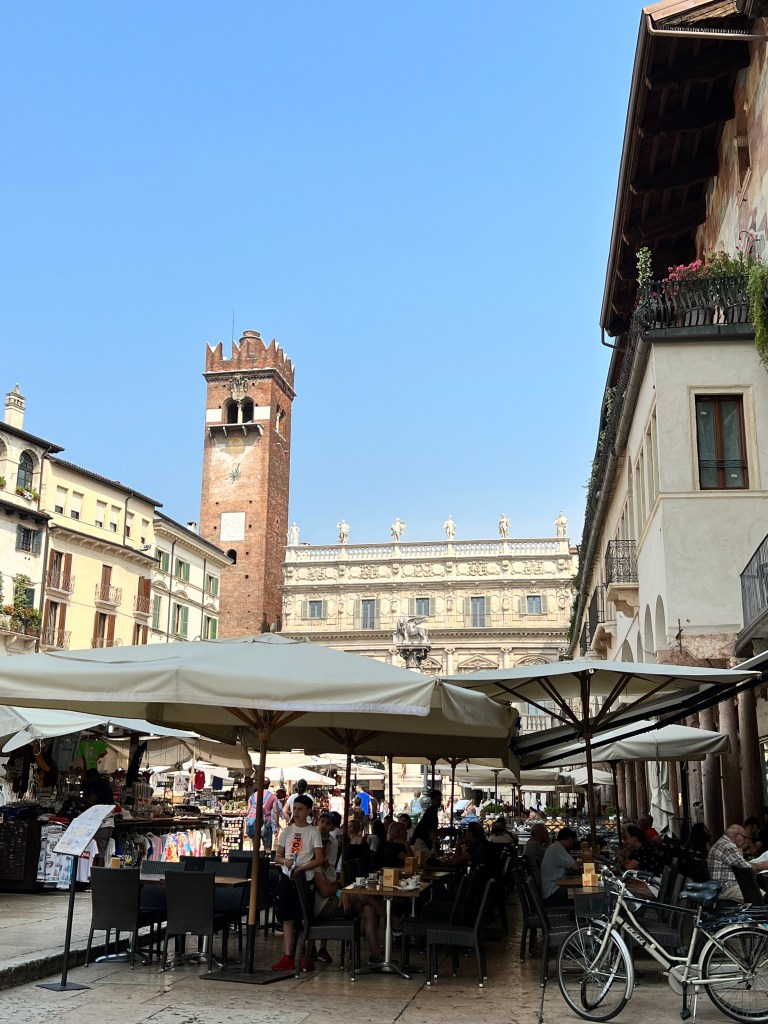
In the Piazza dei Signori is the oldest building in the square, the 12th century Romanesque Palazzo della Ragione with its tower, Torre dei Lamberti. It is often called Piazza Dante since a statue of Dante Alighieri stands in its center. The buildings in this square span five centuries.
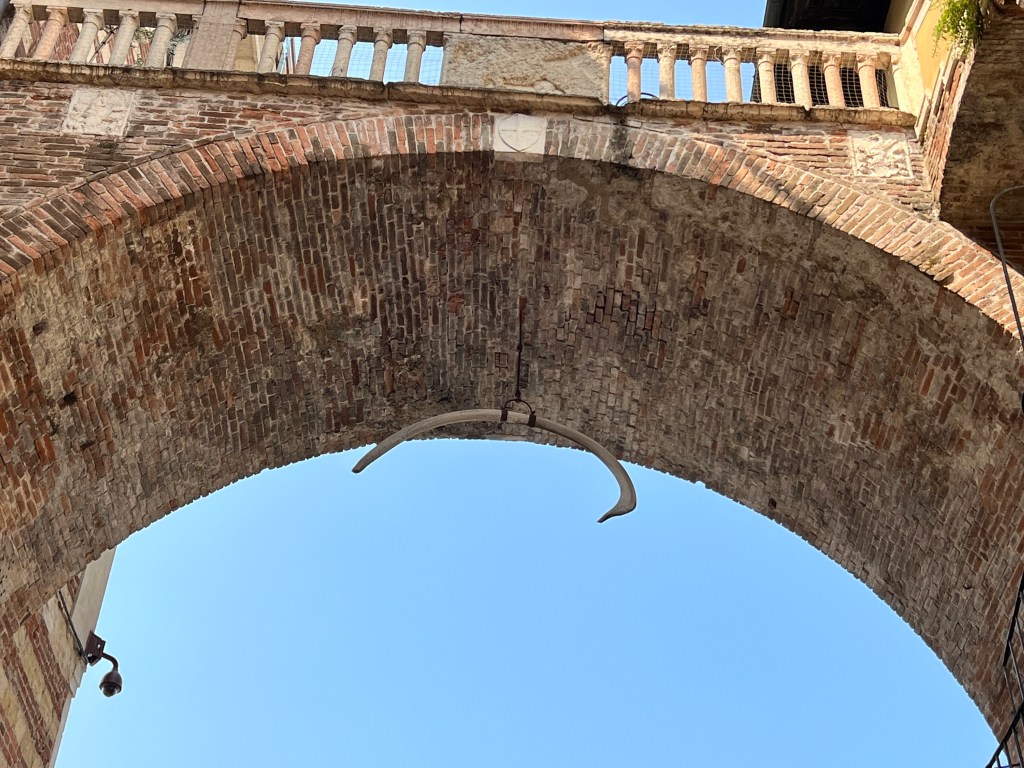
One quirky sight is a whale’s bone that has been dangling from an arch between Piazza Erbe and Piazza Signori since at least 1700. No one seems to know why or how it got there. The walkway above the arch allowed safe passage for judges and magistrates between their homes and city hall so they didn’t have to associate with common riraff. It’s claimed that it will fall on the first innocent person to walk under the archway. If that were true it certainly would have happened by now? Or would it?
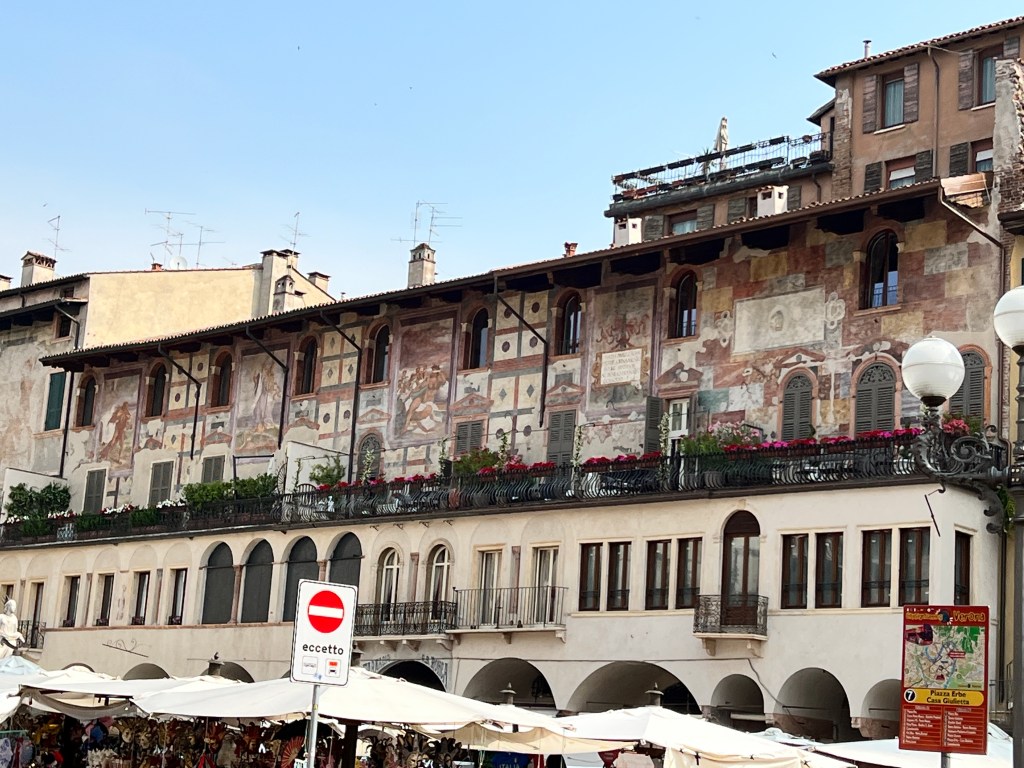
The Piazza Erbe was once the town’s forum during Roman times. It is still used as a market square. The fountain in the middle has provided water for 2,000 years. The Renaissance buildings were supposedly painted by students of Raphael in the 13th century.
At the risk of boring everyone, there is one small piece of history I found of interest. In the Middle Ages, nobility had to choose whether they would support the holy Roman emperors (Ghilbellines) or the popes (Guelphs). In general, Guelphs tended to come from wealthy merchant families, where Ghibellines were predominantly people whose wealth came from agriculture. There is a lot more to this story, but it gets too confusing to write about in one paragraph. Our tour guide mentioned that buildings that had crown like decorations near their rooflines meant the residents were Ghilbellines or pro-emperor.
Another way families would show off their power was to build towers. Verona once had several hundred towers, but the powerful Scaligeri family forced the other nobles to lop off the tops of their towers. Only the Scaligeri were allowed to keep theirs intact. To make matters even worse, the Scaligeri used the bricks from the toppled towers to make roads.
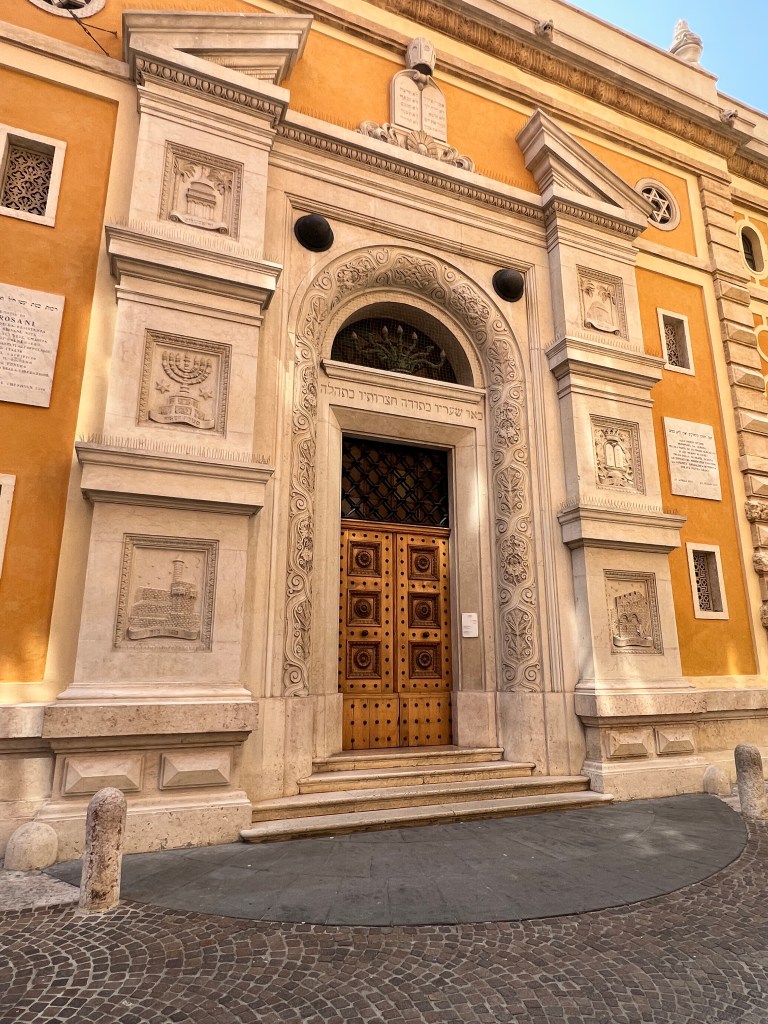
Near the Piazza Erbe is Verona’s main synagogue. First traces of Jewish presence in Verona dates to before the 10th century. The neoclassical building was built in 1864 in the center of what used to be the ghetto. It is still in use and not generally open to the public. The gates of the ghetto were demolished with the arrival of Napoleon’s troops in 1796. Under Austrian rule they were not reintroduced, but it wasn’t until Verona became part of the Kingdom of Italy in 1866 that full social equality was achieved. With the exception of a few buildings, the entire ghetto was torn down.
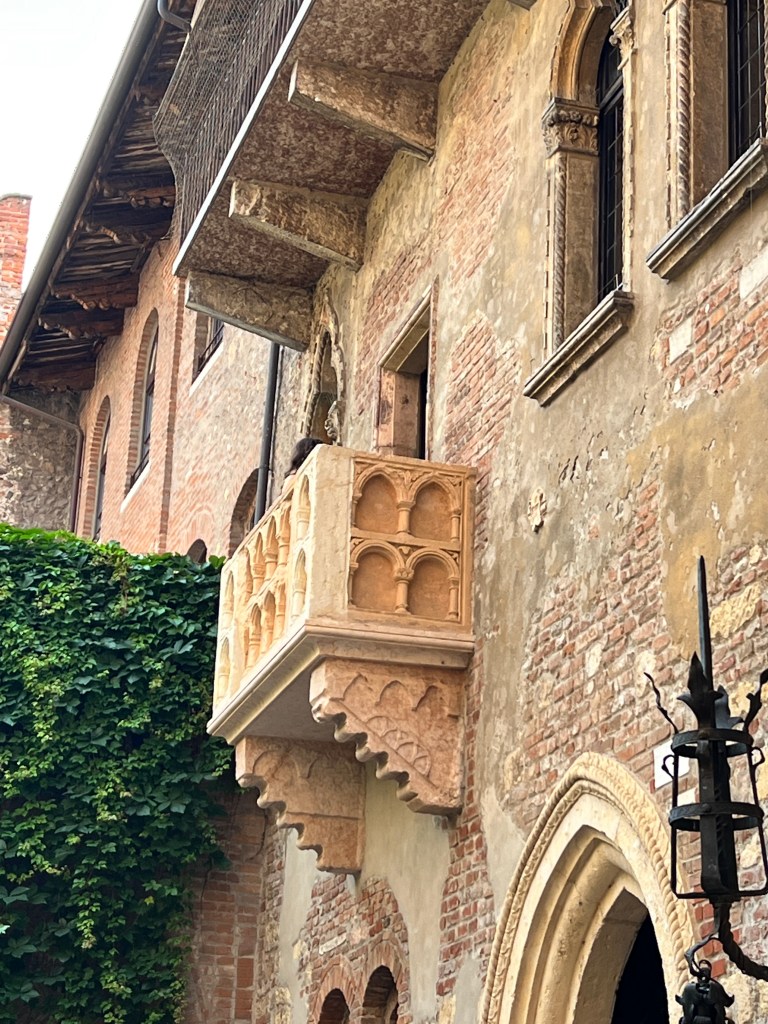
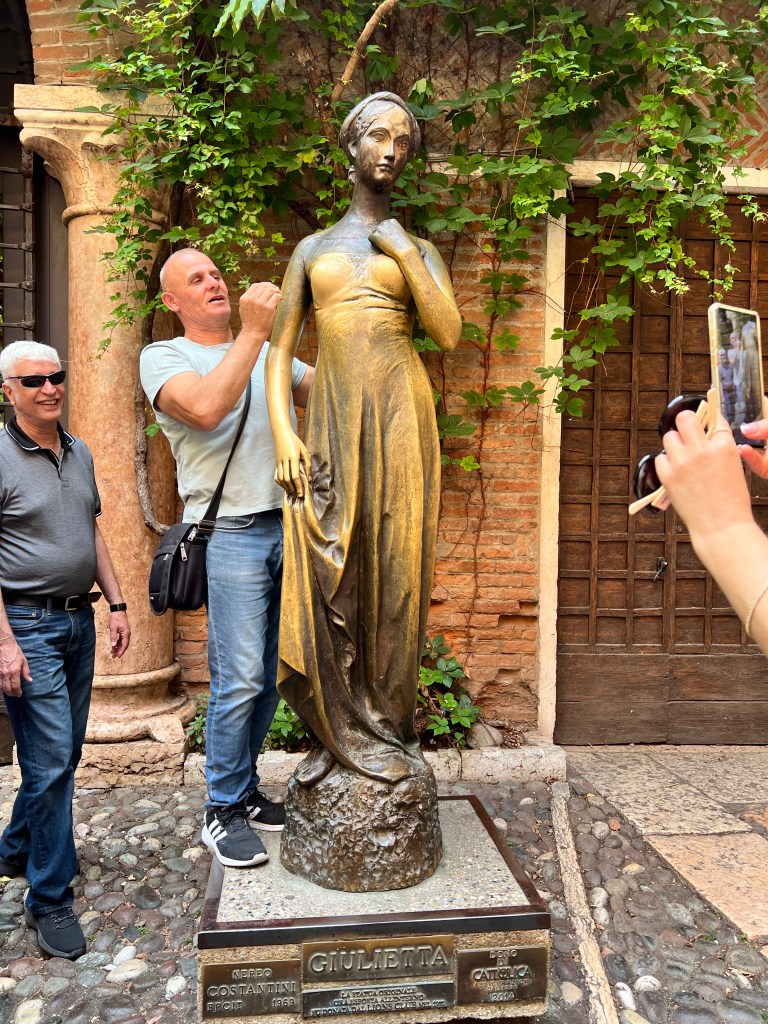
The second most popular tourist sight in Verona is the House of Juliet. People from all over the world pose on the balcony, wait their turn to caress Juliet’s bronze breasts, or write a letter to an imaginary woman. There is even a group of volunteers that answer all of Juliet’s mail. The balcony was actually created in the 1930’s for a movie.
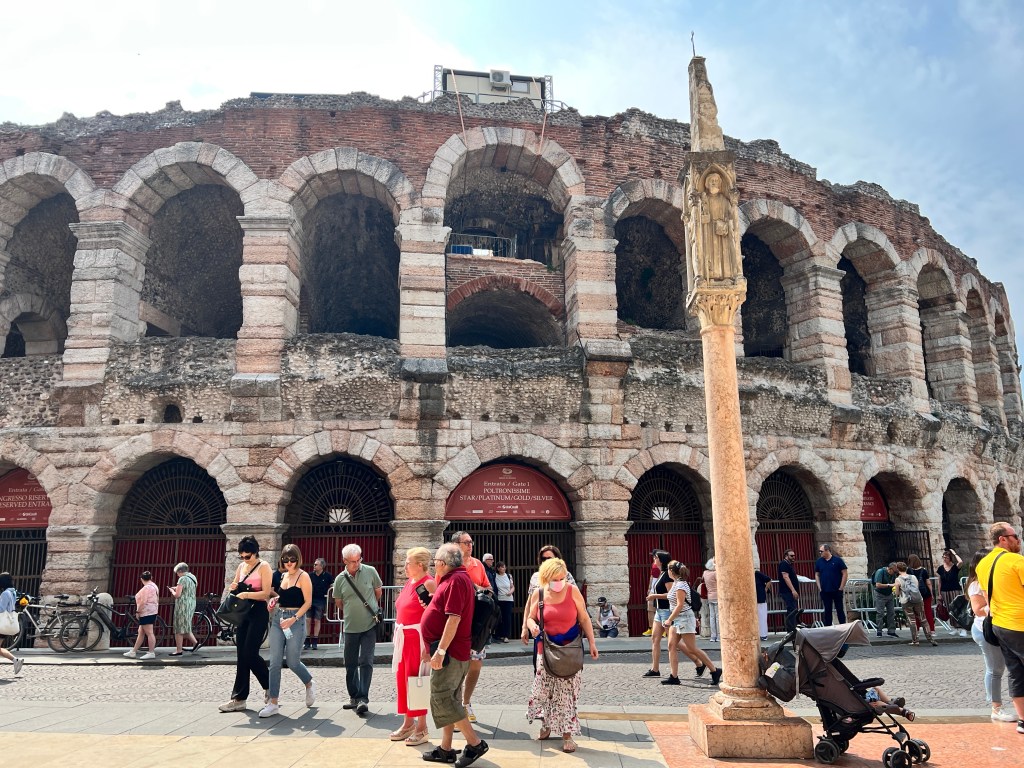
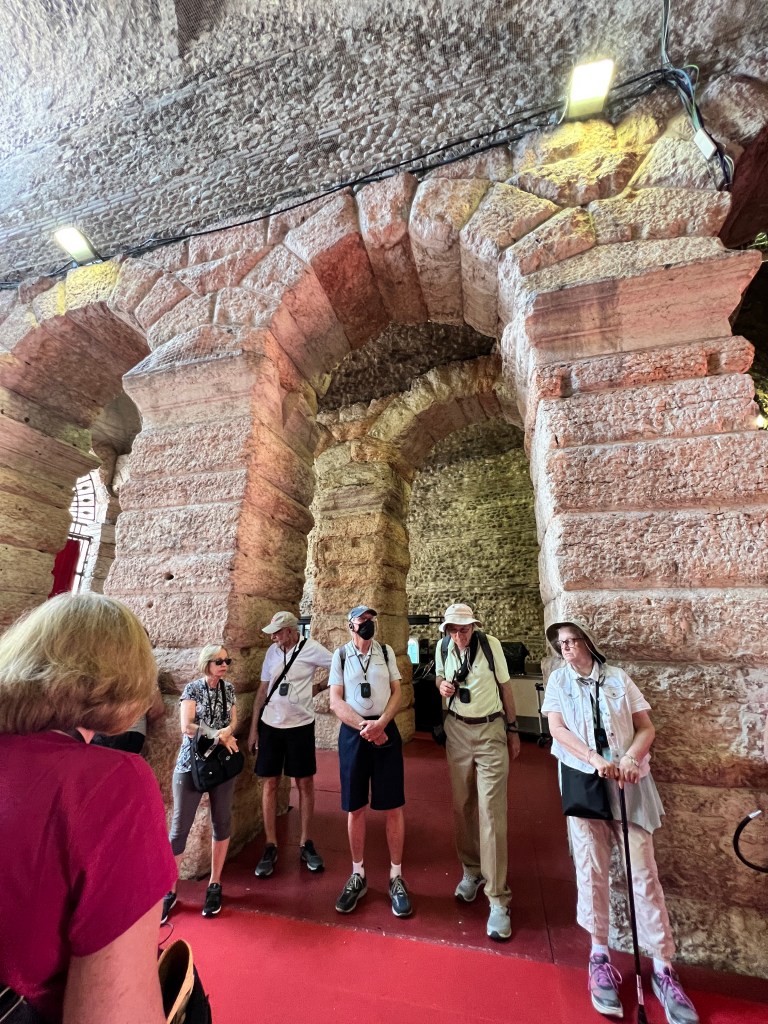
Piazza Bra means “big open space.” It is in this space that we visited Verona’s amphitheater. It is the third largest Roman arena in Italy. Most of the stone is the original pink marble. The stadium was used for gladiator battles and medieval executions. Today it hosts plays, an opera festival, and rock concerts seating up to 25,000 people.
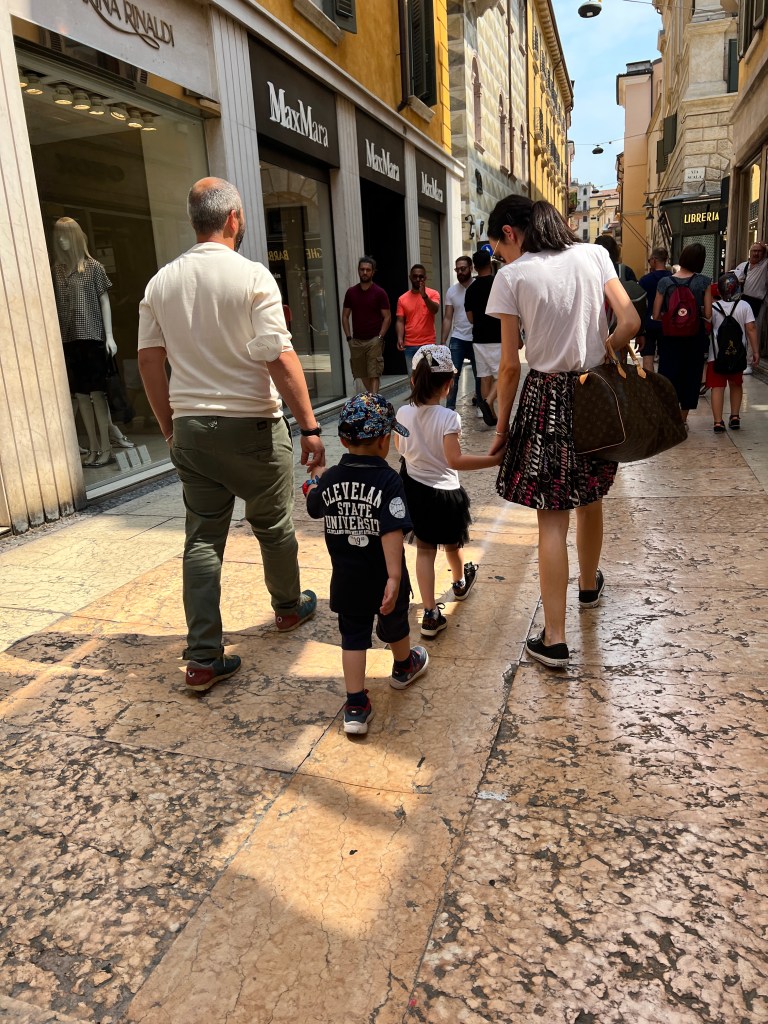
At the tours end, Dan and I spent a little time hunting for gifts for our grandson. It is easy to find gifts for girls, but 10 year old boys, not so easy. We ended up buying him a t-shirt that says gladiator on it and a key ring with a gladiator’s helmet at the market in Piazza Erbe. Yes, I was getting desperate. We also walked along one of Verona’s primary shopping streets before heading back to the hotel to rest until our next activity at 5:30.
In one of the meeting rooms at the hotel we had a surprise session with the author of Letters to Juliet by Ceil Friedman and her sister Lise Friedman. Ceil is an expat from the U.S. living in Verona. She wrote the book in order to better understand why truckloads of letters were addressed to a person that never existed — Juliet, Verona, Italy. Why were people compelled to write to Juliet, and what kinds of advice did they seek? In addition, she discussed how a cadre of volunteers, many of whom were men, leave no letter unanswered. Ceil’s presentation was very enjoyable. The book served as an inspiration for the 2010 movie of that name.
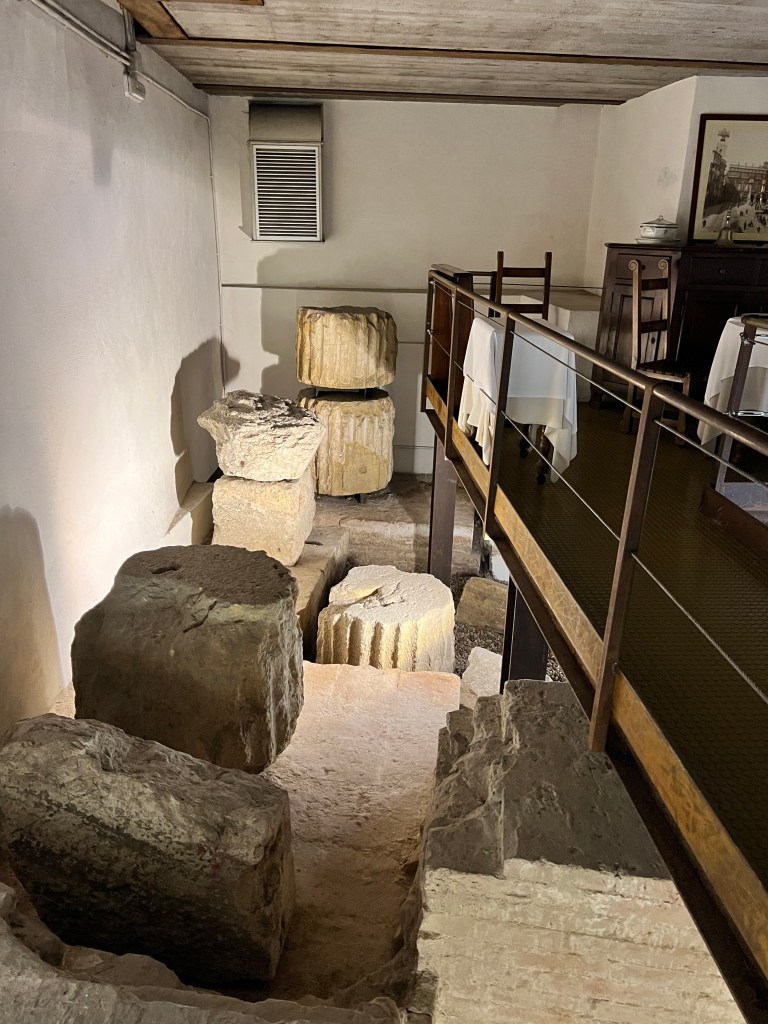
Dinner was at the Ristorante Maffei. Before we sat down, Scott took us for a short excursion down the basement. Down below were Roman ruins at what was then street level. You could even request a table next to the ruins if you were so inclined. This is not unusual. Almost any time you dig down, ruins are found. In fact, whenever a new road or building is being built ruins are almost always found. A team of archeologists is always brought in to access the site and determine what needs to be saved, etc. Dinner was wonderful.
 BY THE WAY WITH WENDY & DAN