
By 10:00 AM we had our breakfast and were ready to meet out tour guide, Ilaria Signorini. Ilaria had several advanced degrees, including one in archeology, and was an expert on the history of Florence. She was to give us crash course on Florence and take us through the Uffizi Gallery. Dan has not been feeling well, with what we think is a sinus infection. He had the option to stay back at the hotel and relax, but he said he felt well enough to come along.
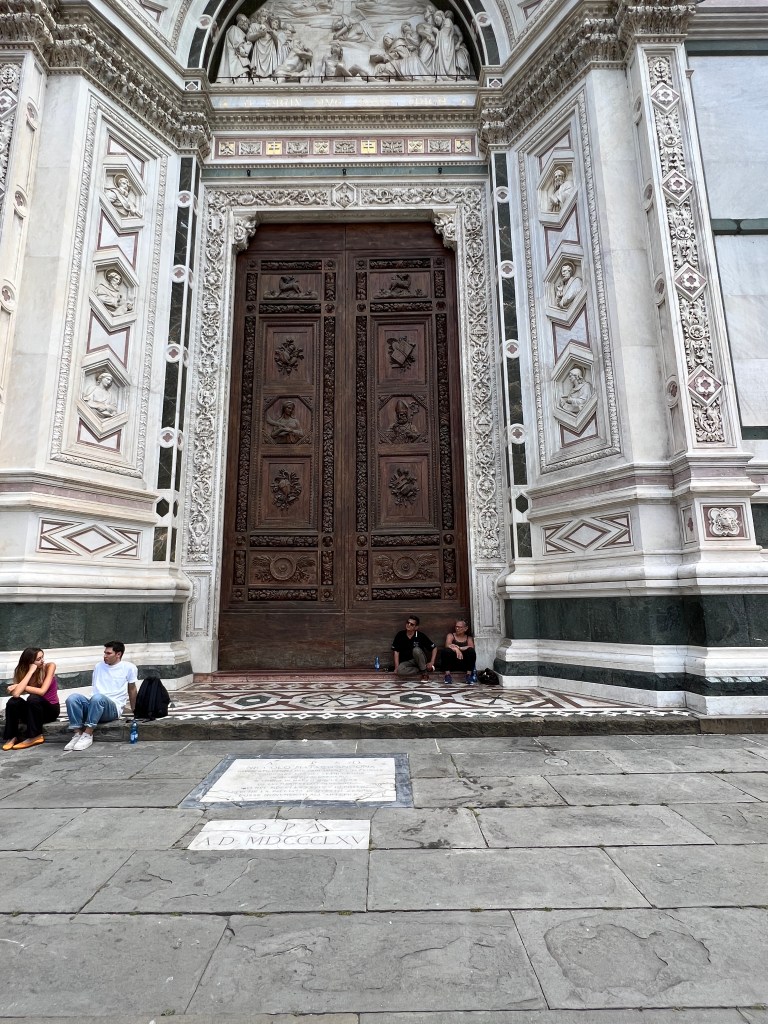
Our first stop was the Santa Croce district. The 14th Century church holds the tombs of Michelangelo, Rossini, Machiavelli, and Galileo. Ilaria told us a facinating story of Niccolo Matas di Ancona. The Church’s facade was unfinished due to lack of funds. Matas offered to complete the work at no charge, but what makes the story more interesting was that Matas was Jewish. At first the Franciscans didn’t know whether or not they should accept his generosity, but they eventually agreed. He did as he had promised, and the facade was completed. In return Matas requested a small favor that upon his death he would be buried in the church along with the other famous Florentines. This, however, the Franciscans could not do. As a compromise, he was eventually buried right outside the front door.
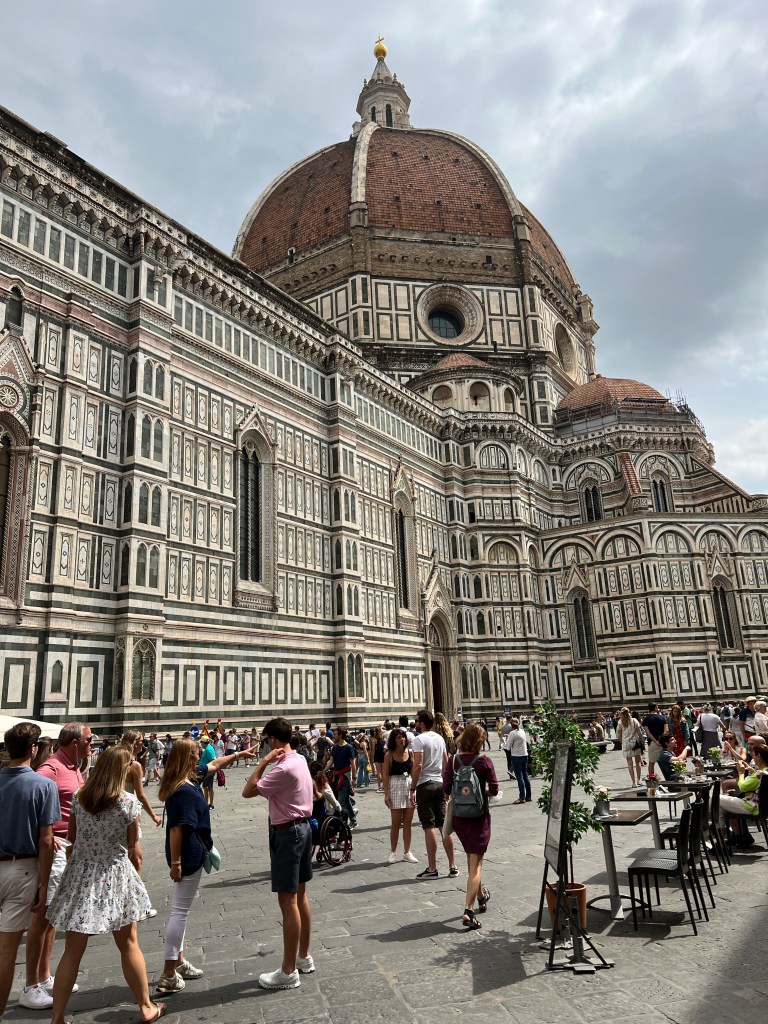
Ilaria then led us to the Duomo, Baptistery and Campanile. One cannot help but be impressed with the the buildings covered in pink, green and white Tuscan marble. The facade on the Duomo, is an imitation of the decorative Florentine style found on the bell tower, only dates from the 1870’s. It’s formal name is Santa Maria del Fiore, and it is the third largest church in the world. The nave was completed in 1420 with the exception of the 140 foot hole in the roof. A competition was held by the city for someone to design a solution for covering the hole. Brunelleschi won the competition and constructed his magnificent dome —the first built since the Romans.
The Baptistery is known for its bronze doors created by Lorenzo Ghiberti. The originals are in the Duomo Museum ,which we hope to see later. Ghiberti used mathematics to create the illusion of receding distances on a flat surface. There was also the 270 foot Campanile (Giotto’s Tower).
Ilaria next showed us the Mercato Nuovo, also known as the Straw Market. It is still a marketplace, but now its merchants sell leather goods. Due to the proliferation of cheap products imported from China, the government now only allow purveyors of authentic Italian leather goods to set up shop. There were measurements stamped into the walls so that the merchants in the days of yore could not cheat their customers. Il Porcellino (the Piglet) is also found there. It is thought that if you place coins in his mouth and pet his snout you will return to Florence. (Basically a take off on the Trevi Fountain in Rome.) His shiny snout has been replaced many times because of this custom.

The Piazza della Republican came next. This was the site of the original Roman Forum. In the 1500’s it served as the center of the Jewish quarter. In 1571 Cosimo I had the area walled up into an official ghetto. It wasn’t until 1870 that ghetto was razed to make room for a more modern city.
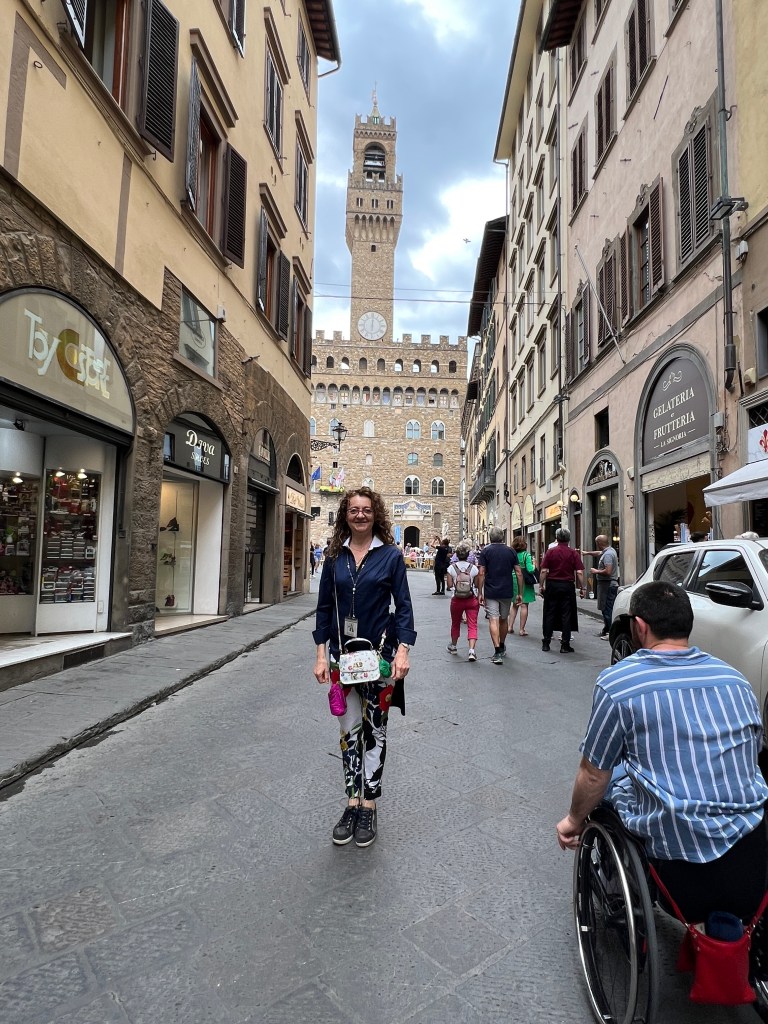
It was now getting close to our entry time to the Uffizi Gallery and we headed to the beautiful Piazza della Signoria. It is dominated by the Palazzo Vecchio tower which served as a town hall in Renaissance times. In 1540 Cosimo I made the building his palace. The Piazza has been the center of the city’s celebrations and executions. Now it offers a large number of restaurants and cafes. Luckily we had place to sit because Dan had reached his limit and had become dehydrated, and on the verge of fainting. While we ordered some drinks and food, Ilaria went to get our entry tickets.
When Ilaria returned I headed to the Uffizi Gallery with her and left Dan behind to recuperate. With her help, I was able to see the most important artwork housed in the museum. The first painting we viewed was the Madonna and Child painted by Filipino Lippi. Lippi added something to his paintings not often seen at the time, and that was real flesh and blood human beings. He was a monk, but left the order after having a relationship with a nun who bore him two children. Some suspect that the woman portrayed in this painting was his lover. They were lucky in that the Medici in power at the time told the order to leave the lovers alone.
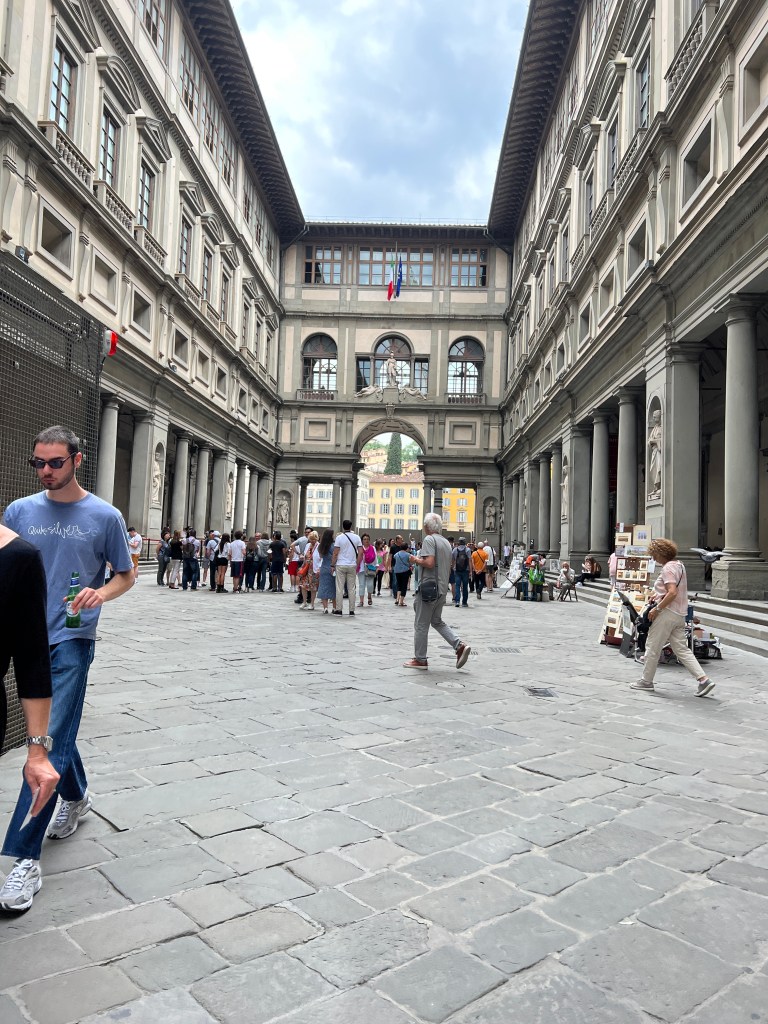

Next was Palo Uccello’s The Battle of San Romano. It was one of the first attempts at painting three dimentionally. I didn’t think it was a particularly good painting, but the artist was credited for his originality.

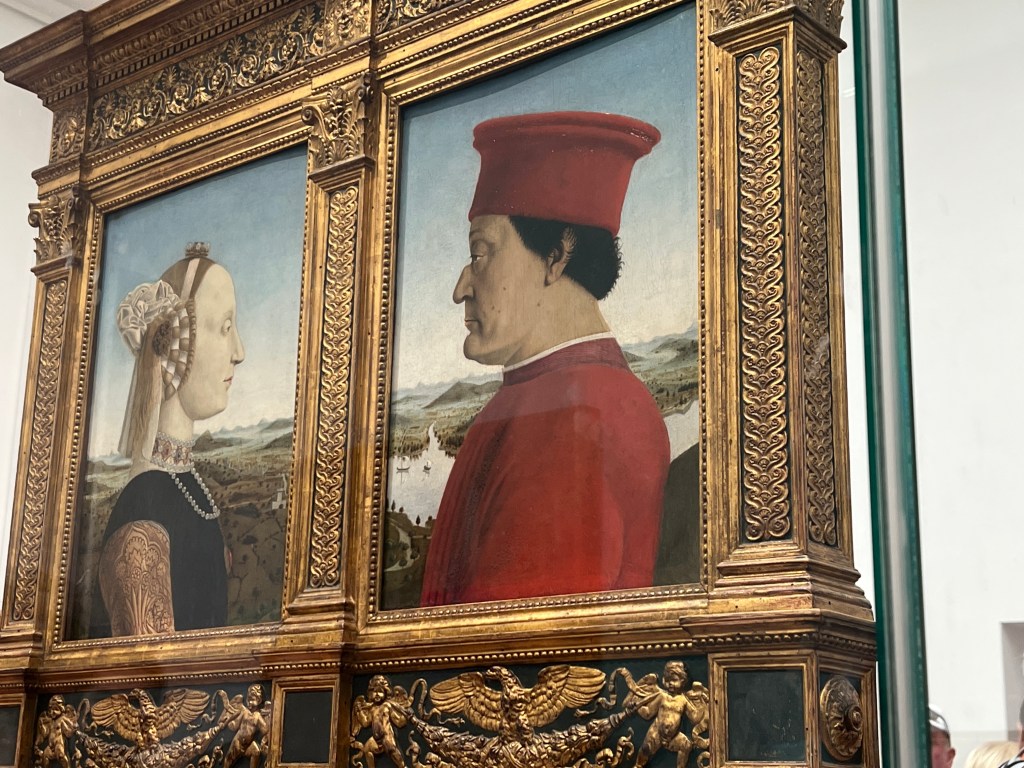
During the Renaissance, paintings no longer had to include saints or religious subjects, but people. Federico da Montefeltro had lost his right eye. In addition, it is said that he had part of his nose cut away so he could see better out of his left eye. Thus the side view of the couple. To make this painting even creepier, some think that the portrait is of his wife after her death, thus her white coloring. The double portrait was done by Pietro della Francesca.
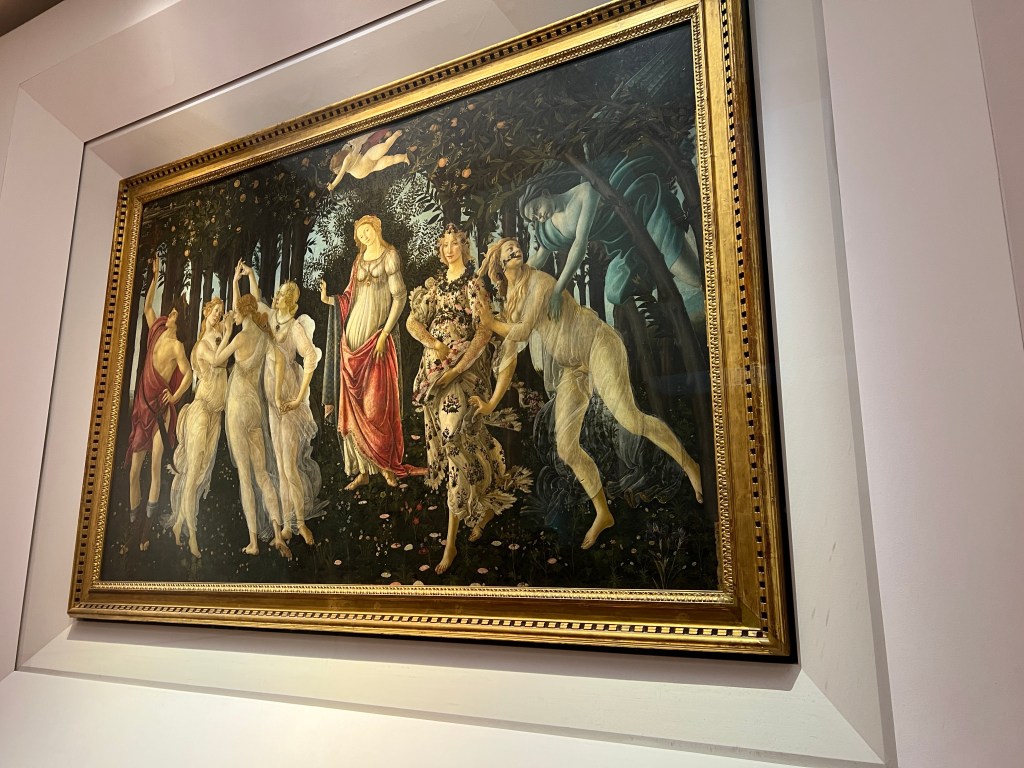
Sandro Botticelli’s paintings were next on the to see list. Primavera or Spring is a large painting depicting a group of figures from classical mythology. Apparently Botticelli liked to depict pregnant women, and all the female figures in the painting are pregnant with the exception of one. She is gazing at a young man at the far left. Ilaria mentioned it is thought that the painting was created in celebration of the engagement of a nobelman’s daughter— the girl gazing at the young man. The inference being that before long she too would be pregnant. Over a 100 species of plants are accurately depicted in this painting including some that are now extinct.
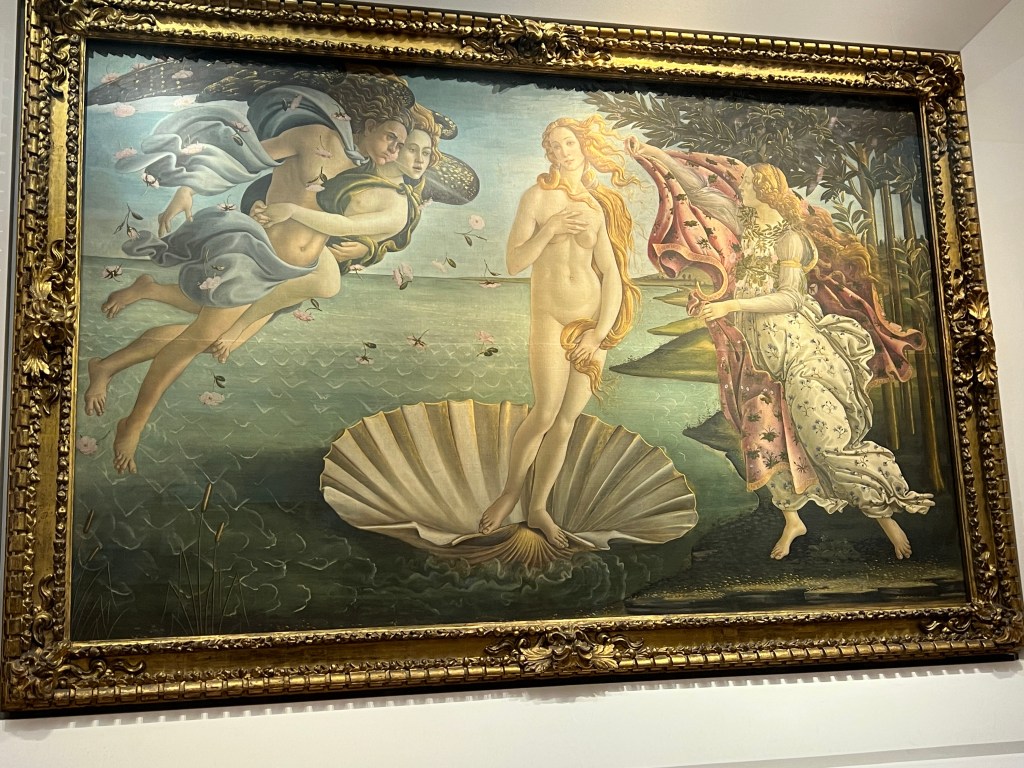
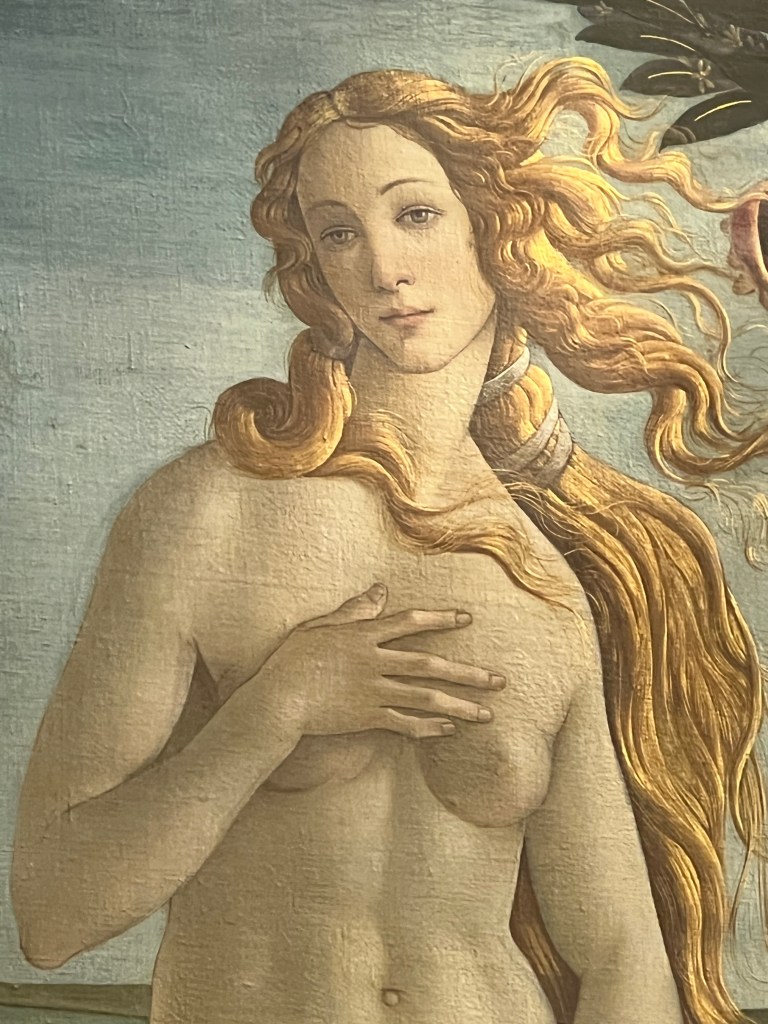
Botticelli’s Birth of Venus was in the same room. That was a lot of beauty to take in. The artist thought that physical beauty was part of appreciating God. Here the goddess Venus is arriving at the shore after her birth, when she emerged from the sea fully-grown. His painting Calumny of Apelles was a political statement. According to Ilaria the artist had become disillusioned with those in power after Lorenzo Medici died and the economy fell apart. It is much darker than his earlier works.
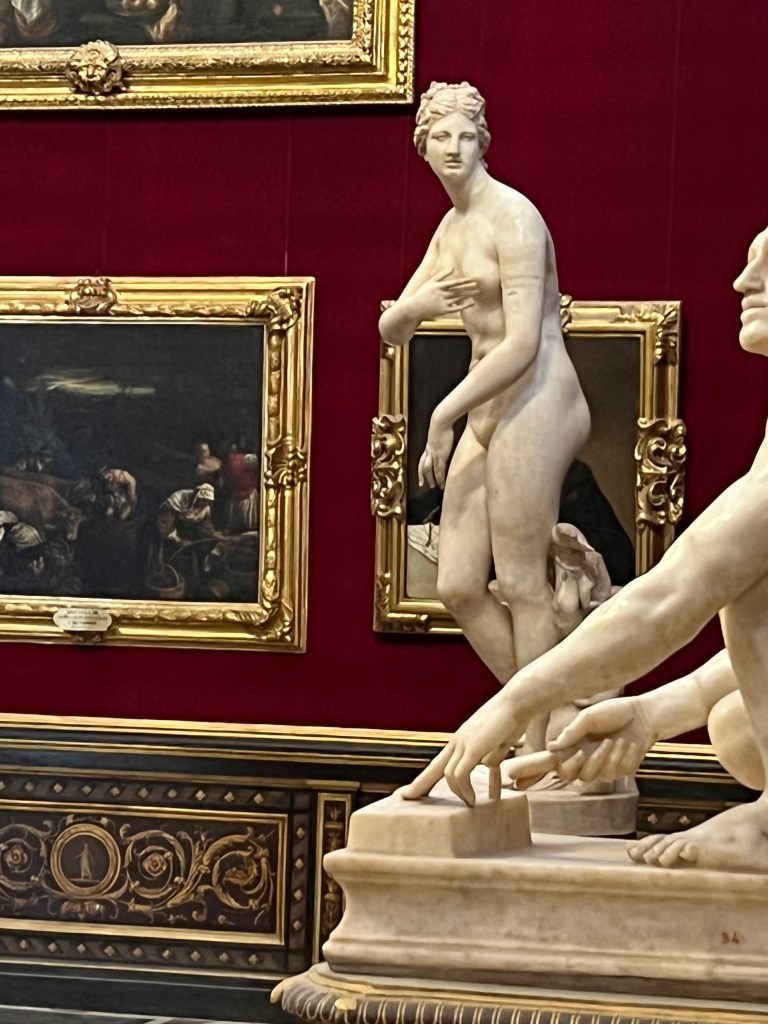
Now for a statue, Venus de’Medici from 1st century BC. Her pose is similar to Botticelli’s Venus. It is a Roman copy of a statue carved by Praxiteles. It was held to be the epitome of ideal beauty and sexuality in the 18th and 19th centuries.
I couldn’t leave the museum without seeing The Annunciation by Leonardo da Vinci, dated to 1472-1476. He was still an apprentice when he completed this work. Ilaria mentioned that almost all depictions of Mary showed her inside, but this one depicts her outdoors. She also mentioned something about the juxtiposition of the table and the angel which Leonardo used to make it clear that he was no longer merely a student of painting, but a master.
Adoration of the Magi by Leonardo da Vinci was left unfinished. He left for Milan which is one reason that is given for it being incomplete. Ilaria mentioned that it may also have been that he became so overcome with the depressing scene that he had painted that he simply couldn’t complete it.

Ilaria was wrapping up my tour when all of sudden Dan appeared. How he found us, I don’t know given that there are hundreds of galleries. Fortunately he was feeling much better, so as Ilaria said her goodbyes, Dan and I continued to view a few more galleries before we too left the Uffizi and headed back to the hotel. We were to meet Eileen Strauss and Jim Murdoch, and Terry and Paul Benfer for a food tour of the Oltrarno neighborhood this evening. They had all just arrived in Italy.
Who do we meet in the lobby of the hotel when we arrive, but Paul Benfer. We had only met via Zoom. He told us Eileen and Jim had also arrived. At 5:00 PM we met in the lobby and headed to the meeting point for our food tour guide.
At L’Radii di santo Spirito we had the chance to taste several regional specialties of Florence. Coccola consisted off fried pizza dough in which you put a piece of Tuscan ham along with a creamy cow cheese called stracchino; some grilled pork sausage, and lampredotto. I gave it all a try, but the lampredotto, which is made from the 4th stomach of a cow was not my favorite. It is a popular street food in Florence and vendors sell sandwiches filled with it. Basically all you taste is the sauce in which the stomach is cooked, but I found the texture “yucky.” Fortunately the Prosecco they served with it helped wash away the taste.
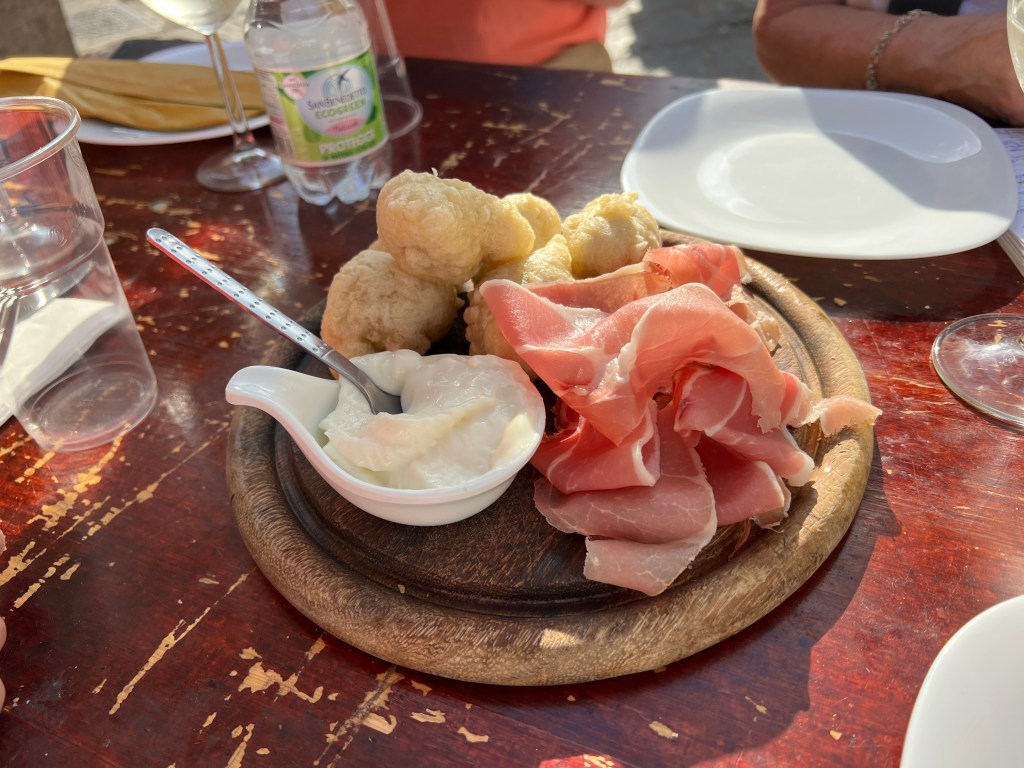
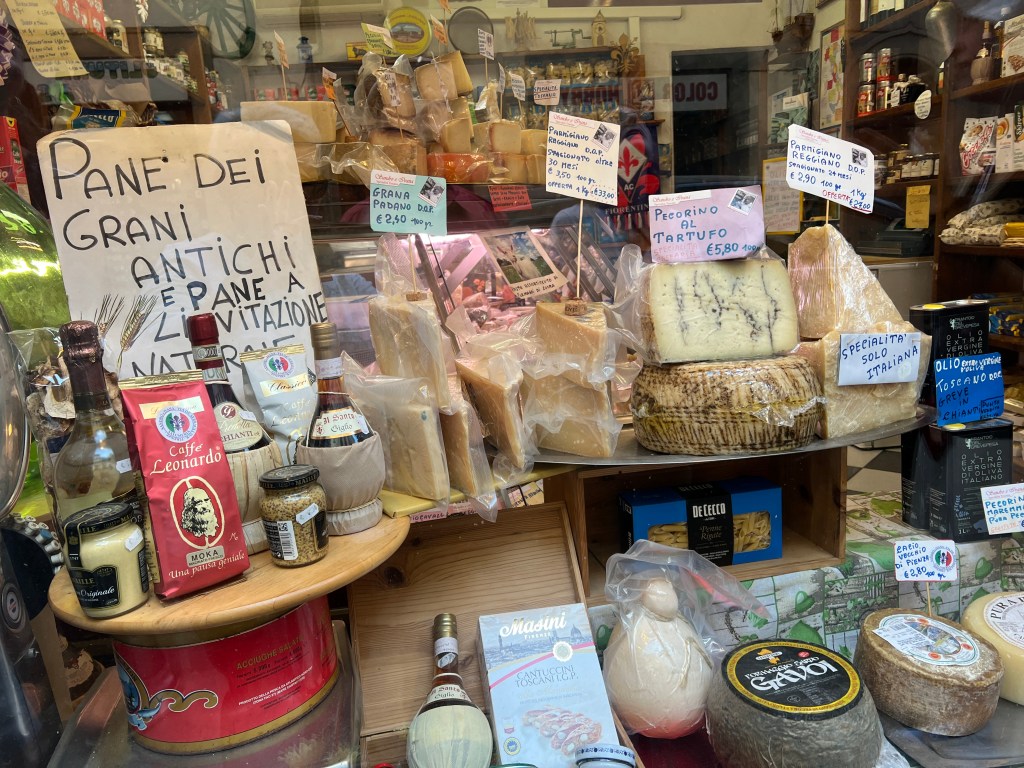
Our next stop was at Sandro & Ivana (Cheese and Salami). The owner of the shop has been involved in the cheese business since he was a child. Here we had the chance to taste Tuscan cheese and cured meat. There were two pecorino (sheep) cheeses, one plain and one with truffle. Along with the cheese came some of Florence’s tasteless bread. The bread is tasteless because of wars between Sienna and Florence. Because Sienna controlled the salt trade, Florence decided to stop using salt as much as possible. In addition, they now claim that their tasteless bread allows the flavors of meats and cheeses to be more fully appreciated. I loved the pecorino with truffle. I would buy it to take home if I could. We also tried a salami aged with fennel seed (finocchiona), which was quite tasty.
One of our favorite stops was at the Florence Food Studio. The owner was making cartucci when we arrived. Biscotti is used to describe biscuits or most types of cookies, but a Mandel bread type of sliced cookie often with almonds, goes by cartucci. Just like when I make Mandel bread after it is baked and sliced it is put back in the oven to become more dry. If fresh cartucci wasn’t enough, the practice is to dip it in a sweet Tuscan dessert wine. The one we had was called Santo Spirito made by the Frescobaldi family. Delicious.
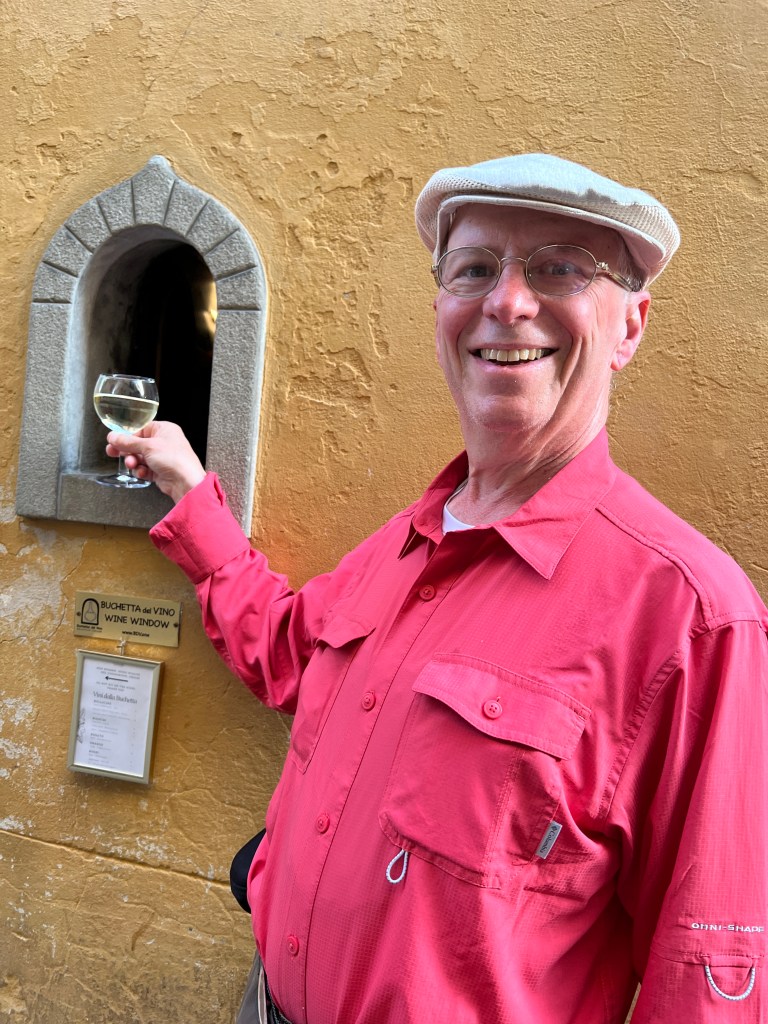
A fun experience was getting wine from a wine door. These were little door like openings in the street where during the Renaissance you could ring a bell and have your wine container filled with the owner’s homemade wine. For us, we rang a bell and ordered glasses of red or white wine, which were then handed to us through the wine door. We then went inside the restaurant, Barbae, where we continued to enjoy our wine along with a Crostini, a wonderful bruschetta topped with a soft mozzarella cheese and tomatoes. The owner of the restaurant was the first in the area to make use of the historic wine doors.
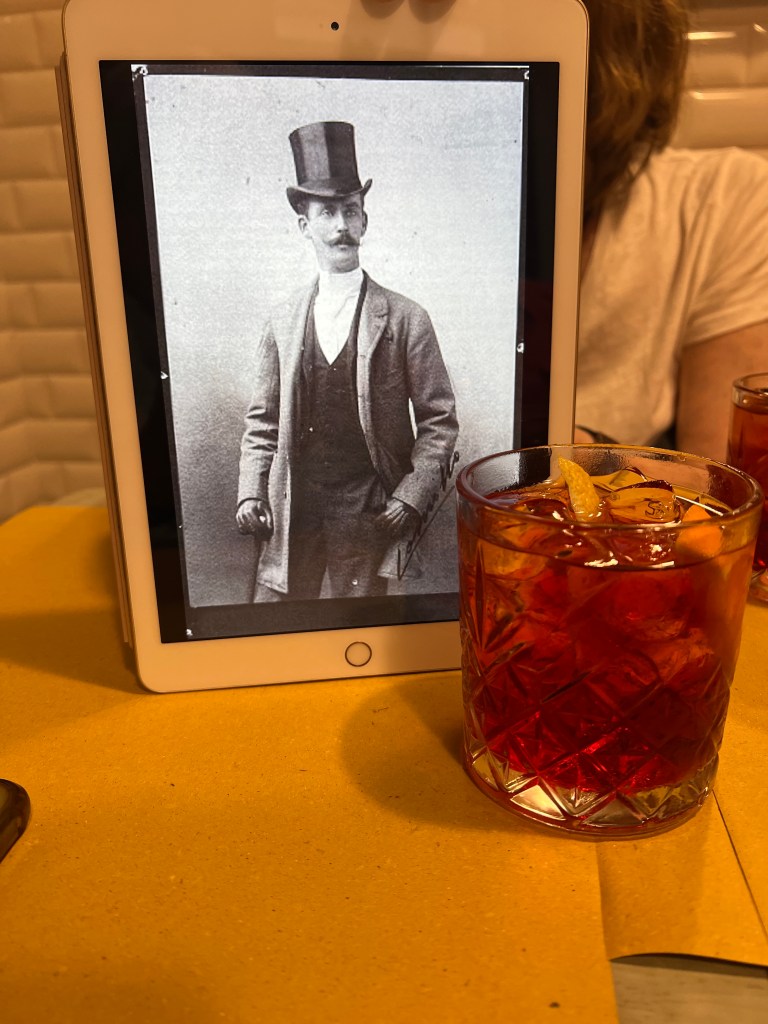
We weren’t done drinking, even though we had enough wine by now. At Fantappie, a wine shop, we had a demonstration of the making of the a Negroni cocktail, one made with gin and the less authentic one referred to as the “Negroni mistake”, that is made with Prosecco. The original was developed by Pascal Olivier Count de Negroni. It is made with lots of ice, one part gin (preferably English), one part vermouth Russo, and one part Compari with an orange slice. Each of us received a large glass of either the traditional or mistake Negroni. Along with the drink we enjoyed a wild boar stew, and papa al pomodoro. The papa was made with stale bread cooked with a tomato-based sauce. Essentially it is a kind of bread soup. As for the Negroni, it was bitter and strong, none of us drank much of it. However, as the ice melted it seemed to improve as did I.
The last stop was at an artisan gelato shop. There were many interesting flavors and it was yummy as usual. It was a nice way to finish up our tour. We all then strolled slowly back to our hotel.
 BY THE WAY WITH WENDY & DAN