
Goodbye Sorrento. Our driver, Pasquale picked us up at 8 AM and we headed to Pompeii. Pasquale was like a character from The Godfather. He was middle aged, casually dressed, and had a wonderful gruff but friendly personality. He tried to engage us in conversation, but it was difficult since his English was as limited as my Duolingo Italian. We arrived in Pompeii before the park opened in plenty of time to connect with our guide for the day, Franco.
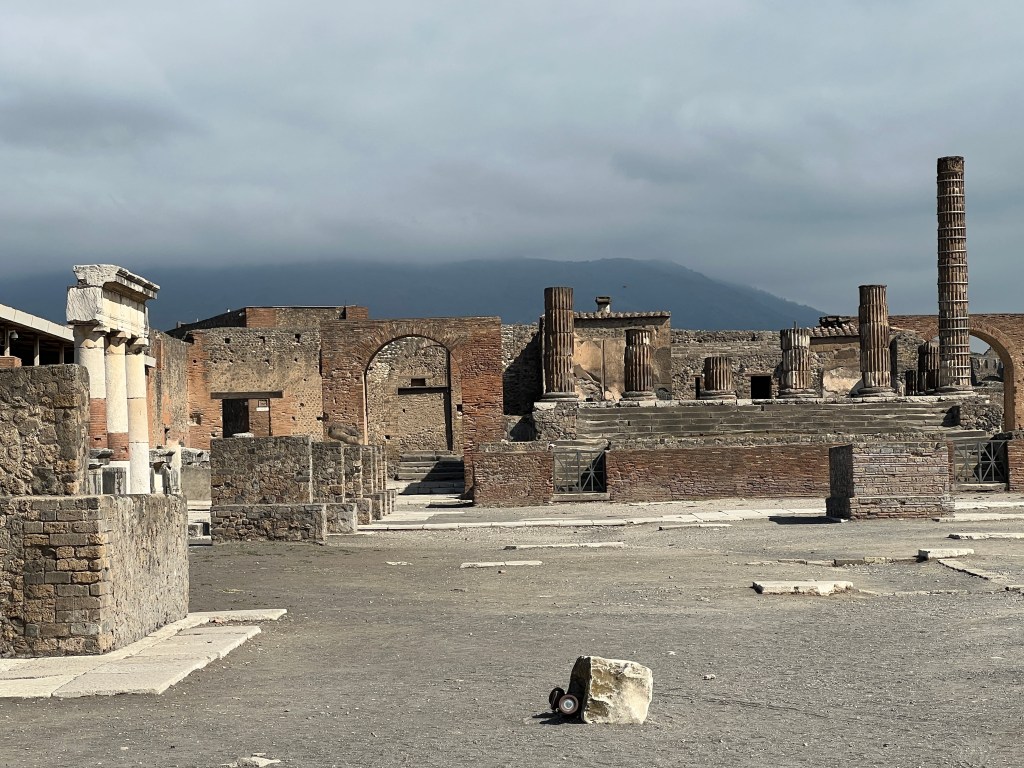
Dan and I felt like celebrities as Franco cut through all of the lines and took us directly into Pompeii. He was a slightly built energetic man who was an expert on antiquities. Our first impression was the vastness of Pompeii. It would take a full day, not the 2 hours we had, to see the entire place. Approximately 1/3 of the city of 20,000 people remains covered in debris that is 30 feet deep. Pompeii had been an important producer of a specialty fish oil product and woolen goods sitting directly on the Mediterranean. After the Mt. Vesuvius eruption it was 3 miles from the coast.
The majority of the population left Pompeii when Mt. Vesuvius first erupted on August 24, A.D. 79. On the second day, ash and pumus filled the sky, but the 3rd day was the worst. Poison gas killed anyone that remained in the city. Preserved by the layers of ooze and ash, Pompeii gives an overview of what how people lived in a middle class Roman town, with its grid like streets and the remains of buildings.
Written records had spoken about the existence of Pompeii, but no one knew where it had been buried. Its location was accidentally discovered in 1599 by a farmer, but excavations didn’t begin until 1748 under the patronage of Don Carlos, King of Naples. The King had an interest in art and antiquities. Anything of value was removed and brought to Naples. Digging proved to be extremely expensive and was stopped, not resuming again until the 20th century. Most of the original artifacts are in the Archaeological Museum in Naples.

Franco provided us with an overwhelming amount of information. If I had managed to remember everything he told us, which I do not, and repeated it all in this blog you would be reading a 500 page text book. Instead, I’m concentrating on a few things that Dan and I found the most interesting.
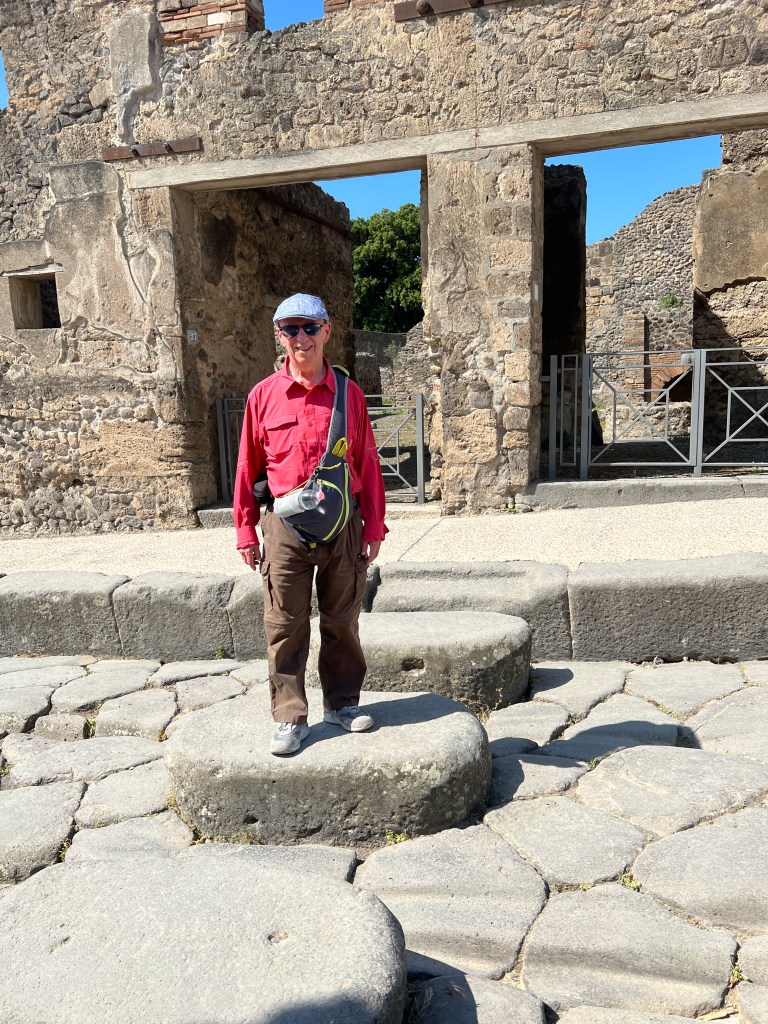
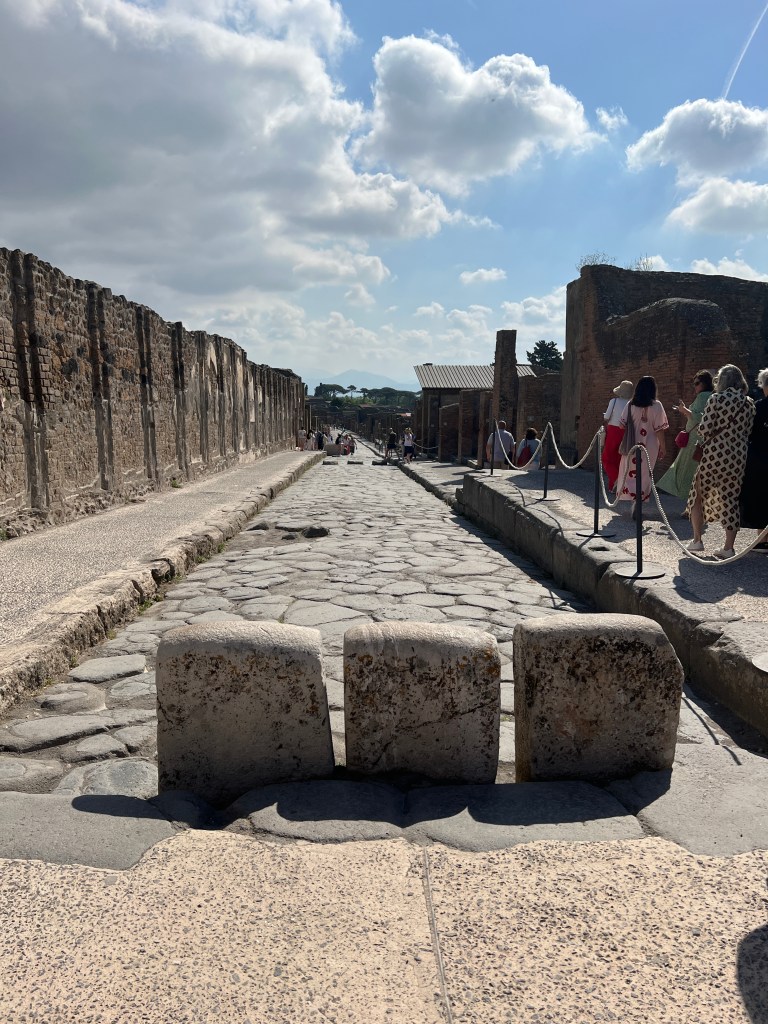
Pompeii had streets with elevated sidewalks. People tended to throw garbage into the streets, but the Romans liked things clean so the streets would be flooded daily. The ground was hard from past volcanic activity and they could not install a drainage system. As a result, the streets would remain very wet. In order to keep the feet of pedestrians dry large stepping stones were placed in the roads allowing them to cross. Chariots and wagons could straddle these stepping stones because all vehicles had standard sized axels. The standard is still used today on vehicles throughout the world.
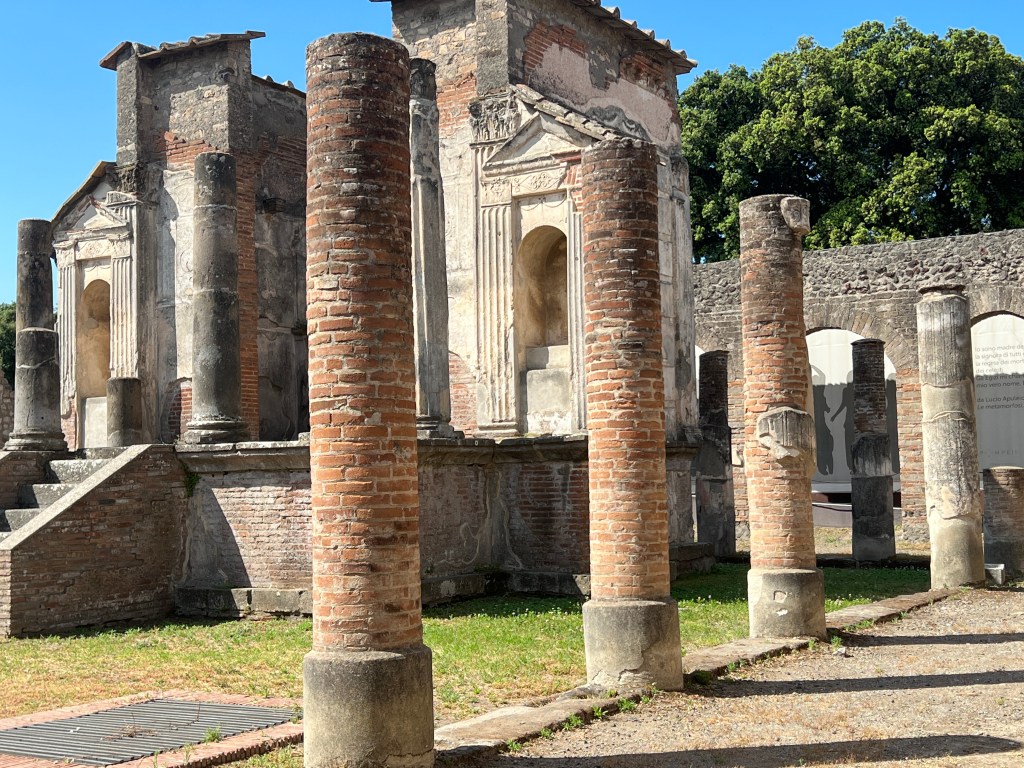
Romans were fairly open minded when it came to religious worship. As long as you bowed down to the Emperor, it didn’t matter what God(s) you worshipped. Within Pompeii is a rare Egyptian temple dedicated to Isis. It is thought to be the only one to be found outside of Egypt.
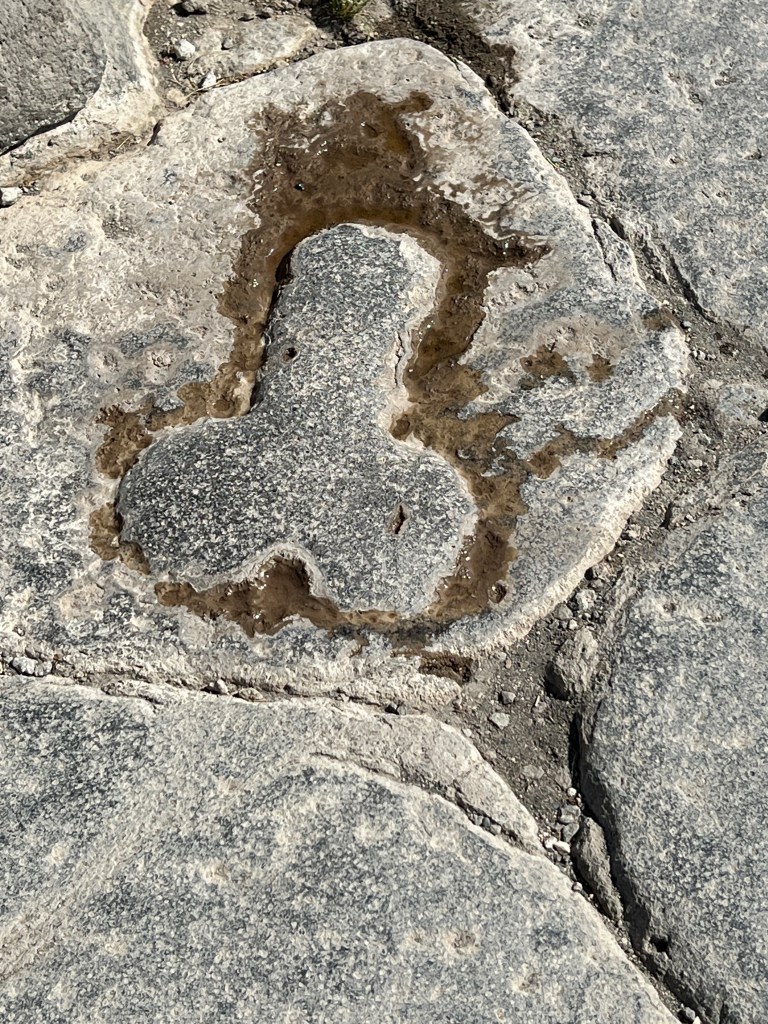
Carved directly into the pavement on the sidewalk was a penis pointing the way toward one of several brothels located in the city. Inside the brothel itself rooms had paintings of what appeared to be a menu of services a customer could pick from. Customers came from all over the Mediterranean and spoke many different languages. These signs would have made it easier for them to communicate their wishes. The pictures were quite graphic.
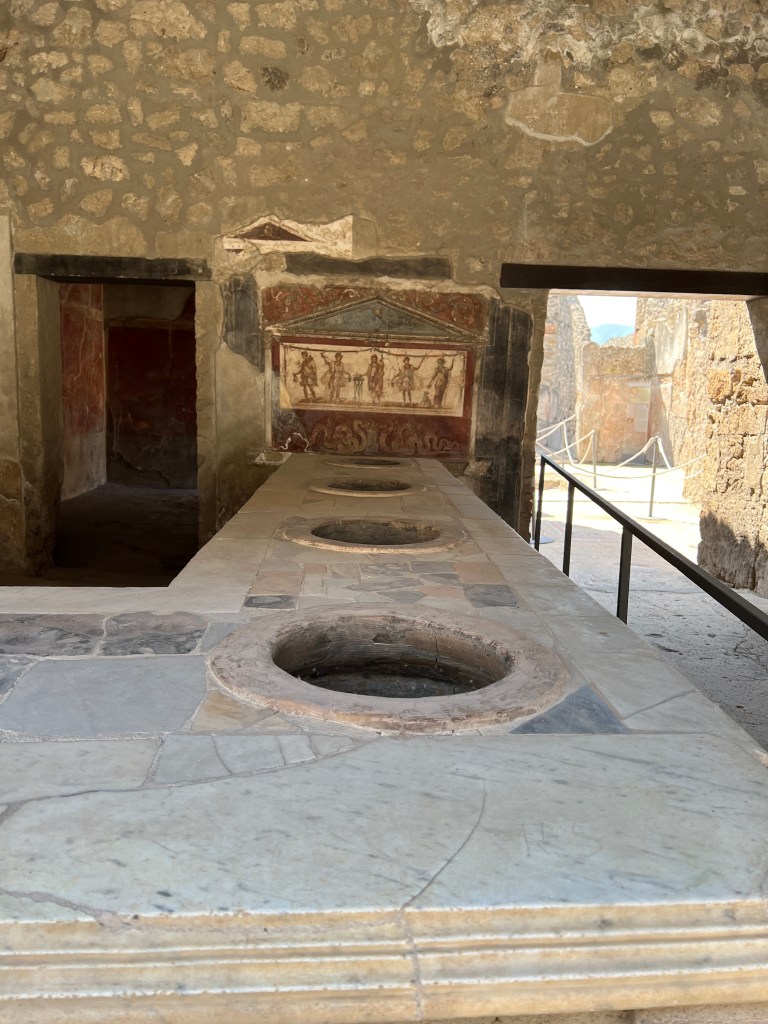
Most Romans didn’t cook for themselves, and certainly visitors required food along with the other amenities the city offered them. Pompeii had over 120 fast food places. Thermopylae were public dining establishments. One can still see the brick counters decorated with marble or terracotta slabs, into which were sunk the jars (folio) containing wine, soup, etc. The pots kept the food and drink hot or cool. Awnings protected diners from the sun. At night accordion style doors would allow these small business to close up for the night. You can see the grooves in the pavement where these doors would slide. Spaces without grooves were probably living quarters.

A one hundred mile long aqueduct carried fresh water down from the hills to a reservoir. If you paid extra, lead pipes could be connected to your home or business so that fresh water would be supplied. For the rest of the population, water was available at public fountains located throughout the city. The water would also be used for washing the streets, as mentioned earlier, and for public baths.
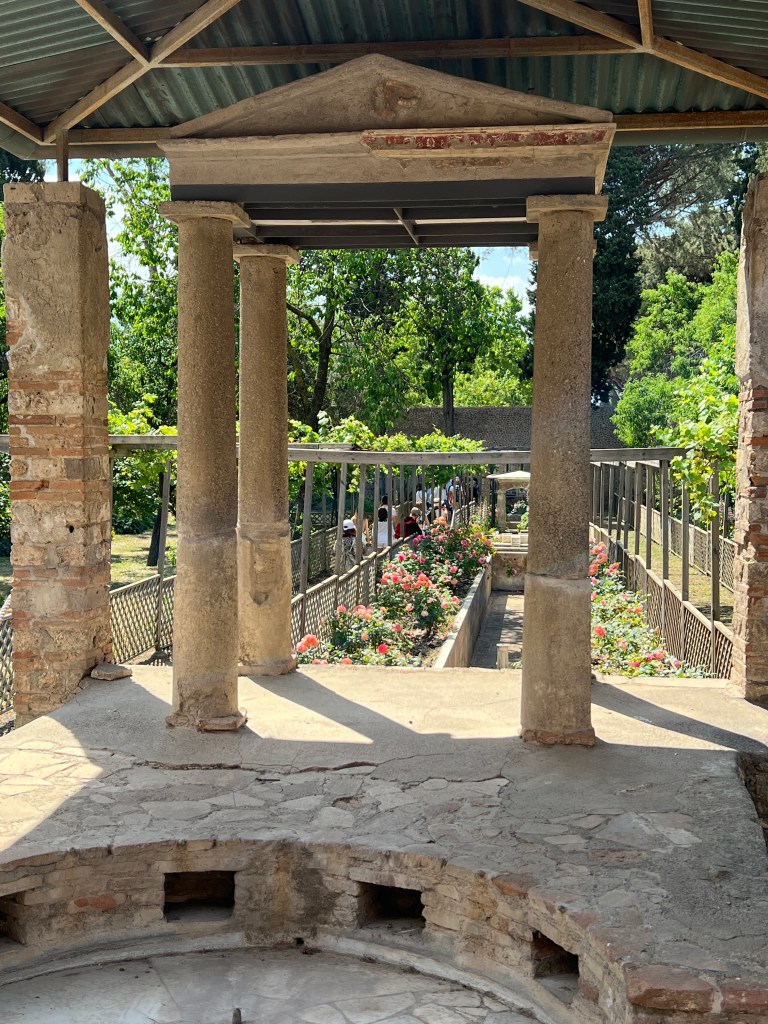
Several homes in Pompeii were those of the wealthy. The most impressive home we saw was the House of the Faun. You were greeted with a mosaic greeting of “HAVE” (hail to you). Inside was a small bronze statue of the Dancing Faun. The most impressive thing, however, was a floor mosaic portraying the Battle of Alexander the Great victory over Darius and the Persians. Both pieces are found in the Archeological Museum in Naples. Another cute touch at some of the homes would be a mosaic of a dog right at the front door. The thought is that it warned a thief that a dog was present.

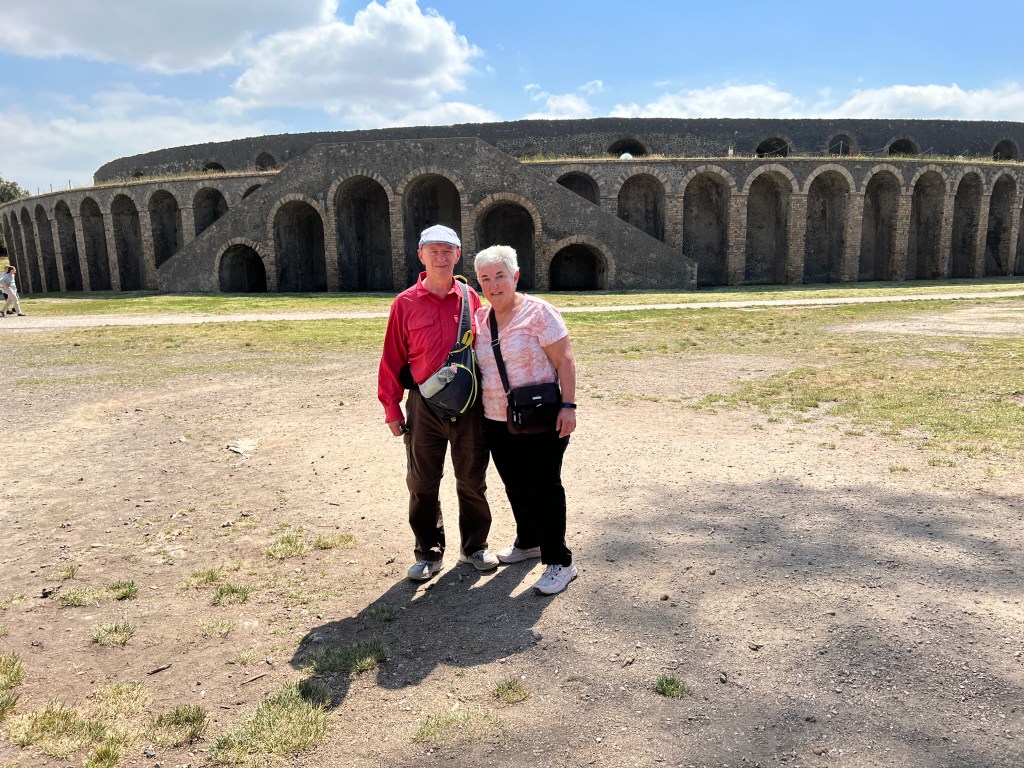
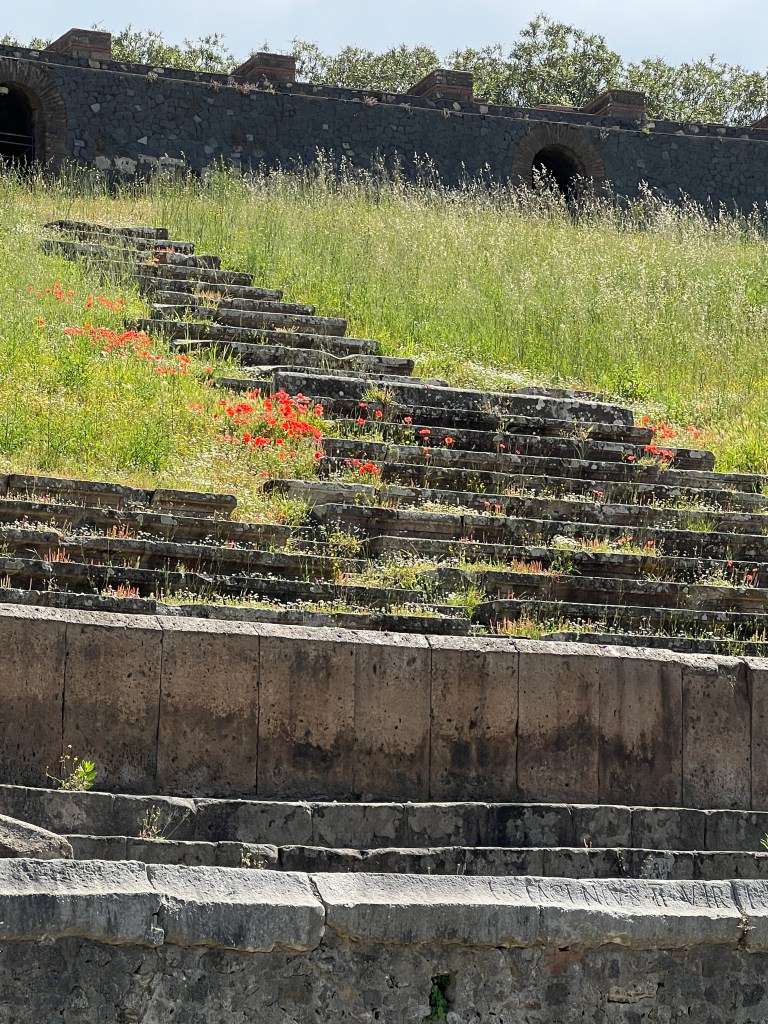
No Roman city would be complete without a theater, amphitheater, and baths. Politicians at the time wanted to please the populace and offered these services for free. They would promote themselves with advertisements sponsored by local businesses. Some of those ads were still visible. Merchants also would advertise their wares with signage. One example we saw was for the sale of wine.

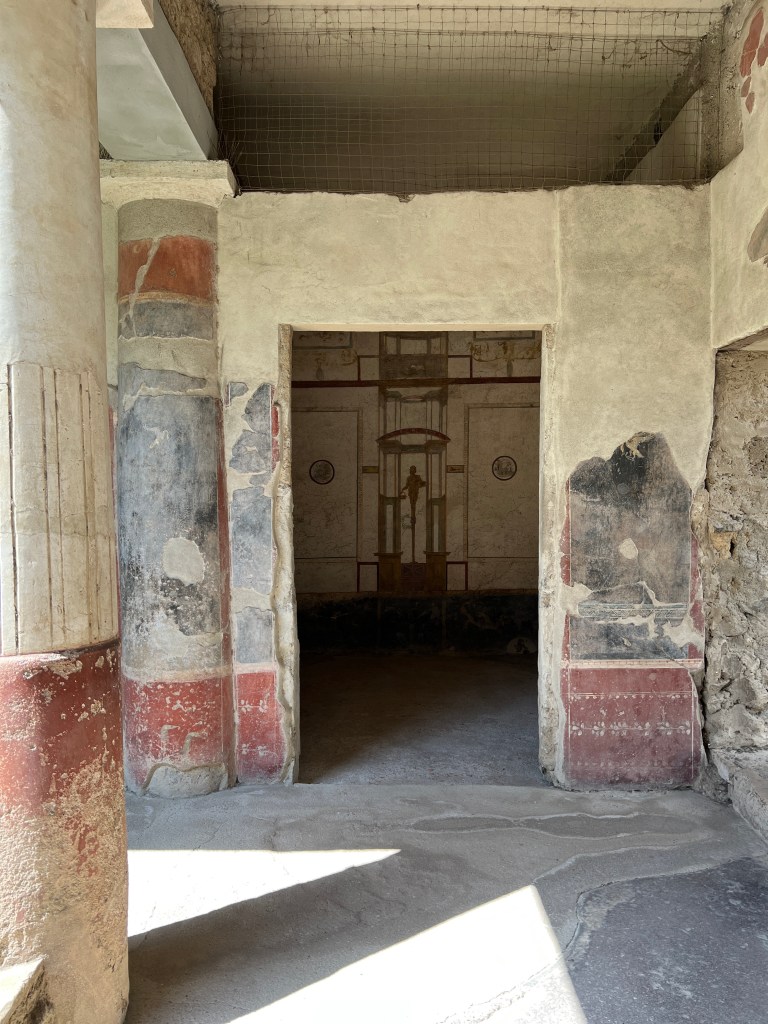
No Roman villas had windows that faced the outside of the home. This was primarily due for security reasons. As a result, much of the artwork found on the walls were done in a style that attempted to give the sensation of openness, since the insides would often be rather dark.
I could go on and on, but I’m already saying too much. After our two hours was almost up, Franco took us to see “the bodies.” You can’t come away from seeing that without an even greater sense of the tragedy that happened here.
Right on cue we met up with Pasquale and were whisked away to Herculaneum. The signage spelled it. Ercolano. It had been a small fishing town of 4,000 people before being destroyed by Mt. Vesuvius. Several wealthy Roman families built their summer homes in the town taking advantage of being directly on the coast. Although much smaller than Pompeii, the building here are better preserved.
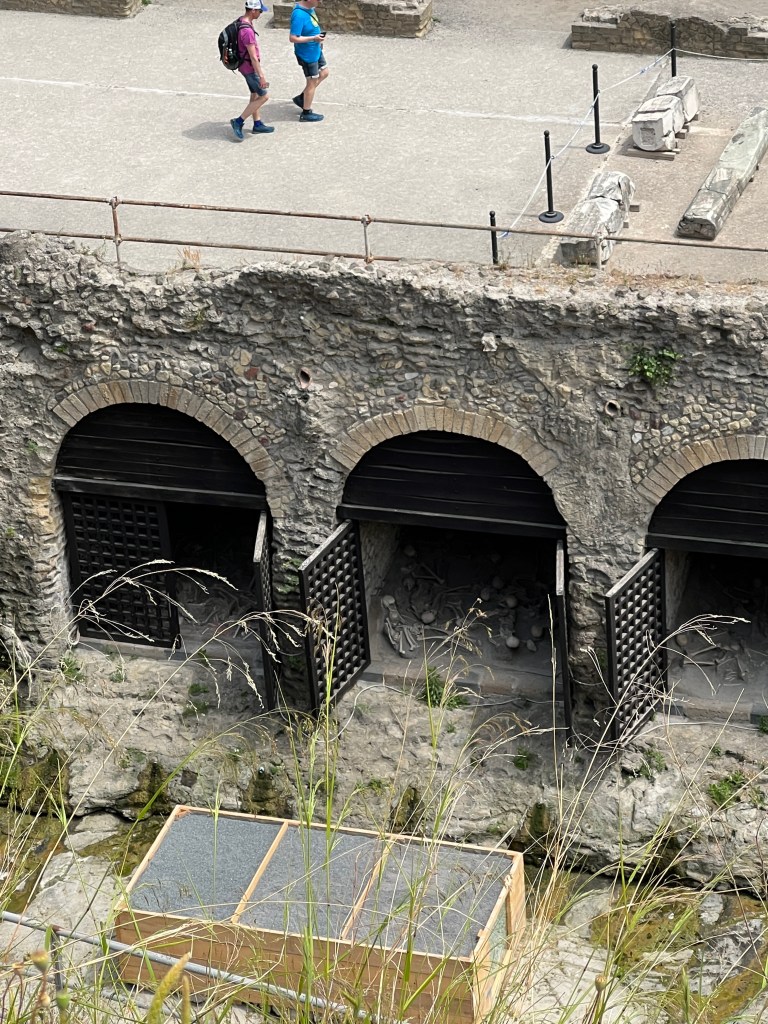
The city was hit with a superheated avalanche of hot gases and ash that would have immediately burned people to death. The town was buried under close to 70 feet of of superheated material. It was originally thought few people died because only 3 skeletons had been found, but that changed a few years ago. Three hundred skeletons were found concentrated in an area where fisherman had kept their boats. People had rushed there hoping to be rescued by sea, but that rescue never came.
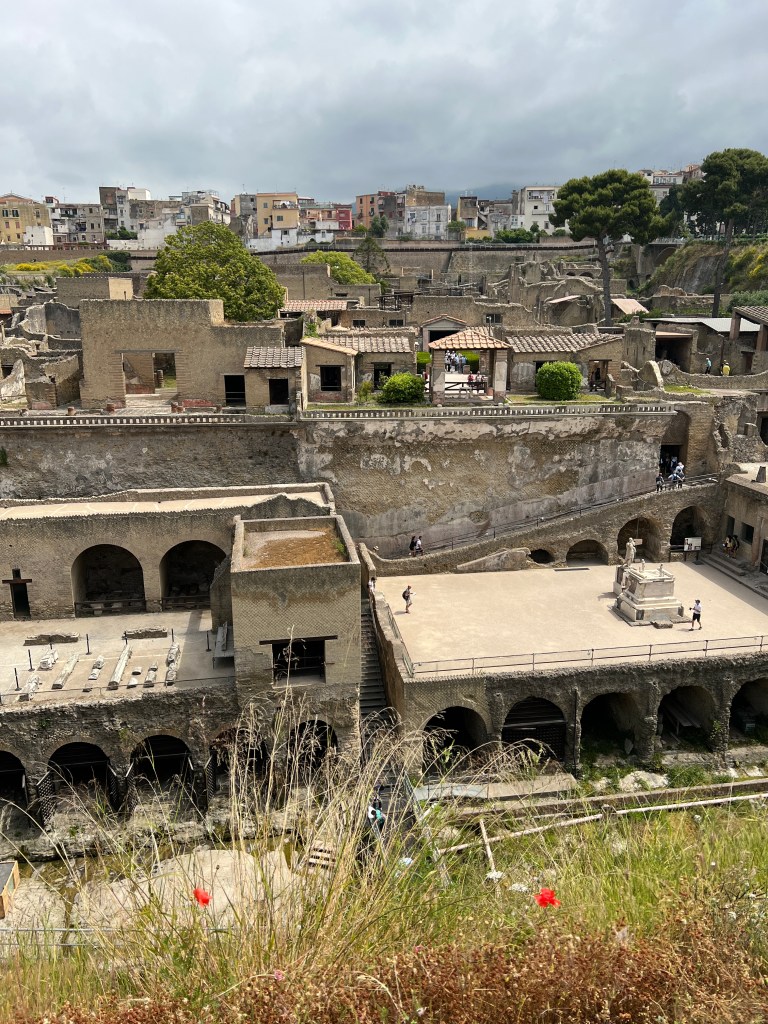
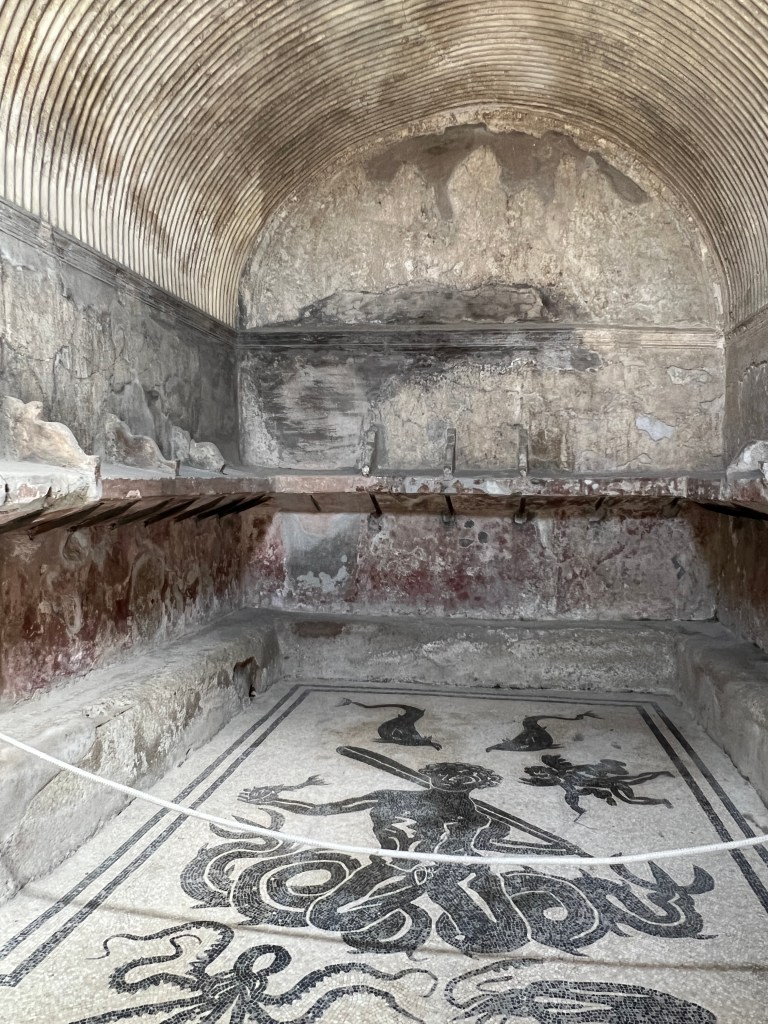
The steam-bath rooms (caldarium) for men and women were interesting to see. There were niches where people would store their clothing. The floor was heated from below. There was the tepidanium where one could take a steam bath, and a Frigidarium where one would take a cold bath. You can also see original wood charred in the disaster.
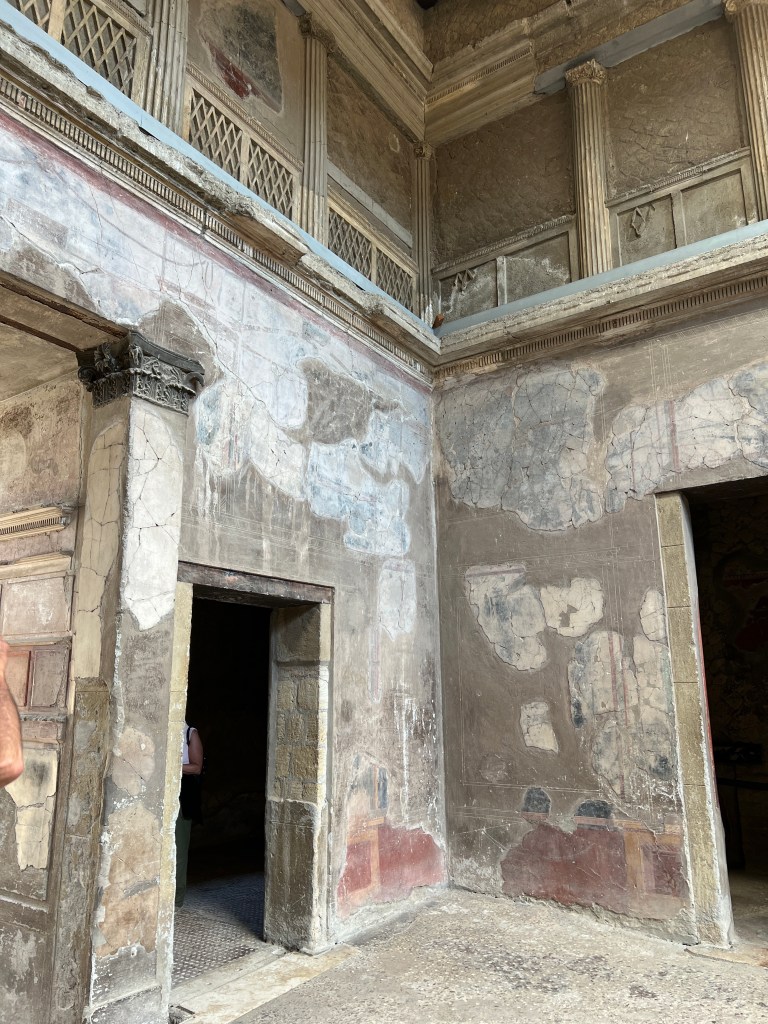
Franco took us through a number of villas pointing out many of the same features we had seen earlier in Pompeii. While we enjoyed visiting Herculaneum, in all honesty, Pompeii was the more interesting of the two. It was a little repetitive, but worth the visit.
Once again we connected with Pasquale and said our goodbyes to Franco. In about an hour we were in the middle of Naples and dropped off in the middle of a very busy Piazza Bellini, pointing right and left as to where our hotel was located. He had no idea, and neither did we. Fortunately Dan spotted some Cabaneri who pointed us in the right direction. The Hotel Piazza Bellini was just down the street. A freshly remodeled hotel was basic in its decor, but very practical in its built-in cabinets and comfortable. A tiny little window opened up and overlooked the town.
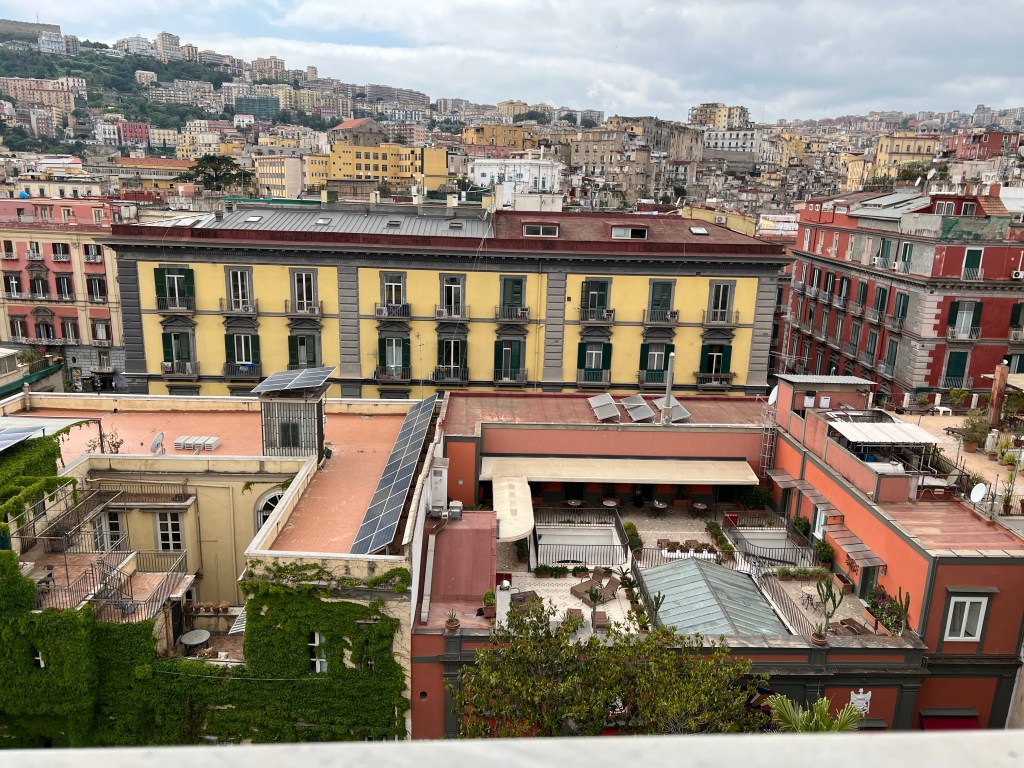
We came to Naples for two things. One was the Archeological Museum, which we plan to visit tomorrow. Secondly, we wanted to eat pizza in the city where it had first been served. So, after checking in we headed out in search of the number one rated pizza place according to a number of different sources, L’Antica Pizzeria Da Michele.
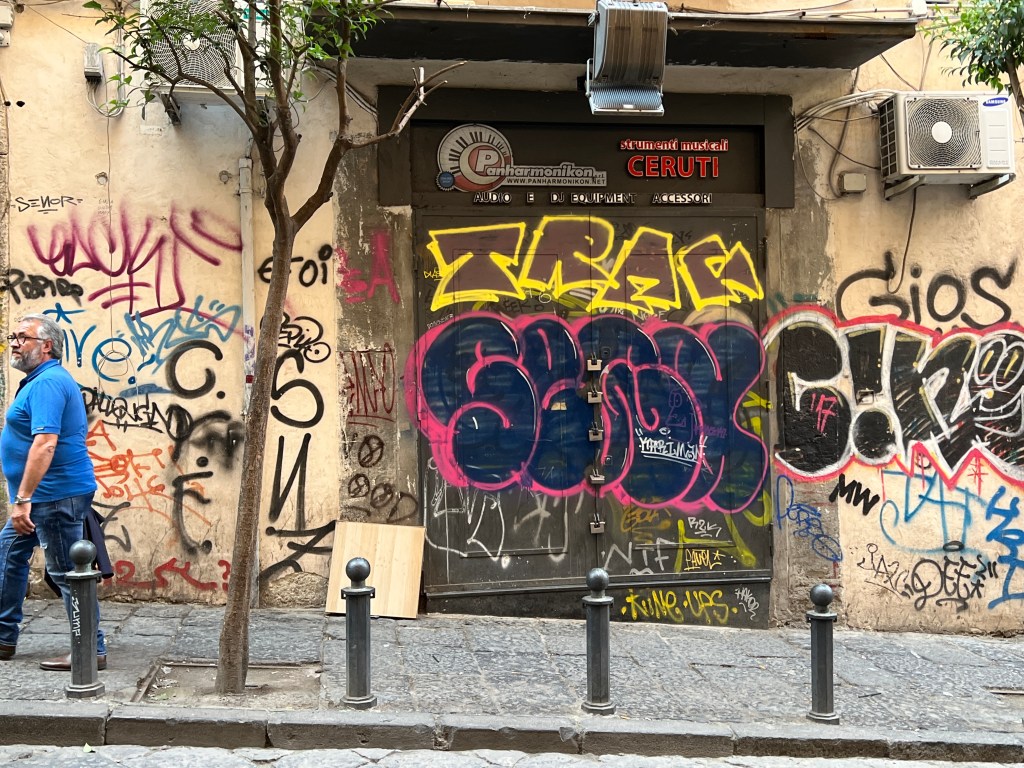
Naples is a gritty city. There is colorful graffiti everywhere, even on churches, and lots of garbage waiting to be picked up. The streets are jammed with people, cars, bikes, and shops, but with very few street signs are visible. Our map was almost useless, but while we were trying to make some sense as to where we were, a young woman took pity on us and offered to take us to the restaurant. She warned us to make certain we left the area before dark because it was known for drug trafficking.
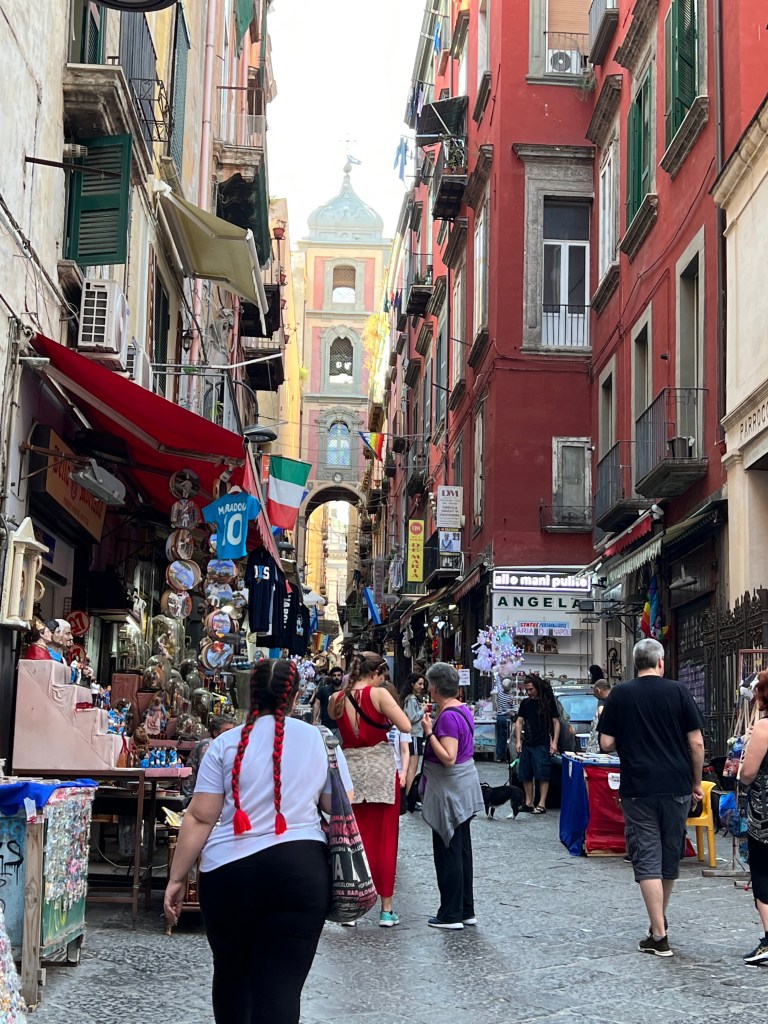
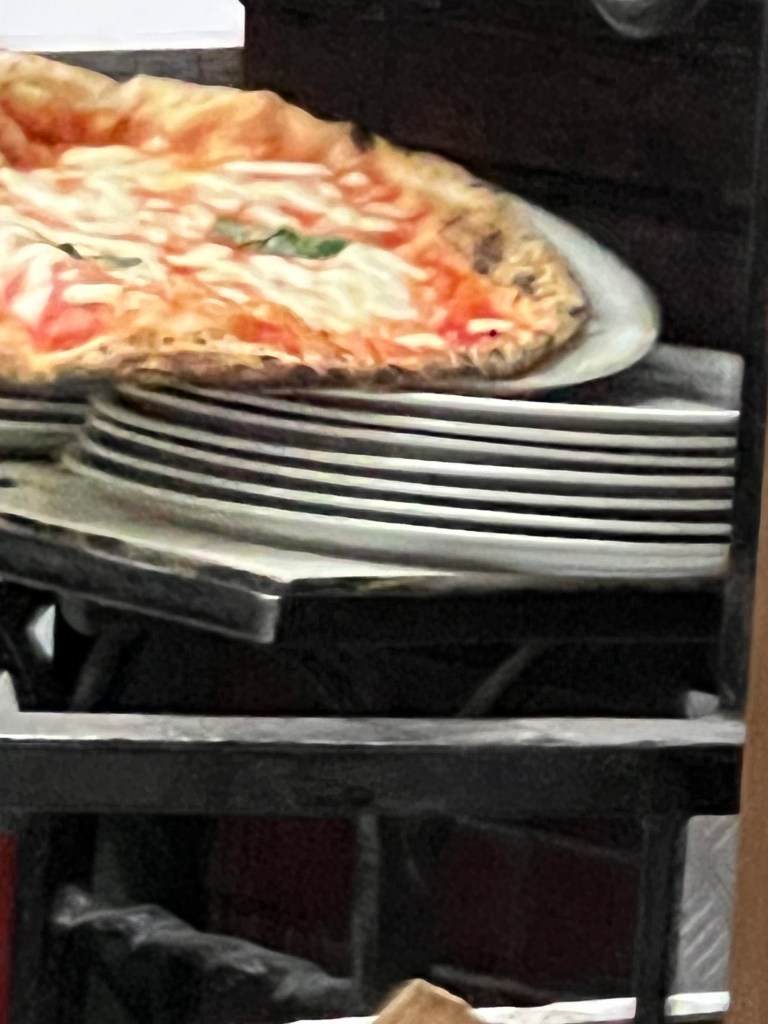
There was a small crowd waiting at the pizzeria for takeout, but we were able to get a table inside after a short wait. The menu was limited consisting only of 4 types of pizzas. We ordered one Marita pizza, which was enough for the two of us. The pizza was fresh out of the oven and very delicious. It is a very simple pizza, but the crust was al dente, and all the ingredients fresh. We liked the Margherita side of our pizza better with its wonderful fresh and creamy mozzarella cheese. To top it off, the pizza only cost 5 Euros.

After our dinner we didn’t waste any time getting back to our hotel. It had been an extremely busy day. Tomorrow we’ll get to see all of the incredible antiquities found at Pompeii and Herculaneum.
1
 BY THE WAY WITH WENDY & DAN